
Owning a California care facility isn’t just a real estate play; it’s a high-stakes commitment to regulatory stewardship where a single oversight can cost $150 per day in fines. You likely entered this market to build a legacy of care and financial security, yet the weight of Title 22 and the fear of Department of Social Services (DSS) citations can feel like a constant shadow. Understanding the full scope of RCFE owner responsibilities is the only way to transform that anxiety into a strategic advantage. It’s about moving from a state of reactive worry to one of proactive leadership.
You shouldn’t have to choose between making a social impact and achieving significant financial returns. This guide will help you master the complex intersection of regulatory compliance, financial stewardship, and operational excellence required to own a successful California care facility. We’ll provide a clear roadmap of your legal obligations, clarify the often-confusing divide between owner and administrator, and establish a framework to protect your investment from liability. By the end, you’ll have the tools to manage your facility with precision, ensuring you aren’t bogged down in daily minutiae while your asset thrives in California’s premium market.
Key Takeaways
- Identify the critical distinction between the legal stewardship of the licensee and the daily operational management handled by the administrator.
- Establish a top-down culture of compliance to navigate Title 22 regulations, effectively shielding your facility from the heavy fines associated with misunderstood RCFE owner responsibilities.
- Implement financial management strategies that ensure long-term solvency while funding the mandatory facility upgrades necessary for a premium market position.
- Learn how to navigate the CCLD inspection process and professionally respond to “Type A” citations to mitigate liability and safeguard your investment.
- Develop a strategic asset management plan that maintains your care home as a “sellable” asset from day one through meticulous record-keeping and operational excellence.
The Dual Nature of RCFE Owner Responsibilities in California
In California, owning a care facility is a sophisticated balancing act that bridges the gap between high-level investment and compassionate service. You aren’t merely a landlord or a passive shareholder. You are the “Licensee.” This designation is a legal identity that makes you the ultimate guarantor of resident safety and regulatory adherence under the California Department of Social Services (CDSS). While many investors view assisted living as a resilient asset class, the reality of RCFE owner responsibilities requires a hands-on commitment to excellence. You cannot simply “set and forget” this business. The state views the owner as the primary steward of the facility’s mission and its legal standing.
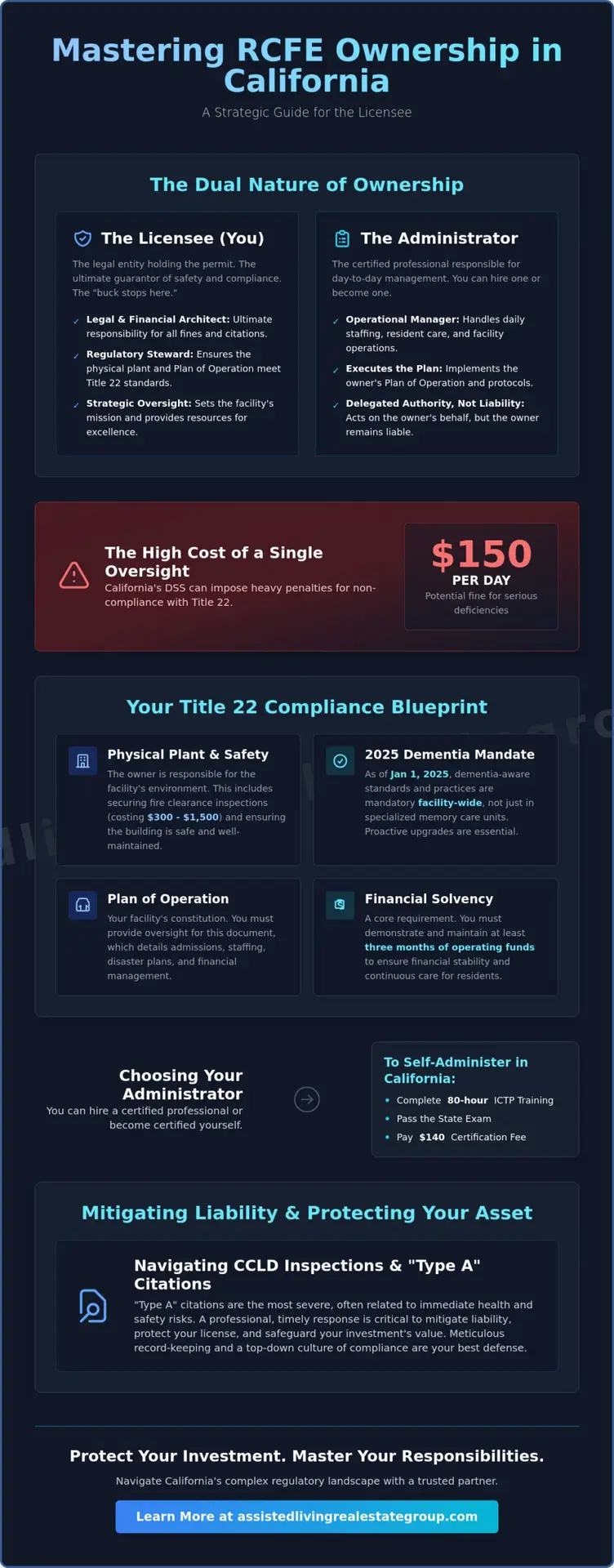
The “buck stops here” principle is the foundation of Title 22 compliance. Even if you aren’t on-site every day, every deficiency, fine, or citation is legally tied to your license. California’s regulatory environment is notoriously strict, with penalties for serious deficiencies reaching up to $150 per day. This creates a unique pressure point for the owner. You must maintain a strategic view of the operation while ensuring that the granular details of care are never overlooked. It’s a dual role; you are both the financial architect of the business and the moral compass of the facility.
Licensee vs. Administrator: Understanding the Hierarchy
Distinguishing between the Licensee and the Administrator is the first step toward effective facility management. The Licensee is the entity, whether an individual or a corporation, that holds the legal permit to operate. The Administrator is the person responsible for day-to-day operations. You have the option to self-administer, but this requires significant preparation. Under California law, you must complete an 80-hour Initial Administrator Certification Training Program (ICTP), pass a state exam, and pay the $140 certification fee. If you choose to hire an Administrator, you are delegating authority, not liability. You remain responsible for ensuring your staff is qualified, trained, and following the facility’s protocols. This hierarchy ensures that the owner provides the necessary resources while the administrator executes the daily plan.
The Owner’s Role in Regulatory Stewardship
Regulatory stewardship is about more than just passing inspections; it’s about maintaining “substantial compliance” as a baseline for your investment’s value. As the owner, you are responsible for the physical plant and the environment. This includes everything from securing fire clearance inspections, which can cost between $300 and $1,500, to ensuring the building meets the new 2025 dementia-aware standards facility-wide. You must also provide oversight of the facility’s Plan of Operation. This document is your operational constitution. It details how the facility will handle:
- Resident admissions and annual reappraisals.
- Staffing ratios and mandatory training schedules.
- Emergency disaster plans and physical plant maintenance.
- Financial solvency and the required three months of operating funds.
Your involvement in these high-level decisions ensures that the facility doesn’t just survive regulatory scrutiny but thrives as a premium service provider.
Navigating Regulatory Compliance under Title 22
Mastering Title 22 isn’t just about avoiding penalties; it’s about establishing a gold standard for your facility. The California Department of Social Services (CDSS) expects the licensee to be the ultimate arbiter of quality. Effective execution of RCFE owner responsibilities requires a deep dive into the Residential Care Facilities for the Elderly Act. This legislation creates a hierarchy where resident safety and dignity are the highest priorities. You must establish a culture of compliance from the top down, ensuring every staff member understands that regulatory adherence is non-negotiable. If you’re looking to acquire a facility that already meets these rigorous standards, exploring turnkey business acquisitions can significantly reduce your initial compliance burden.
California is currently seeing a surge in regulatory scrutiny. As of January 1, 2025, dementia-aware practices are mandatory facility-wide, not just in memory care units. Additionally, new transparency requirements effective July 1, 2026, mandate that you provide written disclosures of all fees, your three-year rate increase history, and staff-to-resident ratios before a contract is signed. Owners must also manage mandatory reporting requirements, such as notifying the state of “unusual incidents” within 24 hours. Regular internal audits are your best defense. By preemptively checking resident files for the now-mandatory annual medical visits and 12-month reappraisals, you can identify gaps before a state inspector does.
Core Health and Safety Mandates for Owners
The licensee holds the ultimate duty to protect resident health. This begins with rigorous oversight of medication management systems. Errors in this area are high-risk and frequently lead to citations. You must also ensure that dietary services provide adequate nutrition tailored to individual needs. Maintaining the physical facility is equally vital. A clean, safe, and well-maintained environment isn’t just a comfort issue; it’s a legal requirement that reflects your commitment to the “substantial compliance” mentioned earlier.
Staffing and Training Oversight
Your team is your greatest asset and your largest liability. You are responsible for verifying that every employee has a background clearance via LiveScan, which typically costs between $100 and $200 per person. Beyond the initial hire, you must monitor ongoing training. While the Administrator handles the schedule, you must ensure they complete their 40 hours of continuing education every two years to maintain their certification. Monitoring staff-to-resident ratios is also critical. Insufficient staffing is a primary cause of neglect citations, and as an owner, you must provide the financial resources to keep these ratios at safe, compliant levels across all shifts.
Financial Stewardship and Revenue Management
RCFE ownership isn’t just about the quality of care; it’s about fiscal endurance and strategic resource allocation. In California, the state mandates that a licensee must demonstrate proof of at least three months of operating funds to maintain their license. This financial cushion isn’t a suggestion. It’s a foundational requirement designed to ensure that resident care is never compromised by a temporary dip in occupancy. Fulfilling your RCFE owner responsibilities means acting as the ultimate fiduciary. You must oversee the management of resident trust funds with absolute transparency, ensuring every dollar is accounted for and protected under the California Code of Regulations Title 22. Professional investors treat the balance sheet as a diagnostic tool, identifying where capital can be deployed to enhance both service delivery and asset value.
Balancing care costs with market pricing is a sophisticated exercise in regional economics. California’s market is highly fragmented. While the Central Valley offers more accessible pricing between $4,200 and $5,500 per month, the San Francisco Bay Area demands a premium, with median costs reaching up to $8,500. As an owner, you must set rates that reflect these regional realities while accounting for the rising cost of labor. With a projected need to grow the caregiver workforce by 22% by 2030, your financial strategy must include competitive wages to attract and retain the talent necessary for a high-performing facility.
Capital Expenditure and Facility Maintenance
Strategic professionals distinguish between routine maintenance and value-add capital improvements. You must budget for high-impact updates, such as modern fire safety systems and ADA-compliant infrastructure. These aren’t just aesthetic choices; they are essential safeguards against “Physical Plant” citations. A serious deficiency that remains uncorrected can attract penalties of $50 per day, while repeat violations within 12 months trigger immediate fines of $150. Investing in the physical plant protects your investment from these avoidable losses and maintains your facility’s position as a premium choice for families.
Optimizing Occupancy and Pricing Strategies
Your role as the owner includes driving the marketing and community outreach efforts that ensure high occupancy levels. High resident turnover is a significant financial risk in this industry, and a strategic marketing plan is your best defense. In Southern California, where competition is fierce, your pricing must be sustainable yet competitive. You aren’t just selling a bed; you’re selling a lifestyle of safety and dignity. To enhance this lifestyle, many owners discover Gym Pros for high-quality fitness equipment that supports resident wellness. By aligning your pricing and amenities with the specific demographics of your local market, you can maintain the healthy margins required to reinvest in the facility’s future and prepare for an eventual high-value exit.
Mitigating Liability and Managing Facility Risk
Risk management is the cornerstone of protecting a high-value care facility investment. In California, the Community Care Licensing Division (CCLD) acts as the enforcement arm of the state, and managing RCFE owner responsibilities effectively means anticipating their move. You aren’t just waiting for an inspection; you’re building a fortress of documentation. When an inspector issues a “Statement of Deficiency,” your response time and accuracy determine your facility’s standing. A “Type A” citation represents an immediate risk to health and safety. These violations carry heavy penalties that start at $50 per day and escalate to a maximum of $150 per day if not corrected by the specified date. Strategic professionals view these regulations not as hurdles, but as the minimum baseline for an elite service model.
Implementing a robust Risk Management Plan is your best defense against the unpredictability of human care. This plan must go beyond simple safety checks; it should include detailed protocols for incident reporting, emergency preparedness, and regular staff competency assessments. By identifying potential failure points in your operation before they result in a resident injury or a state citation, you shield your business from the reputational damage that often follows public enforcement actions. Vigilance is the price of high-yield returns in this niche market.
Navigating the California Inspection Landscape
Your Licensing Program Analyst (LPA) is your primary point of contact with the state. While inspections are unannounced, your relationship with the LPA should be professional and transparent. You don’t necessarily need to be on-site for every visit, but you must ensure your Administrator or a designated representative is prepared to facilitate the inspection at any moment. If you receive a citation you believe is inaccurate, you have the right to appeal. This process requires meticulous evidence and a calm, legalistic approach. Strategic owners use these moments to refine their operations, turning a potential setback into a documented improvement. If you’re ready to secure an asset with a proven track record of compliance, consider our confidential marketing strategy for high-performing facilities.
Insurance and Legal Safeguards for Owners
Relying on basic general liability insurance is a common investor mistake. California care homes require specialized professional liability coverage to address claims related to resident care and medical oversight. Workers’ compensation is another non-negotiable expense, especially given the physical nature of caregiving and California’s strict labor environment. To further protect your personal wealth, your business should be structured as an LLC or a Corporation. This creates a legal shield for your personal assets. Additionally, Employment Practices Liability Insurance (EPLI) is essential for managing the risks associated with California’s complex labor laws, protecting you from claims of wrongful termination or workplace disputes.
Strategic Asset Management and Preparing for Exit
Every operational decision you make today acts as a deposit or a withdrawal from your eventual exit price. True strategic RCFE owner responsibilities extend far beyond the current fiscal year; they encompass the long-term preservation of the business as a liquid, high-value asset. Buyers in the sophisticated California market aren’t just purchasing real estate. They’re acquiring a turnkey revenue stream with a pristine regulatory history. If your facility has a pattern of “Type A” citations or inconsistent documentation, your valuation will suffer significantly. Conversely, a facility that demonstrates “substantial compliance” and stable occupancy commands a premium. You must view yourself as a steward of value, ensuring that the business remains “sellable” from day one.
Think of your record-keeping as the due diligence file you’re building for a future buyer. Meticulous records are the key to a successful future exit. This includes not just the resident files and medical visit documentation mandated by the 2025 updates, but also clear financial statements and maintenance logs. When you analyze an RCFE for sale, the price is often a direct reflection of the trust established through these records. Transparency isn’t just a regulatory requirement; it’s a powerful tool for business valuation. By maintaining a clear audit trail, you remove the friction that often kills deals during the escrow process.
Maintaining Facility Value for Future Sale
High-ROI upgrades in senior care real estate often focus on infrastructure that reduces future liability. This includes modernizing fire safety systems or integrating the advanced dementia-informed design elements that are now becoming the industry standard. Documenting a stable occupancy rate and a history of sustainable annual rate increases provides a roadmap for a buyer’s future success. Your goal is to present a business where the heavy lifting of stabilization and regulatory alignment is already complete. A clean licensing record is perhaps your most valuable intangible asset, signaling to investors that the facility is a low-risk, high-reward opportunity.
Partnering for Success in the California Market
Navigating the complexities of RCFE licensing California requires more than just a generalist’s touch. You must engage with specialized consultants and brokers who understand the specific nuances of the Southern California landscape. A confidential marketing strategy is particularly vital in this industry. You need to protect the operations and maintain staff morale while quietly seeking the right buyer. Consulting with specialists ensures that your business remains truly turnkey, allowing for a seamless transition that preserves the facility’s reputation. By fulfilling your RCFE owner responsibilities with the end in mind, you ensure that your legacy of compassionate care is matched by a legacy of significant financial achievement.
Securing Your Legacy in the California Care Market
Mastering the full scope of RCFE owner responsibilities transforms a complex regulatory burden into a blueprint for long-term market dominance. You’ve seen how the distinction between legal stewardship and daily management creates a framework for both safety and scale. By prioritizing Title 22 compliance and proactive risk mitigation, you don’t just protect residents; you preserve the equity in your business. High-performing facilities in California are defined by this synergy between compassionate service and disciplined financial management.
Achieving success in this niche requires a strategic partner who understands the high stakes of the Southern California market. With over 25 years of specialized California care facility experience, we provide the seasoned expertise needed to manage RCFE and ARF assets with precision. Our specialized brokerage focus ensures that your operational excellence is translated into significant financial returns. Get a Confidential Valuation for Your California RCFE today to see how your commitment to care has built a valuable asset. Your journey toward a successful exit starts with a single strategic step.
Frequently Asked Questions
Is the owner of an RCFE required to be the Administrator?
No, an RCFE owner isn’t required to be the Administrator. You have the flexibility to hire a certified professional to manage the daily operations while you focus on high-level stewardship and asset growth. However, if you choose to self-administer, you must personally complete the mandatory 80-hour Initial Administrator Certification Training Program and pass the California state exam to meet legal requirements.
What are the most common citations for RCFE owners in California?
Common citations often involve medication management errors and physical plant deficiencies that compromise resident safety. The California Department of Social Services also frequently issues “Type A” citations for inadequate staffing ratios or failing to complete the now-mandatory 12-month resident reappraisals. Staying current with updated Title 22 standards is the only way to avoid the daily fines associated with these violations.
Can an RCFE owner be held personally liable for resident injuries?
Yes, an owner can face personal liability if systemic negligence or operational failures are proven in court. While business structures like LLCs or Corporations provide a layer of protection for your personal wealth, they don’t absolve the licensee of their legal duty to ensure a safe environment. Professional liability insurance and robust risk management protocols are essential tools for managing these specific RCFE owner responsibilities.
How often does the state inspect RCFE facilities in California?
The Community Care Licensing Division typically conducts unannounced inspections at least once every two years to ensure ongoing compliance. However, many facilities experience more frequent visits due to “unusual incident” reports or specific family complaints. Maintaining a constant state of readiness is the only effective strategy for navigating these unannounced visits without incurring reputation-damaging citations or heavy financial penalties.
What financial records must an RCFE owner maintain for the state?
Owners must maintain records proving they have at least three months of operating funds available to ensure care is never interrupted. You’re also required to keep meticulous ledgers for resident trust funds and a detailed facility budget that accounts for mandatory safety repairs. These financial records are a core component of your stewardship and are heavily scrutinized during both licensing and annual renewals.
Do I need a special license to own the real estate but lease it to an operator?
You don’t need a care license if you only own the real property and lease it to a separate operating entity. In this scenario, the tenant holding the RCFE license carries the legal weight of the RCFE owner responsibilities. This structure is common for investors using lease-to-own care home opportunities to enter the market while delegating the complexities of daily regulatory compliance to an experienced operator.
What is the “Plan of Operation” and why is the owner responsible for it?
The Plan of Operation is the comprehensive legal blueprint that defines how your facility will provide care and maintain safety. The owner is responsible for this document because it serves as the foundation of the facility’s license. It covers everything from staffing patterns to emergency disaster plans. Any significant changes to your operational model must be updated in this plan and approved by the state.
How does Title 22 define the owner’s responsibility for staff training?
Title 22 mandates that the owner ensures all staff receive initial and ongoing training, including the new 2025 dementia-aware standards required facility-wide. You must verify background clearances via LiveScan for every employee and ensure the Administrator completes their 40 hours of continuing education every two years. Providing the financial resources for this training is a non-negotiable part of your legal stewardship as a licensee.