
The highest-value exit for your California care home isn’t found on a public listing site; it’s secured through silence. When you’re selling your assisted living investment property, the mere whisper of a transition can trigger staff departures and resident anxiety, devaluing your asset overnight. In a 2026 market defined by 90 to 120 day CDSS change-of-ownership timelines and new transparency laws, your strategy must be as precise as your care standards.
You’ve likely spent years balancing the analytical demands of a high-yield investment with the human mission of senior care. It’s natural to feel overwhelmed by the complexity of separating business value from real estate or understanding the latest Title 22 facility-wide dementia standards. This guide provides a roadmap to securing a high-multiple exit while maintaining absolute confidentiality. We will explore how Teri Szoke and our team leverage 25 years of Southern California expertise to manage regulatory hurdles, ensure a smooth RCFE license transfer, and capture the premium your legacy deserves.
Key Takeaways
- Learn why a California care facility sale is a dual-transaction involving both physical real estate and a highly regulated business entity.
- Discover the three pillars of valuation—real estate, operations, and license value—that dictate your cap rate in the 2026 Southern California market.
- Master the “Invisible Sale” philosophy to maintain complete confidentiality when selling your assisted living investment property, preventing staff turnover and resident anxiety.
- Understand the critical distinction between a license “transfer” and a “re-licensing” under California Title 22 and CDSS guidelines to ensure a seamless transition.
- Build a robust “Due Diligence Vault” to accelerate the closing process and leverage 25 years of specialized expertise for a high-multiple exit.
The Anatomy of Selling an Assisted Living Investment in California
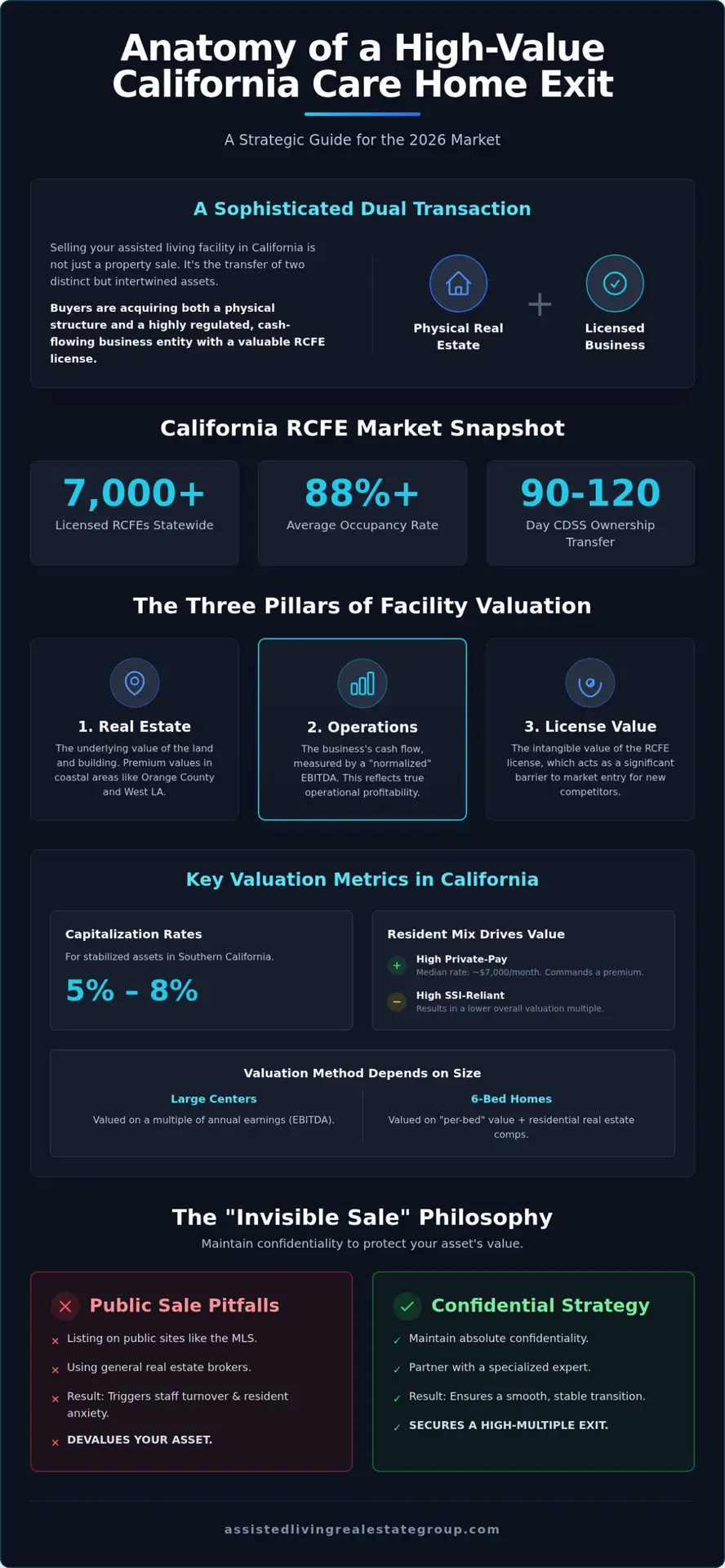
Selling your assisted living investment property in California is a sophisticated dual-transaction. You aren’t just offloading a physical structure; you’re transferring a highly regulated business entity. This hybrid nature means the valuation relies on both the underlying real estate and the operational cash flow, often measured as a multiple of EBITDA. In 2026, with California’s 65+ population exceeding 6.5 million, Assisted living assets have become the gold standard for recession-resistant investments. While other sectors fluctuate, the demand for licensed care remains constant, driven by an aging demographic that requires specialized support regardless of economic cycles.
The core of this value lies in the Residential Care Facility for the Elderly (RCFE) designation. This is the official licensed status in California, and it acts as a significant barrier to entry. With over 7,000 licensed RCFEs across the state and average occupancy rates hovering above 88%, the market is incredibly tight. Buyers aren’t just looking for square footage. They’re looking for a turnkey operation with a clean compliance history and a stable resident base. This scarcity allows strategic sellers to command a premium, provided they can articulate the value of their specific license and operational track record.
RCFE vs. ARF: Impact on Your Sale
The type of license you hold fundamentally dictates your buyer pool and final valuation. An RCFE focuses on seniors aged 60 and older, while an Adult Residential Facility (ARF) serves adults with various disabilities. Buyers for a 6-bed residential care home often look for different metrics than those eyeing a 50-bed community. Understanding these nuances is critical before going to market. For a deeper dive into which model aligns with your goals, explore our guide on RCFE vs. ARF: Which California Facility is Right for You?
Why General Real Estate Brokers Fail Care Facility Sellers
Standard residential or commercial brokers often lack the technical depth required for this niche. Listing a licensed facility on the MLS or other public platforms is a strategic error that can trigger immediate staff turnover and family anxiety. A generalist won’t understand the complexities of California Title 22 compliance or the nuances of a CDSS change-of-ownership application. You need a partner who understands care as much as capital. Teri Szoke and our team bring 25 years of specialized experience to the table, ensuring your reputation remains intact while we secure the highest possible multiple for your life’s work.
Determining the Market Value of Your California Care Facility
Valuing a care facility requires a specialized lens that standard commercial appraisers often lack. When you’re selling your assisted living investment property, the final price isn’t dictated by square footage alone; it’s a calculation based on the three pillars of value: the physical real estate, the operational cash flow, and the intangible worth of the RCFE license. In the 2026 Southern California market, stabilized assets are trading at capitalization rates between 5% and 8%. However, these rates fluctuate based on your specific county, with coastal regions in Orange County or West Los Angeles commanding lower cap rates due to higher underlying land values and premium private-pay rates; for expert analysis of residential trends in these coastal communities, you can visit robertneff.com.
To achieve a high-multiple exit, you must present “clean books” that showcase a normalized EBITDA. In the RCFE context, EBITDA represents the facility’s operational profitability before accounting for financing costs and non-cash charges, specifically adjusted to reflect market-rate salaries and the removal of personal owner expenses. Buyers also look closely at your resident mix. A facility with a high percentage of private-pay residents, who currently pay a statewide median of approximately $7,000 per month, will always outpace the valuation of a facility reliant on Supplemental Security Income (SSI) residents.
The EBITDA Multiple vs. The Per-Bed Value
Larger assisted living centers are almost exclusively valued on a multiple of their annual earnings. Investors look for consistent occupancy, which currently averages over 88% across California, to justify a premium multiple. Conversely, residential 6-bed facilities often sell based on a “per-bed” value added to the residential real estate comps. This premium accounts for the specialized renovations and the existing business income that a standard home doesn’t possess. If you’re unsure where your facility sits on this spectrum, you can request a strategic valuation from our team to see how your specific metrics align with current buyer demand.
The “Intangible” Value of a California License
The RCFE license itself carries significant weight because the California Department of Social Services (CDSS) has created high barriers to entry. Obtaining a new license is a grueling process that can take months of navigation through Title 22 & Other Regulatory Documents. A turnkey operation with a trained staff and a history of compliance is worth a substantial premium because it allows a buyer to bypass the “lease-up” phase and start generating cash flow on day one. For a more detailed breakdown of these metrics, read our guide on How to Value Your Assisted Living Business.
Confidentiality: Protecting Your Reputation During the Sale
Silence is your strongest asset. The moment a caregiver suspects an impending change in ownership, the stability of your facility is at risk, potentially leading to a mass exodus that erodes your EBITDA. When you’re selling your assisted living investment property, public exposure is the enemy of value. We operate under an “Invisible Sale” philosophy, ensuring that your residents, their families, and your dedicated staff remain focused on care rather than the uncertainty of a transition. This approach maintains operational continuity, which is essential for preserving the high occupancy rates that buyers demand in the 2026 California market.
Protecting your reputation requires a rigorous vetting process that begins long before a tour is scheduled. Every potential investor must sign a comprehensive Non-Disclosure Agreement (NDA) and provide proof of funds. We don’t just look for a high offer; we look for operational experience. A buyer who doesn’t understand the nuances of California care can inadvertently cause friction during the transition, jeopardizing the very asset they wish to acquire. By filtering for financial capability and professional intent, we ensure that only serious, qualified parties gain access to your facility’s sensitive data.
Strategic Marketing Without Public Exposure
We bypass traditional real estate platforms like the MLS in favor of a private, curated network of RCFE and ARF buyers. Our strategy utilizes a “Blind Profile,” which markets the facility’s financial strengths, location highlights, and capacity without revealing the specific address or name. This allows us to gauge interest and solicit offers while keeping the business identity shielded. This method is particularly effective in Southern California, where the community of care providers is tight-knit and news travels fast. Our 25 years of experience have allowed Teri Szoke to build a database of vetted investors who respect the necessity of discretion.
Managing the On-Site Visit
The on-site inspection is the most delicate phase of the exit strategy. To maintain the “Invisible Sale,” tours are often conducted after-hours or disguised as routine insurance or safety inspections. This prevents staff from becoming anxious about their job security and ensures residents aren’t disturbed by unfamiliar faces asking technical questions. Ethics and transparency are vital, but they must be balanced with the need for stability. We coordinate these visits with surgical precision, ensuring that the buyer gets the data they need while your facility continues to operate at peak performance. This level of stealth protects your legacy and ensures that the eventual announcement of the sale is a controlled, positive event for all stakeholders.
Navigating the California Regulatory Gauntlet: Title 22 and CCLD
The regulatory environment in California is the most significant hurdle when selling your assisted living investment property. Unlike other states where a business license might simply transfer, the California Department of Social Services (CDSS) treats every sale as a re-licensing process. This means the buyer must prove their own qualifications under Title 22 from scratch. During this window, which typically spans 90 to 120 days, the seller remains the licensee of record. To bridge this gap, a Management Agreement is often utilized, allowing the buyer to begin operational oversight while the seller retains ultimate regulatory responsibility until the final approval.
Maintaining Title 22 compliance during the sale is non-negotiable. Any drop in care standards or documentation during escrow can derail the entire transaction. Buyers in 2026 are particularly sensitive to the new transparency requirements and facility-wide dementia care standards. If your records aren’t impeccable, the Community Care Licensing Division (CCLD) may delay the application, extending your liability period and increasing the risk of the deal collapsing. We help our clients audit their operations pre-sale to ensure the facility is inspection-ready at all times. If you need expert guidance on preparing your facility for the CCLD review, you can consult with our specialized team to secure your exit.
The Licensing Transfer Timeline
The CCLD follows a methodical review process that demands precision. It begins with Step 1: The buyer’s submission of a comprehensive application, including detailed financial plans and operational policies. Step 2 involves the Component I, II, and III review process, where regulators scrutinize the administrator’s credentials and the facility’s emergency disaster plans. Finally, Step 3 culminates in a pre-licensing site visit. This inspection ensures the physical plant meets all current safety codes before the new license is officially issued, marking the completion of the business transfer.
Avoiding Common Licensing Pitfalls
Even seasoned investors stumble on technicalities like fire clearances. A fire clearance is not grandfathered in; the local fire marshal must re-inspect the facility for the new applicant. Additionally, sellers must manage their liability during the transition. If a regulatory citation occurs before the change of ownership is finalized, it remains on the seller’s record, potentially impacting future ventures. For a comprehensive breakdown of these requirements, see our guide on RCFE Licensing in California: The 2026 Investor’s Guide to Success.
Your Exit Strategy: The Path to a Successful Closing
The final phase of selling your assisted living investment property is where the most value is either solidified or lost. It’s the transition from a signed letter of intent to a successful closing. To navigate this, you must prepare a “Due Diligence Vault” early. This digital repository should contain three years of profit and loss statements, payroll records, and the most recent CCLD inspection reports. A buyer’s review in 2026 is exhaustive, often focusing on the new transparency disclosures and staffing ratios. Having these documents organized prevents deal fatigue and signals to the buyer that they are acquiring a professionally managed asset.
Negotiating the final terms goes beyond the top-line price. In many California transactions, sellers might agree to a lease-back arrangement or a structured training period to ensure the new owner is fully integrated into the facility’s culture. This hand-off is critical for resident retention. When you finally introduce the new owner to your team, it must be presented as a strategic partnership designed to enhance care, not just a change in corporate structure. This maintains morale and ensures the staff remains loyal through the licensing transition.
The Role of Teri Szoke and the Specialized Broker
General commercial real estate agents often struggle with the operational intricacies of care homes. They might understand cap rates, but they won’t understand how a single regulatory citation can impact a buyer’s financing. Teri Szoke and our team leverage 25 years of care-specific experience to bridge this gap. We don’t just find buyers; we find the right buyers. Our deep roots in Southern California allow us to consult on facility setup and relicensing, ensuring the buyer is prepared for the CDSS gauntlet mentioned previously.
Final Checklist for a High-Value Sale
Before the buyer’s final site visit, your facility must be impeccable. This means more than just a clean lobby. It requires a deep dive into the operational health of the business to ensure no surprises arise during the final walkthrough.
- Verify all resident files are audit-ready, including updated physician reports and the annual medical visits required by 2026 regulations.
- Address all physical plant repairs, ensuring fire clearances and safety equipment are fully functional and ready for re-inspection.
- Confirm compliance with the latest facility-wide dementia care standards to avoid last-minute CCLD hurdles.
Ready to take the next step? Get a Confidential Valuation for Your California Care Home.
Mastering Your High-Value California Exit
The window for achieving a premium exit in the California care market is defined by strategic preparation and expert timing. By mastering the dual-valuation of your real estate and operations, you ensure that every dollar of your facility’s legacy is captured. Success requires more than just finding a buyer; it demands a surgical approach to confidentiality and a deep understanding of the 90 to 120 day CDSS re-licensing timeline. Selling your assisted living investment property shouldn’t be a source of anxiety, but rather the culmination of your commitment to compassionate care and financial excellence.
With over 25 years of specialized experience in California care facilities, Teri Szoke and our team provide the roadmap you need for a high-multiple closing. We leverage a strictly confidential marketing strategy to protect your reputation while connecting you with qualified, high-intent investors. Don’t leave your transition to a generalist when you can benefit from our seasoned expertise. Partner with the California RCFE experts; contact Assisted Living Real Estate Group today. Your next chapter begins with a strategic, well-executed plan.
Frequently Asked Questions
How long does it take to sell an assisted living facility in California?
A typical transaction for selling your assisted living investment property takes between six and nine months. This timeline includes the initial confidential marketing phase, the escrow period, and the mandatory California Department of Social Services (CDSS) licensing process. The licensing component alone generally requires 90 to 120 days from the submission of a complete application. Coordinating these phases with an expert ensures the transition remains seamless without disrupting facility operations.
Do I need a special broker to sell my RCFE or ARF?
Yes, utilizing a specialized broker is essential because care facilities are dual-asset transactions involving both real estate and a business license. General commercial agents often lack the 25 years of experience required to navigate Title 22 regulations or manage the high level of confidentiality needed in Southern California. A specialist like Teri Szoke understands how to value the business operations and the physical plant to maximize your final exit multiple.
Can I sell the RCFE business without selling the real estate?
You can certainly sell the business operations while retaining ownership of the real property. This strategy allows you to transition into a landlord role, collecting a steady lease payment from a qualified operator. We specialize in matching property owners with experienced RCFE or ARF tenants. This model is often attractive for investors who want to exit daily management while maintaining a long-term interest in the Southern California real estate market; for professional guidance in the Inland Empire, check out Adria Chamberlain | Keller Williams High Desert.
How does the California licensing transfer affect the closing date?
The closing date is fundamentally tethered to the CDSS re-licensing timeline. Since a license cannot be “transferred” in the traditional sense, the buyer must obtain their own approval before taking full control. Transactions often utilize a Management Agreement during the escrow period to allow the buyer to begin operational training. This structure ensures that the business doesn’t stall while waiting for the state to finalize the 90 to 120 day processing period.
What is the current EBITDA multiple for California care facilities in 2026?
In the 2026 market, stabilized Southern California care facilities typically trade at capitalization rates ranging from 5% to 8%. The EBITDA multiple varies based on the facility’s size, occupancy levels, and resident mix. Facilities with high private-pay occupancy and a clean compliance history command the highest multiples. We focus on normalizing your financial statements to ensure your “Due Diligence Vault” reflects the true earning potential of the business to prospective investors.
How do I maintain confidentiality so my staff doesn’t quit?
Confidentiality is maintained through a strict “Invisible Sale” protocol. We use “Blind Profiles” that highlight the financial performance and capacity without revealing the facility’s name or address. All potential buyers must sign a non-disclosure agreement before receiving sensitive data. On-site visits are carefully scheduled after-hours or disguised as routine inspections. This protective approach ensures that your staff remains focused on care throughout the entire process of selling your assisted living investment property.
What are the tax implications of selling my assisted living investment?
While the buyer doesn’t necessarily need to be the administrator, the facility must have a certified RCFE Administrator on staff to be licensed. If the buyer plans to be the administrator of record, they must complete the state-mandated training and pass the exam before the license is issued. Our team often consults on these staffing requirements during the relicensing phase to ensure the buyer’s application meets all Title 22 standards for operational management.