
In the competitive San Francisco market, you aren’t just selling real estate; you’re liquidating a high-barrier-to-entry Title 22 compliance engine. With the median cost of assisted living in the region reaching $8,450 per month in 2026, the financial stakes for a transition have never been higher. If you’re preparing to sell assisted living facility Bay Area assets, you understand that the intersection of compassionate care and sophisticated financial performance requires a seasoned, expert hand. Success here isn’t just about finding a buyer; it’s about identifying a strategic partner who recognizes the intrinsic value of your licensed operations.
You’ve likely spent years perfecting your operational rhythm, and the fear that a public listing might disrupt your staff or alarm your residents is a heavy burden to carry. We’ll show you how to master the complexities of selling your RCFE or ARF with expert strategies designed to maximize your valuation while ensuring total operational confidentiality. This guide provides the roadmap to bridge the gap between business EBITDA and real estate equity, ensuring you secure a quiet sale and a premium ROI that reflects the true worth of your legacy through the lens of care and capital.
Key Takeaways
- Capitalize on the 2026 market window where high barriers to entry and demographic shifts create a premium environment to sell assisted living facility Bay Area properties.
- Learn to optimize the “Triad of Value” by aligning your real estate assets, business operations, and Title 22 license standing for a maximum valuation.
- Implement a confidential marketing strategy that utilizes blind profiles to protect your facility’s reputation and prevent operational disruption during the sale.
- Prepare a professional deal room to showcase your RCFE or ARF compliance history, ensuring a smooth transition with qualified, mission-driven buyers.
- Bridge the gap between financial investment and compassionate care by leveraging a specialized partner who understands the unique California regulatory landscape.
Capitalizing on the 2026 San Francisco Bay Area Senior Care Market
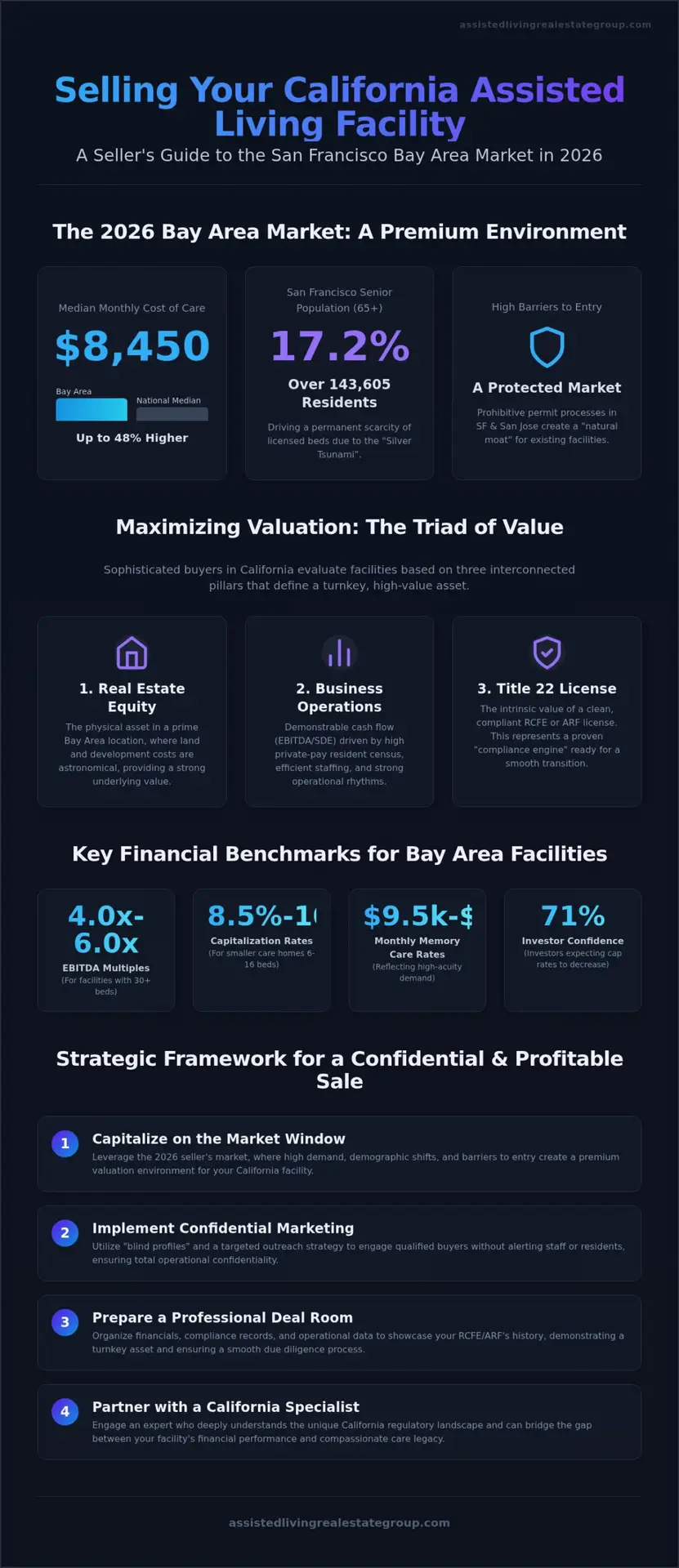
The Bay Area senior housing market has transitioned into a decisive seller’s phase. As of 2026, the “Silver Tsunami” isn’t a distant forecast; it’s a present reality. In San Francisco alone, seniors aged 65 and older now constitute 17.2% of the population, totaling more than 143,605 residents. This demographic concentration, paired with the region’s extreme geographic and regulatory constraints, has created a permanent scarcity of licensed beds. When you decide to sell assisted living facility Bay Area assets, you’re offering more than a business; you’re providing entry into a protected, high-demand economy that is nearly impossible to replicate from the ground up.
Bay Area Demographic Tailwinds
The wealth effect of Silicon Valley and the surrounding enclaves continues to drive a massive supply-demand gap. Many families in Santa Clara and San Mateo counties possess the private-pay capacity to seek premium care, yet new development remains stalled by astronomical construction costs and complex local zoning in cities like San Jose. This environment protects the value of existing RCFE and ARF licenses. Investors understand that What is an Assisted Living Facility? in this region represents a “recession-resistant” asset class. Demand for specialized memory care is particularly acute, with Bay Area monthly rates in 2026 ranging between $9,500 and $11,500, reflecting the urgent need for high-acuity services in Northern California wealthy enclaves.
The Premium Market Advantage
Valuations in the Bay Area consistently outpace the California state average. In 2026, the median monthly cost for assisted living in the region is approximately $8,450, which is up to 48% higher than the national median. This revenue profile attracts institutional investors and private equity firms who are aggressively targeting established facilities with strong Title 22 compliance records. Buyers are looking for stability and a proven “compliance engine” that can weather the state’s rigorous oversight.
- Limited Competition: Prohibitive permit processes in San Francisco and San Jose act as a natural moat for your business.
- Superior Cap Rates: For smaller care homes (6-16 beds), capitalization rates in 2026 range from 8.5% to 10%+, offering attractive yields for strategic buyers.
- Rate Resilience: Premium rate structures in counties like Marin and Santa Clara provide a buffer against rising local labor costs.
While operational overhead in California is high, the ability to command top-tier private-pay rates ensures that margins remain healthy. Buyers are willing to pay a significant “location premium” for turnkey businesses that have already cleared the high hurdles of California licensing and staffing. This makes the 2026 window an ideal time to exit, as investor confidence has returned with 71% of sector investors expecting capitalization rates to decrease through the end of the year.
Maximizing Valuation: What Bay Area Buyers Look for in an RCFE
Valuing a care facility in the San Francisco Bay Area requires a sophisticated understanding of the “Triad of Value.” This framework balances real estate equity, operational cash flow, and the integrity of your license standing. In 2026, buyers aren’t just looking for square footage. They’re searching for a compliance engine that can sustain high-margin private-pay residents. When you prepare to sell assisted living facility bay area assets, your goal is to prove that your RCFE or ARF is a turnkey solution, not a project requiring remediation.
The Financial Foundation
Financial transparency is the cornerstone of a successful exit. For smaller 6-bed care homes, buyers typically focus on Seller’s Discretionary Earnings (SDE). However, for facilities with 30 or more beds, valuations shift toward EBITDA multiples, which in 2026 generally range from 4.0x to 6.0x. You must normalize your financial statements by identifying add-backs, such as one-time repairs or owner-specific expenses, to reveal the true profitability. High concentrations of private-pay residents are essential in the Bay Area, where the median cost of $8,450 per month supports the margins necessary to offset California’s high labor costs. A facility reliant on SSI or Medi-Cal often faces lower valuation multiples due to restricted rate growth.
Regulatory and Operational Excellence
Compliance is the ultimate value protector. Buyers prioritize facilities with a deficiency-free record from the California Department of Social Services (CDSS). Before listing, you should conduct a pre-sale audit of your Title 22 files to ensure every resident reappraisal and staff training log is current. Understanding California’s RCFE regulations is non-negotiable for serious investors. A clean licensing history acts as insurance for a buyer’s investment, mitigating the risk of post-sale regulatory friction. If your facility features a turnkey management team, you’ve removed the primary pain point for institutional buyers: staffing. If you’re unsure how your current compliance record affects your market price, consulting with a specialized broker can provide the clarity needed to optimize your position.
Physical plant upgrades also play a pivotal role. In 2026, Bay Area buyers expect more than basic ADA compliance. High-ROI renovations include integrated smart-home technology for fall detection and energy-efficient climate control systems. These upgrades, combined with staff longevity and a stable resident mix, transform a standard care home into a premium investment asset. By focusing on these tangible and intangible drivers, you ensure your facility stands out in a competitive, high-stakes market where you intend to sell assisted living facility bay area operations for top dollar.
Protecting Your Legacy: The Power of Confidential Marketing
In the tightly knit Northern California care community, news travels fast. The “Bay Area Whisper” is a phenomenon where a rumored sale can destabilize an entire operation within days. When you sell assisted living facility bay area assets, the traditional commercial real estate playbook of public signage and broad exposure is your greatest liability. A “For Sale” sign doesn’t just attract buyers; it triggers a mass exodus of staff and families who fear for the future of their care. Protecting your legacy requires a surgical approach to marketing that prioritizes silence over volume.
Mitigating Operational Risk
Caregivers are the foundation of your facility’s valuation. In high-cost markets like San Mateo or Santa Clara, staffing is already a significant challenge. If employees suspect a transition is coming without a clear, managed narrative, they’ll seek more stable opportunities elsewhere. Maintaining confidentiality ensures that your staff stays focused on resident outcomes while you focus on the exit. You can learn more about The Value of Confidential Marketing for RCFE Sales to understand how this protects your bottom line. Stealth buyer visits should be framed as routine maintenance inspections or family tours to keep the operational environment calm and stable for everyone involved.
Targeting Qualified Buyers
A specialized broker doesn’t just list a business; they curate a deal. This begins with a “Blind Profile” that highlights the facility’s EBITDA, occupancy rates, and high-margin private-pay mix without revealing the specific city or brand. Only after a buyer has been financially vetted and has signed a legally binding Non-Disclosure Agreement (NDA) do they see the full operational picture. This legal firewall is essential in protecting your resident lists and proprietary staffing models. In the 2026 market, the difference between a “tire kicker” and a “qualified RCFE operator” is often their willingness to respect this protocol.
By targeting institutional investors and established Bay Area care chains, we bypass the noise of the public market. These buyers understand the value of a clean Title 22 record and are prepared to pay a premium for a turnkey ARF or RCFE. This ensures that when you finally decide to sell assisted living facility bay area assets, you’re negotiating from a position of strength with buyers who value the mission as much as the metrics. This exclusive process preserves your reputation and ensures a seamless transition for your residents, who deserve continuity of care above all else.
The 5-Step Process to Sell Your California Care Facility
The journey to sell assisted living facility bay area operations is a structured progression from initial valuation to the final transfer of care. It’s not a sprint; it’s a methodical transition that requires strategic positioning and a deep understanding of California’s regulatory hurdles. Success depends on following a roadmap that prioritizes both financial gain and the continuity of resident care.
Preparation and Valuation
You should secure a professional valuation at least 12 months before your intended exit date. This lead time is essential. It allows you to normalize your financials, identify potential add-backs, and address any Title 22 compliance gaps that could trigger price chips during the buyer’s due diligence. Understanding How to Value Your Assisted Living Business is the first step in ensuring you don’t leave money on the table. Before the first buyer is even contacted, you must assemble the “Essential Seven” documents: three years of Profit & Loss statements, tax returns, occupancy logs, CDSS compliance reports, a detailed staffing roster, real estate disclosures, and current resident care agreements.
The Licensing Transition
The most complex phase of a California care home sale is the Change of Ownership (CHOW) process governed by the California Department of Social Services (CDSS). Unlike standard commercial transactions, you cannot simply hand over the keys on closing day. Buyers must submit a comprehensive application to the state, which often takes months to process. To ensure a smooth transition, we often structure deals with interim management agreements or specific lease-to-own options that allow the buyer to manage operations while their license is pending. A Licensing Program Analyst (LPA) acts as the primary regulatory liaison who reviews the buyer’s qualifications and ensures the facility remains compliant during the ownership transfer. Coordinating with your LPA early in the process prevents administrative bottlenecks that can delay your payout.
- Phase 1: Confidential Valuation and Strategic Exit Planning to align your financial goals with market reality.
- Phase 2: Preparing the “Deal Room” with organized Title 22 files and audited financials to instill buyer confidence.
- Phase 3: Targeted Marketing to our exclusive database of pre-vetted Bay Area care operators.
- Phase 4: Offer Negotiation and the “Deep Dive” due diligence period where we defend your valuation.
- Phase 5: Closing and the formal California licensing transition to ensure a seamless handoff.
Navigating this process alone often leads to operational burnout or undervalued offers. If you want to ensure your exit is handled with the expertise your legacy deserves, request a confidential valuation from our specialized team today. We bridge the gap between high-level investment and the compassionate care that defines the Bay Area’s premier RCFE and ARF facilities.
Why a Specialized RCFE Broker is Essential in the Bay Area
Attempting to sell assisted living facility bay area operations through a generalist commercial broker is a high-stakes gamble that rarely pays off. A standard real estate agent understands square footage and cap rates, but they often lack the specialized vocabulary required to navigate Title 22 regulations or the nuances of the California Department of Social Services. In the care industry, the business value is inextricably linked to its licensing standing. If your broker doesn’t understand the difference between an RCFE and an ARF, they can’t effectively defend your valuation when a buyer’s due diligence team begins digging into your compliance history.
Assisted Living Real Estate Group bridges the gap between high-level financial investment and the sensitive nature of compassionate care. We speak the “dual language” of this industry. We can sit across from institutional bankers to discuss EBITDA multiples and debt-service coverage ratios, then pivot to discuss resident reappraisals and staffing ratios with care providers. This 25-year advantage gives you access to a curated network of pre-vetted buyers who are specifically looking for Northern California opportunities. These aren’t just investors; they’re qualified operators who understand the premium value of a well-run Bay Area facility.
Expertise Beyond the Real Estate
Deals in this sector don’t usually fall through because of the property; they collapse because of the “care” side of the ledger. A specialized broker anticipates these friction points before they reach the escrow desk. We understand the local regulatory environment and the specific expectations of Bay Area Licensing Program Analysts (LPAs). This foresight allows us to clean up operational “noise” that might otherwise scare off a sophisticated buyer. For a deeper look at the complexities involved in these transitions, consult The Ultimate Guide to Selling Your California Senior Care Facility. Having a mentor who knows the local landscape ensures that your licensing transfer doesn’t become a bottleneck for your payout.
Your Partner in a Successful Exit
Teri Szoke’s mission is to frame your sale as more than a transaction; it’s the transition of a community legacy. When you sell assisted living facility bay area assets with us, we don’t just put a price on the building. We value the culture, the staff longevity, and the reputation you’ve built over decades. This specialized approach justifies a higher commission because it consistently yields a significantly higher sale price. We know how to market the “intangible” assets that generalists overlook, ensuring you receive a return that reflects both your financial success and your social impact. Don’t leave your legacy to chance. Schedule your confidential valuation with Assisted Living Real Estate Group today.
Securing Your Financial Future and Care Legacy
The decision to sell assisted living facility bay area assets is a defining milestone that requires both analytical precision and emotional intelligence. You’ve built a community that serves a vital social purpose; the 2026 market offers a unique window to maximize that value. Success depends on aligning your Title 22 compliance with a sophisticated financial narrative while maintaining absolute operational silence. By focusing on pre-vetted buyers and a structured exit plan, you protect your staff and residents from the disruption of a public listing.
Assisted Living Real Estate Group brings over 25 years of specialized RCFE and ARF experience to your side. We understand the intricacies of California licensing and utilize a strictly confidential marketing framework to defend your premium valuation. Don’t leave your transition to a generalist who doesn’t speak the language of care. We bridge the gap between financial investment and the human values that drive your business forward.
Request a Confidential Valuation for Your Bay Area Facility today to begin your next chapter with confidence. Your legacy of care deserves a strategic exit that honors everything you’ve built.
Frequently Asked Questions
How long does it take to sell an assisted living facility in the Bay Area?
A successful transaction typically requires six to twelve months from initial valuation to final closing. This timeline accounts for the intricate California Department of Social Services (CDSS) Change of Ownership process, which is often the longest phase. You must prepare for at least three to four months of regulatory review alone. Starting your strategic exit planning early ensures that your Title 22 files and financial records are audit-ready when a qualified buyer emerges.
What is the difference between selling an RCFE and an ARF in California?
The primary distinction lies in the resident population and specific Title 22 requirements. Residential Care Facilities for the Elderly (RCFE) serve those aged 60 and older, while Adult Residential Facilities (ARF) focus on adults aged 18 to 59 with various disabilities. While both require rigorous compliance, buyers often prioritize RCFEs in the 2026 market due to the massive “Silver Tsunami” demographic shift. Each model requires a distinct operational playbook and staffing structure to maintain valuation.
Can I sell my care facility without my staff knowing?
Confidentiality is the cornerstone of our framework. When you sell assisted living facility bay area operations, we utilize blind profiles that omit the facility name and exact address until a buyer is financially vetted. This prevents a “mass exodus” of caregivers and maintains resident stability. By conducting tours after hours or framing them as routine inspections, you can navigate the entire sales process without alerting your staff or families until the transition is finalized.
How is an assisted living facility valued in the current 2026 market?
In 2026, facilities are valued using a combination of Net Operating Income (NOI) and capitalization rates, which currently range from 7.0% to 8.5%. For larger facilities, buyers focus on EBITDA multiples between 4.0x and 6.0x. Smaller six-bed care homes are often valued based on Seller’s Discretionary Earnings (SDE). We analyze your private-pay mix and compliance history to ensure your business operations and real estate assets are both maximized for a premium ROI.
What happens to my RCFE license when I sell the business?
California licenses are non-transferable by law. When you sell, the buyer must apply for their own license through the CDSS. Your current license remains active and in your name until the buyer’s application is approved and the sale closes. Coordinating this “Change of Ownership” requires precise timing to avoid operational gaps. We help you manage this transition with your Licensing Program Analyst (LPA) to ensure the facility remains compliant and open throughout the process.
Do I need to sell the real estate and the business together?
You have the flexibility to sell the business and real estate together or separately. Many owners choose to sell the operational business (OpCo) while retaining the real estate (PropCo) to generate long-term lease income. For those managing complex property portfolios in the region, you can learn more about Integrity Estates Realty to explore how professional real estate and mortgage services can support your long-term goals. We facilitate various arrangements, including lease-to-own care home opportunities and turnkey acquisitions. Separating these assets can sometimes attract institutional investors who prefer real estate holdings without the daily operational responsibilities of a licensed care provider.
Most deals collapse due to undisclosed Title 22 deficiencies or disorganized financial records. If a buyer’s due diligence reveals a history of CDSS citations or inconsistent resident reappraisals, their confidence evaporates quickly. Another common hurdle is the buyer’s inability to secure licensing approval in a timely manner. Our role is to pre-audit your facility and vet buyers’ experience levels to ensure the transaction survives the rigorous scrutiny of California’s regulatory environment and banking requirements.
Is now a good time to sell an assisted living facility in San Francisco or San Jose?
The 2026 market represents a historic opportunity for sellers in San Francisco and San Jose. With regional occupancy rates reaching 89.5% and high barriers to entry preventing new competition, established facilities are in high demand. If you want to sell assisted living facility bay area assets, the current scarcity of licensed beds allows you to command a significant location premium. Renewed investor confidence and rising private-pay rates make this an ideal window for a strategic exit.