
A California dementia waiver isn’t just a regulatory checkbox; it’s the single most valuable intangible asset in the 2026 senior living market. While there are over 7,800 licensed RCFEs in California, only a fraction possess the specialized authorization to capture the premium private-pay rates of the memory care sector. If you’re searching for an RCFE with dementia waiver for sale, you’ve likely realized that the “Silver Tsunami” isn’t a crisis. It’s a blue ocean opportunity for savvy entrepreneurs who want to bridge the gap between financial investment and compassionate care through the boutique RAL model.
You probably already feel that the CDSS licensing process is a minefield of delays, especially with the updated person-centered care regulations that took effect on January 1, 2025. We know the fear of acquiring a facility only to face non-compliance issues or staffing hurdles with the new $16.90 statewide minimum wage. This guide will show you exactly how to identify and acquire a turnkey, profitable care facility while ensuring 100% regulatory compliance during the ownership transfer. You’ll discover the roadmap to achieving high ROI through specialized memory care services, allowing you to scale your impact and income with confidence. We’ll explore 5-8% cap rate benchmarks, valuation strategies for 6-bed homes, and the critical due diligence steps required to protect your legacy in the California market.
Key Takeaways
- Learn why acquiring an existing RCFE with dementia waiver for sale is the fastest route to high-yield returns, bypassing the 6 to 12 month wait for new state approvals.
- Understand the specific California Title 22 physical plant requirements, such as delayed egress and perimeter safety, that define a compliant memory care boutique.
- Discover how to perform a deep-dive regulatory audit using three years of Licensing Program Analyst (LPA) visit reports to protect your investment.
- Identify the “Impact and Income” potential of smaller, residential-style facilities that command premium private-pay rates over traditional institutional settings.
- Gain access to confidential off-market opportunities through a strategic partnership, ensuring you see high-value assets before they hit public real estate listings.
The Value Proposition: Why Invest in an RCFE with a Dementia Waiver?
In the California market, an Residential Care Facilities for the Elderly (RCFE) designation provides the foundation, but a dementia waiver provides the competitive edge. This specialized authorization from the California Department of Social Services (CDSS) allows a facility to house residents with Alzheimer’s, Parkinson’s, and other neurocognitive disorders. Without this waiver, you’re legally restricted in the level of care you can provide, effectively locking yourself out of the most profitable and high-demand segment of the senior living industry. Finding an RCFE with dementia waiver for sale means acquiring a business that is already positioned to serve the most vulnerable, yet fastest-growing, demographic in the state.
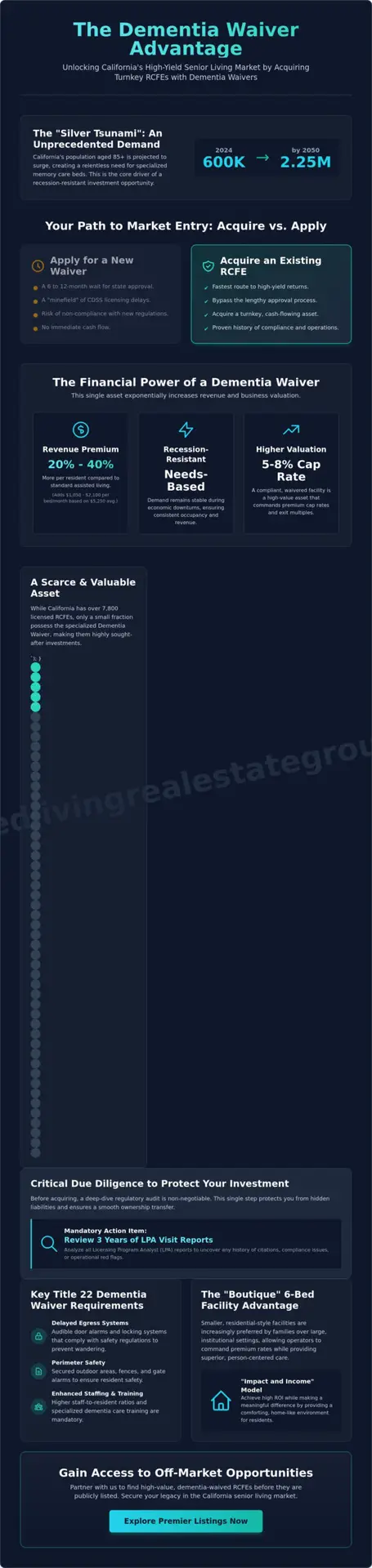
We operate on a philosophy of “Impact and Income.” This isn’t about cold financial spreadsheets; it’s about providing essential, high-quality care for an aging population while securing the high-yield returns that a specialized niche commands. California’s “Silver Tsunami” is driving an unprecedented need for memory care beds. With the number of Californians aged 85 and older projected to grow from 600,000 to over 2.25 million by 2050, the demand for these specialized beds is relentless. Because of the higher staffing ratios and training requirements involved, memory care residents typically pay 20% to 40% more than standard assisted living residents, creating a significant revenue premium for the operator.
Memory Care as a Recession-Resistant Asset
Dementia care is a needs-based service. Unlike luxury real estate or retail investments, memory care remains stable during economic downturns because families don’t stop seeking professional oversight for a loved one with cognitive decline just because the market dips. While large-scale institutional environments often feel cold and overwhelming, “boutique” 6-bed facilities offer an intimate, home-like setting that many California families now prefer. These specialized waivers lower vacancy rates by allowing you to serve a niche market that many standard facilities simply cannot touch.
The ROI of the Dementia Waiver Add-on
Based on 2021 industry data showing an average California assisted living cost of $5,250, the 20% to 40% memory care premium can translate to an additional $1,050 to $2,100 in monthly gross revenue per bed. This increased cash flow doesn’t just improve your monthly bank balance; it exponentially increases the business valuation, or “goodwill,” during your exit strategy. A licensed facility with a history of compliance and an active waiver is a turnkey asset that commands a much higher cap rate than a standard residential property. For a deeper look at the acquisition process, explore The Ultimate Guide to Buying an RCFE Facility in California to understand how these assets fit into a broader investment portfolio.
Understanding California Title 22 Dementia Waiver Requirements
Operating a care facility in California requires more than a standard business license. It requires a deep commitment to regulatory precision. The California Department of Social Services (CDSS) oversees the licensing of all Residential Care Facilities for the Elderly, but a standard license does not automatically grant you the right to care for residents with memory loss. To serve this demographic, you must secure a specialized waiver under California Title 22 Dementia Waiver Requirements. This distinction is critical for any investor evaluating an RCFE with dementia waiver for sale. While a standard license focuses on basic activities of daily living, the dementia and hospice waivers add layers of physical plant safety and operational oversight designed to protect residents with cognitive impairments.
The CDSS Community Care Licensing Division (CCLD) doesn’t view these waivers as mere paperwork. They are dynamic operational mandates. If you’re acquiring an existing facility, you aren’t just buying real estate; you’re inheriting a regulatory history. You must ensure the facility’s physical plant meets stringent safety codes, such as delayed egress systems and alarmed perimeters, which became even more focused under the updated regulations that took effect on January 1, 2025. These rules ensure that residents who might wander stay safe within the boutique environment you provide; many operators choose to discover Boss Security Screens for high-strength window and door protections that maintain a residential feel while meeting strict security needs.
The Dementia Plan of Operation
Every facility with a waiver must maintain a comprehensive “Dementia Plan of Operation.” This document is the facility’s DNA. It outlines specific protocols for hydration, nutrition, and emergency procedures tailored to residents who may not be able to communicate their needs. As a buyer, you must review the seller’s current plan to ensure it’s compliant and reflects modern “Life Enrichment” standards. A weak plan is a red flag that could lead to licensing delays or non-compliance penalties after the sale. If you’re unsure how to evaluate these technical documents, our team can help you review available RCFE opportunities to ensure they meet the gold standard of care.
Staffing and Training Mandates
Memory care requires a higher level of expertise than standard assisted living. California law mandates a 40-hour initial training program for all staff working in dementia-waived homes. This is followed by strict continuing education requirements that must be documented meticulously to protect the facility’s license. Staffing ratios in these facilities are often tighter because the care is more intensive. You’ll need to account for these labor costs, especially with the California minimum wage rising to $16.90 per hour in 2026. High-quality training doesn’t just satisfy the state; it builds the “boutique” reputation that justifies your premium rates and ensures your long-term legacy in the community.
Acquisition Strategy: Buying Existing Waivers vs. New Applications
Time’s the most valuable asset in the California senior living sector. When you evaluate an RCFE with dementia waiver for sale, you’re prioritizing speed over bureaucratic friction. Efficiency defines the professional investor. New waiver approvals from the California Department of Social Services (CDSS) currently take 6 to 12 months to process. During this gap, your facility can’t legally market itself as a memory care provider or charge the premium rates we discussed earlier. By acquiring an existing operation, you bypass this waiting room. You ensure immediate cash flow from day one.
Identifying an RCFE with dementia waiver for sale allows you to avoid the pitfalls of post-purchase upgrades. You might find a beautiful residential property in Southern California, but if the local fire clearance is denied or the zoning department has updated its boutique facility requirements, your application could be dead on arrival. Physical plant limitations, like the inability to install required delayed-egress systems, can turn a perceived bargain into a financial liability. A “Blue Ocean” opportunity exists in identifying under-performing facilities that already possess active waivers. These assets allow you to apply your management expertise to a turnkey infrastructure. You quickly scale both impact and income.
The CHOW (Change of Ownership) Process for Waivers
Success in this niche requires understanding that RCFE licenses and waivers aren’t automatically transferable. They don’t move like a property title. Instead, the buyer must undergo a “Change of Ownership” (CHOW) process. This is effectively a new application for the buyer’s entity. To maintain continuity of care and revenue, savvy investors often utilize a “Management Agreement.” This legal bridge allows the buyer to operate the facility under the seller’s existing license while the state processes the new application. A specialized broker at the Assisted Living Real Estate Group is essential here. They ensure the waiver is preserved and the transition remains seamless.
Cost-Benefit Analysis of the Purchase Premium
The higher purchase price of a facility with an existing waiver is often a bargain compared to the alternative. If you lose 9 months of revenue while waiting for a new waiver, the opportunity cost can easily exceed six figures for a standard 6-bed facility. Beyond the immediate cash flow, many older facilities enjoy “grandfathered” status regarding certain physical plant requirements that new applicants must meet today. Protecting this status is vital for your long-term ROI. To navigate the technical steps of the application itself, review our guide on RCFE Licensing in California: The 2026 Investor’s Guide to Success for a complete breakdown of the state’s requirements.
Critical Due Diligence for Dementia-Waived Facility Sales
Acquiring an RCFE with dementia waiver for sale requires a level of scrutiny that goes far beyond a standard home inspection. In the California market, you aren’t just buying a property; you’re buying a regulated healthcare business. Failure to perform deep due diligence can lead to costly retrofits or, worse, the loss of the waiver during the ownership transition. A successful acquisition hinges on a four-pillar audit strategy: Physical, Regulatory, Financial, and Reputational. Each pillar must be solid to ensure your investment delivers the “Impact and Income” we advocate for.
The financial audit is where you must separate the real estate value from the business “goodwill” tied to the waiver. The waiver is the engine driving your ROI, but it only holds value if the facility has a strong reputation. Conduct a reputation audit by speaking with local placement agencies and checking the facility’s standing in the community. A boutique facility that is well-regarded by local families is far easier to keep at 100% occupancy, ensuring your legacy and your returns are secure from day one.
Physical Plant Requirements for Memory Care
Your physical plant audit must align with the California Fire Code and Title 22 safety standards. Memory care facilities require specialized delayed egress systems on all exit doors to prevent “elopement” while maintaining fire safety compliance. Perimeter fencing must be secure, yet aesthetically pleasing to maintain the premium market position of the home. Additionally, the state requires dedicated outdoor space where dementia residents can safely enjoy the environment. If the facility lacks these features, you’ll need to factor the upgrade costs into your offer price to avoid post-closing surprises. If you’re ready to evaluate specific properties, view our current RCFE listings to find facilities that meet these high standards.
Reviewing the Licensing History
The regulatory audit is where many deals fall apart. You must review the last three years of CDSS “LPA” (Licensing Program Analyst) visit reports for any red flag deficiencies. Pay close attention to “Type A” citations, which represent immediate risks to resident health and safety, versus “Type B” citations, which are technical or administrative violations. A pattern of Type A citations can complicate your relicensing process during the Change of Ownership. Verify that the current Administrator’s certification is active and that all staff training logs are up to date. This historical data provides a clear picture of the facility’s operational health and its future potential under your leadership.
Navigating the RCFE Market with Assisted Living Real Estate Group
Success in the California care industry isn’t about finding a property; it’s about securing a strategic partner who understands the high stakes of the memory care market. Teri Szoke brings over 25 years of specialized California care facility expertise to every transaction, ensuring you aren’t just buying a building, but a sustainable business model. We bridge the gap between a traditional real estate broker and a regulatory consultant. This dual role is essential when you’re navigating the complexities of the California Department of Social Services and the rigorous Title 22 standards. Our commitment to your success is rooted in the philosophy of “Impact and Income,” where your financial returns are directly tied to the quality of life you provide for California’s seniors.
The most lucrative opportunities, particularly a high-value RCFE with dementia waiver for sale, rarely appear on public platforms like Zillow or traditional commercial listing sites. Confidentiality is paramount in this sector. Owners want to protect the privacy of their residents and the stability of their caregiving teams during a transition. Our confidential marketing strategy gives you an exclusive seat at the table for off-market assets that the general public will never see. We hold the keys to this high-barrier-to-entry market, providing the roadmap you need to navigate the “blue ocean” of the aging demographic with confidence and precision.
Our Proven Process for Buyers
We’ve refined a methodical approach to help you acquire a boutique care home without the typical regulatory headaches. Our process includes:
- Off-Market Matching: We connect you with exclusive RCFE listings that align with your specific ROI goals and geographical preferences within California.
- Lease and Purchase Negotiations: Whether you’re looking for a turnkey business acquisition or a lease-to-own opportunity, we handle the complex negotiations to protect your interests.
- Specialized Financing: We bridge the gap between you and lenders who specifically understand the assisted living and memory care asset class, streamlining your path to funding.
Start Your Journey in California Senior Care
2026 is the pivotal year for entering the Southern California memory care market. As the waitlist for specialized services continues to grow, the value of a licensed, dementia-waived facility will only appreciate. We invite you to step into the role of a visionary investor who does good while doing well. Contact us today for a confidential consultation to explore our current off-market listings and begin building your legacy in the California care community.
View Our Current RCFE and ARF Listings in California
Secure Your Legacy in California’s Boutique Care Market
The “Silver Tsunami” isn’t a future crisis; it’s a present-day opportunity for visionary entrepreneurs. With California’s population of residents aged 85 and older projected to reach 2.25 million by 2050, the demand for specialized memory care beds is relentless. You’ve seen that the fastest path to market entry is through acquisition, bypassing the 6 to 12 month wait for new state approvals. Success depends on navigating the nuances of Title 22 compliance and ensuring your physical plant meets the latest safety standards for residents with cognitive decline.
Finding a high-performing RCFE with dementia waiver for sale requires a strategic partner who understands the high barrier to entry in this niche. We offer 25+ years of specialized California experience, providing you with confidential off-market listing access and expert guidance on regulatory audits. Don’t leave your investment to chance when you can leverage a proven roadmap to success. Browse Exclusive RCFE with Dementia Waiver Listings to begin your journey. Your opportunity to achieve significant Impact and Income starts now; we’re ready to help you build a lasting legacy in the California care community.
Frequently Asked Questions
Can I buy an RCFE and add a dementia waiver later?
Yes, you can apply for a waiver after purchase, but you risk discovering that your property can’t meet the stringent California Fire Code. If the local Fire Marshal denies the clearance for delayed egress or if the layout doesn’t support the 2025 person-centered care updates, your investment could be limited to standard assisted living rates. It’s often safer to buy a facility where these physical plant hurdles are already cleared.
Does a dementia waiver transfer to the new owner during a sale?
No, a dementia waiver does not automatically transfer because licenses in California are non-transferable. When you search for an RCFE with dementia waiver for sale, you’re buying a turnkey operation where the infrastructure and plan are already approved. You must still submit a Change of Ownership (CHOW) application to the CDSS to obtain your own license and waiver for that specific location.
What are the physical plant requirements for a dementia waiver in California?
You must install delayed egress systems on all exits and ensure all perimeter gates are alarmed or locked in compliance with fire safety codes. California regulations also mandate secure outdoor spaces that allow residents to wander safely without elopement risks. These requirements are verified during the initial licensing visit and subsequent inspections by your Licensing Program Analyst (LPA) to ensure ongoing compliance.
How much more can I charge for memory care in an RCFE?
Memory care residents typically pay a 20% to 40% premium over standard assisted living residents in the California market. Based on 2021 data showing an average monthly cost of $5,250, this can increase your gross revenue by $1,050 to $2,100 per bed. This higher rate justifies the increased staffing ratios and specialized training costs required to maintain a high quality of life for residents with cognitive decline.
What is the “Dementia Plan of Operation” required by CDSS?
The Dementia Plan of Operation is a mandatory document that outlines your facility’s protocols for resident safety, hydration, nutrition, and “Life Enrichment” activities. It serves as your operational blueprint for the CDSS and must be updated to reflect current standards. Buyers should audit the seller’s existing plan during due diligence to ensure it meets the 2025 person-centered standards before finalizing any business acquisition.
How long does it take to get a dementia waiver approved for an existing facility?
Approval for a new dementia waiver can take between 6 and 12 months from the date of application. This lengthy timeline is why most savvy investors prefer to acquire an RCFE with dementia waiver for sale rather than applying for one post-purchase. Buying an existing operation ensures you don’t lose up to a year of premium revenue while waiting for state bureaucracy to process your paperwork.
Is a 6-bed RCFE with a dementia waiver more profitable than a 15-bed standard facility?
A boutique 6-bed memory care facility often yields higher net profit margins than a 15-bed standard facility due to lower staffing overhead and premium private-pay rates. Well-managed RCFEs with 16 to 49 beds target 10% to 20% margins, but the 6-bed RAL model often exceeds this. By focusing on high-end boutique care, you can achieve a higher ROI while providing a more intimate environment that California families prefer.
Do I need a special administrator certification to run a dementia-waived facility?
You must complete the standard 80-hour Initial Certification Training Program (ICTP) and pass the state exam to become a certified administrator. While there isn’t a separate “dementia license,” California law requires administrators in waived facilities to undergo specific dementia-focused training. This includes an initial 40-hour requirement and ongoing continuing education to maintain your certification and protect the facility’s standing with the CDSS.