
Most California operators treat their financial statements as a tax season chore, but for the elite investor, your P&L is actually a high-performance diagnostic tool. You’ve likely felt the frustration of standard accounting software that fails to distinguish between your real estate debt service and the rising cost of direct care staff, which reached $16.90 per hour in January 2026. It’s exhausting to manually re-categorize expenses within a generic RCFE profit and loss statement template just to see if your Boutique care model is actually hitting the margins you projected while staying compliant with CDSS LIC 401 requirements.
We’re here to change that narrative by providing a specialized financial framework designed for the unique California regulatory landscape. You’ll learn how to master the financial architecture of your facility, turning raw data into a clean, investor-ready document that proves your business’s value. We will explore the exact line items needed to separate operational costs from real estate assets, ensuring you achieve the high-level Impact and Income that defines a successful Residential Assisted Living project.
Key Takeaways
- Discover why generic accounting fails and how a specialized RCFE profit and loss statement template aligns your financials with California’s strict Title 22 compliance standards.
- Identify overlooked revenue streams like care level surcharges and community fees that drive premium margins in Boutique residential environments.
- Gain clarity on managing California’s high-barrier expenses, from specialized professional indemnity insurance to the impact of the 2026 minimum wage on your labor costs.
- Learn how to bridge the gap between operations and investment by using your P&L to calculate EBITDA and attractive Cap Rates for potential buyers.
The Anatomy of an RCFE Profit and Loss Statement: Why Generic Templates Fail
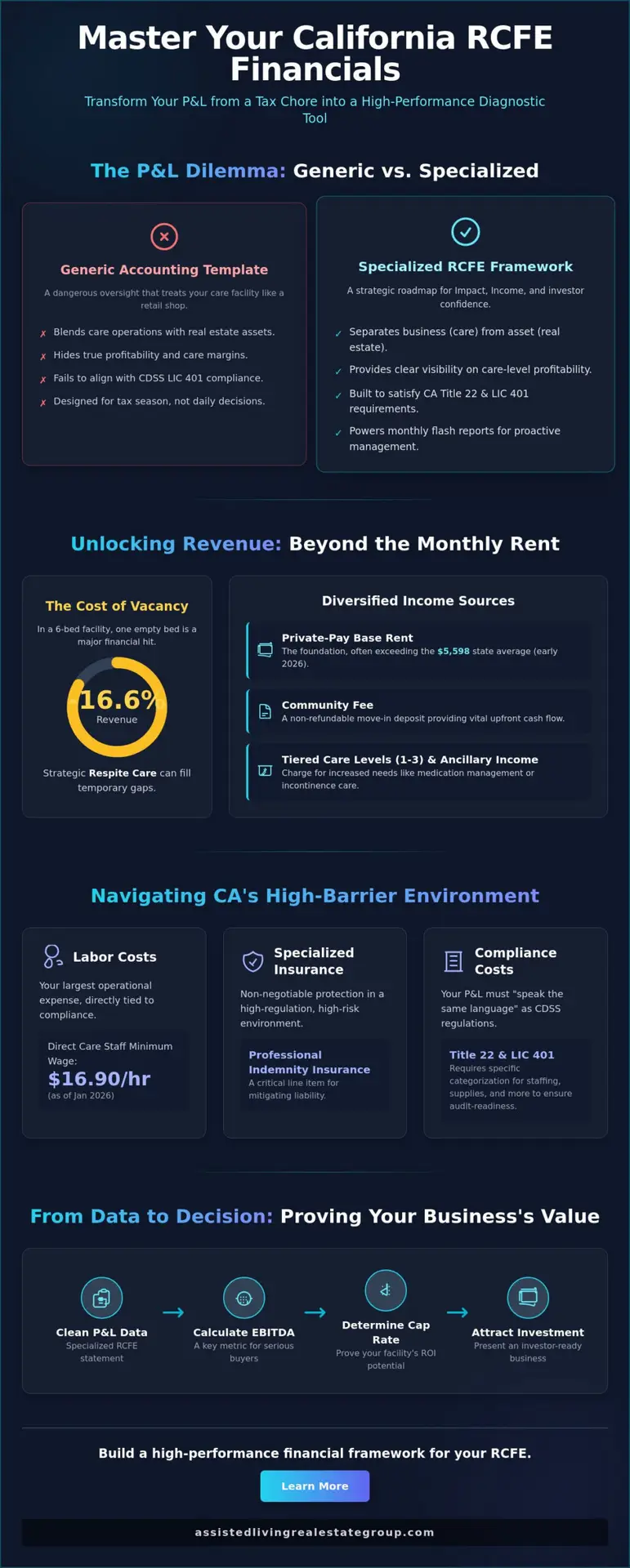
Generic accounting software treats your care facility like a dry cleaner or a retail shop. That’s a dangerous oversight. In the California market, an RCFE profit and loss statement template must serve as a specialized financial instrument that captures the nuances of the social model of care. While institutional facilities focus on massive resident volume and razor-thin margins, the Boutique RAL model prioritizes high-touch service and premium pricing. Your P&L needs to reflect this distinction. It isn’t just a document for your bookkeeper; it’s a strategic roadmap that balances the compassionate side of senior care with the cold reality of real estate investment.
Successful operators understand the dual nature of their financials. You’re managing two distinct entities: the business (the care operations) and the asset (the real estate). A generic template bundles these together, making it impossible to see if your care margins are healthy or if your property is underperforming. By separating these, you achieve our signature philosophy of Impact and Income. You ensure that the financial health of the facility supports a legacy of high-quality care while simultaneously driving the ROI that savvy investors demand.
The Difference Between a Tax P&L and an Operational P&L
Your CPA’s year-end report is designed to minimize your tax liability, but it won’t help you manage your facility on a Tuesday afternoon. For daily success in California, you need monthly flash reports. These reports allow you to track care-level adjustments as a variable revenue line. If a resident’s needs increase, your revenue should reflect that immediately. Standard templates often bury these adjustments in a general “rent” category, blinding you to the actual profitability of your care services.
California Regulatory Context: The LIC 401 Connection
The California Department of Social Services (CDSS) requires a Monthly Operating Budget through the LIC 401 form. If your internal RCFE profit and loss statement template doesn’t speak the same language as your licensing documents, you’re inviting regulatory scrutiny. Your chart of accounts must be built specifically to satisfy Title 22 requirements, ensuring every dollar spent on staffing or supplies is easily auditable. Title 22 regulations dictate your minimum staffing requirements, which directly shapes how you must categorize your labor costs to remain compliant.
Revenue Streams in California Care: Beyond the Monthly Rent
Revenue isn’t just a flat monthly check. If you’re using a basic RCFE profit and loss statement template, you might be missing the granular details that separate a struggling home from a high-yield investment. In California, your income strategy must account for the diverse ways residents fund their care, ranging from private wealth to Long-Term Care Insurance (LTCI) and, in specific counties, the Assisted Living Waiver (ALW) program. While SSI provides a baseline, the Boutique RAL model thrives on private-pay residents who value the intimacy of a 6-bed residential environment. These premium clients are willing to pay for a superior quality of life, often pushing monthly rates well beyond the state average of $5,598 seen in early 2026.
Don’t overlook the “Community Fee.” This non-refundable move-in deposit is a vital cash flow booster that should have its own line on your P&L. It covers the administrative burden of the initial assessment and room preparation required by the California Department of Social Services. Additionally, you must factor in vacancy rates. In a small facility, one empty bed isn’t just a minor dip; it’s a 16.6% hit to your gross revenue. Tracking “Respite Care” income can serve as a strategic buffer, filling those temporary gaps with short-term stays at a higher daily rate.
Tiered Care Levels and Ancillary Income
Your revenue lines must distinguish between basic room and board and actual care services. Use your RCFE profit and loss statement template to track Level 1 through Level 3 care surcharges as independent variables. When a resident requires specialized incontinence care or complex medication management, those costs should be captured as ancillary income rather than being absorbed into the base rent. This transparency ensures you’re compensated for the increased labor hours your staff provides, maintaining the balance between compassion and profitability.
Geography and Revenue: The Southern California Premium
Location dictates your ceiling. Market rates in coastal hubs like Orange County or San Diego often command a significant premium over inland regions. As the Silver Tsunami continues to crest, these high-demand zones offer the greatest opportunity for Impact and Income. If you’re looking to enter these lucrative markets, reviewing an RCFE for sale in a high-demographic area is the first step toward building a legacy. Our team can help you identify these blue ocean opportunities at assistedlivingrealestategroup.com.
Operating Expenses: Navigating California’s High-Barrier Environment
California isn’t just a market; it’s a high-barrier ecosystem where operational excellence is mandated by law. Your RCFE profit and loss statement template must do more than track spending. It has to prove you’re meeting California’s RCFE Financial Record-Keeping Requirements. Staffing is your heaviest lift. With the statewide minimum wage sitting at $16.90 as of January 2026, labor costs can swallow your margins if they aren’t meticulously categorized. You’re not just paying for hours worked; you’re funding a compliance engine that requires constant oversight.
Specialized insurance is another non-negotiable expense in this landscape. You need separate lines for general liability, workers’ comp, and professional indemnity to protect your legacy. Don’t make the common mistake of lumping care supplies with dietary expenses. Food costs are relatively stable, but care supplies fluctuate wildly based on resident acuity. Finally, track your referral fees. In a competitive market, paying a placement agent is a specific cost of acquisition that belongs in your marketing budget. Burying these in miscellaneous costs hides the true price of keeping your beds full.
Labor Costs and Title 22 Compliance
Title 22 requires new direct care staff to complete 40 hours of training within their first 30 days. This isn’t just a compliance check. It’s a significant payroll expense that must be tracked. Your P&L should isolate these training hours to help you see the true cost of turnover. Whether you use shift caregivers or live-in staff, the fiscal impact of the ongoing caregiver shortage is a constant pressure. If you employ exempt administrators, remember the 2026 minimum annual salary is now $70,304. Failing to account for these specific California thresholds can lead to devastating wage-and-hour claims.
Facility Maintenance and Boutique Upgrades
Maintaining a Boutique environment requires a clear distinction between operating expenses (Opex) and capital expenditures (Capex). A fresh coat of designer paint is Opex. Replacing a HVAC system or installing mandated fire safety equipment is Capex. These upgrades aren’t just costs; they’re investments in the real estate asset that justify your premium Boutique rates. California-specific zoning and fire clearance compliance costs must be anticipated in your annual budget to avoid sudden hits to your operational cash flow.
The Strategic RCFE P&L Template: Essential Line Items
A high-performing RCFE profit and loss statement template does more than list numbers; it categorizes them to reveal the operational pulse of your facility. To achieve true financial clarity, your template must organize data into five core pillars: Revenue, Direct Care, Dietary, Administrative, and Facility expenses. This structure allows you to see exactly where your capital is working and where it is being wasted. By treating your P&L as a diagnostic tool, you move from a state of reactive management to proactive leadership.
Revenue lines must be granular. Beyond base rent, you should track Private Pay premiums, SSI baselines, and those vital one-time Community Fees. Direct Care Expenses must capture more than just hourly wages. You need specific lines for care supplies, incontinence products, and pharmacy management. Dietary costs should reflect your commitment to Boutique quality. Food, supplements, and specialized diet prep for residents with high acuity are distinct costs that require their own categories. Administrative lines must include licensing fees, such as the $140 administrator application fee, and mandated training. Finally, Facility expenses track the mortgage, utilities, and the landscaping that maintains your property’s curb appeal and appraisal value.
Structuring Your Chart of Accounts for Success
Investors and lenders look for transparency. Using “Miscellaneous” as a catch-all category is a major red flag that suggests a lack of operational control and can derail a potential sale. Instead, group your expenses into “Controllable” costs, such as food and supplies, versus “Fixed” costs like property taxes and specialized RCFE insurance. This distinction helps you identify where you can trim fat without sacrificing the quality of life for your residents. Implementing eMAR software is a necessary P&L line item in 2026 because it drastically reduces medication errors while providing the digital audit trail necessary for successful CDSS inspections.
Preparing for the “Silver Tsunami” Market
The demographic shift isn’t a crisis; it’s a blue ocean opportunity for savvy entrepreneurs. To capture this market, your budget must allocate funds for technology that enhances resident quality of life, such as smart monitoring or high-speed connectivity. A Boutique RAL thrives on its reputation, and high-end culinary programs are a primary driver of that prestige. Investing in superior nutrition and aesthetic upgrades isn’t just about “doing good”; it’s about “doing well” by maintaining a premium market position that justifies higher investment returns. If you’re ready to expand your portfolio, understanding the nuances of Investing in senior housing is essential for long-term success. To see how these financial strategies translate into high-value assets, view our current California listings and discover your next strategic acquisition.
From Data to Decision: Valuing Your California RCFE Business
Your financial data is finally organized. Now it’s time to translate those rows and columns into a market valuation that reflects the true worth of your legacy. In the California market, a high-quality RCFE profit and loss statement template does more than track cash flow; it serves as the foundation for your “Exit Strategy.” Investors don’t just buy a house; they buy a predictable stream of income and a stabilized real estate asset. To maximize your return, you must understand how a sophisticated buyer views your EBITDA—Earnings Before Interest, Taxes, Depreciation, and Amortization. This number represents the raw earning power of your facility before accounting for your specific financing or tax situation.
The “Cap Rate” conversation is where your P&L dictates your real estate value. In a Boutique RAL environment, a lower Cap Rate often signals a more stable, premium investment, which actually leads to a higher sales price. However, achieving this requires a “clean” P&L. You must remove owner-specific perks—such as personal vehicle leases, family cell phone plans, or non-business travel—that are currently buried in your expenses. By adding these back into your profit, you show a potential buyer the actual ROI they can expect. A specialized broker is essential here to help tell your financial story, ensuring that the “Care vs. Real Estate” split is clearly defined to justify a premium market position.
Calculating Net Operating Income (NOI)
Net Operating Income is the single most important number for California lenders. The formula is straightforward: Total Revenue minus Operating Expenses, excluding your mortgage or debt service. Lenders use this to calculate your Debt Service Coverage Ratio (DSCR), which determines how much they’re willing to lend to a future buyer. If you want to know How to value your assisted living business, you must first ensure your NOI is accurate and verifiable. A clean RCFE profit and loss statement template makes this calculation effortless, providing the transparency that institutional-grade investors demand.
Preparing for an Exit Strategy
Preparation is the difference between a quick sale and a stagnant listing. Industry data shows that providing 24 months of clean, auditable P&Ls can increase your eventual sales price by 20%. This transparency builds trust and reduces the buyer’s perceived risk. We take an “Expert Guide” approach to confidential marketing, ensuring your facility’s reputation remains intact while we identify the right strategic partner for your transition. Don’t leave your legacy to chance. Contact Assisted Living Real Estate Group for a confidential valuation today and see how your operational excellence translates into significant financial wealth.
Secure Your Legacy Through Financial Mastery
Transitioning from a state of financial anxiety to one of strategic clarity starts with your data. You now have the framework to move beyond generic accounting and embrace a specialized RCFE profit and loss statement template that honors both California’s Title 22 mandates and your own ROI goals. By separating care-specific expenses from your real estate assets, you’re positioning your Boutique home as a high-value, investor-ready enterprise. This level of transparency doesn’t just satisfy regulators; it builds the foundation for a premium valuation and a successful exit strategy.
Our group brings over 25 years of specialized RCFE brokerage experience to your corner, maintaining an exclusive focus on California’s complex regulatory landscape. We’ve pioneered the “Impact and Income” model to help visionaries like you achieve significant returns while providing world-class senior care. Unlock the value of your facility with a Strategic Financial Consultation and see how our seasoned expertise can guide your next acquisition or sale. The Silver Tsunami is your blue ocean opportunity. With the right financial roadmap, you’re not just running a business; you’re building a lasting legacy of care and wealth.
Frequently Asked Questions
What is the difference between an RCFE P&L and a standard business P&L?
An RCFE P&L is a specialized instrument that tracks the “social model of care” rather than simple retail inventory. It must account for tiered care levels and Title 22 compliance costs that generic business templates ignore. This granularity is what allows Boutique operators to justify premium rates while maintaining high-touch service for their residents.
Does California DSS require a specific P&L format for licensing?
The California Department of Social Services (CDSS) doesn’t enforce a rigid P&L layout, but they strictly require the LIC 401 Monthly Operating Budget. It’s best practice to align your internal financial statements with the LIC 401 categories. This alignment ensures you’re always ready for a licensing audit or a potential business valuation without scrambling for data.
How should I categorize caregiver wages in my P&L?
Caregiver wages should be isolated under a “Direct Care Labor” category to distinguish them from administrative payroll. You must track base wages separately from overtime and the 40 hours of mandated initial training required for new staff. This helps you monitor the impact of the $16.90 statewide minimum wage on your overall operational efficiency.
What is a healthy profit margin for a 6-bed RCFE in California?
Boutique 6-bed facilities in high-demand California markets often see profit margins between 30% and 50% before debt service. Achieving these numbers requires a focus on private-pay residents and a strategic approach to care-level surcharges. Your P&L should reflect these premium margins to attract future investors who are looking for high-yield RAL opportunities.
How do I account for owner-operator ‘sweat equity’ in my financial statements?
While “sweat equity” doesn’t appear as a cash expense, you must account for it when preparing your facility for a sale. Record a “replacement salary” for any roles you fulfill, such as the administrator. In 2026, the minimum annual salary for exempt employees in California is $70,304, which serves as a realistic benchmark for your financial modeling.
Should I separate real estate expenses from care operations on my P&L?
Separating the business from the real estate asset is essential for a clean financial story. You should use your RCFE profit and loss statement template to distinguish between operational costs like food and care supplies and real estate costs like property taxes or mortgage interest. This separation is the only way to accurately calculate your Cap Rate and ROI.
What are the most common financial mistakes California RCFE owners make?
Many owners fail by lumping diverse costs into a “Miscellaneous” category or ignoring vacancy trends until they become a crisis. Another mistake is neglecting to adjust revenue when a resident’s care needs increase. These errors obscure your true profitability and make it difficult for specialized brokers to market your business effectively during an exit.
How often should I update my RCFE profit and loss statement?
You should generate a fresh report every 30 days to maintain total financial control over your facility. Updating your RCFE profit and loss statement template monthly allows you to produce “flash reports” that identify rising labor costs or supply waste immediately. This rhythm ensures you stay ahead of market shifts and remains compliant with California’s financial record-keeping requirements.