
In the high-stakes California senior housing market, your operating agreement serves as the definitive regulatory bridge between your corporate entity and your license to provide care. A strategic investor knows that evaluating RCFE operations before purchase requires looking far beyond the monthly census to the granular legal details of the partnership structure. You likely understand that Title 22 compliance is non-negotiable; however, a weak agreement can still lead to devastating partner disputes or unexpected licensing delays that stall your momentum in this competitive landscape.
This guide empowers you to master the critical legal and operational components of your RCFE operating agreement to ensure regulatory compliance and protect your senior care investment. We will explore how to architect a bulletproof entity structure that streamlines the mandatory 120-day Change of Ownership notice period and accounts for the state’s five-year holding restriction. By the end of this article, you will have a clear roadmap for securing your investment while preparing for a lucrative exit strategy in California’s rapidly growing silver economy.
Key Takeaways
- Understand why a robust operating agreement acts as the internal constitution for your California LLC, protecting your limited liability status under Cal RULLCA.
- Learn the essential steps for evaluating RCFE operations before purchase by scrutinizing licensee clauses and ensuring all members meet strict CDSS background clearance requirements.
- Discover how to structure capital contributions and profit allocations to balance facility reinvestment with sustainable investor distributions.
- Master the Change of Ownership (CHOW) process by implementing pre-determined valuation formulas and rights of first refusal to ensure a seamless future exit.
- Leverage specialized brokerage expertise to audit operational agreements during due diligence, bridging the gap between real estate acquisition and regulatory licensing.
The Strategic Role of an Operating Agreement in California RCFE Operations
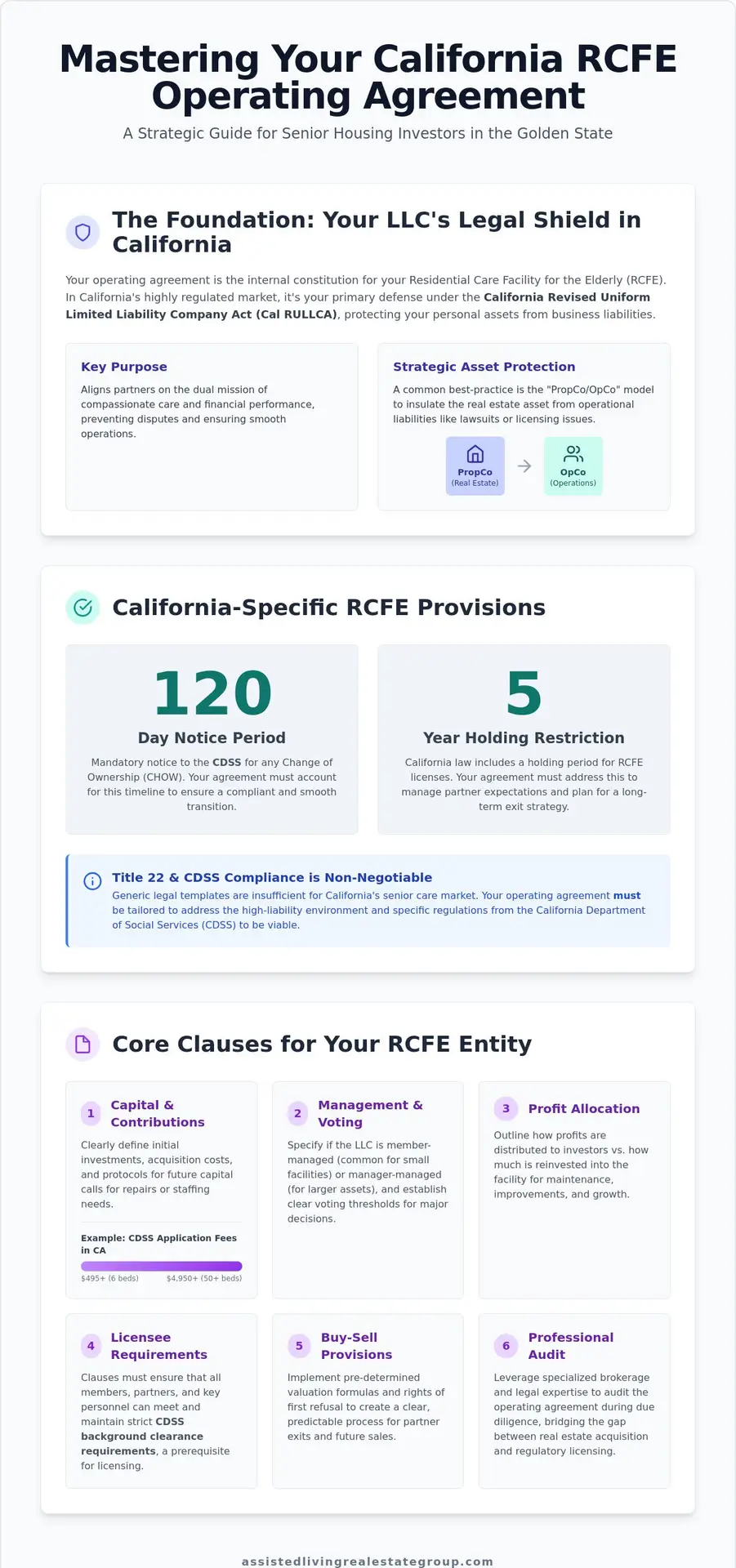
Your operating agreement is far more than a stack of boilerplate legal pages; it’s the internal constitution of your Residential Care Facilities LLC. In California, where regulatory scrutiny is at an all-time high in 2026, this document dictates how your business breathes, grows, and responds to crisis. While many investors focus solely on the physical asset, savvy professionals understand that evaluating RCFE operations before purchase requires a deep dive into how the entity itself is governed. Under the California Revised Uniform Limited Liability Company Act (Cal RULLCA), a written agreement isn’t just a best practice; it’s the primary defense for your limited liability status. Without it, you’re essentially operating under the state’s “default rules,” which rarely align with the complex needs of a 24/7 care environment.
This document serves a vital psychological purpose by aligning partners on the dual mission of compassionate care and financial performance. It bridges the gap between the analytical mind of the investor and the moral compass of the service provider. For maximum protection, strategic operators often utilize a two-tiered structure, separating the real estate holding entity from the operational care entity. This “PropCo/OpCo” model ensures that a licensing issue or an operational lawsuit doesn’t automatically jeopardize the underlying property asset. It’s a sophisticated play that signals to the market that you aren’t just a landlord, but a specialized healthcare executive.
Why Niche-Specific Agreements Outperform Generic Templates
Relying on a generic template in the California senior care market is a recipe for disaster. Generic documents fail to account for the high-liability environment of Southern California senior housing, where Title 22 compliance is the baseline for survival. If your agreement doesn’t specifically address the 120-day Change of Ownership (CHOW) notice period or the mandatory five-year holding restriction, you’re flying blind. Institutional lenders and sophisticated sellers look for these niche-specific details. A tailored agreement proves your facility is a professional enterprise, making it significantly easier to secure favorable financing or attract high-level partners who demand a clear, regulatory-compliant roadmap.
Asset Protection and Limited Liability for Care Providers
In a litigious healthcare market like California, separating personal assets from facility liabilities is your most important task. Plaintiffs’ attorneys often look for any excuse to “pierce the corporate veil” through the alter ego doctrine. If you treat your LLC like a personal piggy bank or fail to follow the governance rules in your agreement, you risk losing your personal home or savings to a facility-related lawsuit. A robust operating agreement acts as the foundational contract that shields investors from operational risks. By maintaining strict corporate formalities, utilizing reliable services like relayregisteredagent.com for entity management, and defining clear member roles, you ensure that the LLC remains a fortress, protecting your wealth while you focus on delivering premium care to California’s aging population.
Fundamental Clauses for Every Residential Care Facility Entity
Evaluating RCFE operations before purchase demands a surgical focus on how the entity handles its most critical resource: capital. Your operating agreement must clearly document initial contributions, covering everything from the facility acquisition price to the tiered CDSS application fees. In 2026, these fees range from $495 for small 6-bed homes to over $4,950 for facilities with 50 or more beds. Beyond the initial buy-in, the agreement needs to define protocols for additional capital calls. These are essential for handling staffing surges or emergency repairs without paralyzing the business or damaging your reputation for premium care.
When evaluating RCFE operations before purchase, the choice between a member-managed or manager-managed structure often depends on scale. Smaller 6-bed facilities frequently thrive under member-management where the owner-operator handles daily oversight. Larger assets typically require a manager-managed model to professionalize operations and satisfy institutional investors. Voting rights shouldn’t be an afterthought. You’ll need to establish clear thresholds for major shifts, such as changing resident care policies or altering the facility’s specialized niche. This ensures no single partner can unilaterally pivot the business away from its core mission or regulatory commitments.
Capital Contributions and Funding Requirements
Identifying “initial” versus “additional” capital is vital for long-term stability. In California, you must also account for the mandatory operating cost reserve, which requires one month of accessible cash for existing facility purchases. Partners contributing specialized expertise rather than cash should have their “sweat equity” meticulously documented to avoid future disputes during a sale. This clarity is a prerequisite for securing assisted living facility financing, as lenders prioritize entities with transparent funding obligations and clear partner accountability.
Distributions and Reinvestment Strategies
With California’s median assisted living cost reaching approximately $7,350 per month in 2024, which is 25% above the national average, the potential for significant returns is clear. However, your agreement must balance member distributions with the need for reinvestment. Setting aside reserves for facility upgrades is mandatory to remain compliant with evolving California Title 22 RCFE Regulations. For instance, the 2025 requirement for facility-wide dementia care standards necessitates ongoing staff training and environmental modifications. Strategic investors prioritize a distribution timeline that accounts for these regulatory reinvestments first, ensuring the facility’s long-term significance and market value. If you’re ready to explore these models in practice, you can view our current RCFE listings to see how established facilities are structured for success.
RCFE-Specific Provisions: Aligning with California Title 22 and DSS Requirements
While standard business agreements focus on fiscal management, evaluating RCFE operations before purchase requires a hyper-focus on California Department of Social Services (CDSS) mandates. Your agreement must include a “Licensee” clause that explicitly identifies the LLC as the entity holding the RCFE license. This isn’t a mere formality; it’s a regulatory requirement that ensures the state knows exactly who is responsible for resident care. You must also hard-code Title 22 record-keeping protocols into your corporate bylaws. This includes the 2026 enforcement of facility-wide dementia care standards and the mandate for resident reappraisals every 12 months. By baking these requirements into your foundational documents, you demonstrate to the Community Care Licensing Division (CCLD) that your facility is built on a bedrock of compliance.
Ensuring Member Eligibility for CDSS Clearance
In California, every member of your LLC with a 10% or greater interest must undergo rigorous background scrutiny. The CDSS requires full transparency in LLC ownership for all RCFE applicants. This process involves LiveScan fingerprinting, which typically costs between $100 and $200 per person. Your operating agreement must define the impact of “disqualifying crimes” as outlined in the Health and Safety Code. If a member loses their state clearance, your agreement needs a “forced buyout” or removal procedure. This protects the facility’s license from being revoked due to a single partner’s legal issues, ensuring your investment remains secure even if partnership dynamics shift.
Operational Authority and the Administrator Role
Your corporate governance must clearly distinguish between the strategic LLC managers and the licensed Administrator. The Administrator is the individual responsible for day-to-day regulatory compliance and serves as the primary point of contact for the DSS. Under 2026 regulations, this individual must pass the state exam within 60 days of completing their 80-hour certification course. Your agreement should include provisions for emergency management if the primary Administrator is incapacitated, naming a qualified backup to prevent a lapse in care. Integrating these RCFE licensing California requirements into your governance structure ensures a seamless chain of command. This clarity is essential when evaluating RCFE operations before purchase, as it confirms the facility can maintain “control of property” and operational continuity during a Change of Ownership.
Planning for Transition: Buy-Sell Provisions and Change of Ownership (CHOW)
Strategic professionals recognize that an RCFE is a transition-heavy asset, not a static holding. Evaluating RCFE operations before purchase requires a clear vision of the endgame, specifically how ownership interests will be transferred when a partner exits. Your operating agreement must include a “Right of First Refusal” to ensure facility ownership stays within a trusted circle of investors. This prevents an outside party from disrupting the delicate balance of a 24/7 care setting. Pre-determined valuation formulas, often based on a multiplier of EBITDA or a price-per-bed metric, are equally critical. By establishing these values early, you avoid the predatory litigation that often plagues Southern California’s senior housing market. For family-owned 6-bed facilities, this level of succession planning is the difference between a legacy and a forced liquidation.
Managing Partner Exits without Disrupting Resident Care
Trigger events like death, disability, or retirement must necessitate an immediate, orderly buyout process. The facility’s operational continuity is paramount because resident care cannot pause for a legal dispute. You’ll find that assessing these valuation metrics and exit triggers is a core component of due diligence assisted living. It ensures that if a partner exits, the remaining members have the liquidity and legal authority to maintain compliance without missing a beat. This foresight protects the residents’ stability while safeguarding the investors’ financial interests during periods of internal change.
The CHOW Process and Entity Continuity
The LLC structure is the gold standard for navigating California’s complex Change of Ownership (CHOW) applications. As of June 22, 2026, ownership changes must be submitted to the state at least 120 days in advance of closing. Your agreement should include clauses that mandate seller cooperation during this period, as the Centralized Applications Bureau (CAB) often takes 90 to 120 days to process these packets. The CHOW process is the critical regulatory handoff between a seller’s liability and a buyer’s new license. It’s also vital to remember that a new five-year holding period resets after every approved CHOW, making your initial entity structure even more important for long-term flexibility. If you’re ready to plan your next strategic move, consult our acquisition experts to ensure your transition is seamless and compliant.
Securing Your Investment: Professional Guidance for Turnkey RCFE Acquisitions
Navigating the intersection of California real estate and licensing is a sophisticated endeavor that requires more than just general business acumen. While the operating agreement provides the legal skeleton for your LLC, a specialized broker provides the operational muscle to execute your vision. Evaluating RCFE operations before purchase isn’t just about checking boxes; it’s about verifying that the business is truly a turnkey acquisition. A well-structured agreement increases the appraisal value of your care home by demonstrating institutional-grade stability and reducing the perceived risk for lenders. When your corporate governance is airtight, you aren’t just buying a house with residents; you are acquiring a high-yield, mission-driven enterprise that is prepared for the rigorous scrutiny of the Centralized Applications Bureau.
Leveraging 25 Years of California Senior Care Expertise
Teri Szoke and the team at Assisted Living Real Estate Group bring over 25 years of specialized experience to every transaction in the Golden State. We mentor investors through the labyrinth of California’s regulatory landscape, ensuring that your due diligence includes a rigorous audit of operational agreements and staffing models. This process is the cornerstone of evaluating RCFE operations before purchase, as it reveals the true health of the business beyond the balance sheet. Our approach to confidential marketing is a signature marker of our service, allowing for a seamless transition without alerting competitors or unsettling residents. We protect the facility’s reputation while identifying the right strategic buyer who appreciates the intersection of ethics and profitability. This level of discretion ensures that the business value remains intact throughout the entire 120-day Change of Ownership process. If you’re ready to see what’s available in today’s market, you can explore our current RCFE listings in California.
Building a Legacy in the Assisted Living Sector
Your operating agreement is the blueprint for a financial legacy that yields a tangible social contribution. By partnering with a broker who understands both the “bricks and mortar” and the “care and compliance” nuances of Title 22, you position yourself for long-term success in a high-barrier-to-entry market. The demographic shift in California is an untapped market potential for strategic professionals who want to achieve significant returns while providing refined service to the elderly. Moving from legal formation to active facility acquisition in Southern California requires a roadmap that accounts for the 5-year holding restriction and evolving dementia care standards. We encourage you to seek specialized consulting for your facility setup and relicensing, and for managing complex procurement needs, RightCostIQ offers expert RFP and negotiation support to ensure your investment is bulletproof from day one. This proactive approach transforms a simple business purchase into a generational asset that serves both your portfolio and your community.
Mastering the Future of Your California Care Investment
Strategic investors recognize that a robust operating agreement is the ultimate safeguard for both resident care and capital preservation. This document serves as your regulatory compass, ensuring every partner remains aligned with Title 22 mandates and the strict 120-day Change of Ownership protocols. Evaluating RCFE operations before purchase requires this level of legal scrutiny to prevent partnership disputes and licensing delays that could otherwise jeopardize your standing in Southern California’s competitive market. By prioritizing entity continuity and clear buy-sell provisions, you build a resilient business that is ready for both operational excellence and a lucrative future exit.
Don’t navigate this complex landscape alone. Our team brings 25 years of combined industry experience, offering specialized knowledge in both real estate and CDSS licensing transitions. We help you bridge the gap between financial ambition and compassionate care. Partner with California’s RCFE Experts to Secure Your Investment and take the first step toward a legacy of significance. The demand for premium senior housing is rising, and with the right roadmap, your portfolio is poised for exceptional growth.
Frequently Asked Questions
Is an operating agreement required for a single-member RCFE LLC in California?
A written operating agreement is essential for a single-member LLC in California. While state law technically permits oral agreements, the California Department of Social Services (CDSS) and institutional lenders demand written documentation to verify entity structure. It serves as your primary defense against claims that the business is merely an “alter ego,” ensuring your personal assets remain shielded from facility liabilities.
Can I change my RCFE operating agreement after I receive my state license?
You can amend your agreement, but you must notify the CDSS of any changes in “controlling interest.” For a full Change of Ownership (CHOW), California law requires a 120-day advance notice before closing. Minor internal governance updates don’t usually require state approval, but they must be formally recorded to maintain your corporate shield and regulatory standing.
What happens if an LLC member fails their background check with the CDSS?
Any member failing a CDSS background check must be immediately removed from the LLC to protect the facility’s license. Disqualifying crimes can lead to automatic license revocation if the individual remains an owner. Your agreement should include a “forced buyout” provision that triggers upon a failed LiveScan or loss of state clearance, allowing for a swift and legal exit.
How does the operating agreement affect my ability to sell the facility later?
Your agreement dictates the transferability of ownership interests and the valuation methods used during a sale. When evaluating RCFE operations before purchase, savvy buyers look for clear exit strategies and right-of-first-refusal clauses. A transparent, well-documented agreement reduces friction during the 90 to 120-day licensing handoff, making the business more attractive to sophisticated investors.
Should the real estate and the care business be in the same operating agreement?
Strategic investors typically separate the real estate and the care business into two distinct LLCs with separate operating agreements. This “PropCo/OpCo” model is a key factor when evaluating RCFE operations before purchase, as it ensures operational liabilities don’t jeopardize the underlying property. It creates a cleaner financial structure that is easier to appraise and provides an additional layer of asset protection.
What is the difference between an operating agreement and the facility’s Plan of Operation?
An operating agreement governs the internal relationship between LLC members, while the Plan of Operation is a regulatory document required by the CDSS. The operating agreement covers profits, voting, and buyouts. The Plan of Operation details how you’ll provide care, staffing ratios, and dementia standards. Both are foundational, but they serve entirely different legal and operational purposes.
How much detail should I include regarding staffing and Title 22 in the agreement?
You should include high-level compliance mandates without cluttering the agreement with granular daily tasks. Specify that all members must adhere to California Title 22 RCFE Regulations and maintain necessary background clearances. This ensures every partner is legally bound to the facility’s mission of care. Keep specific staffing schedules in your Plan of Operation to allow for easier updates as resident needs change.
Can an operating agreement protect me from personal liability in a resident injury lawsuit?
A robust agreement is your first line of defense against being held personally liable in a lawsuit. It establishes the “corporate veil” by proving that the LLC is a separate legal entity from its owners. By strictly following the governance rules in your agreement, you prevent plaintiffs from using the “alter ego” doctrine to target your personal home or savings after a resident injury.