
The most expensive part of your California RCFE license isn’t the application fee; it’s the cost of waiting for a signature that hasn’t arrived yet. While a $990 fee for a six-bed facility seems manageable, the true RCFE licensing cost California investors face includes months of carrying costs and the intricate physical plant upgrades required by Title 22. You understand that in this high-stakes market, time is quite literally money. It’s frustrating to watch potential revenue vanish while navigating unpredictable Fire Marshal timelines or complex solvency requirements.
This article serves as your 2026 financial roadmap, designed to help you master the regulatory landscape and transform your real estate into a high-yield care facility. We’ll move beyond basic fee schedules to explore the strategic capital necessary for success. You’ll gain clarity on the three-month operating reserve mandated by the state and the financial benefits of turnkey acquisitions over starting from scratch. From initial Live Scan fees to the nuances of the 80-hour administrator certification, we’re providing the granular data you need to build a bulletproof budget and secure your place in California’s elite care market.
Key Takeaways
- Discover how California’s high-barrier-to-entry market safeguards your investment by transforming a standard license into a protected strategic asset.
- Calculate the total RCFE licensing cost California by accounting for tiered CDSS application fees and the mandatory 80-hour administrator certification.
- Learn to navigate the mandatory financial solvency test and physical plant standards required to pass Fire Marshal inspections.
- Compare the 60-day Change of Ownership (CHOW) timeline against a 12-month new license application to determine your fastest path to cash flow.
- Master the five-phase CDSS application process to avoid regulatory bottlenecks and ensure your facility meets Title 22 compliance from day one.
Beyond the Application Fee: Viewing the RCFE License as a Strategic Asset
An RCFE license is far more than a piece of paper; it’s the specific operating permit that transforms a standard residential property into a specialized healthcare asset. In the assisted living industry, the license is the barrier that separates a standard landlord from a strategic investor. While the RCFE licensing cost California requires might seem like a regulatory burden, it actually serves as a protective moat. This high-barrier-to-entry market ensures that only serious professionals can compete, protecting your margins from the dilution that comes with low-competition sectors. With the “Silver Tsunami” driving unprecedented demand for senior housing, these licenses have become highly sought-after commodities. You shouldn’t view these expenses as administrative friction; they’re essential capital expenditures that secure long-term yield and significant market positioning.
The Distinction Between RCFE and ARF Licensing Costs
Investors often weigh the merits of Residential Care Facilities for the Elderly (RCFE) against Adult Residential Facilities (ARF). While RCFEs serve those aged 60 and older, ARFs cater to adults with developmental disabilities or mental health needs. This distinction impacts your bottom line from day one. RCFEs typically require higher care-to-staff ratios as residents age in place, which increases operational overhead but often allows for higher private-pay rates. Holding both facility types in a Southern California portfolio allows for strategic diversification. By understanding how each license type dictates staffing and physical plant requirements, you can optimize your investment for both social impact and financial performance. This dual-track approach mitigates vacancy risks and leverages varying reimbursement models across different age demographics.
The Role of Title 22 in Protecting Your Investment
The California Department of Social Services (CDSS) enforces Title 22 regulations to ensure resident safety and operational integrity. While compliance adds to the initial RCFE licensing cost California investors must pay, it also prevents catastrophic financial loss. Rigorous adherence to these standards builds a foundation for asset appreciation. Facilities with clean records and perfect compliance histories command premium prices during exits. Cutting corners on fire safety or staffing documentation isn’t just a risk; it’s a direct threat to your equity. Professional investors treat Title 22 not as a checklist, but as a roadmap for operational excellence and risk mitigation. This regulatory framework ensures that your facility remains a “flight-to-quality” asset in a competitive landscape, securing your reputation as a provider of elite care.
Breaking Down the Direct Administrative and Certification Expenses
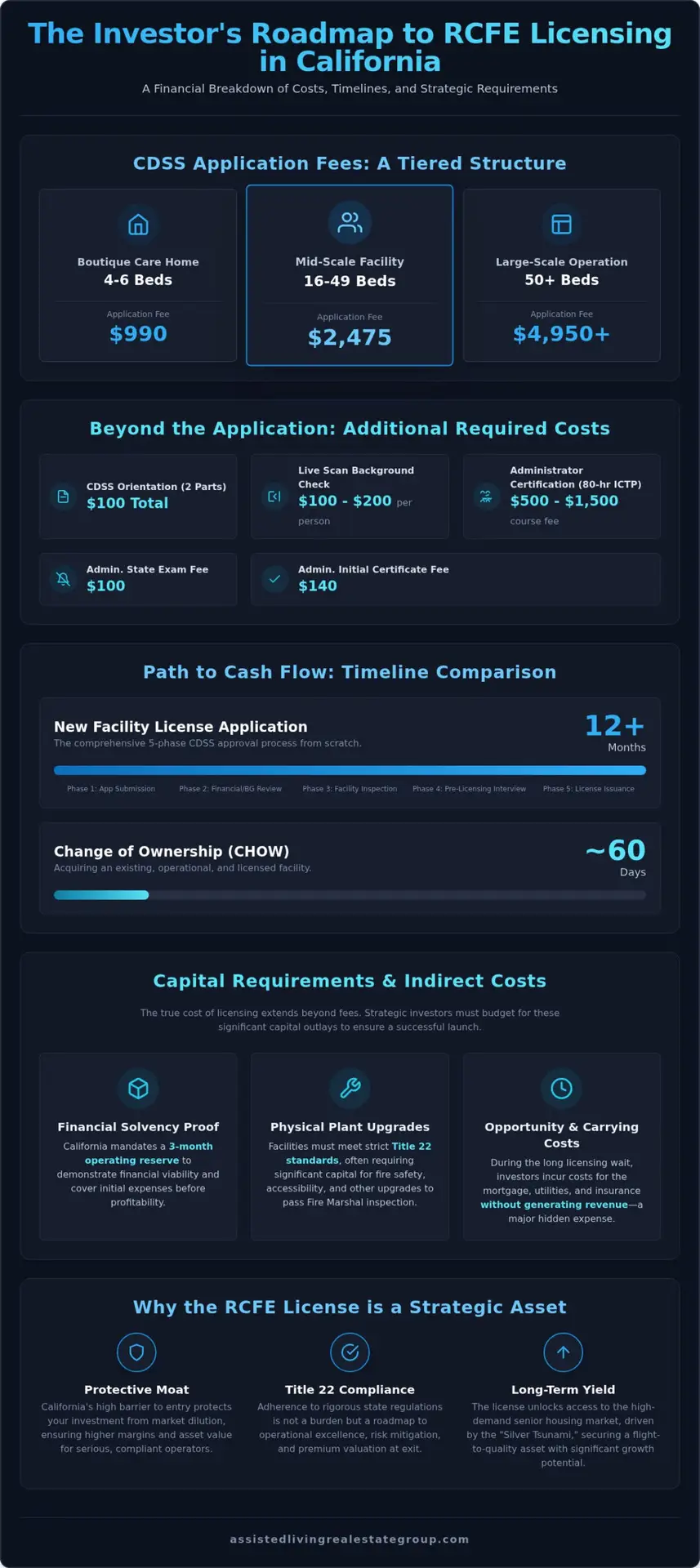
The California Department of Social Services (CDSS) functions as the gatekeeper for your investment. Their tiered fee structure creates a clear distinction between boutique care homes and institutional-scale facilities. For a standard 4-6 bed home, the initial application fee is $990. Larger operations with 16 to 49 beds face a $2,475 fee, while facilities with 50 or more beds see costs starting at $4,950. Totaling your RCFE licensing cost California requires a granular view of both one-time and recurring state fees. Beyond the application, you’ll need to complete a two-part orientation. Component I is an online self-paced session, while Component II involves a live webinar. Each carries a $50 fee, plus minor processing charges. Don’t overlook the Live Scan background checks. These typically run between $100 and $200 per person for all licensees and staff members.
Administrator Certification vs. Facility Licensure
Securing a facility license is separate from obtaining an administrator certificate. Every RCFE must have a certified administrator who has completed the 80-hour Initial Certification Training Program (ICTP). These courses, offered by private vendors, cost between $500 and $1,500. After the course, the state exam adds another $100, followed by a $140 initial certificate application fee. Many strategic investors choose to hire a seasoned administrator rather than self-certifying. This allows you to focus on asset management while a specialist handles the day-to-day Senior Care Licensing Program requirements. If you’re looking for a faster entry point, exploring turnkey business acquisitions can bypass these initial administrative hurdles entirely.
Annual Fees and Regulatory Maintenance
Your financial commitment doesn’t end with the initial approval. CDSS assesses annual fees based on your bed capacity to maintain your standing. If you fail to pay by the billing cycle deadline, you’ll face a penalty equal to 50% of the annual fee. Beyond the state’s invoice, you must budget for the internal costs of maintaining compliance. This includes the implementation of a “Plan of Correction” if a deficiency is found during an unannounced inspection. These corrections often involve physical plant repairs or staff retraining. They can quickly exceed the cost of the initial license. Strategic maintenance prevents these hidden expenses from eroding your net operating income. It’s the price of entry for a high-yield, protected market.
The Capital Behind the Care: Physical Plant Standards and Solvency
While state application fees are the visible tip of the iceberg, the substantial RCFE licensing cost California investors must prepare for lies in the physical transformation of the property and the state’s strict solvency mandates. You aren’t just purchasing a residential home; you’re developing a clinical environment that must feel like a sanctuary while meeting commercial safety standards. In Southern California, local municipal fees and zoning permits often add thousands to your pre-operational budget before you even submit your Section B operational documentation. Fire clearance is frequently the primary bottleneck in the approval timeline. In many Southern California jurisdictions, wait times for a State Fire Marshal (SFM) inspection can stretch for months, making it vital to install required equipment like commercial-grade smoke detectors and fire sprinklers correctly the first time.
Meeting Title 22 Physical Plant Requirements
Title 22 dictates the exact footprint your facility must maintain to remain compliant. You must account for specific square footage mandates: at least 80 square feet for a private room and 60 square feet per resident in a semi-private room. Beyond the walls, your budget must include:
- Emergency Call Systems: Installation of mandatory notification systems in every bedroom and bathroom.
- Accessibility Retrofits: Widening doorways and installing ADA-compliant ramps or walk-in showers to accommodate residents with mobility aids.
- Common Areas: Furnishing indoor and outdoor spaces to meet “homelike” standards while ensuring they remain functional for high-traffic care.
The 3-Month Operating Reserve Requirement
The California Department of Social Services (CDSS) requires every applicant to pass a rigorous financial solvency test. You must prove you have liquid capital equal to at least three months of projected operating expenses. For a typical six-bed RCFE, this reserve generally ranges between $65,000 and $85,000. This isn’t a fee paid to the state, but it’s a non-negotiable verification of funds held in the business entity’s name. This capital must cover payroll, food, utilities, and mortgage payments before your first resident moves in. Strategic professionals demonstrate this liquidity through bank statements or lines of credit to the Community Care Licensing Division (CCLD) to prove the business can survive the initial low-occupancy phase without compromising care quality. Failing this test is one of the most common reasons for application denial, making precise financial planning your most important tool for success.
Navigating the 5-Phase Application Process to Approval
The path to licensure is a methodical sequence of milestones designed to verify both your operational integrity and your financial durability. While the initial RCFE licensing cost California investors pay covers the state’s administrative time, the real investment is the labor hours required to move through the California Department of Social Services (CDSS) pipeline. This process is divided into two primary segments: Section A, which focuses on the applicant and the physical facility, and Section B, which details your comprehensive plan of operation. Success requires a rhythmic progression through five distinct phases, starting with mandatory orientations and ending with a final face-to-face meeting with your Licensing Program Analyst (LPA).
- Phase 1: Orientation and Preliminary Documentation. You must complete Component I (online) and Component II (live webinar) before your application is even considered “received.”
- Phase 2: Formal Application Submission and Fee Payment. This is the point where you submit the LIC 200 form along with your tiered application fee and the exhaustive Section B operational binders.
- Phase 3: Background Clearances and Financial Review. CDSS initiates Live Scan background checks for all associated parties while simultaneously auditing your three-month operating reserve.
- Phase 4: Physical Plant Inspection and Fire Clearance. An LPA conducts a site visit while the State Fire Marshal verifies that your smoke systems, sprinklers, and egress routes meet Title 22 safety standards.
- Phase 5: Component III Orientation and Final Licensure. This is the final “pre-licensing” interview where you prove your mastery of California regulations before the official license is issued.
Timeline Expectations for 2026
The typical timeline for a new license application currently ranges from 6 to 12 months, though complex projects in high-demand areas can stretch to 18 months. Southern California regional offices often experience significant backlogs, particularly regarding Fire Marshal inspections. These delays can be financially draining if you’re carrying a mortgage on an empty facility. For a deeper dive into regional specifics, consult our RCFE License California: The 2026 Southern California Guide. Understanding these windows helps you time your staffing hires and marketing efforts to coincide with your expected approval date.
Developing a Robust Plan of Operation
Your Plan of Operation is the constitutional document of your business. It must outline every detail of resident care, from medication management to disaster response protocols. Incomplete Section B binders are the leading cause of “return to sender” notifications from the CDSS, which can add months to your timeline. Drafting these documents for compliance requires a sophisticated understanding of Title 22 language. If you want to avoid the friction of multiple revisions, consider navigating facility setup with a consultant who understands the specific expectations of California LPAs. A professional plan doesn’t just pass inspection; it provides a scalable roadmap for your facility’s long-term asset appreciation.
Strategic Acquisition: Should You License New or Buy Existing?
Strategic professionals understand that the most significant RCFE licensing cost California investors face isn’t a line item on a state invoice; it’s the opportunity cost of an empty facility. When you choose to license a new facility from scratch, you’re committing to a 6 to 12-month regulatory waiting room. During this window, your mortgage, utilities, and insurance costs continue to accrue while your revenue remains at zero. In contrast, the Change of Ownership (CHOW) process typically concludes within 60 to 120 days. This accelerated timeline allows you to bypass the massive “licensing gap” and step into a cash-flowing asset from day one. Buying an existing business means you’re acquiring more than just real estate; you’re purchasing a validated operational history and an immediate resident base.
The turnkey advantage lies in the continuity of care. While a new license requires you to prove solvency for three months without residents, an acquisition provides the historical financial data needed to satisfy the Community Care Licensing Division (CCLD) requirements. You’re leveraging the previous owner’s regulatory heavy lifting. This doesn’t mean the process is without friction. You must still navigate background clearances and financial reviews, but you’re doing so with the momentum of an active, income-generating facility. A specialized broker acts as your strategic partner, ensuring that the transition of the license doesn’t trigger a “Plan of Correction” or an unexpected cessation of services.
Evaluating the “License Health” of an Acquisition
Before committing capital, you must perform deep-tissue due diligence on the existing license. This involves a meticulous review of the facility’s public record, specifically the Facility Evaluation Reports (FERs) from the last three years. Citations for Type A deficiencies can be red flags that suggest systemic operational failures. You’re not just buying a building; you’re inheriting a reputation with local hospitals and placement agencies. Assessing the tenure of the current administrator and the stability of the caregiver team is essential. For a detailed roadmap on this vetting process, read The Ultimate Guide to Buying an RCFE Facility in California to ensure your investment is built on a solid regulatory foundation.
Confidentiality and Compliance in RCFE Sales
Maintaining absolute confidentiality during a sale is paramount to protecting the facility’s value. If residents’ families or staff members learn of a pending sale through unvetted channels, it can lead to a mass exodus, destabilizing the very asset you’re trying to acquire. Expert brokers utilize a confidential marketing strategy to vet buyers before disclosing sensitive facility details. This discretion ensures a seamless transition of care that satisfies CDSS requirements without alarming the community. If you’re ready to evaluate your entry into this high-barrier market, Contact Assisted Living Real Estate Group for a strategic facility valuation.
Secure Your Position in California’s Elite Care Market
Navigating the RCFE licensing cost California landscape requires more than just capital; it demands a strategic roadmap. You’ve learned that the true investment involves balancing administrative tiers with the physical plant retrofits necessary for Title 22 compliance. Mastering the five-phase application process or opting for a strategic acquisition can significantly impact your speed to market. This high-barrier sector rewards those who treat compliance as a foundation for asset appreciation rather than a hurdle.
With 25 years of specialized RCFE brokerage experience, Assisted Living Real Estate Group stands as the Southern California market leader in senior care assets. We specialize in confidential business-and-real-estate transactions that protect your equity while ensuring continuity of care. Don’t leave your investment to chance in a complex regulatory environment. Explore Turnkey RCFE Opportunities in Southern California today and turn your vision of compassionate, high-yield care into a tangible reality.
Frequently Asked Questions
How much is the RCFE application fee in California for 2026?
The RCFE application fee in California for 2026 follows a tiered structure based on resident capacity. Fees are as follows:
- 1-3 beds: $495
- 4-6 beds: $990
- 7-15 beds: $1,486
- 16-49 beds: $2,475
- 50+ beds: $4,950+
These fees are paid directly to the California Department of Social Services (CDSS) to initiate the review of your operational and physical plant documentation.
How long does the RCFE licensing process take from start to finish?
The licensing process typically takes between 6 and 12 months for a new facility application, though backlogs can extend this to 18 months. Strategic investors often prefer a Change of Ownership (CHOW) for an existing facility, which significantly compresses the timeline to 60-120 days. This shorter window allows for faster resident placement and immediate revenue generation. Your specific timeline will depend on the completeness of your Plan of Operation and the responsiveness of your local regional office.
What is the liquid capital requirement for the financial solvency test?
The financial solvency test requires you to demonstrate liquid capital equal to at least three months of projected operating expenses. For a typical six-bed facility, this reserve usually ranges between $65,000 and $85,000. These funds must be held in a bank account under the name of the licensed business entity. This requirement ensures that the facility can maintain high care standards and payroll obligations during the initial low-occupancy phase before the business reaches a stabilization point.
Do I have to pay for a Fire Marshal inspection separately?
Yes, you must pay for a Fire Marshal inspection separately from your CDSS application fee. These fees typically range from $300 to $1,500 depending on the facility’s location and the complexity of the inspection. The State Fire Marshal (SFM) must verify that your property meets Title 22 safety standards, including proper egress and fire suppression systems. Securing this clearance is often the most critical bottleneck in the RCFE licensing cost California timeline, requiring precise coordination with local fire jurisdictions.
What are the hidden costs of converting a residential home to an RCFE?
Hidden costs often stem from the residential-to-commercial conversion required by Title 22. Essential upgrades typically include:
- Widening doorways for wheelchair accessibility
- Installing ADA-compliant ramps and walk-in showers
- Commercial-grade smoke detectors and emergency call systems
These physical plant improvements for a standard six-bed home can range from $5,000 to $25,000. These expenses are separate from state fees but are mandatory for passing your final pre-licensing inspection.
Can I avoid the application fee if I buy an existing licensed facility?
You cannot avoid the application fee when buying an existing licensed facility, as a Change of Ownership (CHOW) still requires a formal application to the CDSS. While the fee tiers remain the same as a new license, the primary financial benefit is the dramatic reduction in opportunity cost. By acquiring a turnkey asset, you avoid months of carrying costs on an empty building. The application fee is a small price for the immediate cash flow generated by an existing resident base.
Are licensing fees refundable if my application is denied?
Licensing fees are generally non-refundable once the California Department of Social Services begins processing your application. If your application is denied due to an incomplete Plan of Operation or failure to pass the solvency test, you’ll lose the initial fee. This makes it vital to ensure every document in your Section B binder is compliant with Title 22 before submission. Professional consulting can mitigate this risk by ensuring your application meets all regulatory thresholds on the first attempt.
How much does the 80-hour administrator certification course cost?
The 80-hour Initial Certification Training Program (ICTP) typically costs between $500 and $1,500 through private vendors. Beyond the course fee, you must budget $100 for the state exam and $140 for the initial certificate application fee. This certification is a prerequisite for any administrator and must be completed before the facility application can be submitted. It represents a critical component of the total RCFE licensing cost California investors must factor into their pre-operational budget.