
By 2026, Southern California is projected to face a 45% shortfall in licensed care beds for adults aged 65 to 85. This statistic represents more than a demographic shift; it is a significant opportunity for investors to achieve high level financial returns while providing essential social impact. You likely recognize that the barrier to entry in the California real estate market is daunting. Utilizing a professional RCFE lease agreement checklist is vital because the fear of losing rent credits or stumbling over complex CDSS licensing transfer hurdles is a reality for many ambitious operators.
This guide delivers the strategic roadmap needed to turn your operational excellence into long term real estate equity. You’ll learn how to master the complexities of Title 22 compliance and protect your investment through a refined lease-to-own model. We will break down the essential clauses needed to preserve your capital for facility upgrades and establish a clear, documented path to property ownership in the competitive California market. By following this methodical approach, you can navigate the niche requirements of the care industry with the confidence of a seasoned expert.
Key Takeaways
- Master the dual-contract architecture that converts monthly lease payments into long-term real estate equity.
- Leverage a professional RCFE lease agreement checklist to align your operations with 2026 Title 22 enforcement and CDSS licensing mandates.
- Bypass the delays of traditional financing by utilizing lease-to-own models that offer faster entry into the Southern California care market.
- Access exclusive, off-market listings through specialized mentorship that bridges the gap between financial investment and compassionate care.
The Mechanics of Lease-to-Own Care Home Opportunities in California
In California’s high stakes real estate market, standard commercial leases often leave operators with nothing but a receipt at the end of the term. For those looking to build lasting wealth, the lease-to-own model serves as a strategic bridge. It is not just a rental agreement; it is a sophisticated dual-contract structure that separates your operational rights from your eventual ownership. This distinction is critical for your Assisted Living in California venture, as it allows you to secure a facility today without the immediate burden of a 25% commercial down payment. You are essentially buying time and equity simultaneously.
When building your RCFE lease agreement checklist, the first item must be the clear separation of these two legal instruments. The operational lease governs your day-to-day use of the property, while the “Option to Purchase” provides an exclusive, unilateral right to buy the asset at a predetermined price. In a state where property values in markets like Fullerton or Laguna Hills can skyrocket overnight, locking in a purchase price for a 3 to 5 year horizon is a powerful hedge against inflation. This timeline provides a sufficient window to stabilize operations and secure traditional financing later.
The Dual-Contract Approach: Lease vs. Option
A successful transition from tenant to owner relies on how you structure your “Rent Credits.” This mechanism ensures a portion of your monthly lease payment is credited toward your future down payment. It effectively forces equity accumulation while you focus on the facility’s profitability. Unlike a standard lease, the non-refundable “Option Fee” you pay upfront acts as a genuine stake in the game. It signals your commitment to the landlord and secures your position as the primary successor for the property. This fee is your entry ticket to a niche market with high barriers to entry.
Why 2026 is the Year for Lease-Option Models
Current financial conditions in Southern California make traditional acquisitions challenging for many rising operators. High interest rates often eat into the margins of a new 6-bed facility. By choosing a lease-option, you preserve your liquid capital for the rigorous RCFE licensing in California process. This strategy allows you to prove the business model’s profitability before committing to a 30-year mortgage. It is a methodical way to scale. You can verify the cash flow, stabilize the staff, and ensure Title 22 compliance without the immediate pressure of a massive debt load. Your RCFE lease agreement checklist should prioritize these terms to ensure your operational excellence eventually translates into tangible real estate equity.
Regulatory Synergy: Title 22 and the Lease-to-Own Operator
Bridging the gap between a commercial lease and state licensing requires more than a standard template. In California, the Department of Social Services (CDSS) maintains strict oversight of who holds operational control. Your RCFE lease agreement checklist must specifically address the transition period where the buyer often serves as a Facility Manager while the Change of Ownership (CHOW) application is pending. This period is delicate. The seller remains legally responsible for the license, but you are the one steering the ship. A well drafted agreement clarifies that you, as the operator, are solely responsible for day to day care and Title 22 compliance, even before the deed officially transfers.
Maintaining resident continuity is the moral and legal baseline of any successful care home transition. During the lease-to-own period, you must ensure that California Residents’ Rights are upheld without interruption. Any disruption in care or documentation can trigger a CDSS investigation that jeopardizes both the license and your future purchase option. Your RCFE lease agreement checklist should include a provision for regular operational audits to ensure the facility remains in “good standing” throughout the lease term. This proactive approach protects your equity and the residents’ well being simultaneously.
Navigating California Title 22 Compliance
The lease contract must explicitly define the boundary between property maintenance and resident care. While a landlord typically handles structural issues, the RCFE operator is responsible for everything inside the four walls that impacts health and safety. You’ll also need to ensure the lease structure doesn’t inadvertently violate anti-kickback laws by appearing to tie rent to resident referrals. It’s essential to include a clause stating that the operator must maintain a valid RCFE license at all times, as any lapse would constitute a material breach of the lease.
Protecting the License Asset
For a seller, the license is the facility’s most valuable asset. They won’t hand over the keys to just anyone. They require an operator who can demonstrate a track record of passing CDSS inspections. If a facility fails an inspection or receives a serious citation during the lease term, the agreement must outline specific “cure” protocols to protect the license’s integrity. Working with a specialized RCFE broker ensures that both parties are vetted for regulatory competence, reducing the risk of a deal falling through due to licensing hurdles. This level of expert vetting is what separates a successful strategic transition from a risky gamble.
Lease-to-Own vs. Traditional RCFE Acquisitions
A traditional RCFE acquisition in the California market often requires a staggering 25% commercial down payment. For many strategic professionals, this upfront capital requirement is a significant roadblock that delays market entry by years. By contrast, a lease-to-own agreement allows you to bypass the lengthy bank appraisal process and the immediate need for massive liquidity. You gain immediate operational control, enabling you to start generating cash flow while your purchase option matures. This speed to market is a competitive advantage in Southern California, where the demand for licensed care beds is projected to see a 45% shortfall by 2026. Locking in a 2026 purchase price for a 2029 or 2030 acquisition is a masterstroke in a state where property values consistently trend upward.
When evaluating these two paths, your RCFE lease agreement checklist should prioritize the “Option to Purchase” clause to ensure your future equity is legally protected. This structure allows you to build “sweat equity” by improving the facility’s reputation and occupancy rates before you ever sit at the closing table. It’s a lower-risk entry point that provides the flexibility to walk away if the local market dynamics shift, though most operators find the long-term ROI of ownership far outweighs the initial lease costs. You are essentially test-driving the business while the real estate value appreciates in your favor.
Financial Advantages for the Savvy Investor
The primary benefit of the lease period is the ability to maximize business valuation. By increasing occupancy and streamlining staffing costs during the lease term, you create a more attractive profile for future lenders. This strategy preserves your liquid cash for high-end facility upgrades or Investing in an Adult Residential Facility in California to diversify your portfolio. Every dollar saved on a down payment today is a dollar that can be reinvested into the quality of care and the facility’s physical plant, ensuring you meet the rigorous standards of Title 22 Admission Agreements and resident satisfaction.
The Seller’s Perspective: Why Offer a Lease-to-Own?
Sellers often prefer this model because it attracts higher-quality operators who have significant “skin in the game” through non-refundable option fees. It allows a retiring owner to generate steady passive income while planning a confidential exit strategy that doesn’t disrupt the residents’ lives. From a tax perspective, structuring the deal as a lease-to-own can help minimize immediate capital gains liabilities by spreading the transition over several years. For the seller, it’s about legacy and financial security; for you, it’s the ultimate RCFE lease agreement checklist item to secure a premium asset in a high-barrier-to-entry market.
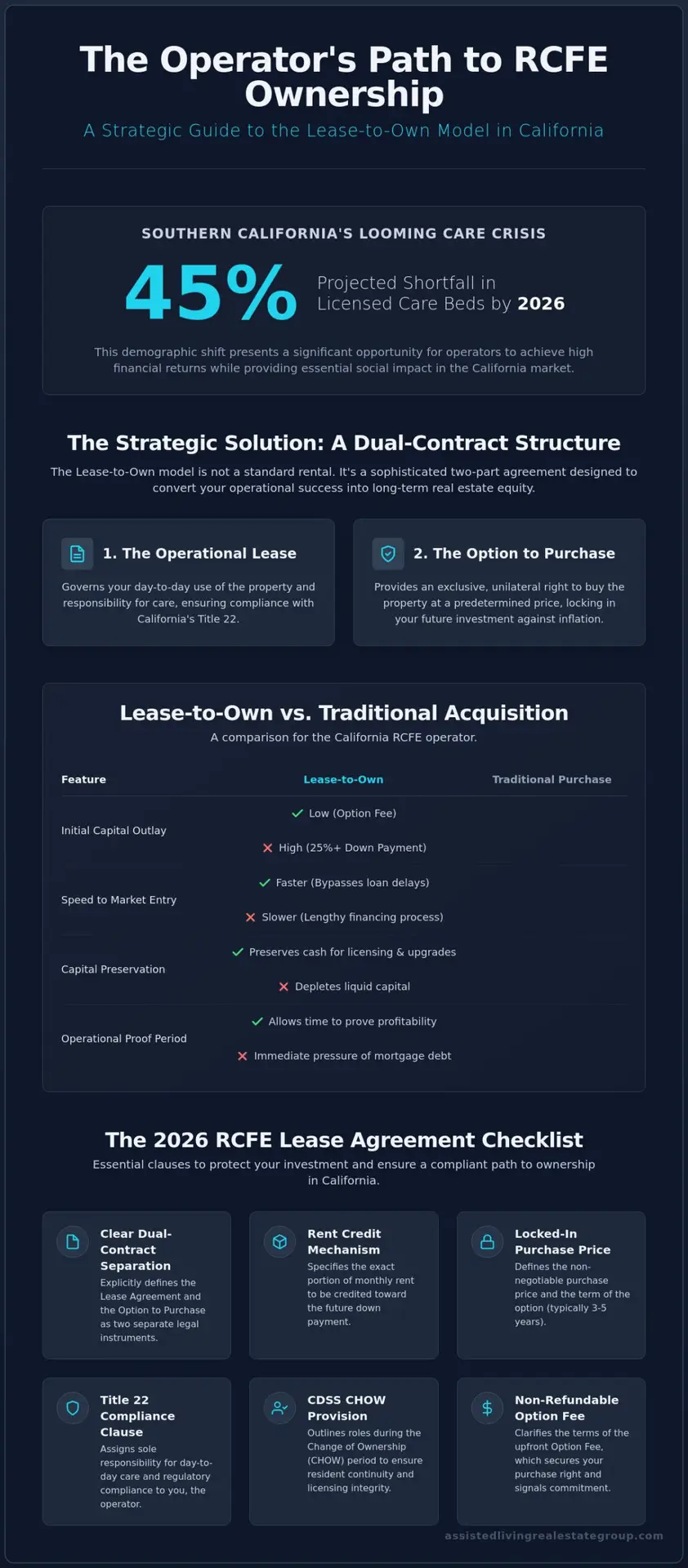
The 2026 RCFE Lease Agreement Checklist: Essential Clauses
Securing a high-performing facility in Southern California often requires looking beyond public listings. Specialized RCFE brokers provide access to off-market opportunities where sellers prefer a confidential transition over a public sale. Once a potential site is identified, your RCFE lease agreement checklist must guide your due diligence to ensure the business is as healthy as the real estate. This process involves a deep dive into the facility’s compliance history with the California Department of Social Services (CDSS), verifying that no outstanding citations or recurring Title 22 violations threaten the future license transfer.
Negotiating the lease-option requires precision. You must establish a fixed purchase price and define exactly how much of your monthly rent will be credited toward your down payment. These rent credits are the engine of your equity growth. Additionally, the agreement should include a Right of First Refusal (ROFR). This clause ensures that if the landlord receives a third party offer, you have the priority to match it and secure the property. Clear purchase option triggers, such as the successful completion of a 3 month operating fund verification, should be explicitly documented to prevent legal ambiguity. A CDSS-compliant management agreement is the final piece of the structural puzzle. This document allows you to step into the operational role while the Change of Ownership (CHOW) is processed, ensuring the facility’s reputation and resident care remain stable. By integrating these specific triggers into your RCFE lease agreement checklist, you create a methodical, secure transition that honors both your financial goals and the residents’ needs.
Due Diligence: Beyond the Physical Inspection
Analyzing the last 36 months of Profit & Loss statements is non-negotiable. You need to see the reality of the facility’s cash flow, not just a pro-forma projection. In Southern California, zoning encumbrances can vary significantly between municipalities. Checking local ordinances in cities like Fullerton or Laguna Hills ensures your 6-bed facility won’t face unexpected operational restrictions during your lease term. You must verify that the physical plant meets all current fire clearance standards before signing.
Structuring the Agreement for Success
Defining maintenance caps prevents disputes over who pays for what. For instance, if a major HVAC system fails in year two of your lease, the contract should specify a dollar threshold for operator responsibility. Beyond repairs, the agreement must be survivable. It should remain legally binding even in the event of the seller’s death or disability, protecting your long-term path to ownership. For a deeper look at the acquisition process, consult The Ultimate Guide to Buying an RCFE Facility in California.
If you’re ready to secure a strategic foothold in the California care market, contact our specialized brokerage team today to view our current off-market lease-option opportunities.
Partnering with a Specialized California RCFE Broker
Success in the California care industry isn’t just about finding a building; it’s about navigating a regulatory labyrinth with a mentor who knows the terrain. General commercial brokers often stumble over the specific language required in a comprehensive RCFE lease agreement checklist. They treat these facilities like standard office spaces, missing the critical intersection of real estate law and CDSS licensing requirements. This oversight can lead to deals that fail at the 11th hour because the lease didn’t satisfy Title 22 mandates. Partnering with a specialist ensures your contract protects your operational rights and your path to ownership from day one.
Teri Szoke provides more than brokerage services; she offers a strategic mentorship born from 25 years of specialized experience in the California market. This expertise is vital when accessing our exclusive database of Southern California listings. Many of these opportunities are off-market, held in confidence to protect the reputation of the facility and the stability of the residents. By working with a guide who understands the nuances of the “strategic transition,” you gain access to high-barrier-to-entry markets that others simply can’t reach. You aren’t just buying a business; you’re building a long-term portfolio of care facilities through a proven, methodical acquisition model.
The ALREG Advantage: 25 Years of Care Industry Expertise
We bridge the gap between sophisticated financial investment and the moral compass of compassionate care. Our team understands that a 6-bed facility in Fullerton requires a different deal structure than a large assisted living center in Laguna Hills. We customize every lease-option to fit the specific local zoning and market demand of the Southern California landscape. Our confidential marketing strategy is designed to protect your business during the transition, ensuring that staff and residents remain undisturbed while you finalize your RCFE lease agreement checklist and prepare for operational control.
Your Next Steps in the California Care Market
The 2026 market presents a unique window of opportunity for professionals ready to convert demographic shifts into strategic growth. It’s time to move from curiosity to conviction by securing a roadmap tailored to your financial goals. We invite you to take the following steps:
- Schedule a confidential consultation to discuss your 2026 investment objectives.
- Review our current database of exclusive lease-to-own opportunities across Southern California.
- Request a custom valuation to understand the true equity potential of your target facility.
If you’re ready to master the complexities of the California care sector, contact us today to begin your strategic transition toward property ownership and operational excellence.
Mastering Your Strategic Transition to Property Ownership
Mastering the California care market requires a blend of financial precision and regulatory awareness. You’ve learned how a lease-to-own structure serves as a sophisticated bridge to real estate equity, allowing you to bypass the hurdles of traditional lending. By utilizing a refined RCFE lease agreement checklist, you protect your investment from the risks of Title 22 non-compliance and secure a fixed purchase price in an appreciating market. This methodical approach ensures your operational excellence translates into long term wealth.
With over 25 years of specialized RCFE brokerage experience, we provide the expert guidance needed to navigate CDSS licensing and confidential marketing. We understand the high stakes of protecting your business reputation while scaling your portfolio. It’s time to move from the analytical phase to tangible growth.
Explore Exclusive California Lease-to-Own Opportunities
The opportunity to make a lasting social impact while achieving significant financial returns is within your reach. We look forward to helping you build a legacy of care and prosperity in the Golden State.
Frequently Asked Questions
Can I operate an RCFE in California under a lease-to-own agreement?
Yes, you can operate an RCFE under a lease-to-own structure in California. This model is a viable strategy for strategic professionals who want to focus on care while the landlord manages the real estate. It allows you to enter the market with less upfront capital than a traditional purchase. You’ll need to ensure your RCFE lease agreement checklist includes specific operational control clauses required by the CDSS.
What is a typical option fee for a 6-bed care home in Southern California?
Option fees are negotiated privately between the parties involved. There isn’t standardized public data for these rates in the 2026 California market. Typically, the fee is a non-refundable upfront payment that secures your exclusive right to purchase the property later. It signals your commitment to the seller and acts as a significant stake in the future acquisition of the facility.
Do I need a separate license if I am leasing the care home property?
Yes, the operator must hold a valid RCFE license regardless of property ownership. The California Department of Social Services (CDSS) issues the license to the individual or entity responsible for the residents’ care. Even if you’re leasing, you’re the one legally accountable for Title 22 compliance. The property owner doesn’t need a care license unless they’re also the primary operator of the facility.
What happens to my rent credits if I choose not to exercise the purchase option?
Rent credits are typically forfeited if you choose not to exercise your purchase option. These credits are designed as an incentive to help you accumulate a down payment over the lease term. Because they’re part of a private contract, the specific terms of forfeiture should be clearly outlined in your agreement. Losing these credits is a primary risk factor for operators who fail to stabilize the business.
Is the purchase price in a lease-to-own contract negotiable at the end of the term?
The purchase price is generally fixed at the beginning of the lease term. This protects you from California’s rising real estate values and allows you to build equity through operational improvements. While some contracts allow for a future appraisal to determine the price, most savvy investors prefer a predetermined amount. This certainty is a core component of a strategic RCFE lease agreement checklist designed for long term financial gain.
How does the CDSS view lease-option agreements during the licensing process?
The CDSS focuses on operational control and financial stability rather than the specific real estate contract. They require evidence that the operator has at least three months of operating funds and the authority to manage the facility. During the licensing process, you must demonstrate that the lease agreement doesn’t interfere with your ability to meet Title 22 standards. The department views the operator as the legally responsible party.
What are the risks of a lease-to-own care home for the seller?
Sellers face the risk of property mismanagement or license jeopardy if the operator fails to maintain standards. If the facility receives major citations during the lease, the underlying value of the business could decrease. Sellers also risk the opportunity cost of not selling the property outright in a high demand market. They mitigate these risks by vetting operators for experience and requiring substantial non-refundable option fees.
Can I use a lease-to-own model for an Adult Residential Facility (ARF) in California?
Yes, the lease-to-own model is equally applicable to Adult Residential Facilities (ARF) in California. The structural mechanics of the lease and purchase option remain the same as those for an RCFE. You’ll still need to navigate the specific CDSS licensing requirements for ARFs; however, the strategic advantage of converting monthly rent into future equity remains a powerful tool for facility expansion and long term success.