
In the high-stakes California residential care market, your insurance policy isn’t just a monthly line item. It’s the ultimate safeguard for your facility’s valuation and licensing status. You’ve worked hard to build a legacy of compassionate service, yet the constant pressure of rising premiums and the fear of a sudden license revocation can feel like an insurmountable weight. Mastering the specific RCFE insurance requirements California mandates in 2026 is no longer optional for the strategic professional; it’s the foundation of a resilient, high-value business model.
You likely recognize that the line between a profitable investment and a legal liability is thinner than ever in our litigious state. This guide promises to provide the clarity you need to protect your real estate assets and ensure absolute compliance with the Department of Social Services. We will explore the mandatory $1 million per occurrence liability thresholds, the impact of recent Title 22 updates on your risk profile, and the strategic steps required to lower your facility’s risk for a future premium exit. By aligning your coverage with current 2026 standards, you secure both your residents’ safety and your financial future.
Key Takeaways
- Master the mandatory RCFE insurance requirements California enforces under HSC 1569.605, ensuring your facility maintains the essential $1 million per occurrence coverage baseline.
- Understand the critical distinction between professional and general liability to shield your business from both premises-related accidents and care-delivery errors.
- Prepare for the 2026 financial climate by navigating mandatory workers’ compensation limits and the complexities of property insurance in California’s unique risk landscape.
- Learn how a pristine claims history acts as a strategic asset, significantly increasing your facility’s marketability and valuation during a future exit or sale.
- Evaluate the trade-offs between admitted and non-admitted carriers to secure a sophisticated insurance portfolio that balances cost-efficiency with absolute regulatory compliance.
California Mandatory Liability Insurance: Understanding HSC 1569.605
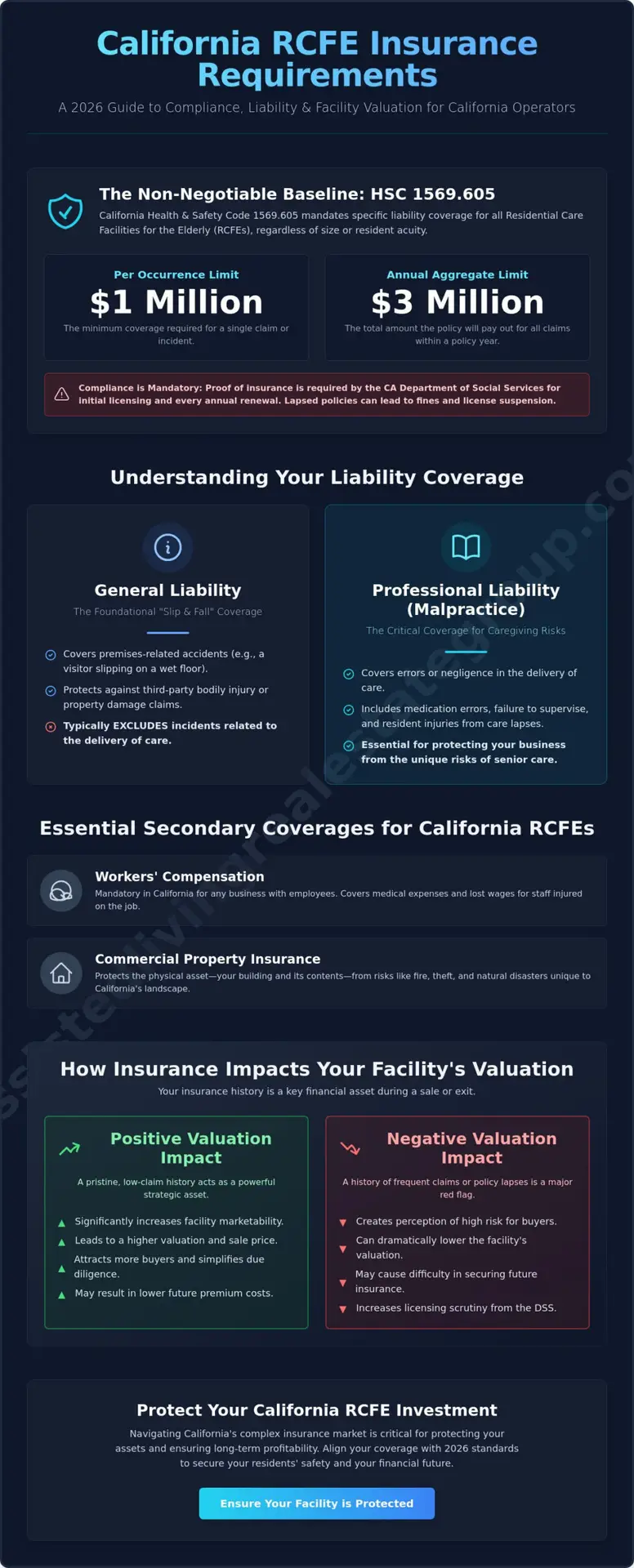
California Health and Safety Code 1569.605 serves as the non-negotiable baseline for liability within the state’s residential care sector. It’s the regulatory floor that ensures every operator maintains a minimum level of financial responsibility. Whether you manage a boutique six-bed home or a sprawling hundred-unit community, this mandate applies universally. It doesn’t matter if your residents are fully ambulatory or require extensive memory care; the law makes no exceptions for bed capacity or resident acuity. Since July 1, 2015, the law has dictated that every facility must maintain a policy with at least $1 million per occurrence and $3 million in the total annual aggregate.
This statutory requirement focuses on protecting residents from injuries caused by the negligence or professional malpractice of the licensee and their employees. For the sophisticated investor, understanding Assisted Living standards and the RCFE insurance requirements California mandates is about more than just checking a box. It’s about protecting the business entity and the real estate from catastrophic legal claims. Verification of this coverage isn’t a one-time event. The California Department of Social Services (DSS) requires proof of insurance for your initial licensing application and every subsequent annual renewal. Without it, your ability to operate ceases immediately.
The Statutory Mandate for RCFE Operators
The legislative intent behind the 2015 insurance mandate was to create a more stable and accountable care environment across the state. Before this law, many facilities operated with inadequate coverage, leaving both residents and owners exposed to financial ruin. Today, the DSS monitors compliance with rigorous scrutiny. If your policy lapses, the penalties are swift and severe. You face immediate administrative citations, heavy daily fines, and the potential for a summary suspension of your license. In the eyes of the state, an uninsured facility is an unsafe facility. HSC 1569.605 is the cornerstone of RCFE risk management in California.
Who Must Be Covered Under the Policy?
A compliant policy must extend protection far beyond the business entity itself. It’s vital that the licensee, administrators, and all staff members are included under the blanket of coverage. In our litigious California environment, a plaintiff’s attorney will often target every individual involved in a resident’s care. You also need to address the role of independent contractors. If you bring in third-party physical therapists or specialized clinicians, your policy should clearly define how their actions affect your liability. Don’t assume their personal insurance shields your facility. Ensuring your RCFE insurance requirements California policy covers all personnel is a strategic necessity for long-term asset protection.
Professional vs. General Liability: The $1 Million Standard
In California’s complex senior care market, a standard commercial general liability policy is simply the baseline. While general liability covers the “slip and fall” incidents common to any physical location, it often excludes the very thing that defines your business: the delivery of care. This is where professional liability, often called malpractice insurance, becomes essential. According to the California Department of Aging, RCFEs provide a specific range of non-medical care that involves significant human interaction and oversight. If a resident suffers a medication error or an injury due to a lack of supervision, a standard business policy will leave you exposed. You must ensure your coverage specifically addresses the unique risks inherent in caregiving.
The $1 million per occurrence minimum is the non-negotiable California standard that every operator must meet to remain in good standing. This isn’t just a recommendation from your broker; it’s a regulatory mandate that shields your business entity from the high costs of litigation in a state known for significant jury awards. Beyond the per-claim limit, the $3 million annual aggregate limit is required for most licensed care facilities. This aggregate acts as a financial reservoir for the entire policy year. For those pursuing Turnkey Business Acquisitions, verifying that the current policy meets these specific RCFE insurance requirements California standards is a critical component of professional due diligence.
Distinguishing Professional Malpractice from General Liability
DSS inspectors prioritize professional liability because it directly impacts resident welfare. Scenarios like “failure to supervise” or resident elopement aren’t just operational failures; they’re professional negligence. If a resident with cognitive decline wanders off-site because a door alarm was ignored, that is a professional liability claim. These care-related incidents are the primary drivers of litigation in California. A standard policy might cover a visitor tripping on a rug, but it won’t protect you when a resident’s family alleges neglect. Professional liability is the primary focus of every regulatory audit and legal challenge.
Policy Limits and Aggregate Thresholds
The “per occurrence” limit refers to the maximum amount an insurer will pay for a single claim. In contrast, the “aggregate” limit is the total amount available during the policy year across all claims. While the $1 million per occurrence is the legal minimum, sophisticated institutional buyers looking at facilities with 30 or more beds often demand higher limits. This increased coverage makes the facility more marketable and lowers the risk profile for future investors. A $1M/$3M policy is the industry benchmark for California RCFE compliance. Aligning your coverage with these thresholds ensures you are prepared for both regulatory scrutiny and the financial realities of the California market.
Essential Secondary Coverages: Protecting the Asset and the Team
Protecting your RCFE investment requires looking beyond the mandatory liability thresholds. While the California Health and Safety Code 1569.605 sets the baseline for resident protection, secondary coverages are what truly insulate your business entity from operational volatility. In 2026, the California insurance market is increasingly complex. Wildfire risks and rising labor costs mean that a “one size fits all” policy is often a recipe for financial exposure. You need a sophisticated suite of protections that address the physical asset, your employees, and the specific risks inherent in senior care.
Workers’ Compensation in the Care Environment
Caregiving is physically demanding work. Your staff frequently engages in resident transfers, heavy lifting, and repetitive motions that lead to high injury rates. In California, workers’ compensation isn’t just a best practice; it’s mandatory for every employer. For 2026, the minimum Temporary Total Disability (TTD) rate is $264.61 per week, with a maximum of $1,764.11. Operating without this coverage is a major risk. California imposes severe penalties on “uninsured” RCFE employers, including stop-work orders and significant fines. Understanding these labor-related costs is a vital part of your financial modeling, as detailed in our Ultimate Guide to Buying an RCFE Facility in California. With a proposed 10.4% rate increase pending for late 2026, proactive risk management is essential to keep premiums manageable.
Property Insurance and Real Estate Protection
The facility itself is often your largest capital investment. While the state doesn’t mandate property insurance, your lender or landlord certainly will. When evaluating policies, always prioritize “Replacement Cost” over “Actual Cash Value.” In a high-inflation environment, Actual Cash Value often leaves you underinsured after a loss because it subtracts depreciation. This distinction directly impacts your facility’s valuation during a sale. Sophisticated buyers want to see that the real estate is fully protected against California-specific perils like wildfires or seismic activity. The California FAIR Plan reached a record 668,600 policies in late 2025, highlighting how difficult it has become to find traditional coverage in high-risk zones. Securing robust property insurance ensures your RCFE insurance requirements California strategy covers both the business and the bricks-and-mortar.
Abuse and Employment Liability
Two often-overlooked riders are Abuse and Molestation coverage and Employment Practices Liability Insurance (EPLI). Abuse coverage is critical because standard professional liability policies may exclude intentional acts. In the senior care sector, this protection is a requirement for any institutional-grade operation. Similarly, EPLI protects you from wrongful termination or harassment claims. Given California’s employee-friendly legal climate, an EPLI policy is a strategic necessity for maintaining a clean operational record and protecting your profit margins. These secondary layers transform a basic policy into a comprehensive asset protection plan.
The Broker’s Perspective: How Insurance Impacts Facility Valuation
Insurance is often viewed as a defensive necessity, but in the context of a sale, it becomes a primary indicator of operational excellence. Sophisticated buyers don’t just look at financial statements; they scrutinize the risk profile. If you’ve maintained strict adherence to RCFE insurance requirements California mandates, you’ve essentially pre-vetted your business for a high-value exit. A history of frequent claims or inadequate coverage suggests deeper systemic issues in management. This can lead to significant price reductions or even the collapse of a deal during escrow. In our experience, insurance is the silent partner in your facility’s valuation.
Your insurance portfolio reflects your facility’s “Standard of Care” and operational maturity. Visionary investors seek out facilities that demonstrate a proactive approach to risk. They want to see that you haven’t just met the bare minimums but have built a robust shield around your assets. This attention to detail signals that the business is a stable, turnkey opportunity rather than a high-risk gamble. When you’re ready to maximize your return, consider how RCFE Sales strategies leverage your clean record to attract premium offers.
Insurance Records and Due Diligence
A “Loss Run Report” is a formalized document from your carrier detailing every claim filed against your policy over the last three to five years. For a buyer, this is a transparency tool. Clean loss runs demonstrate a superior standard of care and effective risk mitigation. Conversely, a checkered history signals to institutional investors that your facility might be a liability waiting to happen. As you prepare to Sell Your Adult Residential Facility in California, gathering these records is a non-negotiable step in your exit strategy. Inadequate insurance is a common “deal killer” that can be avoided with proper planning.
Securing Coverage for a New Acquisition
Acquiring an RCFE involves a complex dance between the buyer, the seller, and the California DSS. You can’t simply inherit the seller’s policy; you must secure your own. Lenders providing capital for RCFE real estate loans will demand proof of insurance before a single dollar is funded. This process must start early because underwriters in 2026 are increasingly selective. A specialized broker who understands the senior living niche is vital here. They can identify facilities with “insurable” track records and navigate the timeline of the licensing transfer period to ensure coverage is active the moment you take ownership. This ensures a seamless transition and protects your new investment from day one.
Navigating the California Insurance Market for Senior Care
The 2026 California insurance market is a landscape defined by selectivity. As admitted carriers recalibrate their risk appetite due to wildfire exposure and “acuity drift” concerns, many operators find themselves pushed toward the surplus lines market. Securing a policy that meets the RCFE insurance requirements California mandates requires more than a simple quote comparison. It demands a partnership with an agent who understands the nuanced intersections of Title 22 compliance and institutional risk management. You shouldn’t settle for a generalist when your facility’s valuation is on the line.
Managing your premiums in this environment is a strategic exercise in operational discipline. Insurance carriers aren’t just looking at your bed count; they’re analyzing your staff retention, your dementia care protocols, and your documentation accuracy. Facilities that demonstrate a commitment to refined service and rigorous safety protocols often secure more favorable terms. Preparing for an insurance audit or a site inspection should be treated with the same level of gravity as a DSS inspection. These moments are your opportunity to prove that your facility is a low-risk, high-performing asset.
Evaluating Specialized Carriers
An “admitted” carrier is one that is formally approved by the California Department of Insurance and backed by the California Insurance Guarantee Association (CIGA). This provides a safety net if the insurer becomes insolvent. However, because the senior care market is specialized, many comprehensive policies are only available through “non-admitted” or surplus lines carriers. While these don’t have CIGA backing, they offer the tailored coverage necessary for facilities in high-risk wildfire zones or those offering specialized memory care. When interviewing an agent, ask about their experience with “Social Services” niches and their track record with California RCFE claims. A specialized broker is your most valuable ally in this niche market.
Next Steps for California Investors
Your first priority is a comprehensive review of your current policy against the 2026 regulatory standards. Ensure your liability limits, workers’ compensation tiers, and property replacement costs reflect current market realities. If you’re positioning your facility for a future sale, your insurance portfolio must be as clean as your financial statements. A disorganized insurance history is a red flag for institutional buyers. To ensure your business remains market-ready and fully protected, Consult with Assisted Living Real Estate Group for expert guidance on California facility sales and licensing. We help you bridge the gap between regulatory compliance and significant financial returns.
Securing Your Legacy in the California Care Market
Mastering the RCFE insurance requirements California mandates is more than a regulatory box to check; it’s a strategic maneuver to solidify your facility’s market position. You’ve seen how maintaining the $1 million per occurrence liability threshold and a pristine claims history serve as the pillars of asset protection. These elements transform a standard care home into a premium, institutional-grade investment that attracts sophisticated buyers. By aligning your coverage with 2026 standards, you’re not just staying compliant; you’re actively de-risking your future exit.
Whether you’re preparing for a high-value sale or seeking your next turnkey acquisition, your roadmap requires seasoned expertise. Our team brings over 25 years of specialized care facility experience and a confidential marketing strategy to every high-value transaction. We invite you to View Current California RCFE Listings and Investment Opportunities and leverage our California-wide brokerage expertise. Your commitment to operational excellence today ensures a prosperous and impactful legacy for years to come.
Frequently Asked Questions
Is liability insurance really mandatory for a 6-bed RCFE in California?
Yes, liability insurance is mandatory for every licensed facility in the state, including 6-bed residential homes. California Health and Safety Code 1569.605 makes no exceptions for small-scale operations. You must maintain the $1 million per occurrence and $3 million aggregate minimums to remain in good standing with the Department of Social Services.
What happens if my RCFE insurance policy lapses?
A policy lapse triggers immediate regulatory action from the California DSS. You’ll likely face administrative citations and heavy daily fines. In severe cases, the state may issue a summary suspension of your license, which forces you to cease operations until proof of valid coverage is provided.
Does California Title 22 specify insurance requirements?
Yes, Title 22 regulations mandate that facilities comply with all statutory RCFE insurance requirements California law establishes. Inspectors use these regulations to verify your policy limits during annual reviews or unannounced visits. Failing to meet these standards is a direct violation of your licensing agreement and can jeopardize your business standing.
How much does RCFE insurance typically cost in California?
Costs vary significantly based on your facility’s location, resident acuity, and claims history. While general commercial property insurance for small California businesses can average around $125 per month for basic coverage, RCFE premiums are typically higher due to professional liability risks. Properties in wildfire-exposed areas often see significantly higher rates, sometimes ranging from $10,000 to $25,000 per $1 million of insured value.
Can I use a standard homeowners insurance policy for a residential care home?
You cannot use a standard homeowners policy for a residential care business. Homeowners insurance specifically excludes commercial caregiving activities and professional liability. Operating under a residential policy leaves your real estate and business entity completely exposed to catastrophic financial loss and regulatory penalties.
What is an “Additional Insured” and why do California landlords require it?
An “Additional Insured” endorsement extends your liability protection to another party, such as a landlord or property owner. California landlords require this to ensure they aren’t held financially responsible for incidents occurring within your care operation. It’s a standard requirement for most commercial leases to protect the property owner’s assets.
Do I need separate insurance for an Adult Residential Facility (ARF)?
Yes, Adult Residential Facilities require policies tailored to their specific resident demographic. While the $1M/$3M limits are often the benchmark, the professional liability risks for ARFs differ from RCFEs. This is because they serve adults with developmental disabilities or mental health needs rather than the elderly, requiring different underwriting expertise.
What are “Loss Runs” and why do they matter for my facility sale?
Loss runs are formalized reports from your insurance carrier that document your claims history over a specific period. They are vital during a facility sale because they prove your operational maturity to potential buyers. A clean loss run report directly increases your business valuation by demonstrating a low risk profile to institutional investors.