
On a Tuesday in November 2024, a veteran owner in Orange County watched a $3.1 million deal evaporate because of a single Title 22 documentation gap that surfaced during the buyer’s final walkthrough. You’ve spent years balancing impact and income, yet the fear of a premature leak to staff or the complexity of California’s regulatory web can make the exit process feel like a high-stakes gamble. It’s a common anxiety among those who have built boutique care environments and now seek to realize their hard-earned equity without compromising their resident legacy.
We understand that your facility is more than just a real estate asset; it’s a pillar of the community. This comprehensive preparing your RCFE for sale checklist is designed to remove the guesswork and maximize your ROI as we move into the 2026 market. You’ll learn exactly how to position your business for a top-dollar valuation while ensuring a seamless, confidential transition that respects the “Silver Tsunami” opportunity. We’ll guide you through every critical step, from auditing your financial statements to securing a buyer who values your specific model of compassionate care as much as you do.
Key Takeaways
- Capitalize on the “Silver Tsunami” by initiating your exit strategy 12-24 months early to capture a premium valuation in the competitive 2026 Southern California market.
- Audit your financial records and calculate a “True” Cap Rate that proves your boutique facility’s ROI to investors, even in a shifting interest rate environment.
- Use our preparing your RCFE for sale checklist to conduct a “Mock LPA Inspection,” ensuring your facility exceeds California Title 22 standards before hitting the market.
- Master the art of confidential marketing with “Blind Profiles” that protect your care legacy and resident peace of mind while attracting high-level strategic partners.
- Streamline the complex “Change of Ownership” (CHOW) and dual-escrow process to ensure a successful business transfer and real estate closing.
Preparing Your Southern California RCFE for a Premium Sale
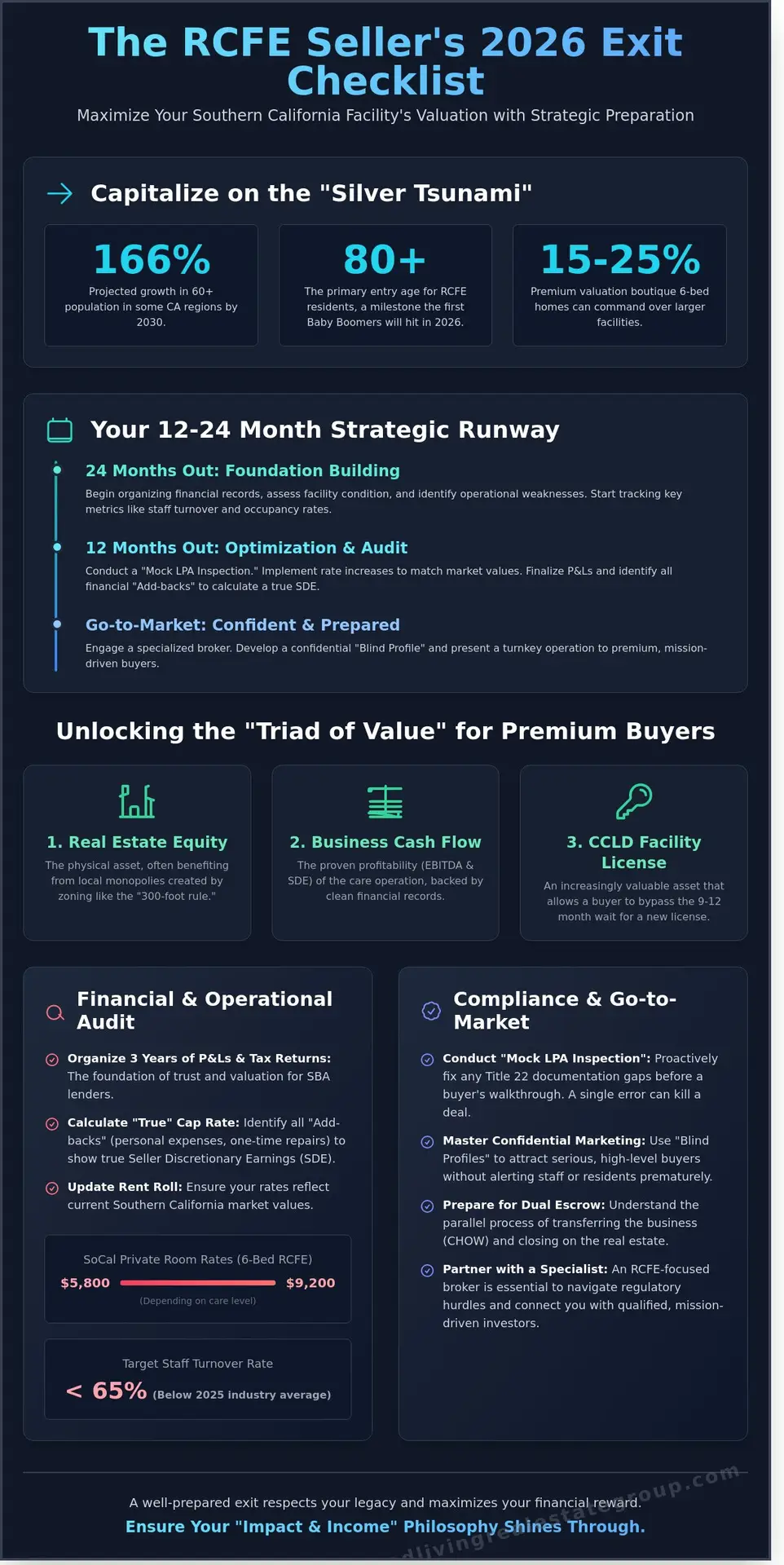
The “Silver Tsunami” isn’t a distant forecast; it’s a 2026 reality. By that year, the first wave of Baby Boomers will cross the age 80 threshold, the primary entry point for Residential Care Facilities for the Elderly (RCFE). In California, the Department of Aging projects the 60+ population to grow by 166% in some regions by 2030. This demographic shift creates a “blue ocean” for owners, but a premium exit isn’t guaranteed by market demand alone. Success requires a strategic runway. You must begin your preparing your RCFE for sale checklist at least 12 to 24 months before the listing date to maximize your valuation.
Premium buyers look for a “triad of value” that distinguishes a boutique home from a struggling facility. This triad consists of the real estate equity, the operational business cash flow (EBITDA), and the facility license issued by the Community Care Licensing Division (CCLD). While institutional giants struggle with high turnover and impersonal care, your boutique RAL (Residential Assisted Living) facility offers the intimacy families crave. Positioning your 6-bed home as a high-end alternative to 100-bed facilities allows you to command a higher price per bed, often exceeding market averages by 15% to 25%.
Understanding the Southern California Market Landscape
Southern California is a patchwork of micro-markets with distinct regulatory hurdles. In the San Fernando Valley, high barriers to entry make existing licenses incredibly valuable. Meanwhile, in areas like San Jacinto, you must navigate California Health and Safety Code 1520.5, the “300-foot rule” regarding over-concentration. Because the state limits how many facilities can exist on a single block, your existing 6-bed home often holds a localized monopoly. This scarcity turns your property into a protected asset for savvy investors who want to avoid the 9 to 12-month wait for a new license.
The “Impact and Income” Philosophy of Selling
Selling your RCFE represents the culmination of years of service. We believe in the “Impact and Income” philosophy; your financial reward should mirror the quality of life you’ve provided. A well-documented history of care compliance and staff retention ensures your legacy continues under new ownership. Mission-driven buyers are currently paying premiums for turnkey operations that allow them to “do good while doing well” from day one. By preparing your RCFE for sale checklist with a focus on operational excellence, you attract buyers who value resident dignity as much as the cap rate.
The Financial & Operational Audit: Proving Your Facility’s ROI
Numbers are the language of trust in the Residential Assisted Living market. To maximize your exit, your financial house must be spotless. Organizing three years of clean P&L statements and tax returns isn’t just a chore; it’s the foundation of your valuation. In the 2026 California interest rate environment, buyers are scrutinizing the “True” Cap Rate more than ever. They want to see that your boutique facility remains profitable even if debt service costs rise. A current Rent Roll is vital. Southern California rates for a private room in a 6-bed RCFE currently range from $5,800 to $9,200 depending on the care level. If your rates are stuck in 2022, you’re leaving money on the table. This audit is the most demanding part of any preparing your RCFE for sale checklist.
Transparency sells. Document your staffing ratios and payroll records clearly. California’s Title 22 regulations are strict, and savvy investors will check your records against your reported income. Proving you have a stable team with a turnover rate below the 2025 industry average of 65% reduces the buyer’s perceived risk. High-level investors aren’t just buying a building; they’re buying a predictable cash flow machine. If you’re unsure where to start, our team can help you evaluate your current operations to ensure no profit is left behind.
Maximizing Your Valuation Through Financial Clarity
Investors focus on Seller Discretionary Earnings (SDE). You must identify “Add-backs” to reveal the true profitability of the care business. These include personal vehicle expenses, one-time facility repairs, or health insurance premiums you’ve run through the business. Most Southern California buyers utilize SBA 7(a) financing. These lenders require intense documentation. If your P&Ls don’t match your tax returns, the deal will die in underwriting. Professional clarity transforms a “mom and pop” care home into a high-value investment asset.
Occupancy and Revenue Management
Consistent 95% occupancy proves your facility is a “blue ocean” opportunity. You must document your resident mix with precision. While California’s Assisted Living Waiver (ALW) provides steady income, a high “Private Pay” ratio usually commands a higher sales price in markets like Orange County or San Diego. Buyers want to see a history of annual rate increases that keep pace with California’s rising labor costs. It’s essential to learn how to value an assisted living facility before you set your asking price. Proving your revenue is sustainable is the only way to secure a premium multiple in this competitive landscape.
Compliance & Physical Assets: Meeting California Title 22 Standards
Title 22 compliance is the bedrock of RCFE business value.
Investors in the Southern California market don’t just buy real estate; they buy a legacy of regulatory excellence. A single “Type A” deficiency can slash your valuation by 15% overnight. To protect your “Impact and Income” potential, start by conducting a “Mock LPA Inspection.” This internal audit should mirror the rigor of a California Department of Social Services (DSS) evaluator, focusing specifically on Title 22, Division 6, Chapter 8. You must identify every hairline fracture in your compliance before a buyer’s due diligence team finds them. This proactive step is the most critical item on your preparing your RCFE for sale checklist.
Updating your Facility Sketch (LIC 999) and Emergency Disaster Plan (LIC 610E) to meet 2026 standards is essential. California’s recent legislative shifts require more robust evacuation protocols and climate-resiliency plans. Buyers seek a “Boutique” environment that is both aesthetically pleasing and operationally sound. Physical improvements that yield the highest ROI include:
- Installing ADA-compliant, non-slip luxury vinyl plank flooring to reduce fall risks and modernize the interior.
- Servicing or replacing HVAC systems to meet the latest California energy efficiency codes, ensuring resident comfort during heatwaves.
- Refreshing exterior landscaping with drought-tolerant, high-end “curb appeal” features that signal a premium care environment.
The Regulatory Readiness Checklist
Verify your current fire clearance through the Office of the State Fire Marshal (OSFM). If your facility has undergone structural changes without an updated LIC 205, your sale will stall at the finish line. Address deferred maintenance immediately. A roof with less than five years of life or outdated electrical panels will lead to heavy credit requests during escrow. Securing an “A” rating from the DSS is non-negotiable for a premium sale; it proves your facility is a low-risk, high-reward asset in a competitive market.
Standardizing Your Operations
Documentation is the bridge between a chaotic facility and a profitable enterprise. You must organize all resident files and personnel records to be audit-ready, focusing on physician reports (LIC 602A) and appraisal tools. Ensure the Administrator’s certificate is current, as California requires 40 hours of continuing education every two years under LIC 9214 regulations. Create a comprehensive binder of Standard Operating Procedures (SOPs). This manual acts as the roadmap for the new owner, ensuring a seamless transition and preserving the “Boutique” quality of care that justifies your premium cap rate. Completing this preparing your RCFE for sale checklist ensures your business stands out as a turnkey opportunity for savvy investors.
The Confidential Marketing Strategy: Protecting Your Care Legacy
A public listing is the fastest way to devalue your California care home. When a facility appears on general real estate sites like Zillow or LoopNet, it triggers immediate anxiety for families and employees. This instability often leads to “census bleed,” where residents move out to avoid the uncertainty of new ownership. Maintaining a high occupancy rate is a vital part of your preparing your RCFE for sale checklist. We use a “Blind Profile” to market your asset effectively. This document highlights your 12% cap rate or your luxury renovations in Southern California without revealing the street address. It allows us to attract high-net-worth investors while keeping your daily operations quiet and stable.
Before any sensitive data is shared, every prospect must sign a binding Non-Disclosure Agreement (NDA). We don’t just hand over profit and loss statements to anyone who asks. We demand proof of funds, typically 25% of the purchase price in liquid capital, and a thorough review of their care experience. This vetting process ensures we only deal with serious “Impact and Income” seekers who understand the California regulatory environment. It protects your staff from unnecessary stress and keeps your proprietary care models confidential until a legitimate offer is on the table.
Managing the Human Element During a Sale
Timing is everything when you’re exiting the RAL space. You shouldn’t announce the sale to your team until the buyer’s financing is secured and the due diligence period is nearly closed. Protecting resident stability prevents “Move-outs” that could tank your valuation mid-escrow. Discover the value of confidential marketing to see how we maintain this delicate balance. Keeping the transition quiet ensures your 24/7 care remains the priority while you finalize the preparing your RCFE for sale checklist.
Leveraging Specialized Brokerage Networks
General commercial brokers often miss the nuances of California’s Title 22 requirements. They don’t have the network to find boutique buyers in specific markets like Thousand Oaks or Carson. Our expert guide model focuses on finding investors who value the legacy you’ve built. We navigate the complex licensing transition, ensuring the new owner is prepared for the 60 to 90 day CHOW process required by the state. This specialized approach ensures your boutique environment continues to thrive under new leadership while you capture the maximum ROI on your investment.
Executing the Sale: Why a Specialized RCFE Broker is Essential
The final stage of your exit strategy requires more than a standard real estate agent; it demands a strategic partner who understands the high-stakes intersection of California healthcare law and commercial property. While your preparing your RCFE for sale checklist likely focused on physical upgrades and financial audits, the execution phase centers on regulatory precision. Closing a Southern California care home involves a sophisticated dual-escrow process where the real estate transaction and the business transfer move on parallel tracks. Without a specialized broker, these tracks often collide, leading to collapsed deals or significant tax liabilities.
The Complexity of the California CHOW Process
In California, you don’t simply “transfer” a license. The Department of Social Services (DSS) requires a formal Change of Ownership (CHOW) application from the buyer. This process is notoriously rigorous. We coordinate directly with the Community Care Licensing Division to ensure the buyer’s application aligns with the facility’s current standing. Licensing delays are the most common reason for closing extensions, often pushing timelines back by 120 days or more if the initial paperwork contains errors. We mitigate this by pre-vetting buyers for their operational experience and financial liquidity before they ever step foot in your facility. You must remember that the sale is not final until the state approves the buyer’s application.
Partnering with Assisted Living Real Estate Group
We view the “Silver Tsunami” of aging demographics as a blue ocean opportunity for those who prioritize excellence. With 25 years of California care experience, we’ve refined a roadmap that protects your legacy while maximizing your ROI. Our team focuses on “Boutique” environments because they command higher cap rates and attract premium buyers who value quality of life as much as cash flow. We operate under a strict “Impact and Income” commitment; we ensure your transition is profitable and that the residents you’ve served continue to receive exceptional care.
Our specialized approach manages the post-sale consulting period, typically ranging from 30 to 90 days, where you train the new owner on your specific RAL operational nuances. This handoff is critical for resident retention and staff stability. If you’re ready to move from the daily grind of operations to a well-funded retirement, it’s time to see what your hard work is worth in today’s aggressive market. Get a Confidential Valuation for Your CA Care Home.
Success in this niche market isn’t accidental. It’s the result of following a rigorous preparing your RCFE for sale checklist and having the right guide to navigate the final mile. We handle the granular details of the dual escrow and the DSS hurdles so you can focus on your next chapter with total peace of mind.
Cement Your Legacy in California’s Boutique Care Market
Success in the 2026 California market requires more than a simple listing. It demands rigorous alignment with Title 22 compliance standards and a transparent financial audit that proves your facility’s ROI to sophisticated investors. By following this preparing your RCFE for sale checklist, you’re not just selling real estate; you’re transitioning a vital community asset. You’ve spent years building a reputation for quality care. Now it’s time to capture the full value of that dedication through a strategic, confidential exit that protects your residents and your staff.
The Assisted Living Real Estate Group brings 25+ years of combined industry experience to your boardroom. We specialize exclusively in the California RCFE and ARF sectors, utilizing a proprietary confidential marketing system to ensure your transition remains private until the deal is done. We understand the “Impact and Income” philosophy that drives this industry. Let us help you navigate the complexities of state licensing and boutique valuation to ensure you receive the premium return your hard work deserves.
Secure Your Confidential RCFE Valuation Today
Your next chapter starts with a clear understanding of your facility’s true worth in today’s competitive landscape.
Frequently Asked Questions
How long does it typically take to sell an RCFE in California?
Selling a California RCFE typically takes between 180 and 365 days from the initial listing to the final close of escrow. This timeline accounts for the 60 to 90 days required for the California Department of Social Services (CDSS) to process a Change of Ownership application. You’ll spend the first 30 days preparing your RCFE for sale checklist to ensure financial records are audit ready. The remaining months focus on buyer vetting and securing financing.
Can I sell my RCFE business without selling the real estate?
You can certainly sell the RCFE business operations while retaining ownership of the physical real estate. This strategy allows you to transition into a landlord role, securing a long-term triple net lease that provides steady passive income without daily operational headaches. We see this frequently in Southern California where property values in cities like Irvine or Pasadena exceed $1.5 million. It’s a powerful way to maintain your legacy and achieve Impact and Income.
What is the most important factor in determining an RCFE valuation?
The most critical factor in determining your RCFE valuation is your trailing 12 month Net Operating Income (NOI). Investors in the California market apply a capitalization rate, usually between 8% and 12% for boutique facilities, to this figure to establish a fair market price. While quality care is vital, buyers prioritize a clear Impact and Income ratio. A facility with a consistent 95% occupancy rate and documented private pay revenue will always command a premium price.
Will my residents have to move out if I sell the facility?
Residents don’t have to move out when you sell your facility. California Title 22 regulations require a specific notification process, usually a 60 day written notice, but the goal is always a seamless transition of care. Maintaining a stable resident base is essential for the buyer’s return on investment. If you’re following a preparing your RCFE for sale checklist, you’ll ensure all resident files are compliant with licensing standards to prevent any disruption in their boutique living experience.
Do I need to be a licensed administrator to sell my RCFE?
You don’t need to hold a current California RCFE Administrator Certificate to sell your business. As the owner, you’re the equity holder, not necessarily the operator. However, the buyer must prove to the CDSS that they have a licensed administrator ready to take over on day one. Most Southern California transactions involve owners who have transitioned into a strategic role, leaving the day to day management to a 15 year veteran administrator while they focus on growth.
What happens to the RCFE license during a change of ownership (CHOW)?
During a Change of Ownership, the seller’s license remains active until the CDSS issues a new license to the buyer. This ensures there’s no gap in care for the seniors residing in your home. The buyer must submit a comprehensive application package to the Centralized Applications Bureau in Sacramento at least 90 days before the projected close. We call this the interim period where both parties must cooperate closely to maintain the boutique standards of the RAL environment.
Is 2026 a good year to sell a senior care facility in Southern California?
2026 represents a blue ocean opportunity for sellers as the first wave of Baby Boomers reaches the age of 80. In California, the population of seniors over 65 is projected to grow by 2.1 million by 2030. This demographic shift creates an urgent demand for boutique residential assisted living spaces. Selling in 2026 allows you to capitalize on peak demand before the market becomes saturated with institutional competitors. It’s the perfect window to maximize your returns.
How do I keep the sale confidential from my employees?
Maintaining confidentiality requires a strict protocol involving Non Disclosure Agreements for all potential suitors. You shouldn’t announce the sale to your 10 or 12 employees until the buyer’s financing is fully committed and the licensing application is in its final stages. Conduct facility tours after hours or on weekends to avoid suspicion. This discretion protects your staff retention rates and ensures your residents feel secure in their boutique home environment throughout the entire transition process.