
By 2040, California’s assisted living resident population is expected to more than double, transforming your RCFE from a local care home into a high-stakes investment asset. You’ve worked tirelessly to build a boutique environment that prioritizes resident dignity, yet 2026 market data suggests that many owners leave up to 20% of their potential exit value on the table due to poor deal structuring. Successfully negotiating the sale of an assisted living facility in Southern California requires more than a high cap rate; it demands a strategic balance between financial ROI and strict Title 22 compliance. We understand the anxiety of managing a $2,000 organizational change fee or the fear of staff turnover during a sensitive licensing transfer.
You want a clean exit that honors your legacy without compromising care standards. This guide provides the professional roadmap you need to master RCFE negotiations, protect your staff, and find a buyer who respects your boutique model. We’ll explore how to leverage current market demand to secure your maximum Impact and Income while navigating the complexities of CDSS transfer timelines with seasoned expertise.
Key Takeaways
- Learn how to justify a premium cap rate by auditing three years of financial records and highlighting boutique differentiators like specialized memory care.
- Master the tactical art of negotiating the sale of an assisted living facility by using “Stalking Horse” bids to create competitive urgency among qualified investors.
- Navigate the complexities of California deal structures, including the strategic use of Management Agreements while awaiting CDSS license approval.
- Protect your staff and resident base with a strict “Blind Listing” strategy that ensures operational continuity until a non-refundable deposit is secured.
- Discover why partnering with a specialized niche broker is the only way to successfully navigate Title 22 compliance while maximizing your exit value.
Preparing Your Southern California RCFE for a Premium Negotiation
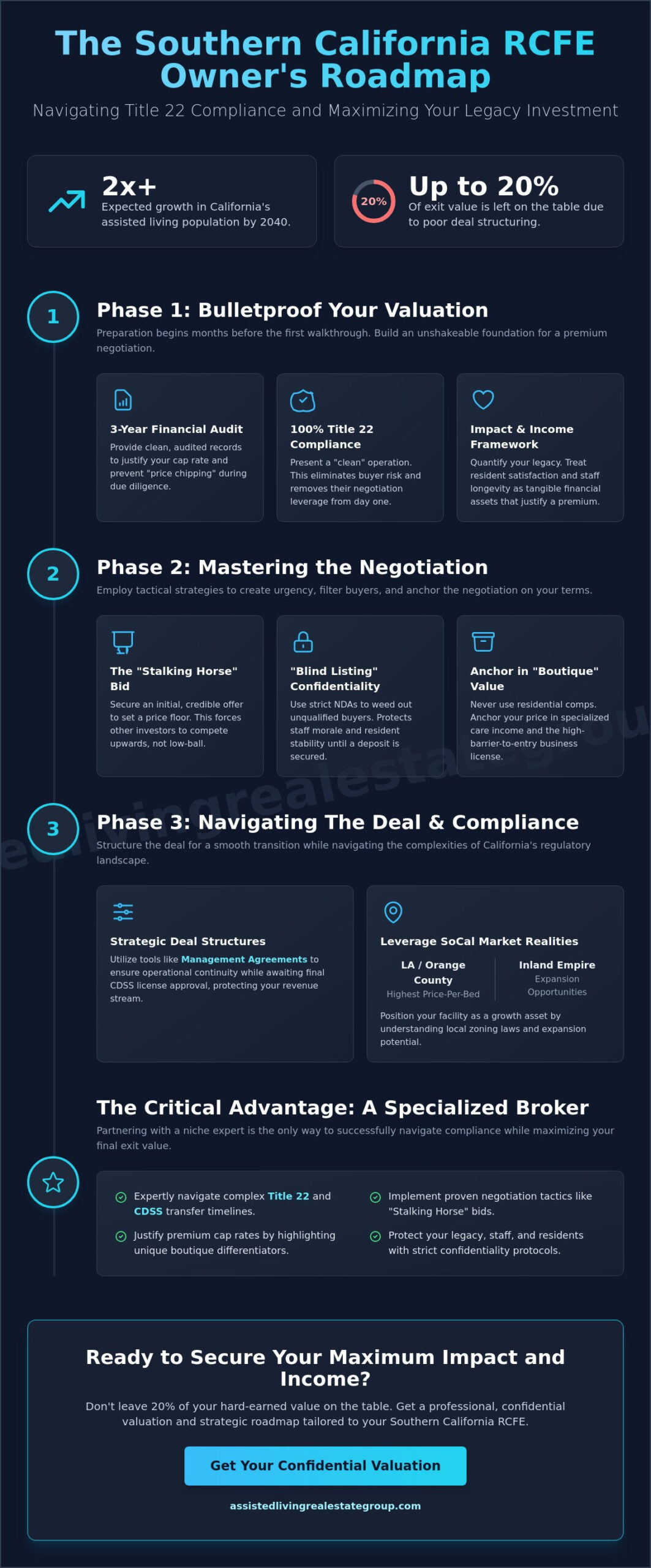
Preparation isn’t just about aesthetic upgrades; it’s about bulletproofing your data. In the high-stakes environment of Southern California, negotiating the sale of an assisted living facility begins months before the first walkthrough. You need three years of clean, audited financial records to justify your cap rate. This transparency stops buyers from “price chipping” during due diligence, where they attempt to claw back value based on financial ambiguity. In a market where senior housing occupancy rates reached 84.4% in late 2023, investors in 2026 are looking for stability and proof of performance.
Compliance is your strongest shield. Ensure your facility is 100% compliant with Title 22 regulations before you hit the market. Any deficiency in resident files, medication logs, or staff training records becomes a negotiation lever for the buyer. When you present a “clean” operation, you eliminate the buyer’s perceived risk, allowing you to hold firm on a premium price point. Remember that organizational changes alone carry a minimum $2,000 application fee in California, so showing a turn-key, compliant operation saves the buyer time and money from day one.
The “Impact and Income” Valuation Framework
Your legacy is more than a building; it’s the reputation you’ve built within the assisted living facility industry. We quantify this through our “Impact and Income” framework, which treats resident satisfaction and staff longevity as tangible financial assets. A high-quality care model justifies a premium multiple because it reduces the buyer’s post-sale churn risk. Boutique care homes outperform institutional facilities in 2026 by offering the intimacy and specialized attention that modern families demand and are willing to pay a premium for.
Southern California Market Realities
Demand varies significantly across the Southland. While Los Angeles and Orange County command the highest price-per-bed, the Inland Empire offers unique opportunities for expansion due to slightly more flexible zoning laws. Navigating these local ordinances is critical. They dictate whether a buyer can increase capacity or add luxury amenities that drive ROI. Understanding these nuances helps you position your property as a growth asset rather than a static one. To get a precise figure on your property’s worth, consult our guide on How to Value Your Assisted Living Business. By identifying your boutique differentiators, such as specialized dementia care or luxury amenities in coastal San Diego, you move from selling a business to selling a premium brand.
Tactical Negotiation Steps for Maximum Sale Value
Negotiating the sale of an assisted living facility in the high-demand Southern California corridor requires a calculated offensive. You aren’t just selling real estate; you’re selling a high-barrier-to-entry business license and a proven care model. One of the most effective ways to drive value is by establishing a “Stalking Horse” bid. By securing an initial, credible offer to set the floor, you create immediate urgency among other Southern California investors. This forces them to compete on your terms rather than low-balling based on general residential metrics.
Confidentiality serves as your most potent filtering tool. By requiring strict non-disclosure agreements before releasing sensitive financials, you weed out “tire-kickers” and focus solely on qualified buyers. This approach protects your staff morale and resident stability while positioning your facility as an exclusive, turnkey “Blue Ocean” opportunity. In a market where the U.S. assisted living industry is projected to exceed $140 billion by 2030, savvy buyers understand that the time to acquire premium California assets is now. If your occupancy is currently trending upward, negotiate a structured “Earn-out” period. This ensures you’re compensated for the future revenue growth you’ve already set in motion.
Anchoring the Price in the “Boutique” Market
Never let a buyer anchor the price using traditional residential comps. Your valuation should be rooted in the specialized care income your boutique RCFE generates. Defend your asking price by emphasizing the rigorous requirements of the California Health and Safety Code, which makes obtaining new licenses a lengthy and expensive ordeal. This scarcity creates a natural premium for existing, compliant facilities. You hold the keys to a niche market, so maintain a position of strength through a confidential marketing strategy that prioritizes quality over quantity.
Leveraging Buyer Psychology
Success depends on understanding whether your buyer seeks an active lifestyle as an owner-operator or the steady ROI of a passive investor. Frame the “Silver Tsunami” not as a looming crisis, but as a guaranteed demand surge that secures their long-term investment. With California’s aging population set to double by 2040, the scarcity of licensed beds in regions like Orange County and San Diego is your greatest closing lever. Use this demographic data to shift the conversation from current cash flow to the next decade of explosive growth.
Navigating Deal Structures and Title 22 Compliance
The structure of your deal is the foundation upon which your financial exit rests. When negotiating the sale of an assisted living facility, the choice between an asset sale and a stock sale dictates your tax liability and future legal exposure. In California, most sophisticated buyers insist on an asset sale. This allows them to step into the operation with a clean slate, leaving behind any historical liabilities associated with your specific corporation. While a stock sale might offer you favorable tax treatment, it’s often a non-starter for buyers wary of California’s litigious environment.
Beyond the corporate structure, you must negotiate the allocation of the purchase price. This involves dividing the total value between the real estate, the business goodwill, and the Furniture, Fixtures, and Equipment (FF&E). A strategic allocation can significantly impact your net proceeds after the California Franchise Tax Board takes its share. By properly valuing your boutique brand as high-value goodwill, you justify a higher overall price that reflects your facility’s reputation and resident satisfaction. This level of detail ensures that the Impact and Income you’ve built is preserved through the transition.
Asset vs. Stock Sales for California Care Homes
Southern California buyers predominantly favor asset sales because they provide protection against successor liability. By purchasing assets rather than corporate stock, the buyer avoids inheriting your past employment disputes or resident care claims. However, as a seller, you must weigh this against the potential for higher taxes on the recaptured depreciation of your real estate. For a deeper look at how buyers evaluate these deals, review The Ultimate Guide to Buying an RCFE in California. Understanding their perspective allows you to pre-emptively structure an offer that satisfies their risk appetite while protecting your bottom line.
The Licensing Pivot
The most complex phase of the transaction involves the Title 22 Change of Ownership Regulations. Because RCFE licenses are strictly non-transferable, the buyer must submit a completely new application to the California Department of Social Services (CDSS). During this transition, you must negotiate a Management Agreement that allows the buyer to manage the daily operations while you remain the licensee of record. This is a high-trust period where you are still legally responsible for compliance, including the mandatory $2,000 minimum application fee for organizational changes. In 2026, Southern California operators should expect the CDSS license approval process to span four to six months from the initial filing. Negotiate clearly on who bears the cost of licensing consultants and the $54.85 online orientation fees during this bridge period. Successfully bridging this licensing gap is the difference between a stalled deal and a successful exit.
Maintaining Confidentiality and Operational Continuity
Confidentiality is the bedrock of a successful exit. In the competitive Southern California market, the mere rumor of a transition can trigger a mass exodus of caregivers or cause families to look for alternative placements. To mitigate this, we employ a strict “Blind Listing” strategy. This ensures that while you are negotiating the sale of an assisted living facility, your competitors and employees remain unaware until the deal is secured. By masking the facility’s identity and location, we prioritize operational stability, ensuring that your occupancy rates, which likely hit that 84.4% late-2023 benchmark, don’t dip during the process. Protecting your trade secrets and specialized boutique care protocols through robust NDAs is non-negotiable to prevent intellectual property theft by unqualified looky-loos.
Operational continuity requires a meticulous transition plan that keeps resident care quality at the forefront. California families pay a premium for the intimacy of a boutique care home, and any perceived drop in standards during a sale can lead to immediate move-outs. Your negotiation must include a clear roadmap for how the buyer will maintain your established legacy of care. Protect your legacy by implementing a confidential marketing strategy that filters for serious, high-value buyers who value “Impact and Income” as much as you do.
The “Staff Reveal” Strategy
Managing the human element is the most delicate part of the transaction. We recommend handling buyer tours under the guise of “insurance inspectors” or “interior designers” to avoid alerting employees prematurely. Negotiate the timing of the official “Staff Reveal” to happen only after the buyer’s deposit has become non-refundable in escrow. This protects you from a situation where staff quit over a deal that eventually falls through. Focus on negotiating the retention of key staff members as part of the total business value; a stable, experienced team is often the buyer’s most valuable asset for maintaining Title 22 compliance.
Non-Compete and Non-Solicitation Clauses
California law is notoriously strict regarding non-compete agreements, but they remain enforceable when tied to the sale of a business. You must negotiate reasonable geographic and temporal boundaries, such as a five-mile radius and a three-year term, to satisfy the buyer’s need for market protection. However, ensure you negotiate exceptions if you plan to continue in the industry through consulting or non-competing “Impact and Income” ventures. Robust non-solicitation clauses are equally vital. These prevent the buyer from poaching your remaining staff for their other facilities, ensuring your boutique care model remains intact even after you’ve made your exit.
Partnering with a Specialized Southern California Broker
General real estate agents often fail in the RCFE and ARF niche because they treat these facilities like standard residential assets. They lack the technical vocabulary to discuss cap rates, Medi-Cal provider application fees, or the nuances of Title 22 compliance. When negotiating the sale of an assisted living facility, an inexperienced broker can inadvertently trigger a crisis by failing to maintain the strict confidentiality required to protect your staff and resident base. You need a strategic partner who understands that you aren’t just selling a building; you’re transferring a delicate ecosystem of care and a high-barrier-to-entry business license.
Teri Szoke and the Assisted Living Real Estate Group bring over 25 years of seasoned expertise to the Southern California market. We bridge the gap between cold financial ROI and the heart-centered mission of senior care. Our team provides the roadmap necessary to navigate the “Silver Tsunami” of aging demographics, framing this shift as a “blue ocean” opportunity for the right investor. By leveraging our exclusive, confidential database of pre-qualified buyers, we ensure your facility is only seen by those who respect the boutique care model and have the capital to close the deal without unnecessary delays.
The Value of Niche Expertise
A specialized broker justifies their commission by securing significantly higher sale multiples than a generalist could ever achieve. We understand how to quantify your facility’s reputation and resident satisfaction as tangible assets that drive up your exit value. Our deep knowledge of CDSS requirements and the 2026 licensing timeline prevents deals from stalling during the critical transition period. If you are looking to transition out of a different care model, you can also learn how to Sell Your Adult Residential Facility in California: The Definitive Guide. This specialized focus ensures that every regulatory hurdle, from the $1,000 surety bond requirement to the latest administrator certification fees, is handled with precision.
Securing Your Financial Legacy
Moving from the role of an operator to that of an investor is a significant post-sale journey that requires careful planning. Your legacy deserves to be protected by a buyer who understands the value of “Impact and Income.” We help you move from a state of curiosity to a state of conviction, ensuring that your exit is both clean and highly profitable. The first step in this process is obtaining a professional, confidential assessment of your business’s worth in today’s competitive landscape. Contact Teri Szoke today for a confidential RCFE valuation and discover how our specialized roadmap can maximize your return while honoring the boutique care environment you’ve worked so hard to build.
Secure Your Legacy in the Southern California Market
The “Silver Tsunami” isn’t a crisis; it’s your blue ocean opportunity to finalize a legacy of boutique care with significant financial reward. We’ve explored how mastering Title 22 compliance and choosing the right asset structure can prevent price chipping during due diligence. You now understand that negotiating the sale of an assisted living facility in 2026 requires a specialized roadmap that prioritizes confidentiality through blind listings and strategic staff reveals. These steps ensure your operational continuity remains intact while you transition from operator to investor.
Don’t leave your exit to chance with a generalist who doesn’t understand the nuances of the Los Angeles, Orange County, or San Diego markets. With over 25 years of specialized RCFE and ARF experience, we provide the seasoned expertise needed to find heart-centered buyers who value both your impact and your income. Our confidential marketing strategies ensure your residents and staff remain undisturbed while you achieve your maximum exit value.
Your post-sale journey as a savvy entrepreneur starts with a single, strategic step toward securing your financial future and honoring the care model you’ve built.
Frequently Asked Questions
How long does it typically take to close the sale of an RCFE in Southern California?
Closing typically takes four to six months in 2026. This timeline is largely dictated by the California Department of Social Services (CDSS) and their review of the buyer’s license application. While the real estate transaction might close faster, the operational transfer requires this bridge period. We often use Management Agreements to allow the buyer to begin oversight while the license is pending.
Can I sell my assisted living business without selling the real estate?
Yes, you can sell the business operations separate from the real estate by establishing a long-term lease. This is a popular strategy for owners who want to retain the property as a passive income asset while exiting the daily grind of caregiving. We specialize in structuring lease-to-own care home opportunities that provide the buyer with a path to ownership while securing your monthly cash flow.
What is the current cap rate for boutique 6-bed RCFEs in Los Angeles and Orange County?
Boutique 6-bed RCFEs in Los Angeles and Orange County currently command premium cap rates that reflect their high-barrier-to-entry status. While institutional facilities might see different metrics, boutique models justify higher multiples due to specialized care income and intimacy. With California’s senior population expected to double by 2040 and occupancy rates hitting 84.4% in late 2023, these assets are valued as high-growth opportunities.
How do I handle a buyer who wants to change the care model after the sale?
If a buyer intends to pivot the care model, it’s best to address this during the initial vetting process. Negotiating the sale of an assisted living facility involves finding a heart-centered buyer who aligns with your legacy. You can include specific transition protocols in the purchase agreement to ensure your residents continue receiving the boutique care they expect during the ownership change.
What happens to my RCFE license when I sell the business?
Your RCFE license is non-transferable under Title 22 regulations. When the business is sold, the license effectively terminates for you, and the buyer must obtain a new one. This process involves the buyer paying a minimum $2,000 application fee for organizational changes and completing a $54.85 online orientation. We guide both parties through this licensing pivot to ensure zero operational downtime.
Is it better to negotiate a stock sale or an asset sale for a California care home?
Asset sales are the standard for California care homes because they protect the buyer from your historical liabilities. While a stock sale might offer you tax advantages, most Southern California investors refuse to inherit potential employment or care-related claims. Structuring an asset sale allows for a clean break; it ensures your exit is final and your financial legacy is protected from future litigation.
How much can I expect to pay in broker fees for a specialized RCFE sale?
Broker fees for a specialized RCFE sale reflect the deep technical expertise required to navigate Title 22 and CDSS hurdles. Unlike general residential agents, a niche broker justifies their fee by securing higher sale multiples and managing the complex licensing transition. This investment ensures you don’t leave money on the table in a high-demand market where specialized care income is a major value driver.
What are the most common reasons RCFE sales fall through during negotiation?
Sales most frequently fail due to Title 22 compliance deficiencies discovered during due diligence or unexpected staff turnover. If a buyer finds significant issues in resident files or medication logs, they may use it to chip away at the price or walk away entirely. Maintaining operational continuity and keeping the sale confidential until a non-refundable deposit is in escrow are critical safeguards against these deal-killers.