
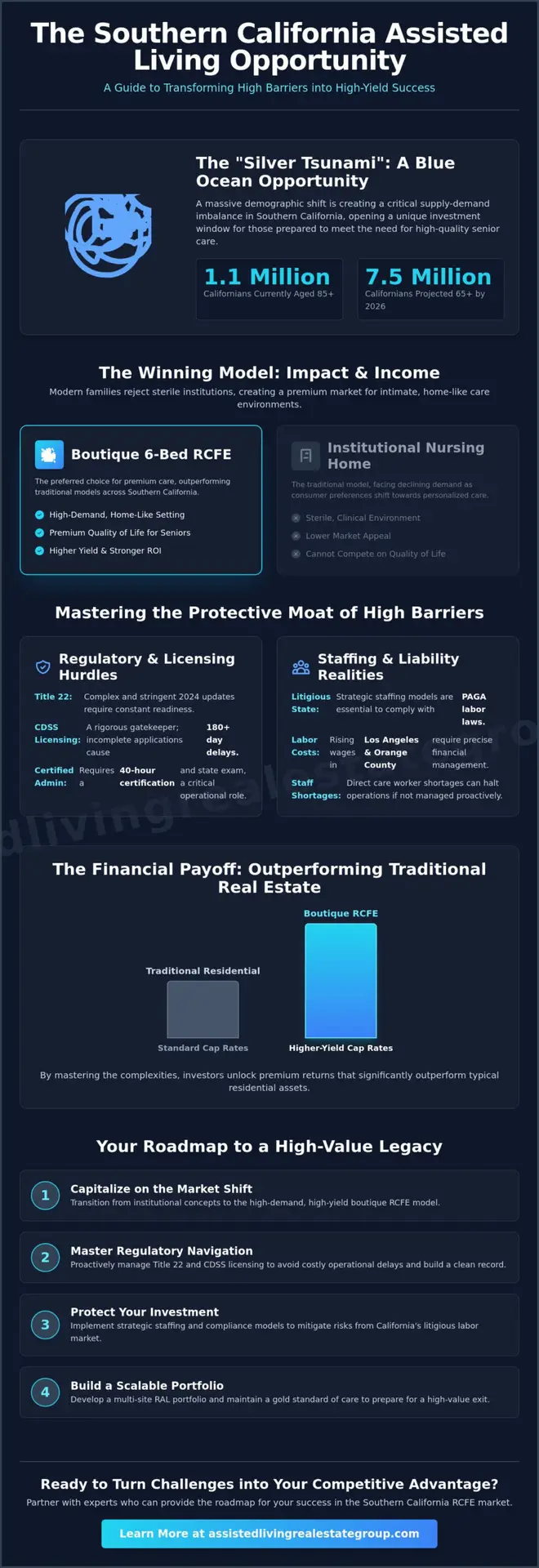
What if the complex regulations that keep most investors out of the Southern California market are actually your greatest competitive advantage? You already know that the challenges of owning an assisted living facility in a state like California can feel overwhelming. Between the stringent 2024 updates to Title 22 regulations and the rising labor costs across Los Angeles and Orange County, the barrier to entry is undeniably high. However, for the visionary entrepreneur, these hurdles act as a protective moat. They ensure that only those committed to excellence can tap into the blue ocean opportunity created by the 1.1 million Californians currently aged 85 and older.
We’ll show you how to master the RCFE landscape to turn operational friction into a streamlined engine for Impact and Income. This guide provides a clear roadmap to mitigate liability risks in our litigious state while maximizing your ROI through specialized boutique RAL models. You’ll discover how to balance the analytical demands of a real estate investment with the heart-centered mission of providing a premium quality of life for seniors. By the end of this piece, you’ll have the strategies needed to transform high-barrier challenges into a legacy of high-yield success.
Key Takeaways
- Capitalize on the Southern California “Silver Tsunami” by transitioning from institutional nursing homes to the high-demand, high-yield boutique RCFE model.
- Master the challenges of owning an assisted living facility by navigating the complexities of Title 22 and CDSS licensing to avoid costly operational delays.
- Protect your investment from California’s litigious labor market by implementing strategic staffing models that comply with PAGA and state-specific labor laws.
- Discover how to optimize ROI and outperform traditional residential cap rates through precise financial management and “Impact and Income” strategies.
- Build a legacy with a scalable multi-site RAL portfolio and prepare for a high-value exit by maintaining the gold standard of boutique care and clean records.
The 2026 Landscape: Demand vs. Complexity in Southern California
By 2026, the California Department of Aging projects the state’s population aged 65 and older will reach approximately 7.5 million people. This demographic shift, commonly known as the “Silver Tsunami,” is creating a massive supply-demand imbalance in the Southern California real estate market. For the strategic investor, this isn’t a crisis. It’s a “blue ocean” opportunity. While the demand for high-quality care is skyrocketing, the barriers to entry remain high, protecting those who have the expertise to navigate the system.
The boutique 6-bed Residential Assisted Living (RAL) model is currently outperforming institutional nursing homes across the state. Families in 2026 are rejecting sterile, clinical environments. They’re seeking intimate, residential-style settings that feel like home. This shift is the foundation of the “Impact and Income” philosophy. It’s the belief that you don’t have to choose between significant investor returns and compassionate, high-level care. You can do good while doing well.
One of the primary challenges of owning an assisted living facility in California is the sheer complexity of the regulatory environment. From Title 22 compliance to strict local zoning ordinances, the path to licensure is rigorous. This high-barrier-to-entry nature of the Southern California care sector is exactly what keeps cap rates attractive for those who successfully establish their facilities. It’s a specialized niche that requires a roadmap, not just a mortgage.
The Southern California “Blue Ocean” Opportunity
Demographic shifts in Los Angeles, Orange County, and San Diego are hitting a tipping point. Despite the surging demand, supply remains constrained because of the difficulty in finding and retrofitting suitable residential properties. Assisted living is no longer seen as a last resort but as a lifestyle choice for seniors who value community and safety. Investors who focus on boutique, residential environments are capturing the premium market share that institutional facilities simply can’t reach.
Understanding the RCFE vs. ARF Distinction
Navigating the challenges of owning an assisted living facility starts with choosing the right licensure model. In California, a Residential Care Facility for the Elderly (RCFE) serves residents 60 and older. An Adult Residential Facility (ARF) typically serves adults aged 18 to 59 with various disabilities. While both models are essential, the RCFE model offers more resilience in the current Southern California economy due to the massive volume of aging baby boomers. Understanding these nuances is critical for long-term ROI. For a deeper analysis of these paths, explore our guide on RCFE vs. ARF: Which California Facility is Right for You?
Regulatory Hurdles: Navigating Title 22 and California Licensing
The California Department of Social Services (CDSS) acts as both a guardian of senior safety and a rigorous gatekeeper for investors. Oversight isn’t a periodic check-in; it’s a constant state of operational readiness. One of the primary challenges of owning an assisted living facility is moving from the initial vision to a licensed, revenue-generating reality without succumbing to bureaucratic delays. Application pitfalls frequently stall progress for 180 days or longer. These delays usually stem from incomplete Part A or Part B documentation, or failing to secure a designated Administrator who meets the state’s stringent requirements.
The Administrator is the heartbeat of your Residential Assisted Living (RAL) investment. In California, this individual must complete a 40-hour certification program and pass a state-administered exam. They’re legally responsible for the facility’s daily adherence to the law. If your Administrator lacks the expertise to manage staff effectively, your facility risks falling victim to the nursing and direct care worker shortages that have strained the industry since 2020. A vacancy in this role isn’t just an HR issue; it’s a critical bottleneck that can halt your operations entirely.
Title 22 Compliance: The Owner’s Daily Challenge
Title 22 of the California Code of Regulations is the definitive rulebook for Residential Care Facilities for the Elderly (RCFE). To maintain a “deficiency-free” record, your boutique home must master three high-stakes areas:
- Medication Management: Errors here are the fastest way to receive a “Type A” citation.
- Resident Rights: Ensuring dignity and autonomy is a legal mandate, not a suggestion.
- Physical Plant Safety: This includes everything from water temperature settings to seismic bracing.
Building a culture of compliance means your team is ready for an unannounced visit at 2:00 PM on a Tuesday or 4:00 AM on a Sunday. For a technical breakdown of these requirements, refer to our RCFE Licensing in California guide.
Zoning and Local Southern California Ordinances
Southern California real estate offers immense “blue ocean” potential, but local NIMBY (Not In My Backyard) attitudes in affluent neighborhoods like La Jolla or Newport Beach can create friction. Fortunately, California Health and Safety Code Section 1566.3 offers a significant advantage for the boutique model. This state law protects small RCFEs with 6 beds or fewer, stipulating that local municipalities must treat them as residential property. They cannot impose special use permits or zoning variances that don’t apply to other single-family homes.
Despite this state protection, you’ll still face local hurdles. Fire marshal clearances are notoriously strict in SoCal, especially in high-fire-risk zones. Older residential builds often require significant ADA modifications, such as widening doorways to 32 inches or installing roll-in showers, to meet modern accessibility standards. Success in this market requires a strategic partner
Operational Realities: Staffing and Liability in a Litigious State
Operating a Residential Assisted Living (RAL) home in Southern California requires more than just a passion for seniors; it demands a rigorous approach to human resources and risk management. The primary challenges of owning an assisted living facility in this region often center on hiring and retaining compassionate caregivers within a labor market where retail giants and fast-food chains compete for the same entry-level talent. California labor laws add layers of complexity that can’t be ignored. You must master the nuances of overtime, mandatory meal breaks, and the looming threat of the Private Attorneys General Act (PAGA). This specific legislation allows employees to sue for labor code violations on behalf of the state, often resulting in six-figure settlements that can cripple an unmanaged facility.
Standard general liability insurance won’t protect your legacy in this litigious environment. Professional liability and specific “abuse and molestation” coverage are non-negotiable for any RCFE. Owners must also focus on “Transitions of Care.” When a resident returns from a hospital stay, the first 72 hours are critical. Mismanaging this transition leads to readmissions and exposes the facility to negligence claims. Success in this “blue ocean” opportunity requires a shift from passive ownership to active, strategic oversight.
The Staffing Crisis and the Boutique Solution
Boutique RAL facilities often see 20% to 30% lower turnover rates than institutional 100-bed centers because caregivers feel like part of a family rather than a number. To stay competitive, owners must prepare for California’s minimum wage increases. SB 525 mandates a path toward higher wages for healthcare workers, which will significantly impact 2026 operating budgets. One of the major challenges of owning an assisted living facility is balancing these rising costs with the need for high-quality care. Savvy investors offset these costs by:
- Providing professional development pathways that turn a “job” into a career.
- Fostering a culture of “Impact and Income” where staff feel valued.
- Implementing flexible scheduling to accommodate the high cost of living in SoCal.
Risk Mitigation and Resident Satisfaction
Preventing falls and medication errors requires more than just luck. It requires data. Implementing digital “Quality Measures” allows owners to track patterns and intervene before an incident occurs. High resident satisfaction is your best defense against litigation. When families feel heard through weekly communication protocols, they’re 85% less likely to pursue legal action if a minor accident happens. Building trust is the ultimate risk management strategy. By focusing on boutique environments, you provide the intimacy and luxury that justify premium market positions while naturally reducing the friction that leads to legal disputes.
Financial Management: ROI, Cap Rates, and ROI Optimization
Investing in Southern California real estate usually yields cap rates between 3% and 5% for standard residential rentals. Residential Assisted Living (RAL) flips this script. By integrating a high-demand service into the property, savvy owners often see cap rates climb into the 10% to 15% range. This isn’t just a property play; it’s a business-backed asset that leverages the “Silver Tsunami” demographics. However, one of the primary challenges of owning an assisted living facility involves balancing these high returns against escalating operational overhead unique to the California market.
Operational costs require meticulous oversight. Southern California utility rates from providers like SCE and SDG&E remain among the highest in the nation, and food inflation has increased raw material costs by roughly 12% since 2022. Perhaps most pressing is professional liability insurance. Premiums for California RCFEs rose by nearly 20% in 2023 alone, demanding a proactive approach to risk management. To stay profitable, strategic owners use our “Impact and Income” spreadsheet. This proprietary tool projects revenue based on resident acuity levels, ensuring you don’t over-extend on care costs without corresponding rate adjustments.
Choosing turnkey acquisitions over ground-up builds typically accelerates your path to ROI. California’s CEQA requirements and local zoning hurdles can delay new construction for 24 to 36 months. A turnkey facility allows you to bypass the “red tape” and begin generating cash flow from day one, which is vital for servicing debt in a high-interest-rate environment.
Maximizing Income through Specialized Care
Specializing in high-acuity care like Memory Care or securing Hospice waivers allows for premium “boutique” pricing. In affluent markets like Orange County or San Diego, private pay residents often pay $7,000 to $10,000 monthly for intimate, high-end environments. This private pay model is the gold standard for ROI. It outperforms government-reimbursed programs, which often provide stagnant rates that don’t keep pace with the rising challenges of owning an assisted living facility in high-cost coastal regions.
Due Diligence: Identifying Financial “Red Flags”
Smart investors audit the seller’s books with a skeptical eye. A P&L statement might show profit on paper, but you must verify actual cash flow to ensure the business is healthy. You’re buying two distinct assets: the real estate and the operations. Separating the “Business Value” from the “Real Estate Value” is critical for accurate tax planning and securing SBA financing. For a detailed breakdown of the verification process, see The Ultimate Guide to Buying an RCFE Facility in California.
Ready to analyze your first deal? Connect with our strategic partners to review your ROI projections and find your blue ocean opportunity.
Scaling and Exit Strategies: The Role of a Strategic Partner
Scaling from a single 6-bed residential care facility for the elderly (RCFE) to a multi-site Southern California portfolio is the definitive path to creating a lasting legacy. While the initial challenges of owning an assisted living facility often center on daily operations, the transition to a portfolio owner requires a shift toward strategic asset management. Savvy investors recognize the “Silver Tsunami” as a blue ocean opportunity, but capturing that value requires a roadmap that balances real estate appreciation with operational excellence.
Preparing for a high-value exit begins years before the actual sale. Institutional buyers and private equity groups look for “clean” businesses. This means maintaining 95% or higher occupancy rates and a history of zero Type A deficiencies under Title 22 regulations. Financial transparency is non-negotiable. If your records aren’t audit-ready, you leave money on the table. Confidentiality is the most critical element of a successful sale. Marketing an operational care business requires a “silent” approach to protect the census. If residents or staff sense instability, the resulting turnover can slash your valuation by 15% to 25% overnight.
The Turnkey Advantage
Acquiring an established facility with an active license and trained staff significantly reduces year-one risk. You bypass the grueling 12 to 24 month period of “lease-up” and initial licensing delays. The Change of Ownership (CHOW) process is a critical 60 to 90 day regulatory window during which the California Department of Social Services (DSS) reviews the new provider’s qualifications. Managing this timeline effectively is essential to ensure that private pay or insurance reimbursements continue without interruption. Buying turnkey allows you to focus on optimizing the “Boutique” experience rather than fighting uphill against startup inertia.
Partnering for Success in Southern California
The Assisted Living Real Estate Group leverages 25 years of local experience to help you navigate the complexities of the California market. We don’t just list properties; we act as consultative brokers who understand the intersection of real estate and Title 22 compliance. Our mission is to help you achieve “Impact and Income” by matching you with assets that offer both high ROI and superior care standards. Whether you’re looking to scale or sell, our strategic guidance ensures you don’t just participate in the market, but lead it. View Current California RCFE Listings to find your next opportunity.
Seize the Blue Ocean Opportunity in Southern California
The 2026 demographic shift isn’t a crisis; it’s a massive opportunity for investors who understand the California market’s unique demands. Success in this niche requires mastering Title 22 compliance and maintaining strong cap rates despite a complex regulatory environment. While the challenges of owning an assisted living facility are real, they create a high barrier to entry that protects those with the right expertise. You’re positioned to build a boutique RAL legacy that balances high-level financial returns with essential community service.
The Assisted Living Real Estate Group provides the roadmap you need to scale. With 25+ years of specialized Southern California experience, we’re experts in confidential RCFE and ARF marketing. We understand both the real estate assets and the intricate Title 22 business operations required to thrive. Don’t navigate this litigious landscape alone when you can leverage a partner who knows every corner of the state’s licensing requirements.
Achieve Impact and Income. Partner with Southern California’s RCFE Experts
Your journey toward a high-performing, heart-centered investment starts today. We’re ready to help you turn these market complexities into your greatest competitive advantage.
Frequently Asked Questions
Is it hard to get an RCFE license in California in 2026?
Obtaining an RCFE license in 2026 remains a rigorous process because the California Department of Social Services (CDSS) maintains strict oversight. You’ll need to complete an 80-hour initial certification program and pass a state exam with a score of at least 70 percent. It’s a high-barrier-to-entry market that rewards savvy investors who follow our regulatory roadmap to navigate the complex application requirements.
How much can a 6-bed assisted living facility owner make in Southern California?
A 6-bed boutique RAL in Southern California can generate substantial gross revenue, with private pay rates in Los Angeles and Orange County averaging $6,000 to $9,500 per resident monthly according to 2024 Genworth data. This translates to a potential gross monthly income of $36,000 to $57,000. Managing the challenges of owning an assisted living facility involves balancing these high returns against labor costs that often consume 40 percent of your gross revenue.
What is the biggest mistake new RCFE owners make in California?
The biggest mistake new California owners make is failing to account for the 2024 minimum wage increases and strict overtime laws. Many investors underestimate the “Silver Tsunami” demand and choose properties that lack proper zoning or ADA accessibility. This oversight leads to costly retrofitting that can delay your opening by 6 to 12 months, eating away at your initial capital reserves.
Do I need a medical background to own an assisted living facility?
You don’t need a medical degree to own an RCFE in California, but you must hire a certified administrator. California Health and Safety Code 1569.613 requires the person responsible for daily operations to hold a valid RCFE Administrator Certificate. This allows you to focus on the real estate and investment strategy while your staff manages the clinical care, perfectly blending impact and income.
How does California Title 22 affect daily operations?
Title 22 of the California Code of Regulations dictates every operational detail, from required fire drills to the exact temperature of tap water. You must maintain detailed records for each resident and ensure your facility meets strict physical plant requirements at all times. Non-compliance results in Type A or Type B citations, which the CDSS publishes on their public website for 5 years.
Can I run an assisted living facility out of my own home in California?
You can operate a small RCFE out of a residential home, as California law treats facilities with 6 or fewer residents as a residential use of property. This means local municipalities can’t impose special use permits or zoning variances that they wouldn’t require for a single-family home. It’s the foundation of the boutique RAL model, allowing you to scale your legacy in quiet, high-end neighborhoods.
What are the staffing ratio requirements for a small RCFE in CA?
California doesn’t mandate a specific numerical staff-to-resident ratio, but Title 22 Section 87411 requires sufficient personnel to provide necessary care. For a 6-bed facility, this typically means at least 1 caregiver is on-site 24/7, with additional staff during peak morning hours. One of the main challenges of owning an assisted living facility is adjusting these levels as resident acuity increases over time.
How long does the licensing process take for a new facility?
The licensing process for a new California RCFE typically takes between 6 and 12 months from the time you submit your application to the CDSS. This timeline includes the mandatory orientation, the building inspection, and the final pre-licensing visit. Delays often occur if your fire clearance from the Office of the State Fire Marshal takes longer than the standard 60-day window, so plan your carry costs accordingly.