
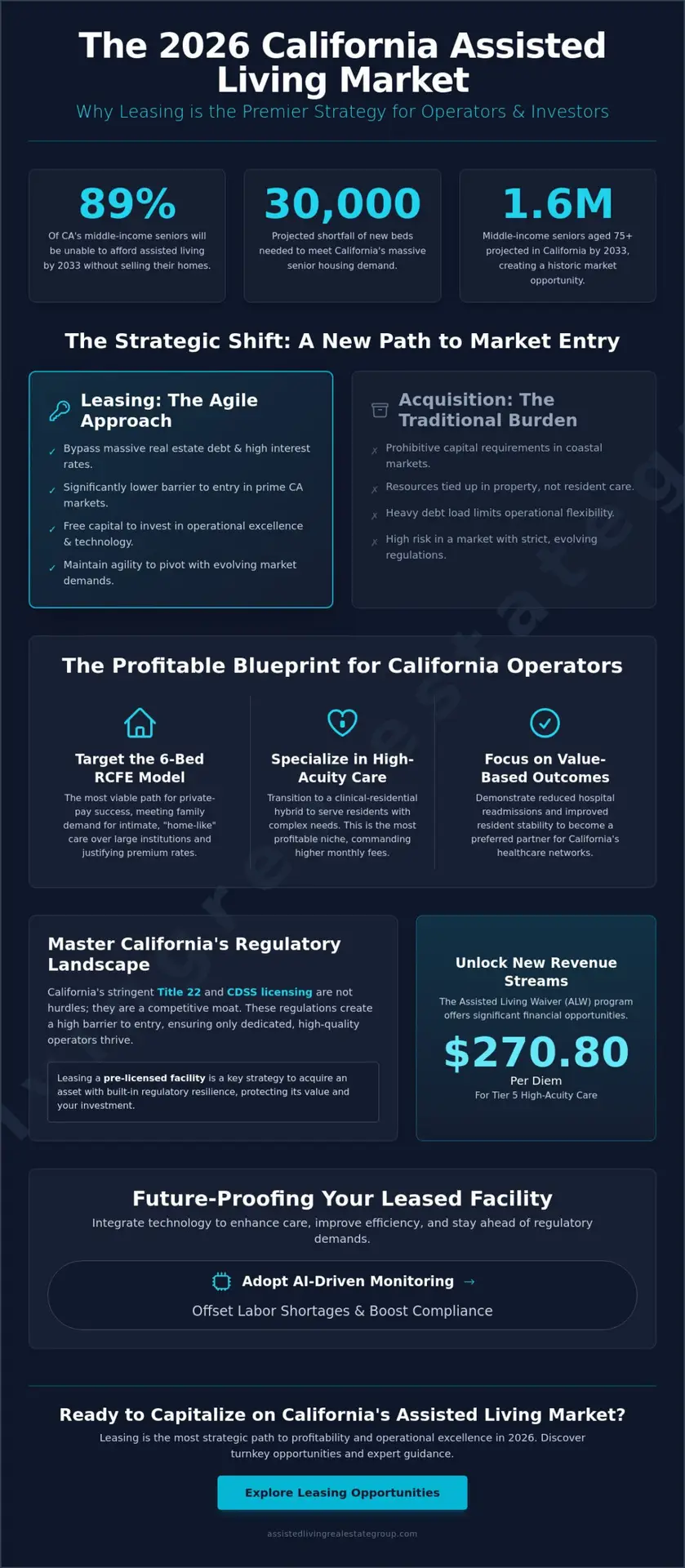
By 2033, 89% of California’s middle-income seniors won’t be able to afford private-pay assisted living without liquidating their primary residences. This demographic shift isn’t a crisis for the prepared professional; it’s an untapped market potential for those ready to provide elite care through agile operational models. You’ve likely noticed that the capital requirements for outright acquisition in coastal markets like West Los Angeles or San Diego have become a significant barrier to entry. This is exactly why leasing an assisted living facility in California has emerged as the most strategic move for 2026. It allows you to bypass the massive debt of property ownership while focusing your resources on operational excellence and high-acuity resident outcomes.
We understand that the complexities of California Department of Social Services (CDSS) licensing and the recent Title 22 updates can feel overwhelming. This guide provides the roadmap you need to master the nuances of RCFE and ARF properties within the current regulatory environment. You’ll learn how to identify profitable leasing opportunities that lower your barrier to entry and align with the statewide shift toward value-based care. We’ll examine the latest ALW reimbursement rates, which now reach up to $270.80 per diem for Tier 5 care, and explore how to build a sustainable business model that bridges the gap between significant financial returns and compassionate service.
Key Takeaways
- Discover why the 2026 California market demands operational agility and how to capitalize on the projected statewide need for 30,000 new beds.
- Learn why targeting high-acuity care and value-based outcomes is the most profitable strategy for modern residential care operators.
- Identify the massive “middle-market” opportunity and why the boutique 6-bed RCFE model remains the most viable path for private-pay success.
- Master the complexities of leasing an assisted living facility in California by integrating AI-driven monitoring to offset labor shortages and regulatory pressure.
- Understand how confidential marketing strategies protect your reputation and resident stability during turnkey business acquisitions or lease transitions.
The 2026 California Landscape: Why Leasing an Assisted Living Facility is Trending
In 2026, the California senior care market has reached a critical inflection point. Traditional property acquisition models are buckling under the weight of high interest rates and rigorous state mandates. This reality has transformed leasing an assisted living facility in California from a secondary option into a premier strategic move for high-level operators. Agility is the new currency. By opting for a lease, you decouple operational excellence from the heavy capital drag of real estate debt, allowing you to pivot as market demands shift. This model provides the financial breathing room to invest in top-tier staffing and technology rather than tying up millions in a single piece of Southern California dirt.
We’re witnessing the “Silver Tsunami” in real-time. California faces a massive supply-demand gap, with an estimated 1.6 million middle-income seniors aged 75 and above projected by 2033. This demographic surge isn’t just about volume; it’s about a fundamental shift in understanding long-term care options. Families are rejecting the sterile, institutional warehousing of the past. They’re demanding mission-driven, boutique environments where residents receive personalized attention. Boutique RCFEs are currently outperforming large-scale centers because they offer the intimacy families want with the operational flexibility you need to maintain high occupancy rates.
California Demographics and Leasing Demand
The aging-in-place trend is particularly potent in Southern California, where a massive wealth transfer is currently fueling a surge in private-pay demand. We’re seeing a distinct consumer preference shift. Families in affluent pockets of Orange County and West LA are actively choosing leased 6-bed residential care homes over massive assisted living campuses. They want the “home-like” feel without sacrificing safety. For an operator, leasing these smaller, high-end properties allows for a more refined service model—incorporating personalized touches like custom wall calendars from Photobook Press—that justifies premium monthly rates. It’s a strategy that prioritizes quality over quantity, ensuring long-term significance in a competitive market.
Regulatory Evolution: Title 22 in the Next Decade
The California Community Care Licensing Division (CCLD) continues to enforce stringent updates to Title 22, specifically focusing on dementia care and resident safety. While some see this as a hurdle, strategic investors view RCFE licensing in California as a powerful barrier to entry. It keeps the market exclusive and ensures that only the most dedicated professionals thrive. When you secure a lease on a pre-licensed facility, you’re essentially acquiring an asset with built-in regulatory resilience. This protection maintains your asset value and provides a solid foundation for achieving significant financial returns while providing essential social contributions.
High-Acuity Care and Value-Based Outcomes in Leased Facilities
“High-acuity” is the most profitable phrase in the 2026 California care market. As medical needs for seniors intensify, the traditional assisted living model is evolving into a sophisticated clinical-residential hybrid. For those currently leasing an assisted living facility in California, this shift represents a significant opportunity to command higher monthly rates by providing complex care that large, institutional competitors often struggle to deliver with the same intimacy. Success in this niche requires a meticulous balance between high-end hospitality and clinical-grade precision. It’s about transforming a residence into a center of excellence that addresses the physiological and emotional needs of a fragile population.
The industry is moving rapidly toward Value-Based Care (VBC), a model that prioritizes health outcomes over the sheer volume of services. Recent senior housing market analysis highlights that facilities capable of demonstrating reduced hospital readmissions and improved resident stability are becoming the preferred partners for healthcare networks. In a leased setting, this means integrating non-invasive technology like AI-powered fall detection and smart medication management. These tools don’t just enhance safety; they provide the hard data needed to prove your facility’s value to families and medical partners alike. If you’re looking to enter this space, exploring lease-to-own care home opportunities can provide the necessary foothold to build a reputation for clinical excellence.
Specialized Memory Care as a Growth Engine
Alzheimer’s prevalence continues to climb across California, creating an urgent demand for secure, high-quality RCFEs. Specialized memory care is no longer an add-on; it’s a primary growth engine for lessees. In 2026, memory care rates in California typically range from $6,500 to $11,500, which is significantly higher than standard assisted living base rates. To future-proof a leased facility, operators must ensure their properties meet the latest Title 22 dementia care standards. This includes enhanced staff training and specialized environmental safety features that protect residents while maintaining a sense of dignity.
Value-Based Reimbursement in California
The transition from fee-for-service to fee-for-outcome is reshaping how California operators approach reimbursement. We’re seeing more RCFE lessees successfully partnering with Medicare Advantage plans to capture additional revenue streams tied to resident wellness. Investors now prioritize leased properties that are pre-wired for clinical monitoring tech. This infrastructure allows for real-time health tracking, which is essential for participating in the value-based programs that are quickly becoming the state standard for high-performing facilities.
The Middle-Market Gap: California’s Greatest Leasing Opportunity
The “forgotten middle” represents the most significant investment arbitrage in the state’s care sector today. While luxury high-rises cater to the ultra-wealthy and subsidized housing serves the low-income, 1.6 million middle-income seniors in California will be searching for a home by 2033. Most of these individuals won’t be able to afford the steep price tags of institutional assisted living without liquidating their primary residences. This creates a massive opening for strategic professionals. Leasing an assisted living facility in California allows you to enter this market with a lean cost structure that institutional players simply can’t replicate. You aren’t just providing a bed; you’re offering a viable financial solution for families caught in the middle.
Boutique 6-bed RCFEs are the only sustainable model for this segment. Large facilities are burdened by massive debt service and high corporate overhead, which forces them to keep rates high. In contrast, a residential lease model operates with lower fixed costs and higher operational efficiency. By leasing underperforming residential assets in emerging neighborhoods, you can capture this demand while maintaining healthy margins. This isn’t about cutting corners; it’s about strategic resource allocation that prioritizes direct care over marble lobbies and marketing departments.
Institutional vs. Boutique: A 2026 Comparison
In 2026, the boutique model is outperforming large-scale institutions in both resident satisfaction and fiscal resilience. Smaller facilities naturally support better staffing ratios, which leads to superior health outcomes and lower turnover. During inflationary periods, the agility of a leased residential home allows you to adjust your service offerings and costs more rapidly than a 100-unit complex. This flexibility is also seen in the scalability of the adult residential facility California model, where operators can expand their portfolio one home at a time without the massive capital calls required for commercial construction.
Lease ROI in the Middle-Market
Analyzing lease-to-revenue ratios in Southern California reveals that middle-market leasing is remarkably recession-proof. While luxury demand fluctuates with the stock market, the need for mid-priced care is a demographic certainty. Identifying turnkey lease opportunities in areas like the Inland Empire or the San Gabriel Valley can yield significant returns because the gap between lease payments and resident revenue is optimized. Investors are increasingly drawn to these properties because they offer a clear path to profitability while serving a critical social need. When you master the middle market, you’re building a business with long-term significance and a protected bottom line.
Future-Proofing Your Lease: Technology and Regulatory Resilience
In 2026, a lease agreement is only as strong as the technology protecting your bottom line. We’ve moved beyond simple call lights and basic security. Today, leasing an assisted living facility in California requires a proactive stance on liability and operational efficiency. Privacy-first, camera-free AI monitoring has become the industry standard for high-performing RCFEs. These systems detect falls and changes in resident gait in real-time, providing a safety net that traditional staffing models can’t match. By integrating these tools, you aren’t just protecting residents; you’re significantly lowering your insurance premiums and shielding your business from the litigation risks that often plague California operators. This technological approach should also extend to your billing systems; you can learn more about how modern payment solutions streamline these administrative burdens.
Environmental sustainability is another critical pillar of future-proofing. With California’s aggressive energy mandates and the expansion of Title 24 requirements, energy-efficient facilities are no longer a luxury. Solar integration and smart HVAC systems are essential for managing the high utility costs associated with Southern California operations. When you evaluate a lease, look for properties that prioritize green infrastructure. These features directly reduce the overhead in triple-net lease structures, ensuring that more of your revenue stays in the business rather than going to the utility company. If you’re ready to secure a technologically advanced property, explore our turnkey business acquisitions to find a facility ready for the 2026 market.
The Digital Transformation of the RCFE
Electronic Health Records (EHR) have effectively transitioned from a best practice to a licensing expectation in California. The California Community Care Licensing Division (CCLD) now prioritizes digital documentation during inspections to ensure accuracy in resident reappraisals. Beyond compliance, family portal technology has become a powerful lease marketing tool. It provides real-time updates to loved ones, building the trust necessary to maintain high occupancy. Telehealth integration is also vital, allowing your facility to manage high-acuity needs on-site and reducing the hospital readmissions that can damage your facility’s reputation with medical partners.
California Labor and Staffing Strategies
California’s minimum wage increase to $16.90 in January 2026 has intensified the need for innovative staffing models. You can’t solve the caregiver shortage by simply paying more; you must create an environment that reduces burnout. Future-proofed facilities use automation for repetitive administrative tasks, allowing caregivers to focus on the human connection that defines quality care. Maintaining regulatory compliance is a continuous process for rcfe license california holders. Success requires a commitment to ongoing education and a staffing strategy that prioritizes long-term retention over constant recruitment.
Navigating the 2026 Market: Strategic Lease Acquisitions
The 2026 California market has matured into a definitive seller’s and lessor’s environment. High-performing RCFEs are no longer viewed simply as real estate; they’re high-yield operational assets with immense demographic tailwinds. If you’re currently looking at leasing an assisted living facility in California, you’re competing for limited inventory that meets the state’s modern clinical and safety standards. This scarcity gives current facility owners significant leverage, but it also rewards operators who can demonstrate a track record of high-acuity success. Securing these prime opportunities requires speed, precision, and access to a network where reputation is the primary currency.
Confidentiality is the cornerstone of any successful lease transition. When you’re negotiating a lease or a turnkey acquisition, public exposure can destabilize your resident base and trigger immediate staff turnover. We utilize a sophisticated, confidential marketing strategy to ensure that the business’s value remains intact throughout the negotiation process. This approach protects the delicate ecosystem of care while allowing for a seamless handoff between the lessor and the operator. For those looking to maximize their long-term position, preparing for a high-value lease-to-own exit within the next 24 months is a savvy move. It allows you to build operational history and cash flow before committing to full property ownership.
The Value of Specialized Brokerage in Leasing
General commercial brokers often fail in this niche because they don’t understand the granular requirements of the California Department of Social Services (CDSS). A standard lease doesn’t account for the specificities of Title 22 or the nuances of high-acuity care. With over 25 years of California-specific care industry experience, we bridge the gap between financial investment and compassionate care. We identify exclusive, off-market RCFE for sale or lease opportunities that never hit public listing sites, giving our clients a distinct advantage in a crowded field.
Next Steps for California Lessees
Your first step is a comprehensive portfolio audit to identify future-proofing needs. You must understand how 2026 valuation metrics for Southern California lease arrangements differ from previous years. These metrics are no longer based solely on bed count; they’re based on your ability to produce value-based outcomes and maintain regulatory resilience. To secure your future in this high-barrier market, start by consulting with our expert RCFE brokers to develop a customized roadmap that aligns your financial goals with the needs of California’s aging population.
Securing Your Legacy in California’s Care Economy
The 2026 landscape has redefined what it means to be a successful operator. By focusing on leasing an assisted living facility in California, you’ve chosen the path of operational agility and high-acuity specialization. You’re now equipped to bridge the middle-market gap and leverage AI-driven technology to offset labor shortages. Success in this exclusive niche requires more than just capital; it requires a roadmap built on technical credibility and a deep commitment to resident outcomes. We’ve spent over 25 years navigating Southern California licensing and Title 22 compliance, facilitating over $500 million in care facility transactions. This seasoned expertise ensures your investment aligns with both your financial goals and your moral compass.
The window for strategic entry into these high-performing markets is narrowing as demand continues to outpace supply. It’s time to transition from curiosity to conviction. Explore Exclusive California RCFE Lease and Investment Opportunities to secure a position in a market defined by long-term significance. Your vision for a profitable, mission-driven care home is within reach, and the right partnership will unlock the door to this high-barrier industry.
Frequently Asked Questions
What is the projected growth for the California assisted living industry by 2030?
California requires an estimated 30,000 new beds by 2030 to keep pace with the state’s rapidly aging population. This demand is driven by the 1.6 million middle-income seniors aged 75 and older who will require care by 2033. This demographic shift represents an unprecedented opportunity for strategic operators to provide essential services in a market with a significant supply shortage.
How are California Title 22 regulations expected to change in 2026?
The California Community Care Licensing Division is currently focused on the active enforcement of the Title 22 updates that took effect on January 1, 2025. These regulations prioritize enhanced dementia care standards, more frequent resident reappraisals, and rigorous digital documentation requirements. Staying ahead of these standards is essential for maintaining your facility’s license and ensuring the highest level of resident safety.
Why is leasing an RCFE considered a better entry point than buying in 2026?
Leasing an assisted living facility in California provides the operational agility needed to navigate a high-interest, high-regulation environment without the massive capital drag of property ownership. This model allows you to bypass the significant debt service associated with real estate acquisition. You can then redirect those resources toward clinical excellence, staffing retention, and technology integration to ensure significant financial returns.
What role does technology play in the future of leased care facilities?
Technology serves as both a safety net and a powerful marketing tool for modern California care homes. AI-driven fall detection, smart medication management, and telehealth services allow facilities to manage high-acuity residents more effectively. These “privacy-first” systems provide the data necessary to participate in value-based care programs, which are quickly becoming the state standard for high-performing residential care facilities.
How can I future-proof my California care home against rising labor costs?
Future-proofing requires a shift toward automation for administrative tasks to allow your caregivers to focus entirely on resident interaction. With the California minimum wage reaching $16.90 on January 1, 2026, efficiency is no longer optional. Implementing innovative retention models and reducing staff burnout through better workflow design helps stabilize your labor costs while maintaining the high-quality care that families demand.
Is memory care a viable investment niche for leased facilities in Southern California?
Memory care remains one of the most profitable niches in Southern California due to the rising prevalence of Alzheimer’s and a shortage of specialized beds. Monthly rates for memory care in California typically range from $6,500 to $11,500, which is significantly higher than standard assisted living. Secure, high-quality RCFEs that meet specialized dementia care standards command a premium position in the 2026 market.
What is the middle-market gap in California senior housing?
The middle-market gap refers to the 89% of California’s middle-income seniors who cannot afford traditional private-pay assisted living without selling their primary residences. These individuals have too much income for Medi-Cal but not enough for luxury institutional settings. Boutique 6-bed RCFEs are the only viable solution for this segment, offering a more affordable, home-like environment with leaner operational overhead.
How do I find off-market assisted living facilities for lease in California?
Securing off-market opportunities requires partnering with specialized brokers who possess deep, California-specific care industry expertise. General commercial listings often fail to capture the nuances of leasing an assisted living facility in California, such as licensing status and Title 22 compliance. We use confidential marketing strategies to connect qualified operators with exclusive opportunities that never reach the public market, protecting the facility’s reputation and resident stability.