
The most successful exits in the California recovery market aren’t won on the open market; they’re secured through strategic silence and clinical precision. You’ve spent years building a sanctuary for healing, so the fear of watching staff and residents flee at the mere mention of a sale is a valid concern. It’s natural to feel professional anxiety regarding the shifting sands of state regulations and the financial implications of the 23 dollar per hour healthcare minimum wage mandated by SB 525 as of July 2026.
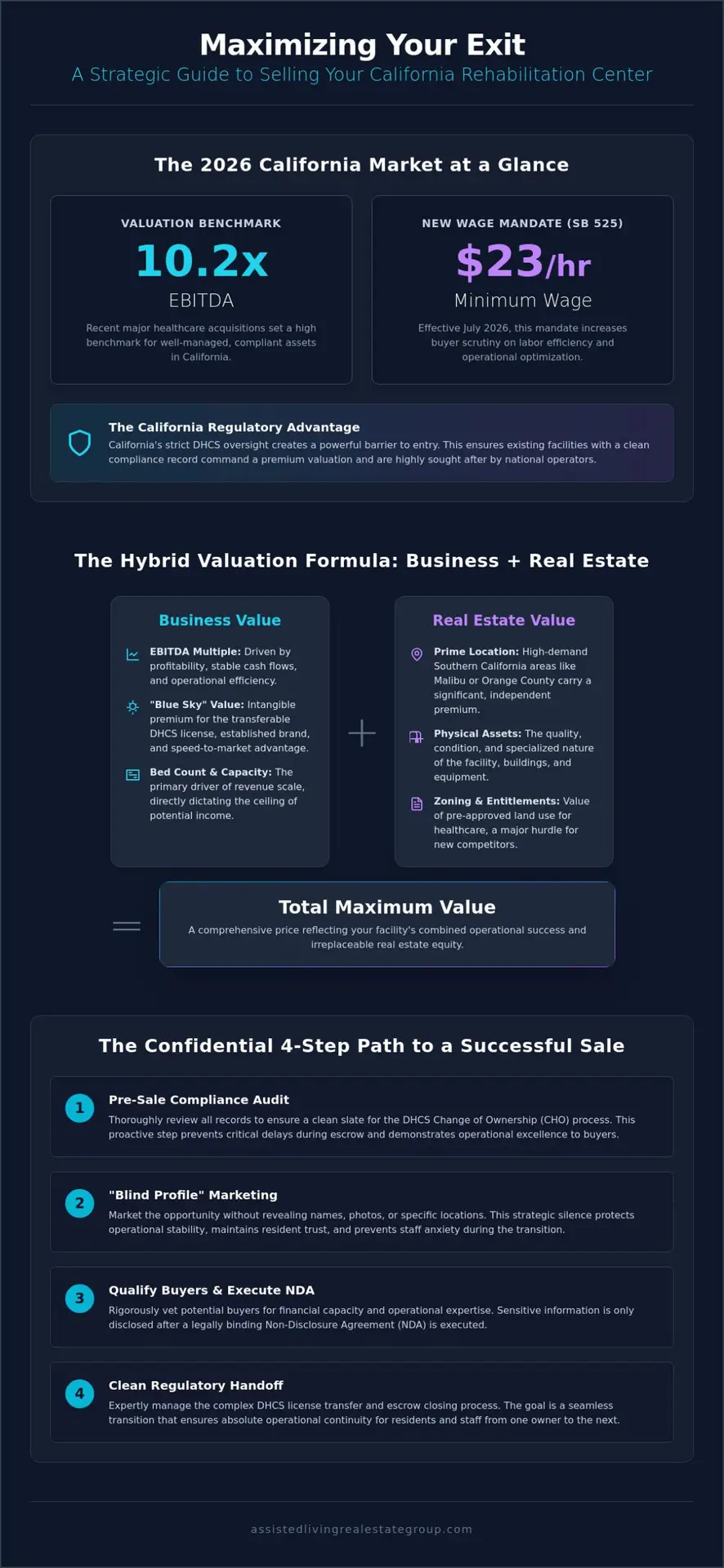
You can master the complexities of the current market to achieve a high-value sale without compromising the mission of your facility. This strategic guide will show you exactly how to sell my rehabilitation center by leveraging expert brokerage insights to navigate valuation, marketing, and the closing process. We’ll examine the impact of recent 10.2x EBITDA valuation benchmarks, the intricacies of DHCS licensing transfers, and the tactical steps required to ensure operational continuity for your residents during a clean regulatory handoff. By the end of this article, you’ll have the roadmap needed to bridge the gap between financial legacy and compassionate care.
Key Takeaways
- Analyze how 2026 California legislative changes and healthcare wage mandates impact the market demand and financial desirability of your recovery beds.
- Master the hybrid appraisal model to accurately price and sell my rehabilitation center by balancing business EBITDA multiples with prime California real estate values.
- Utilize a “Blind Profile” marketing approach to maintain absolute confidentiality, ensuring your facility’s operational stability and resident trust remain intact during the transition.
- Prepare for a clean regulatory handoff by conducting a pre-sale compliance audit that streamlines the DHCS change of ownership process and the escrow period.
- Partner with a strategic mentor who brings 25 years of specialized experience in bridging the gap between Southern California healthcare operations and high-value real estate investments.
Understanding the 2026 California Behavioral Health Market
Southern California remains the epicenter of the behavioral health market, where the demand for recovery beds in urban hubs like Los Angeles and Orange County continues to outpace supply. In 2026, the landscape has shifted from a fragmented collection of local operators to a sophisticated asset class. Institutional investors and private equity firms are aggressively targeting boutique California facilities. They aren’t just buying businesses; they’re acquiring high-barrier-to-entry licenses in a state known for its rigorous standards. When you decide to sell my rehabilitation center, you’re positioning a specialized piece of healthcare real estate that offers both significant financial returns and deep social impact.
The intersection of operational profitability and real estate value has never been more pronounced. Recent market activity, including the 10.2x EBITDA multiples seen in major 2026 healthcare acquisitions, has set a high benchmark for well-managed assets. However, the implementation of SB 525 has introduced new variables. With the healthcare worker minimum wage now at 23 dollars per hour for most facilities as of July 2026, buyers are scrutinizing labor efficiency more than ever. Strategic professionals see this not as a crisis, but as an opportunity to acquire facilities that have already optimized their operations for this new economic reality.
The California Regulatory Advantage
California’s strict oversight by the Department of Health Care Services (DHCS) serves as a powerful valuation driver. These regulations create a formidable barrier to entry, ensuring that existing facilities hold a premium position in the market. Credibility is the currency of this industry. A facility with a clean compliance record and a history of successfully treating individuals undergoing drug rehabilitation commands a much higher price than a new, unproven startup. California remains the primary destination for out-of-state clients seeking high-end, specialized care, which bolsters the desirability of these assets for national operators looking to expand their footprint.
Market Drivers for Recovery Facility Acquisitions
The primary driver in 2026 is the increasing need for specialized behavioral health services tailored to specific demographics. Financial buyers are looking for stable cash flows and scalable models, while strategic buyers often pay a premium to secure a specific geographic territory or a specialized niche. Reimbursement rates have stabilized, providing a clearer picture of long-term revenue potential. For those looking to sell my rehabilitation center, the current climate favors sellers who can demonstrate a sophisticated blend of clinical excellence and fiscal discipline. The market is exclusive, and the roadmap to a successful exit requires a deep understanding of these localized California dynamics.
Determining the Maximum Value of Your Rehab Center
Valuation in the California market isn’t a one-dimensional calculation. While generalist brokers often rely on a standard EBITDA multiple, this approach frequently ignores the massive equity held in the underlying Southern California real estate. To truly maximize your exit, you must employ a “Business + Real Estate” hybrid appraisal model. This strategic framework recognizes that a facility in a high-demand area like Malibu or Laguna Beach carries a real estate premium that exists independently of its clinical cash flow. When you prepare to sell my rehabilitation center, understanding this duality is the key to securing a price that reflects both your operational success and your physical assets.
EBITDA multiples vary significantly across different California counties due to localized reimbursement trends and real estate demand. For instance, a facility in Orange County may command a higher multiple than a similar operation in the Inland Empire because of the perceived exclusivity and higher private insurance density. In this context, Blue Sky Value represents the intangible premium assigned to your facility for its transferable DHCS license, established brand reputation, and the significant time a buyer saves by avoiding the arduous California startup process. Bed count remains the primary driver of scale, as capacity directly dictates the ceiling of your potential revenue.
Financial Metrics That Matter to Buyers
Investors in 2026 are intensely focused on the quality of your earnings and your specific payer mix. A facility with a high concentration of private PPO insurance is far more attractive than one reliant on fluctuating reimbursement rates. Historical occupancy rates serve as the ultimate proof of stability, demonstrating that your facility maintains consistent demand. It’s also vital to identify hidden costs, such as the 2026 healthcare wage increases, which could depress your valuation if not properly accounted for. If you want to see how these metrics align with current market trends, you can explore confidential marketing strategies to gain a competitive edge.
Operational Assets That Drive Premiums
Your clinical staff is often your most valuable non-physical asset. A seasoned, credentialed team that remains through the transition provides a buyer with immediate operational continuity. Proprietary treatment protocols also build significant brand equity, distinguishing your facility from institutional competitors. Finally, ensure your physical plant is in peak condition. In the fast-paced California market, deferred maintenance is a deal-killer that gives buyers leverage to negotiate your price downward during escrow. Turnkey excellence is what justifies a premium return.
The Critical Role of Confidentiality in Facility Sales
In the high-stakes environment of California behavioral health, discretion isn’t just a courtesy; it’s a financial necessity. A public listing is often the “kiss of death” for an active recovery facility. When competitors, staff, or referral partners see a center on a general business-for-sale website, the narrative immediately shifts from healing to instability. The decision to sell my rehabilitation center often triggers a wave of professional anxiety regarding staff retention and patient trust. To protect the premium valuation we discussed in previous sections, you must maintain a veil of absolute secrecy until the definitive agreement is signed.
We utilize a “Blind Profile” approach to navigate this delicate phase. This strategy involves marketing the facility’s key attributes, such as its Southern California location, bed count, and high-quality payer mix, without ever revealing the name or specific address. By controlling the flow of information, you ensure that only vetted, qualified buyers with the financial capacity to close a deal ever see your sensitive clinical data. This protective barrier allows you to continue focus on resident care while the strategic groundwork for your exit is laid behind the scenes.
Protecting Your Staff and Patient Base
Maintaining operational normalcy is the only way to prevent “referral leakage.” In the tight-knit California recovery community, rumors of a sale can cause clinical partners to divert new admissions to competing facilities. You must use robust, California-compliant Non-Disclosure Agreements (NDAs) that carry significant legal weight. These documents aren’t just formalities; they’re essential tools to ensure that prospective buyers treat your operational secrets with the same respect you do. Communicating the transition to your team should only happen at the strategic “tipping point” of the escrow process, typically once all major contingencies are removed.
The Controlled Marketing Process
Success requires a Confidential Information Memorandum (CIM) that sells the vision of your facility’s future potential. This document is shared only after a buyer has been thoroughly vetted for both clinical alignment and financial readiness. When you sell my rehabilitation center through specialized brokerage networks, you bypass the noise of the open market and speak directly to institutional investors who value confidentiality. Site visits are managed with extreme care, often scheduled after hours or disguised as routine facility inspections to keep residents and staff focused on their daily recovery routines. This methodical rhythm ensures that the value you’ve built remains intact from the first inquiry to the final handoff.
Navigating the California Sale Process: From Audit to Escrow
Selling a California rehab center isn’t just a transaction; it’s a regulatory marathon. The journey to sell my rehabilitation center begins long before any buyer signs a Letter of Intent (LOI) or reviews your financial statements. You must start with a rigorous pre-sale operational and compliance audit. This isn’t just about cleaning up the books; it’s about ensuring your facility is bulletproof against the scrutiny of institutional due diligence. Once your internal systems are verified, you can set a strategic price based on the hybrid valuation model we established earlier, ensuring you capture both business and real estate value.
The roadmap to a successful closing follows a disciplined sequence:
- Phase 1: Conduct a pre-sale operational and compliance audit to identify potential deal-killers early.
- Phase 2: Secure a professional valuation and set a strategic price that reflects 2026 market multiples.
- Phase 3: Execute a confidential marketing strategy to vet buyers without disrupting your facility’s daily rhythm.
- Phase 4: Manage the complex Change of Ownership (CHOW) process with the Department of Health Care Services (DHCS).
- Phase 5: Facilitate a smooth transition of clinical and administrative leadership to ensure resident continuity.
DHCS and Licensing Transfer Requirements
The California Department of Health Care Services (DHCS) holds the keys to your exit. In 2026, the Change of Ownership (CHOW) process remains a critical path that requires meticulous documentation and proactive management. A common pitfall is failing to account for current processing timelines, which can stall a deal in escrow for months if not managed with professional foresight. Buyers will look for evidence that the facility meets all Title 22 requirements and that the incoming ownership group satisfies California’s “fit and proper” standards. If you’re ready to navigate this timeline with expert precision, contact our specialized brokerage team today.
Due Diligence: What the Buyer Will Scrutinize
Due diligence in the behavioral health sector is uniquely invasive. When you prepare to sell my rehabilitation center, your clinical records and billing practices become the primary focus of the buyer’s investigative team. They’ll perform a deep dive into historical payer denials and ensure that your revenue is sustainable under current California regulations. Beyond the financials, real estate inspections are paramount. In Southern California, zoning verification for behavioral health is increasingly complex. You must verify the validity of all local and state permits, ensuring there are no outstanding code violations that could derail the sale at the eleventh hour. Precision at this stage is what separates a failed deal from a record-breaking exit.
Executing Your Exit with Assisted Living Real Estate Group
The decision to sell my rehabilitation center represents the culmination of your professional journey and your commitment to the recovery community. At Assisted Living Real Estate Group, we don’t just list properties; we mentor our clients through a high-stakes transition that requires both financial acumen and clinical sensitivity. With over 25 years of combined industry experience, our team specializes in the unique regulatory and real estate landscape of Southern California. We understand that a recovery facility is a complex, living asset. It’s not just a building; it’s a sanctuary that requires a specific roadmap to transfer ownership without losing its soul or its value.
Teri Szoke’s team bridges the critical gap between healthcare operations and strategic real estate investment. We’ve spent decades building a curated network of qualified buyers who specifically seek RCFEs and recovery facilities in the California market. These aren’t speculative bidders but institutional-grade investors who understand the barrier-to-entry advantages we’ve discussed in this guide. If you are also managing senior care assets, you can review our companion guide on How to Sell Your Assisted Living Facility in California to see how we apply this same rigor across the care spectrum.
Why a Specialized Brokerage is Essential
Generalist commercial brokers often fail to grasp the nuances of DHCS licensing or the emotional weight of a resident-centered business. Using a generalist to sell my rehabilitation center is a risk that can lead to broken deals, leaked confidentiality, and depressed valuations. Our proven track record in Southern California behavioral health allows us to anticipate regulatory hurdles before they become escrow obstacles. We lead the negotiation process with a focus on your legacy, ensuring that the final price reflects the premium service and operational excellence you’ve established.
Your Next Steps to a Successful Sale
The 2026 market peak offers an unprecedented opportunity for owners ready to capitalize on the consolidation trends we’ve observed. Success requires preparation. It’s time to move from curiosity to conviction by scheduling a confidential valuation and market assessment. We’ll help you prepare your facility for maximum exposure within our exclusive circles while maintaining the absolute discretion your staff and residents deserve. Take the first step toward your high-value exit and Get a Confidential Valuation for Your CA Care Home today. Our methodical approach ensures that your transition is as seamless as the care you provide.
Securing Your Legacy in the California Recovery Market
The path to a successful exit in the California recovery sector requires a sophisticated blend of clinical integrity and financial foresight. A premium sale hinges on a hybrid valuation model that respects both your Southern California real estate and your operational cash flow. By maintaining absolute confidentiality through a blind profile, you protect your staff and residents from the disruption that public listings inevitably cause. Navigating the DHCS change of ownership process in 2026 demands the steady hand of a strategic mentor who understands the high-barrier-to-entry nature of this exclusive market.
When you decide to sell my rehabilitation center, you’re transitioning a mission-driven sanctuary that deserves a refined handoff. With over 25 years of specialized experience in confidential RCFE and recovery facility transactions, Assisted Living Real Estate Group provides the deep expertise in Southern California real estate and licensing necessary to close with conviction. Contact Teri Szoke for a Confidential Valuation of Your Rehab Center to begin your strategic exit today. Your commitment to care has built this value; now, it’s time to ensure your legacy is both profitable and permanent.
Frequently Asked Questions
How long does it take to sell a rehab center in California?
The typical timeline for a successful exit ranges from six to twelve months. This duration is largely dictated by the California Department of Health Care Services (DHCS) and its processing times for licensing transfers. While the marketing and negotiation phase may only take a few months, the regulatory handoff is a methodical process that requires patience and precision to ensure a clean transition for your residents.
Will my staff find out if I am selling my rehabilitation center?
Staff members don’t need to know about the transition until the final stages of escrow. By utilizing a “Blind Profile” marketing strategy and strictly vetted buyer networks, we maintain absolute confidentiality. We lead the process with robust, California-specific non-disclosure agreements to ensure that your facility’s operational stability and resident trust remain completely intact until it’s the strategic time for a formal announcement.
What is the current EBITDA multiple for recovery centers in Southern California?
Current market data in 2026 shows that high-performing California facilities often command multiples between 4x and 8x EBITDA. Premium assets with a strong private insurance payer mix and prime real estate have seen benchmarks move even higher, influenced by institutional acquisitions in the broader healthcare sector. Your specific valuation will depend on your facility’s capacity, location, and historical occupancy rates.
Can I sell my rehab business without selling the real estate?
What is a DHCS CHOW and why does it matter for my sale?
A CHOW is a Change of Ownership application that must be filed with the Department of Health Care Services. It’s the most critical regulatory hurdle in your sale because it governs the legal transfer of the facility’s license to the new owner. Without a successful CHOW approval, the buyer cannot legally provide treatment, making this process the anchor of your escrow timeline and closing conditions.
How do I value the “Blue Sky” of my licensed facility?
Blue Sky value represents the intangible premium a buyer pays for your established reputation and active California license. Because the state has such high barriers to entry and rigorous licensing requirements, a turnkey facility is worth significantly more than a new startup. We calculate this value by analyzing the time and capital a buyer saves by stepping into an already profitable, compliant operation.
Do I need a special broker to sell a drug and alcohol recovery facility?
A specialist broker is essential because these transactions involve complex healthcare regulations that generalist commercial agents don’t understand. When you decide to sell my rehabilitation center, you need a partner who can navigate Title 22 requirements and DHCS nuances. A specialized guide ensures that your clinical assets are valued correctly and that the sale doesn’t collapse during the regulatory due diligence phase.
What documents do I need to have ready for a buyer’s due diligence?
You should prepare three years of detailed profit and loss statements, active DHCS licenses, and your clinical policy manuals. Buyers in 2026 will also scrutinize your labor costs under the SB 525 minimum wage requirements and your historical payer mix. Having a clean, organized data room ready for inspection demonstrates professional excellence and helps maintain deal momentum during the sensitive escrow period.