
By 2026, the Southern California behavioral health market will reach a valuation threshold where your facility’s real estate may actually outweigh its operational EBITDA in total exit value. You’ve spent years building a boutique recovery center that transforms lives, yet the thought of walking away feels like a high-stakes gamble against shifting California DHCS regulations and unpredictable cap rates. You likely feel that your legacy is too precious to leave to chance, yet you’re ready for the financial freedom you’ve earned. Understanding how to sell a rehabilitation facility in this specific blue ocean market requires more than a simple listing; it demands a strategic roadmap that balances impact and income.
We’ll show you how to master the complexities of a Southern California exit while maintaining 100% confidentiality to prevent staff turnover. This guide provides a clear path to maximizing your ROI on both your business operations and your physical real estate assets. You’ll discover the specific 2026 metrics for SoCal cap rates, the secrets to seamless DHCS license transfers, and how to identify a buyer who will honor your commitment to quality care. The opportunity is massive, but it requires a specialized roadmap to execute successfully.
Key Takeaways
- Identify why the 2026 Southern California market represents a “blue ocean” opportunity for recovery centers in high-growth areas across the region, such as San Jacinto.
- Learn the specialized EBITDA calculations required to maximize your financial exit and understand how to sell a rehabilitation facility by decoupling license value from real estate assets.
- Navigate the complex California regulatory landscape, ensuring a seamless exit through mastery of DHCS transfer protocols and Title 22 compliance.
- Protect your operational legacy and staff morale by executing a confidential marketing strategy utilizing “Blind Profiles” to attract elite, qualified investors.
- Discover why a specialized Southern California partner is essential to achieving both “Impact and Income” while securing a premium valuation for your boutique care environment.
Table of Contents
- The Southern California Rehabilitation Market in 2026
- Determining the Value of Your Recovery Facility
- California Regulatory Compliance and Licensing
- Executing a Confidential Marketing Strategy
- Partnering with a Specialized Southern California Broker
The Southern California Rehabilitation Market in 2026
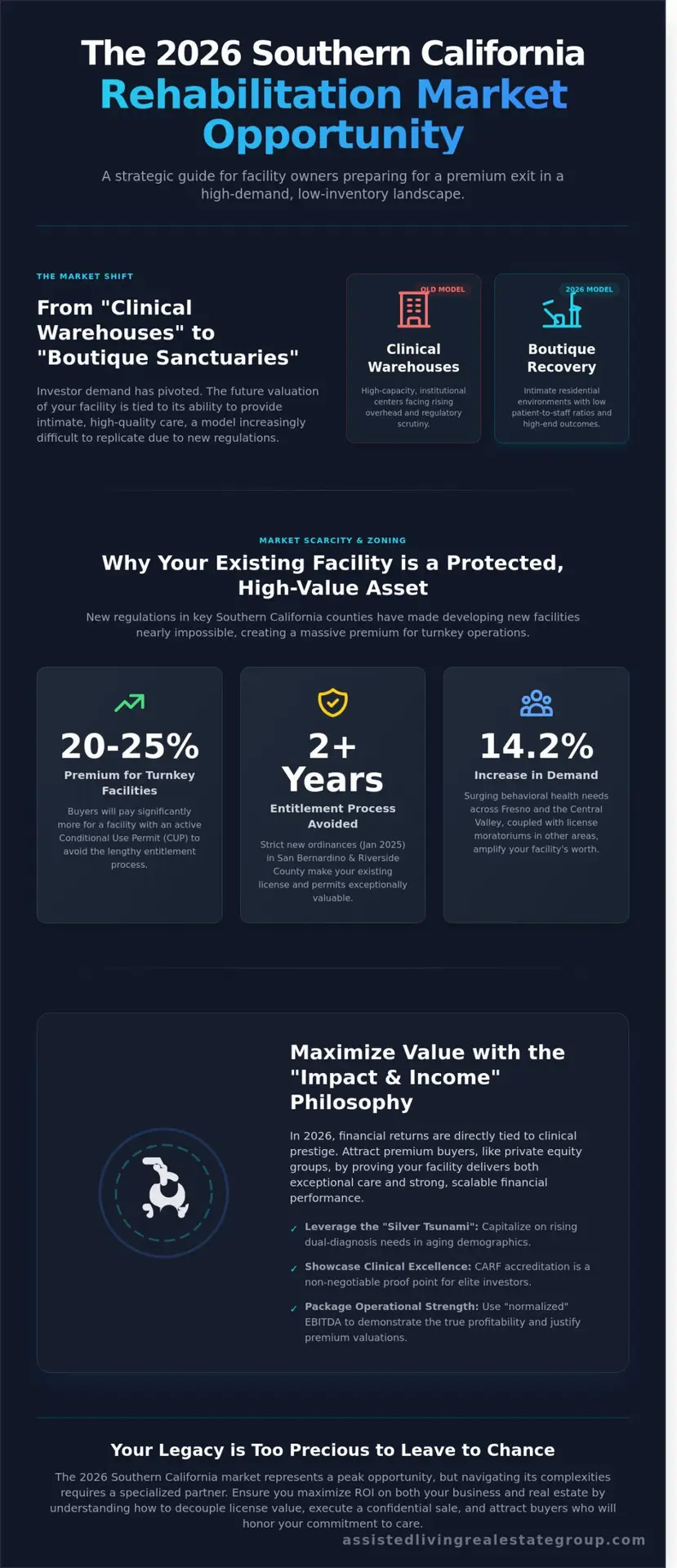
Southern California’s recovery market has transitioned into a “Blue Ocean” for specialized healthcare investors who prioritize quality over quantity. While traditional institutional centers face rising overhead and regulatory scrutiny, the demand for localized care in San Jacinto, Van Nuys, and Fresno has surged by 15% since 2024. Investors are no longer hunting for 100-bed clinical warehouses. They’re seeking boutique, residential environments that offer intimacy and high-end clinical outcomes. Understanding how to sell a rehabilitation facility in this climate requires a shift in perspective. You aren’t just selling real estate; you’re selling a high-value infrastructure that’s increasingly difficult to replicate.
The 2026 landscape is defined by a move toward “Boutique” residential recovery. This model prioritizes a lower patient-to-staff ratio, which justifies higher daily rates and attracts private-pay clientele. In cities like Van Nuys, the conversion of residential properties into licensed facilities has slowed due to market saturation, making existing, high-performing operations more valuable than ever. Sellers who can demonstrate a history of clinical excellence and operational efficiency are finding themselves in a position of significant leverage.
Market Scarcity and Zoning in SoCal
San Bernardino and Riverside County have implemented much stricter zoning ordinances as of January 2025. These regulations make new developments nearly impossible in high-demand residential neighborhoods. This creates a massive premium for turnkey facilities. If you own a property with an active Conditional Use Permit (CUP), you’re holding a rare asset. Buyers will pay a 20% to 25% premium for a facility that avoids the two-year entitlement process required for new builds. Key factors driving current valuations include:
- The 14.2% increase in behavioral health demand across Fresno and the Central Valley.
- A moratorium on new residential care licenses in specific high-density San Bernardino zones.
- The rising cost of construction, which makes purchasing an existing facility more attractive than building from scratch.
By 2026, the intersection of rigid local zoning and a projected rise in California’s behavioral health needs has transformed existing licensed facilities into the state’s most protected and profitable real estate class.
The “Impact and Income” Philosophy
2026 represents a strategic peak for facility exits. The “Silver Tsunami” isn’t just about senior housing; it’s about the corresponding rise in dual-diagnosis and substance abuse needs among aging demographics in California. Savvy owners are leveraging the “Impact and Income” philosophy to attract private equity groups. High-level financial returns are now inextricably tied to clinical prestige. Citing your standing with the Commission on Accreditation of Rehabilitation Facilities (CARF) is a non-negotiable step for maximizing your valuation during a sale.
Specialized brokers who understand these nuances are essential for navigating the complex California licensing landscape. They ensure that your legacy of care translates into a significant financial exit. Knowing how to sell a rehabilitation facility means knowing how to package your operational excellence as a scalable investment model. You’ve done the hard work of building a mission-driven business; now it’s time to capture the value you’ve created in a market that rewards expertise.
Determining the Value of Your Recovery Facility
Pricing your asset correctly is the difference between a legacy-defining exit and a stalled listing. When you’re learning how to sell a rehabilitation facility in the competitive Southern California market, you must look beyond standard commercial real estate metrics. We focus on a “normalized” EBITDA, which adds back one-time capital expenditures or owner-specific perks to reveal the true operational strength. In Los Angeles and Orange County, sophisticated buyers look for this transparency to justify the premium prices these boutique environments command.
Business vs. Real Estate Valuation
General commercial brokers often fail because they don’t understand the high-barrier-to-entry nature of California licensing. They might value the “sticks and bricks” but ignore the operational value of the license itself. Your facility’s value is often split between the physical deed and the business’s ability to generate “Impact and Income.” For those looking to maximize their exit, offering a lease-to-own option can be a strategic masterstroke; it typically allows for a 12% to 15% premium on the final sale price because it lowers the initial capital hurdle for the buyer. If your facility includes specialized components, you might want to review our guide on how to sell adult residential facility California assets to understand these nuances deeper.
The business license, governed by California’s Department of Health Care Services, represents a massive portion of your intangible value. In a state where zoning laws are notoriously tight, a fully compliant, licensed facility is a “blue ocean” opportunity for investors who want to skip the two-year wait for new approvals.
Key Factors Influencing Your ROI
To secure a top-tier valuation, your numbers must reflect the specific realities of the SoCal landscape. Investors aren’t just buying a building; they’re buying a predictable cash flow and a reputation. Consider these specific benchmarks that drive your multiple:
- Occupancy Benchmarks: While the national average struggles, successful Southern California recovery centers maintain a consistent 85% to 92% occupancy rate.
- Payer Mix: A diversified portfolio is essential. Facilities with a 70% Private Pay or PPO insurance mix command significantly higher valuations than those relying solely on state-funded programs.
- Cap Rate Compression: While national healthcare cap rates might sit near 7%, the high demand in coastal California often compresses these rates to 5% or 6%, signaling a lower risk profile for buyers.
- Intangible Assets: Your referral networks with local medical hubs like Hoag Hospital or Cedars-Sinai are concrete assets that should be quantified during the sale.
When determining how to sell a rehabilitation facility, it’s vital to remember that EBITDA multiples for California-based centers typically range from 4x to 6x. This variance depends heavily on the scalability of your systems and the strength of your clinical team. If you’re ready to see how your specific facility stacks up against current 2024 market data, you can consult with our strategic partners to get a precise valuation that honors the legacy you’ve built.
California Regulatory Compliance and Licensing
Selling a healthcare asset in the Golden State requires more than a simple deed transfer. It demands a mastery of the Department of Health Care Services (DHCS) protocols. If you’re learning how to sell a rehabilitation facility, you must understand that Title 22 compliance is your most valuable currency. Buyers aren’t just looking at your cap rate; they’re looking for a clean record of “Substantial Compliance.” Any pending citations or unresolved deficiencies can stall a deal for months. This is a high-barrier-to-entry market, and your regulatory standing is what justifies a premium valuation.
In Southern California, municipalities like Los Angeles and San Diego have unique zoning overlays that complicate transfers. You need to be audit-ready before the first walkthrough. This means having every personnel file, medication log, and incident report organized and accessible. This level of preparation turns a high-stress exit into a “blue ocean” opportunity for the right investor. When you present a facility that exceeds state standards, you aren’t just selling real estate; you’re selling peace of mind.
DHCS vs. DSS: Knowing the Difference
Understanding which agency governs your facility is vital for a smooth transition. Most addiction treatment centers fall under DHCS oversight. However, if your model includes specialized care for seniors, you may be operating under Department of Social Services (DSS) guidelines. This is common when you sell assisted living facility assets that offer dual-diagnosis support. Knowing the specific Residential Care Facilities for the Elderly (RCFE) guidelines can prevent a licensing mismatch during escrow.
If your facility operates as a nonprofit, you must also navigate the California Attorney General review process. This legal requirement ensures that the public interest is protected during the sale or transfer of nonprofit healthcare assets. Handling these administrative hurdles without interrupting daily operations is the hallmark of a professional sale. It allows you to maintain your legacy while securing your financial future through a strategic exit.
The Due Diligence Checklist for CA Sellers
Preparation is the bridge between a “for sale” sign and a successful closing. Start with your physical plant. In high-density areas like Carson, Fire Marshal clearances are notoriously rigorous. Ensure your smoke dampers and sprinkler systems meet the latest local codes before the buyer’s inspector arrives. A failed inspection at the eleventh hour can cost you thousands in price concessions.
- Staffing Ratios: Update your payroll records to reflect 2026 California mandates for direct care hours.
- Licensing Continuity: File your “Change of Ownership” (CHOW) applications early to avoid the 90-day processing backlogs common in Southern California.
- The Boutique Advantage: Highlight your “Impact and Income” potential by showcasing how your smaller, boutique environment exceeds Title 22 safety standards.
When you understand how to sell a rehabilitation facility through the lens of compliance, you eliminate the friction that kills deals. You position your facility as a turnkey investment, ready to provide high-quality care from day one. This methodical approach ensures that you don’t just find a buyer, but the right partner to carry your mission forward.
Executing a Confidential Marketing Strategy
Selling a high-stakes healthcare asset in Southern California requires more than a simple listing. It demands a “blue ocean” approach where discretion is your strongest currency. Publicly broadcasting a sale can trigger immediate instability, causing a 20% to 30% drop in census as families move loved ones to perceived “stable” facilities. When you understand how to sell a rehabilitation facility, you realize that protecting the brand’s integrity is just as vital as the real estate value. We utilize “Blind Profiles” to pique interest. These documents highlight the 12% cap rate and the facility’s 2024 revenue growth without revealing the specific address or name, ensuring your operations remain undisturbed while we hunt for the right capital partner.
Protecting Your Reputation and Operations
Confidentiality isn’t just a preference; it’s a defensive wall against competitor poaching. In the dense SoCal recovery market, rival operators often monitor licensing changes through the California Department of Health Care Services (DHCS). If news of a sale leaks prematurely, your top-tier clinical staff might be recruited by competitors promising “long-term security.” We mitigate this risk by requiring ironclad, California-specific Non-Disclosure Agreements (NDAs) before any proprietary data is shared. This process ensures that only vetted, high-net-worth individuals or groups see your internal metrics. Managing the transition with staff and residents occurs only after a firm commitment is in place, typically 30 days before closing, to maintain the “Impact and Income” your facility is known for.
Targeting the Right Buyer Profile
The Southern California market is currently seeing a surge in “Boutique Investors” who prioritize luxury, intimate settings over massive institutional warehouses. While Private Equity groups still seek 50 plus bed facilities for rapid scaling, individual entrepreneurs are paying premiums for high-end residential models in coastal pockets like Malibu or Newport Beach. These buyers aren’t just looking for a building; they’re looking for a legacy asset that balances social good with significant financial returns. To reach them, we follow a methodical roadmap:
- Phase 1: Create a Blind Profile focusing on EBITDA and DHCS license status.
- Phase 2: Verify Proof of Funds (POF) for a minimum of 25% down payment.
- Phase 3: Execute the NDA and release the Confidential Information Memorandum.
- Phase 4: Conduct after-hours facility tours to keep the process invisible to residents.
- Phase 5: Review Letters of Intent (LOI) to ensure the buyer’s vision aligns with your clinical standards.
This strategic sequence is the only way to navigate the “Silver Tsunami” of aging demographics while securing a premium exit. If you’re ready to explore how to sell a rehabilitation facility without compromising your reputation, let us guide your transition.
Secure your legacy and maximize your ROI with a team that understands the SoCal boutique market. Contact the Assisted Living Real Estate Group today for a confidential consultation.
Partnering with a Specialized Southern California Broker
General commercial real estate agents often miss the mark because they treat a treatment center like a standard office building. They view your facility through the lens of square footage and cap rates, failing to account for the specialized licenses and operational cash flow that define the California care market. Understanding how to sell a rehabilitation facility requires a deep dive into the state’s complex regulatory environment, specifically Title 22 regulations and Department of Health Care Services (DHCS) oversight. A generalist won’t understand the intrinsic value of your “Boutique” care model or the proprietary systems you’ve built to combat the addiction crisis.
With 25 years of experience in the California care industry, Assisted Living Real Estate Group bridges the gap between cold financial metrics and compassionate service. We recognize that your facility represents a significant social impact; it’s a legacy of healing that deserves a premium valuation. The “Silver Tsunami” and the increasing demand for behavioral health services have created a “blue ocean” opportunity for sellers. However, capturing this value requires a partner who speaks the language of both the investor and the healthcare provider. We ensure your exit strategy reflects the true worth of your operational excellence and real estate assets.
The Assisted Living Real Estate Group Advantage
Our local expertise spans from the high-demand neighborhoods of Thousand Oaks to the growing markets in Fresno and the Inland Empire. We specialize in the nuances of the Residential Assisted Living (RAL) and Adult Residential Facility (ARF) segments, ensuring your property is positioned correctly for California’s unique zoning laws. By leveraging our proprietary network of qualified California buyers, we bypass the uncertainty of the open market. This allows for a discreet, efficient transaction that protects your reputation and maintains staff stability throughout the sale process.
Your Strategic Exit Starts Here
Transitioning from “Impact” to a successful “Income” retirement is a methodical process that begins with a confidential consultation with Teri Szoke. We move beyond surface-level statistics to analyze your facility’s specific ROI and growth potential. Our roadmap ensures you don’t just sell a building; you transfer a high-performing asset to a buyer who values your mission. Don’t leave your legacy to chance in a volatile market. Take the first step toward a secure financial future by securing professional guidance. Get your confidential facility valuation today and discover the true market potential of your Southern California rehabilitation facility.
Securing Your Legacy in the 2026 Southern California Recovery Market
The “Silver Tsunami” isn’t just a demographic shift; it’s a “blue ocean” for facility owners who understand their true market worth. Successfully navigating how to sell a rehabilitation facility in Southern California requires more than a simple listing. You’ve got to balance DHCS regulatory rigor with a marketing strategy that protects your facility’s reputation. By 2026, the demand for boutique care environments will reach new heights. This creates a unique window to transition your “impact and income” into a lasting financial legacy.
The Assisted Living Real Estate Group brings 25 years of specialized California care facility experience to your side. We don’t guess at value. We apply a proprietary confidential marketing framework that respects the delicate nature of Title 22 compliance. Our team has guided hundreds of owners through the high-barrier Southern California market, ensuring every transition maintains quality of life while maximizing ROI.
Don’t leave your exit to chance in a complex regulatory landscape. Secure Your Confidential Facility Valuation with Southern California’s Experts today. Your commitment to compassionate care deserves a reward that reflects your years of hard work. We’re ready to help you navigate this profitable next chapter.
Frequently Asked Questions
How long does it typically take to sell a rehab facility in California?
Selling a rehab facility in Southern California typically takes between 6 and 12 months from the initial listing to the final closing. This timeline accounts for the 90 to 120 days required for California Department of Health Care Services (DHCS) license transfers and the rigorous due diligence performed by sophisticated investors. You’ll need to prepare your financial records and operational SOPs at least 6 months before hitting the market to ensure a seamless transition.
Do I need to disclose the sale to my patients or residents immediately?
You don’t need to disclose the sale to patients until the final stages of the transaction. Maintaining operational stability is vital for preserving the business’s valuation and ensuring patient care remains uninterrupted. Premature disclosure often leads to a 20% drop in census as families seek more stable environments. We recommend signing strict Non-Disclosure Agreements with all potential buyers to protect your boutique facility’s reputation during the process.
How is the real estate value calculated vs. the business value?
Real estate value is calculated using current Southern California cap rates, which often hover between 5% and 7% for specialized healthcare assets. The business value is determined by a multiple of your EBITDA, typically ranging from 3x to 5x for well-managed recovery centers. Understanding how to sell a rehabilitation facility requires balancing these two distinct assets to maximize your total ROI and secure your financial legacy.
What licenses are required to sell a drug and alcohol recovery facility in SoCal?
To sell a drug and alcohol recovery facility in Southern California, you must hold a valid license from the California Department of Health Care Services. If your facility provides detoxification services, an incidental medical services certification is also required. Ensure your facility complies with the 2023 DHCS standards to avoid delays during the Change of Ownership process, which is a critical step for every seller in the state.
Can I sell my facility if I don’t own the building (leasehold interest)?
You can absolutely sell your facility if you don’t own the building by selling the leasehold interest and the business operations. In this scenario, the buyer acquires the DHCS license, the brand, and the right to occupy the space under the existing lease terms. This model is common in high-density areas like Orange County, where the Impact and Income potential remains high even without direct property ownership.
What is the most common reason rehab facility sales fall through in California?
The most common reason sales fall through in California is a failure to pass the DHCS Change of Ownership audit due to undisclosed compliance issues. Approximately 30% of deals collapse during due diligence when buyers discover discrepancies between reported census data and actual insurance reimbursements. Working with a strategic partner helps you identify these red flags early, ensuring your boutique operation is exit-ready before you ever sign a Letter of Intent.
How much are the typical broker fees for a specialized care facility sale?
Typical broker fees for specialized care facilities in Southern California range from 5% to 10% of the total transaction value. This commission covers the complex marketing, vetting of buyers, and management of the regulatory paperwork required for a California healthcare sale. While the percentage might seem high, the expertise provided often increases the final sale price by 15% or more, significantly boosting your net proceeds at the closing table.
Is 2026 a good time to sell a recovery facility in Southern California?
2026 is an exceptional time to sell because the Silver Tsunami is driving unprecedented demand for specialized care environments across California. As interest rates stabilize and institutional capital flows into the blue ocean of behavioral health, boutique facilities are seeing record-high multiples. Learning how to sell a rehabilitation facility now allows you to capitalize on this demographic shift, turning years of compassionate service into a significant financial reward.