
California’s “Silver Tsunami” is no longer a distant forecast; it’s a 9 million person reality that has turned the senior living market into a massive blue ocean for savvy investors. According to the Public Policy Institute of California, the state’s 65 plus population will grow by over 2 million individuals by 2030. While most see a crisis, strategic entrepreneurs recognize a rare opportunity to generate both impact and income through boutique residential assisted living. However, the path to entry is guarded by a complex regulatory gatekeeper. Learning how to get an RCFE license in California requires more than just a passion for care; it demands a precise execution of Title 22 standards and a clear understanding of the state’s rigorous 2026 licensing requirements.
You likely realize that the bureaucratic hurdles of the Department of Social Services can feel like a barrier designed to keep you out. It’s frustrating to face potential delays or confusion between administrator certification and facility licensure when your capital is ready to work. This guide promises to demystify the process, offering a comprehensive roadmap to navigate the licensing timeline and position your facility as a premium, high-end asset. We will explore a step by step checklist that covers everything from zoning to final inspections, ensuring your investment becomes a legacy of quality care.
Key Takeaways
- Identify the “blue ocean” opportunity within California’s aging demographic by transitioning from traditional real estate to the high-yield boutique RCFE model.
- Master the essential dual-track roadmap to understand exactly how to get an RCFE license in California by separating administrator certification from facility licensure.
- Navigate the complex zoning landscape of Southern California, including how to leverage the “6 or fewer” rule to streamline your launch in Los Angeles and Orange County.
- Learn to align your property selection with rigorous CDSS safety standards to ensure your facility is both compliant and investment-ready from day one.
- Implement the “Impact and Income” philosophy to transform a standard care home into a premium luxury brand that commands higher occupancy and superior ROI.
What is an RCFE License and Why is it the Key to California Senior Care?
An RCFE (Residential Care Facility for the Elderly) license is the regulatory gateway to operating a non-medical senior living home in the Golden State. Overseen by the California Department of Social Services (CDSS) and the Community Care Licensing Division (CCLD), this credential permits you to provide care and supervision to residents aged 60 and older. Understanding What is Assisted Living? in a residential setting is the first step toward mastering this niche. By 2026, California’s population over 65 will reach an estimated 8.4 million people. This demographic shift, often called the “Silver Tsunami,” creates a massive demand for high-quality housing. For savvy investors, learning how to get an RCFE license in California isn’t just about compliance; it’s about securing a premier real estate asset that delivers both impact and income.
In Southern California, the 6-bed “Boutique” model has emerged as the gold standard for private investors. These facilities offer a luxury, intimate environment that institutional nursing homes cannot replicate. This model allows for higher price points and superior resident outcomes, making it a blue ocean opportunity for those who value quality over quantity. The ability to provide personalized care in a residential neighborhood creates a competitive advantage that large-scale facilities struggle to match. It’s a strategic play that combines high-yield real estate with a mission-driven service.
The Legal Foundation: Title 22 Regulations
Title 22 is the regulatory framework for non-medical senior care. It serves as the operational bible for every RCFE owner in the state. Recent updates emphasize resident-centered care, shifting the focus from basic supervision to holistic wellness. This shift requires a sophisticated approach to licensing that prioritizes the dignity and autonomy of the senior. Mastering these regulations is the only way to protect your investment and ensure long-term viability in the 2026 market. You’ll need to align your physical plant and staff training with these strict standards to remain in good standing with the CCLD.
RCFE vs. ARF: Choosing Your Investment Path
Investors often weigh the merits of an RCFE versus an Adult Residential Facility (ARF). While both fall under CCLD oversight, an RCFE serves the elderly, whereas an ARF caters to adults with developmental disabilities or mental health needs. Many Southern California investors prefer the RCFE path because it typically yields higher cap rates and offers more flexibility in private-pay pricing. Before you decide, review our guide on RCFE vs. ARF: Which California Facility is Right for You? to align your strategy with your financial goals. Successfully learning how to get an RCFE license in California positions you to capture the premium segment of the aging market while building a lasting legacy of care.
The Dual-Track Process: Administrator Certification vs. Facility Licensure
The journey to mastering how to get an RCFE license in California requires a dual focus. You aren’t just licensing a business; you’re certifying a leader and a physical environment simultaneously. This dual-track system ensures that operational expertise meets rigorous physical safety standards. California separates the person (the Administrator) from the building (the Facility) to create layers of accountability. For 2026 investors, running these tracks concurrently is the fastest route to opening your doors. You can’t legally accept a single resident without both components securing final approval from the California Department of Social Services Senior Care Licensing division.
The logic behind this separation is simple. A beautiful building without a qualified leader is a liability, and a brilliant administrator without a safe facility can’t provide care. By 2026, the “Silver Tsunami” will demand 25% more beds than are currently available in many California counties. To meet this demand, you must synchronize your personal certification with your property acquisition. Most entrepreneurs find that managing both tracks leads to a licensure timeline of 6 to 9 months. This period is your window to build a brand that balances impact and income.
Becoming a Certified RCFE Administrator
The Administrator is the heartbeat of the boutique care model. You must complete the 80-hour Initial Administrator Certification Training Program (ICTP) through a state-approved vendor. This curriculum covers Title 22 regulations, resident rights, and dementia care. After completing the 80 hours, you have 60 days to pass the State Exam with a score of 70% or higher. Don’t overlook the background clearance. Every administrator undergoes a Live Scan fingerprinting process to check for criminal records. This step ensures the “Impact” side of your strategy remains ethically sound. It’s a high-barrier-to-entry requirement that protects the most vulnerable Californians while securing your professional legacy.
Securing the Facility License
While the administrator focuses on compliance, the facility track focuses on the real estate. You must demonstrate “legal control” of the property through a recorded deed or a long-term lease before the state reviews your application. The process begins with a mandatory 3-hour online orientation hosted by the CDSS. The application itself is split into two phases. Part A focuses on your business structure, financial solvency, and organizational charts. Part B focuses on the physical plant, including fire clearances and floor plans. Most successful 2026 projects transition from application to licensure in 180 to 270 days. If you’re looking for a strategic roadmap for RAL investments, understanding this timeline is critical for your financial pro forma.
- Legal Control: A signed 5-year lease or grant deed is mandatory.
- Orientation: Completion of the $50 CDSS online component.
- Application Part A: Focuses on the “Who” (Business entity).
- Application Part B: Focuses on the “Where” (Physical safety).
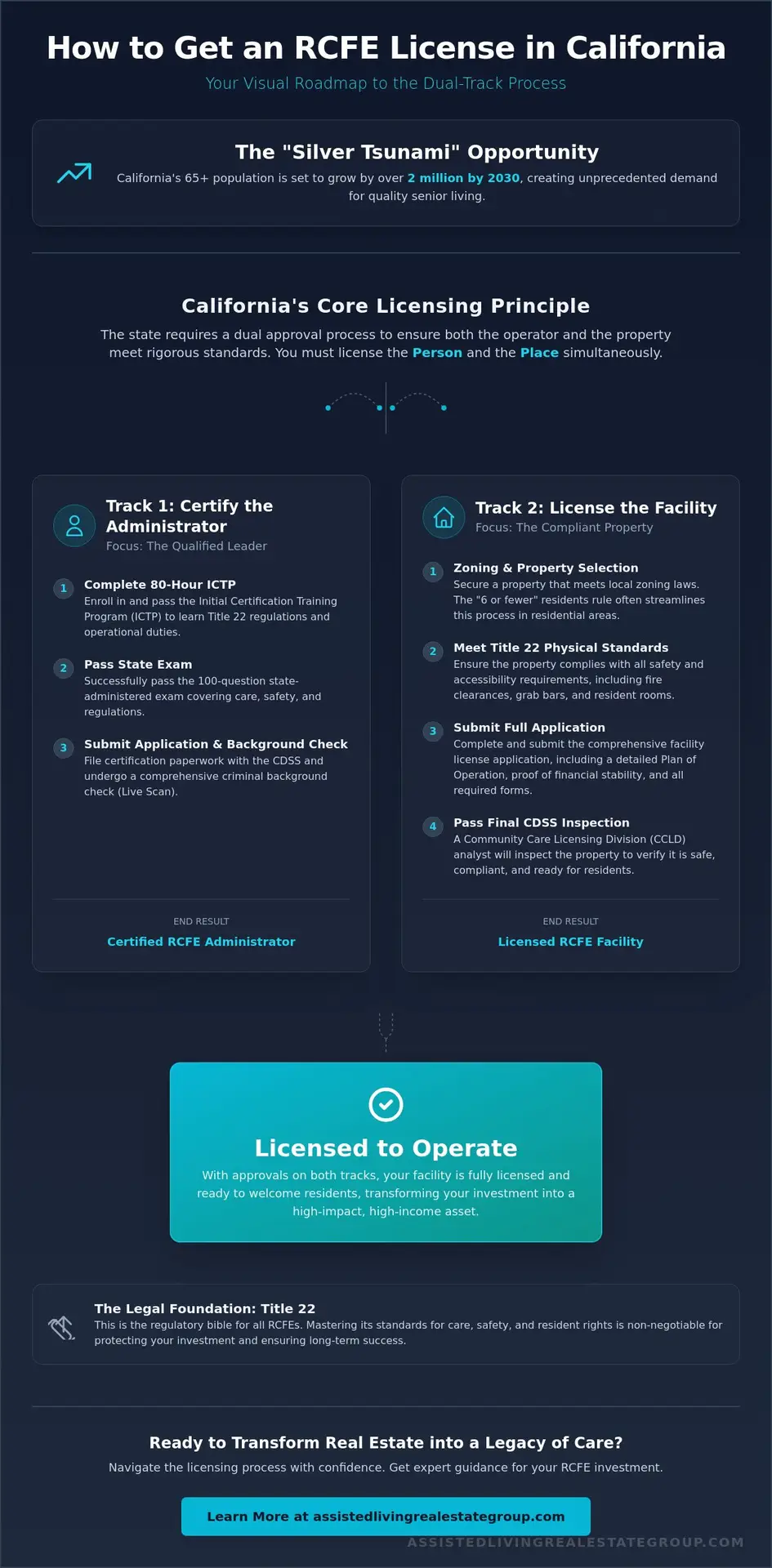
Step-by-Step Roadmap to Your California RCFE Facility License
Securing a license is the strategic moat that protects your high-yield investment from low-barrier competition. The California Department of Social Services (CDSS) maintains rigorous standards to ensure that every “Boutique” RAL environment provides world-class care. Understanding how to get an RCFE license in California requires a shift in perspective. You aren’t just filling out forms; you’re building the operational foundation for a legacy of impact and income.
- Step 1: CDSS Applicant Orientation. You must complete the mandatory orientation, either online or at a local Community Care Licensing Division (CCLD) office. This session provides the baseline regulatory framework for Title 22 compliance.
- Step 2: Secure a Compliant Property. Focus on high-demand Southern California pockets like North San Diego County or the coastal communities of Orange County. Your property must meet specific R-2.1 occupancy standards to house non-ambulatory residents.
- Step 3: Submit Application Packets. Part A focuses on the applicant’s financial stability and background, while Part B details the facility operations, including your plan of operation and sample menus.
- Step 4: Component II and III Interviews. You will meet with a Licensing Program Analyst (LPA) to demonstrate your competency. This is where your identity as a professional operator is verified.
- Step 5: Final Inspection and Fire Clearance. The process concludes with a physical site validation and formal approval from the State Fire Marshal.
The Critical Role of Fire Clearance
Fire clearance is often the longest lead-time item in the licensing timeline. You must coordinate closely with the State Fire Marshal and local Southern California agencies, such as the Los Angeles County Fire Department or the Orange County Fire Authority. Most boutique RAL facilities aim for an R-2.1 occupancy classification. This allows you to serve non-ambulatory residents, which is essential for capturing the highest level of care revenue. A common pitfall is failing to install a compliant, monitored fire alarm system or integrated sprinkler system early in the renovation phase. These oversights can delay your opening by 90 to 120 days.
Component III: The Final Pre-Licensing Inspection
The Component III inspection is the final hurdle before you can begin accepting residents. During this walk-through, the LPA verifies that the physical environment matches the operational plans submitted in your Part B packet. They check for everything from water temperature settings (between 105 and 120 degrees Fahrenheit) to the presence of 30-day emergency food supplies. The final inspection is a test of both physical safety and operational readiness. You must demonstrate that your boutique environment isn’t just a house; it’s a regulated healthcare facility that maintains a warm, home-like atmosphere. Master this step, and you officially unlock the door to the “blue ocean” opportunity of California senior living.
Southern California Zoning and Regulatory Hurdles
Success in the Southern California market requires a strategic shift in perspective. While many novice investors see Los Angeles, Orange County, and San Diego as high-barrier markets, seasoned experts recognize them as high-yield “blue oceans.” The primary tool for bypassing local resistance is the “6 or fewer” rule. Under California Health and Safety Code Section 1566.3, a residential care facility serving six or fewer residents is considered a residential use of property. This means local municipalities can’t require a Conditional Use Permit (CUP) or charge zoning fees that aren’t applied to other single-family homes. It’s a powerful legislative shield that protects your investment from NIMBYism and local red tape.
Investors often claim California regulations make it impossible to find a property. This objection usually stems from looking at traditional real estate listings rather than “licensable” assets. Specialized brokers identify properties with the correct floor plans, egress points, and fire safety potential before they hit the open market. This strategic approach is vital for anyone learning how to get an RCFE license in California while maintaining a competitive ROI. High-end boutique facilities in coastal pockets like Newport Beach or La Jolla can command monthly rates 40% higher than the state average, turning the “Silver Tsunami” into a legacy-building opportunity. You aren’t just buying a house; you’re securing a platform for both impact and income.
Working with SoCal Regional Licensing Offices
Your relationship with the Community Care Licensing Division (CCLD) defines your timeline. In Southern California, you’ll likely interact with the El Segundo, Orange, or San Diego regional offices. Each district has a distinct operational culture. For example, the El Segundo office manages a high volume of applications, requiring your paperwork to be flawless to avoid being buried at the bottom of the stack. Building a professional relationship with your assigned Licensing Program Analyst (LPA) is a strategic move. They aren’t just inspectors. They’re the gatekeepers to your license. Treat every interaction as a high-stakes business meeting to ensure your project stays on track.
Avoiding Common Licensing Delays
Data from the California Department of Social Services (CDSS) indicates that incomplete application packets cause 75% of initial rejections. A single missing signature or an outdated form can set your project back 90 days. Another frequent pitfall involves staffing plans. You must demonstrate the ability to meet required staff-to-resident ratios from the first day of operation. This isn’t just about compliance; it’s about the boutique quality of care that justifies your premium position. To master these technical requirements, review our RCFE Licensing in California: The 2026 Investor’s Guide to Success for a granular breakdown of the 2026 standards.
Maximizing Your ROI: From Licensed to Profitable
Securing your credentials is the first hurdle. The real challenge lies in transforming a regulatory approval into a high-performing financial asset. Understanding how to get an RCFE license in California is the foundation, but the “Impact and Income” philosophy is what drives long-term success. In the competitive Southern California market, the most profitable facilities aren’t the large, institutional nursing homes. They’re “Boutique” environments that offer intimacy, luxury, and specialized care. High-quality care naturally leads to higher occupancy rates, often exceeding 95% in premium neighborhoods like Newport Beach or La Jolla.
The Assisted Living Real Estate Group streamlines this transition. We help you move beyond the basics of how to get an RCFE license in California toward a model that captures the “Silver Tsunami” opportunity. By 2030, the Public Policy Institute of California projects the state’s senior population will reach 9 million. This demographic shift represents a blue ocean for savvy investors. We position your facility as a premium brand, ensuring your ROI reflects the elite level of service you provide.
The Value of a Turnkey RCFE
Speed to market is a critical factor in your investment’s success. Starting a new facility from the ground up often involves a 12 to 18 month lead time for zoning, permits, and construction. Buying an existing, licensed facility can reduce this timeline to 3 or 6 months. This provides immediate cash flow and operational stability. Our team leverages a confidential marketing advantage, giving you access to established care homes that never appear on public real estate sites. You can learn more about this strategy in The Ultimate Guide to Buying an RCFE Facility in California.
Building Your Legacy in Senior Care
The rewards of this industry are both moral and financial. Providing elite care in Southern California creates a lasting legacy while generating significant monthly revenue. You’re doing good while doing well. This niche market has high barriers to entry; however, with the right strategic partner, those barriers become your competitive advantage. Don’t navigate this complex landscape alone. To secure your position in this high-growth sector, Partner with Teri Szoke and the Assisted Living Real Estate Group to move from licensing to turnkey business acquisition today.
Master Your Future in California’s Senior Care Market
Navigating the “Silver Tsunami” requires more than just capital; it demands a strategic roadmap through the dual-track process of administrator certification and facility licensure. By 2026, California’s aging population will reach record numbers, creating a massive opportunity for investors who understand how to get an RCFE license in California while adhering to strict Title 22 and CDSS regulations. Success in this high-barrier market hinges on mastering Southern California’s complex zoning hurdles and transforming a residential property into a high-yield RAL facility.
The Assisted Living Real Estate Group brings 25 years of specialized experience to your project, acting as your expert guide from initial site selection to the final sale. We provide confidential marketing expertise for RCFE and ARF assets, ensuring you maximize your ROI while providing elite care. You don’t have to face these regulatory hurdles alone. Our team bridges the gap between sophisticated real estate investment and heart-centered service, helping you secure a premium market position.
Start your journey to Impact and Income and contact the Assisted Living Real Estate Group today. Your vision for a profitable, boutique care environment is within reach.
Frequently Asked Questions
How much does it cost to get an RCFE license in California in 2026?
Expect to pay approximately $3,514 for the initial application fee for a boutique 1 to 6 bed facility based on the latest California Department of Social Services (CDSS) fee schedules. This investment doesn’t include the $500 administrator exam fee or the costs associated with mandatory live-scan fingerprinting and local fire clearances. Savvy investors budget for these regulatory hurdles as the “price of admission” to a high-yield market that balances impact and income.
How long is the RCFE licensing process from start to finish?
The journey from initial orientation to final licensure typically spans 6 to 9 months. This timeline accounts for the three-part application process, mandatory fire marshal inspections, and the CDSS regional office review period. While the “Silver Tsunami” has increased demand, following a strategic roadmap helps you avoid common documentation errors that often cause 90 day delays in the approval queue.
Can I get an RCFE license without a medical degree or nursing background?
You don’t need a medical degree or a nursing license to own or operate a Residential Assisted Living (RAL) facility in California. The state prioritizes administrative competency and a clean background over clinical credentials for the licensee. This regulatory structure allows entrepreneurs to focus on high-level business scaling and ROI while hiring qualified staff to manage the daily care needs of the residents.
What is the 80-hour RCFE administrator certification course?
The 80-hour certification is a mandatory training program that covers California Title 22 regulations, business operations, and resident care standards. It’s a foundational requirement for anyone learning how to get an RCFE license in California. You’ll spend 60 hours in a classroom or live-stream environment and 20 hours in self-study before sitting for the state-proctored exam to prove your operational expertise.
Do I need a different license for a 6-bed home versus a 50-bed facility?
California uses a tiered licensing system where your facility’s capacity determines your specific fee structure and fire safety requirements. A 6-bed boutique home operates under different building codes than a 50-bed institutional facility, specifically regarding R-3.1 fire clearance standards. Choosing the 6-bed model often allows for faster market entry and a more intimate, premium care environment that justifies higher monthly resident fees.
Can I apply for an RCFE license before I have a property?
You can’t submit a final license application without a designated physical address because the state ties the license to a specific site. However, you should complete your 80-hour administrator training and draft your operations manual while you’re in the property acquisition phase. Securing a property that meets local zoning and fire safety standards is a non-negotiable prerequisite for the Component III application stage.
What happens if my RCFE license application is denied by CDSS?
If CDSS denies your application, you’ll receive a formal “Notice of Denial” outlining the specific regulatory violations or missing documentation. You have 15 days to file a written appeal or request a meeting with the regional manager to contest the decision. Most denials result from inadequate financial plans or failure to pass the pre-licensing inspection, making professional guidance essential during the initial filing.
Is an RCFE license transferable when I buy or sell a facility?
RCFE licenses are not transferable between individuals or legal entities; they’re specific to the owner and the location. When you purchase an existing boutique facility, you must submit a “Change of Ownership” (CHOW) application to CDSS to obtain your own license. Understanding how to get an RCFE license in California through the CHOW process is vital for investors looking to acquire cash-flowing assets without starting from scratch.