
What if the highest offer on your senior care facility isn’t actually a successful exit, but a three-month delay that ends in a regulatory rejection? In the competitive 2026 market, finding a qualified buyer for an RCFE requires more than just a proof of funds letter. It demands a strategic partner who is both financially liquid and operationally prepared to pass the rigorous CDSS background check. Many sellers lose sleep over “tire kickers” who lack the necessary administrator certification or the specific liquidity required by Title 22 regulations.
You’ve spent years building a legacy of compassionate care. We understand the anxiety that comes with protecting your facility’s reputation and ensuring your staff and residents remain undisturbed during a transition. This guide will show you how to vet candidates for operational competency and regulatory readiness. You will learn the exact financial benchmarks and background requirements needed to ensure your buyer can successfully navigate the licensing transfer. We’ll outline a roadmap for identifying a buyer who respects your legacy while providing the guaranteed funding needed for a seamless close.
Key Takeaways
- Verify more than just a bank letter. Learn how to scrutinize a buyer’s capacity for SBA 7(a) or commercial financing within the California market.
- Master the process of finding a qualified buyer for an RCFE by vetting their mandatory California Administrator Certification and LiveScan clearance.
- Protect your legacy. Use strict NDAs and blind profile marketing to keep your sale confidential from staff and residents.
- Navigate the escrow-licensing overlap. Understand how a specialized broker manages the complex timing required for a successful California close.
- Stop wasting time on tire kickers. Identify the hybrid investor-provider profile that ensures your deal actually crosses the finish line.
The Complexity of Finding a Qualified Buyer for an RCFE in California
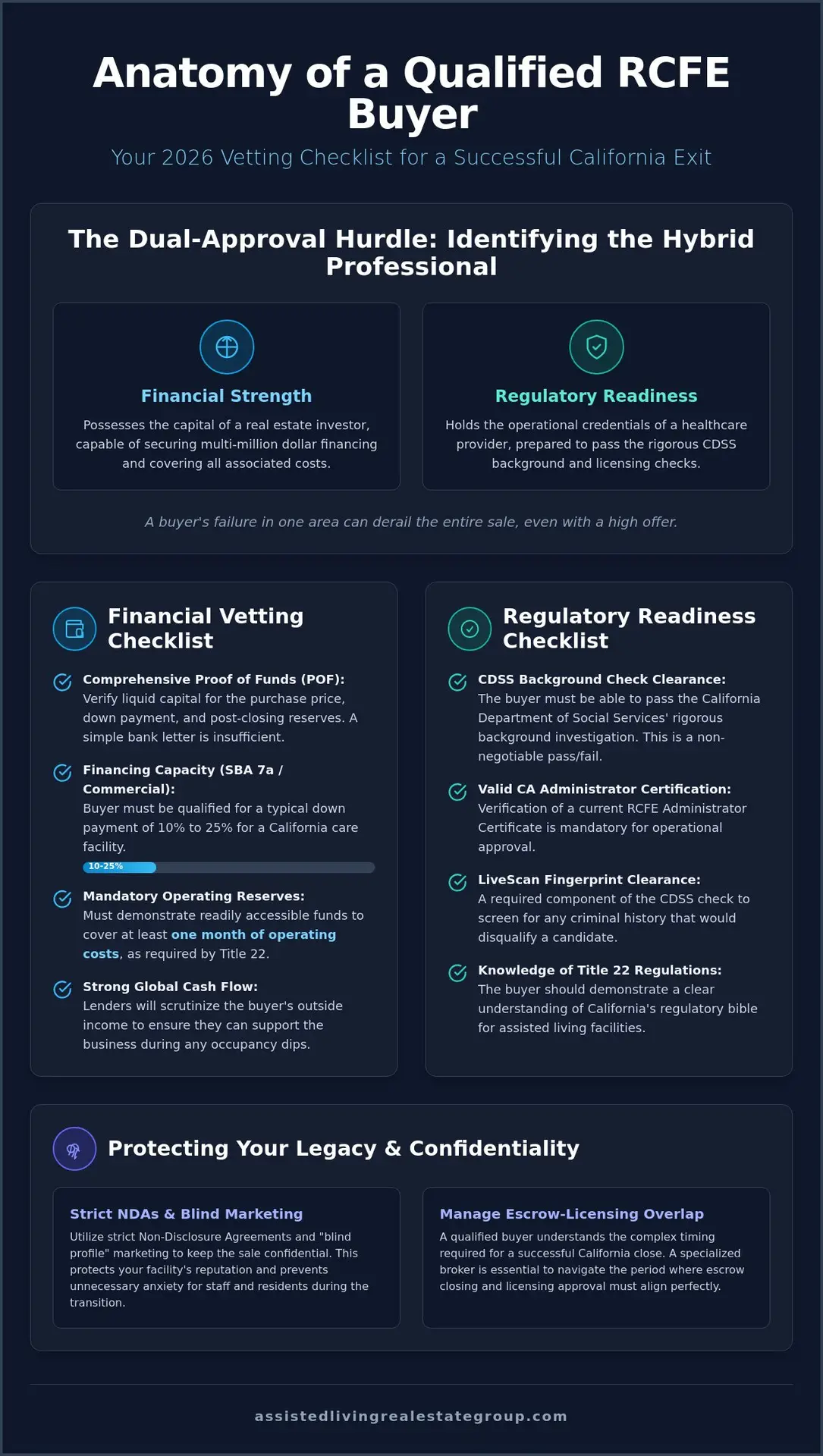
Finding a qualified buyer for an RCFE in California is a multidimensional challenge that transcends traditional real estate transactions. Most residential brokers look for a high credit score and a down payment. In the senior care sector, these metrics are merely the baseline. A truly qualified candidate is a hybrid professional; they must possess the capital of a real estate investor and the operational mindset of a healthcare provider. Because an assisted living facility (ALF) is a highly regulated business, the pool of viable purchasers is naturally smaller and more exclusive than in general commercial real estate.
Sellers often face a dual-approval hurdle that can derail a deal at the eleventh hour. A buyer might secure a commercial loan but fail the California Department of Social Services (CDSS) background check. Conversely, an experienced administrator might have the regulatory credentials but lack the liquidity for the 2026 financial requirements. This high-barrier entry ensures that only the most strategic professionals succeed in the Southern California market. With senior housing occupancy projected to exceed 90% by the end of 2026, the demand is high, but the vetting process remains the primary bottleneck for a successful exit.
Real Estate Value vs. Business Operational Value
In a standard sale, the deed is the prize. However, when you’re selling a care home, the buyer must be qualified to hold the business license, not just own the physical structure. This distinction is vital because a deed without an active license is just a house; it’s the operational capacity that generates the 20% to 35% net margins typical of private-pay facilities. A turnkey business acquisition in the California RCFE market involves the purchase of a fully operational care home where the buyer assumes control of both the physical property and the existing resident care structure. If a buyer cannot prove they can maintain the facility’s legacy and operational standards, the deal carries too much risk for the seller.
The California Regulatory Landscape in 2026
The CDSS plays a central role in buyer vetting, acting as a gatekeeper for the industry. In 2026, regulatory scrutiny is tighter than ever. Title 22 serves as the regulatory bible, determining everything from staffing ratios to financial solvency requirements. In Southern California’s competitive market, a buyer’s suitability is often judged by their ability to navigate these complex rules without triggering a licensing delay. A buyer must demonstrate they have one month of operating costs readily accessible for an existing facility purchase. Without this level of regulatory readiness, even the most well-funded investor will find themselves blocked by state mandates, making professional vetting an absolute necessity before signing a contract.
Financial Vetting: Verifying Liquidity and Funding Capacity
A standard bank pre-approval letter is often insufficient when you’re evaluating a candidate for a multi-million dollar care facility. In the specialized world of senior housing, finding a qualified buyer for an RCFE necessitates a rigorous analysis of their balance sheet that goes far beyond a credit score. You need to see a comprehensive Proof of Funds (POF) statement that accounts for the purchase price, the down payment, and the mandatory post-closing reserves. If a buyer can’t demonstrate immediate access to liquid capital, the risk of an escrow collapse increases exponentially as the deal progresses toward the licensing phase.
Lenders in California look at more than just the buyer’s assets; they scrutinize the Debt Service Coverage Ratio (DSCR) of the facility itself. A sustainable RCFE must generate enough income to cover its debt obligations while maintaining high-quality care standards. Most successful transactions in 2026 utilize SBA 7(a) or conventional commercial financing, which typically requires a down payment of 10% to 25%. However, the lender will also evaluate the buyer’s “Global Cash Flow,” ensuring their outside income can support the business during any potential occupancy fluctuations. If you want to ensure your exit is secure, consulting with an expert in confidential marketing strategy can help identify these pre-vetted candidates before you ever open your books.
Commercial Financing for RCFEs
Securing a loan for a California care facility is a specialized process. Lenders require appraisals that value the business’s income potential alongside the real estate. A qualified buyer must be prepared to show three years of personal and business tax returns to satisfy these institutions. Specialized brokers often verify a buyer’s lender-readiness by reviewing their personal financial statement (PFS) early in the process, ensuring they meet the specific requirements of California’s commercial lending landscape. This proactive vetting prevents “tire kickers” from wasting your time with offers that will never clear the bank’s underwriting department.
Operational Reserves and Transition Costs
Liquidity doesn’t end at the down payment. A strategic buyer must have significant reserves to handle the “relicensing” period, which can take 60 to 120 days during a Change of Ownership (CHOW). While the state mandates at least one month of operating costs be readily accessible, a truly prepared buyer should carry three to six months of capital to cover initial staffing, high insurance premiums, and complying with CDSS licensing requirements regarding financial solvency. Red flag profiles often include buyers who are “all in” on the down payment with zero remaining liquidity. These profiles almost always lead to operational failure or regulatory intervention shortly after the keys change hands.
Regulatory Readiness: Can the Buyer Pass CDSS Licensing?
Financial liquidity provides the foundation, but regulatory suitability is what permits the doors to stay open. Finding a qualified buyer for an RCFE requires a deep dive into the candidate’s professional history and their standing with the California Department of Social Services (CDSS). The state doesn’t grant licenses to individuals based on their net worth alone. Instead, they scrutinize the buyer’s ability to provide safe, dignified care under strict Title 22 guidelines. If a buyer has a history of citations or lacks the requisite certifications, the Change of Ownership (CHOW) process will likely stall, leaving the seller in a precarious position.
The vetting process includes a mandatory LiveScan fingerprinting and background clearance. This isn’t a formality. California law includes specific statutory disqualifiers that can prevent an individual from ever holding a license. Additionally, the CDSS evaluator will conduct a suitability interview to assess the buyer’s operational knowledge. This high-stakes meeting is where the buyer must prove they can translate regulatory theory into daily operational excellence. Success here requires more than just reading a manual; it requires a commitment to the ethical and professional standards of the California senior care industry, much as specialized accreditation from ccpac.com maintains high benchmarks in the freight sector.
The RCFE Administrator Requirement
A buyer cannot simply hire their way out of regulatory knowledge. Every facility must have a certified administrator. This individual must complete an 80-hour Initial Certification Training Program (ICTP) and pass a state-proctored exam. Current 2026 fees include $140 for the application and $100 for the exam. For absentee investors, identifying a “Designated Administrator” early is essential to avoid delays. To understand the full scope of these requirements, review our guide on RCFE Licensing in California: The 2026 Investor’s Guide to Success. This ensures the buyer is fully prepared before escrow begins.
Title 22 Compliance and Experience
Title 22 is the regulatory framework that governs every aspect of a California care home. First-time buyers face a steep learning curve. They must prove they can manage complex staffing ratios and varying resident acuity levels from day one. The California Assisted Living Association offers vital resources for maintaining these professional standards. A buyer with a clean professional record is a premium asset. When finding a qualified buyer for an RCFE, prioritize those who view compliance not as a burden, but as a strategic advantage for long-term profitability and resident safety.
Confidentiality and Vetting: Protecting Your Facility’s Reputation
Confidentiality is the bedrock of a successful care facility transaction. Unlike general commercial real estate, where a “For Sale” sign might attract interest, a public listing for a care home can trigger immediate operational instability. Finding a qualified buyer for an RCFE requires a disciplined, multi-stage vetting process that prioritizes your facility’s reputation above all else. You must implement a strict Non-Disclosure Agreement (NDA) before any proprietary financial data or resident counts are released. This ensures that only serious, pre-vetted investors gain access to your sensitive business information.
The “Blind Profile” approach is a critical tool in this process. By marketing the facility’s metrics, such as its EBITDA or its Southern California sub-market, without disclosing the exact address, you maintain total control over the narrative. This strategy prevents “tire kickers” from disrupting your daily operations. You shouldn’t allow a facility tour until the buyer has proven their financial liquidity and regulatory readiness. Every unvetted visitor represents a risk to the peace and privacy of your residents, and in a market where senior housing occupancy is projected to exceed 90% by the end of 2026, protecting your operational flow is paramount.
The Risks of Premature Disclosure
A poorly handled sale can lead to a sudden exodus of staff and residents. In California, where the workforce shortage remains a primary challenge in 2026, losing key caregivers can compromise your licensing standing with the CDSS. Rumors of a sale often create a sense of uncertainty that rivals find easy to exploit. By keeping the sale “off-market” and targeting a curated pool of strategic professionals, you protect the value you’ve built over decades. If you’re considering a transition, our confidential marketing strategy is designed to safeguard your facility’s legacy while maximizing your return.
Vetting for Cultural and Mission Alignment
Profitability is essential, but it shouldn’t be the only metric you consider. A buyer whose care philosophy aligns with your current culture will ensure a smoother transition for everyone involved. Mission-driven buyers are often more resilient and less likely to cut corners on Title 22 compliance. They understand the delicate balance between financial gain and social contribution. For those looking to transition from other types of care, we also provide a guide on how to sell your Adult Residential Facility in California, which follows similar confidential vetting protocols. Finding a qualified buyer for an RCFE who shares your values is the surest way to ensure your facility continues to thrive under new ownership.
The Strategic Advantage: Why a Specialized RCFE Broker is Essential
General real estate agents often treat a care home like a standard residential property; they focus on curb appeal and square footage while ignoring the regulatory landmines that can blow up a deal. Finding a qualified buyer for an RCFE requires a deep understanding of the “escrow-licensing overlap,” where a transaction’s success depends on the synchronized timing of financial closing and state approval. A specialized broker acts as the bridge between these two worlds, ensuring that the 60 to 120 day Change of Ownership (CHOW) timeline doesn’t derail your exit strategy or leave your facility in a state of operational limbo.
At Assisted Living Real Estate Group, we leverage over 25 years of combined industry experience to protect our clients’ interests. We understand that your time is a finite resource. This is why we filter approximately 90% of all initial inquiries before they ever reach your desk. By the time a buyer is presented to you, they’ve already been vetted for financial liquidity, operational experience, and regulatory readiness. This exclusive approach ensures you only engage with high-value, ready-to-operate investors who possess the sophistication required for the Southern California market. Our pre-vetted database is a curated pool of strategic professionals who understand that a premium facility justifies a premium investment.
Navigating the Southern California Market
The demand for boutique care settings in Los Angeles, Orange County, and San Diego has reached historic levels in 2026. However, pricing a business in these high-stakes regions requires more than just looking at comparable real estate sales. We analyze your facility’s EBITDAR, resident acuity levels, and staffing efficiency to position your business as a premium investment. Our success fee model aligns our interests with yours; we only succeed when you achieve a clean, profitable exit that honors the legacy of your care home. Finding a qualified buyer for an RCFE in these competitive counties demands local expertise that can distinguish between a serious operator and an opportunistic amateur.
Your Next Steps Toward a Successful Exit
Preparation is the difference between a failed escrow and a life-changing sale. You should begin by requesting a confidential valuation to understand exactly where your facility stands in the current market. We’ll help you assemble a robust due diligence package that includes three years of financial records and your facility’s CDSS “Licensing Report Card.” This transparency builds trust with serious buyers and accelerates the vetting process, moving you closer to a transition that respects both your financial goals and your residents’ well-being. Contact Teri Szoke and the team for a confidential consultation.
Securing Your Legacy in the 2026 California Market
The process of finding a qualified buyer for an RCFE in 2026 demands more than just financial vetting. It requires a strategic partner who understands the intricate dance between California’s Title 22 regulations and commercial lending requirements. You’ve worked hard to build a facility that provides essential care; don’t let a poorly vetted buyer compromise that legacy. By prioritizing confidentiality and regulatory readiness, you ensure a transition that protects your residents and your financial future.
As Southern California market leaders with 25+ years of specialized experience, we serve as your expert guide through this complex landscape. Our team of confidential marketing experts is dedicated to identifying investors who are ready to operate and ready to close. The current demographic shift presents an untapped market potential for strategic professionals, but capturing that value requires a precise roadmap.
Take the first step toward a clean exit today. Secure a Confidential Valuation for Your California RCFE and discover how our seasoned expertise can turn your dedication into a significant financial return. Your legacy deserves a buyer who is as committed to excellence as you are.
Frequently Asked Questions
What is the most important qualification for an RCFE buyer in California?
The most critical qualification is the buyer’s dual status as a financially solvent investor and a regulatory-compliant operator. In California, a buyer must demonstrate they have at least one month of operating costs readily accessible for an existing facility. They also need to pass the CDSS suitability interview. Without this balance, even a well-funded investor won’t clear the state’s rigorous licensing hurdles.
How do I verify a buyer’s financial liquidity without scaring them off?
You should require a Personal Financial Statement (PFS) and a Proof of Funds (POF) before sharing sensitive operational data. Professional investors in the senior care space understand that finding a qualified buyer for an RCFE involves high-level transparency. A specialized broker handles these requests discreetly. This ensures you only engage with candidates who have the capital to close the deal and the liquidity to sustain operations.
Can a buyer acquire an RCFE if they don’t have an Administrator Certificate?
A buyer can acquire a facility without a personal certificate if they hire a certified California RCFE Administrator to manage daily operations. This “Designated Administrator” must be identified in the licensing application. While the buyer doesn’t need the certification, they still must pass a LiveScan background clearance and a suitability interview with a CDSS evaluator to prove they understand Title 22 standards.
How long does it typically take to vet a buyer for a California care facility?
Initial financial and experience vetting usually takes two to five days through a specialized brokerage. However, the comprehensive regulatory vetting performed by the state occurs during the Change of Ownership (CHOW) period. This process typically lasts between 60 and 120 days. During this time, the CDSS reviews the buyer’s plan of operation, financial solvency, and criminal record to ensure they’re fit to provide care.
What happens if a buyer fails the CDSS background check during escrow?
If a buyer fails the background check, the CDSS will deny the license transfer, effectively killing the deal. Statutory disqualifiers for certain crimes are non-negotiable in California. This failure usually allows the seller to terminate the contract and keep a portion of the earnest money deposit. It’s why pre-screening candidates for prior citations or legal issues is a non-negotiable step in the vetting process.
Is it possible to sell my RCFE without my staff and residents finding out?
Confidentiality is maintained by using a “Blind Profile” and requiring a signed Non-Disclosure Agreement (NDA) before disclosing your facility’s identity. This prevents staff or residents from learning about the sale prematurely. By keeping the listing off public portals, you protect your facility’s reputation. Finding a qualified buyer for an RCFE through private networks ensures the transition remains seamless and your operational stability is never threatened.
What is a ‘Blind Profile’ in RCFE marketing?
A Blind Profile is a strategic marketing tool that describes your business’s financial performance and general location without revealing its name or address. It focuses on technical metrics like net margins, bed capacity, and specific Southern California sub-markets. This allows you to attract serious investors while keeping your intentions private from competitors, employees, and the local community until a qualified candidate is identified.
Why shouldn’t I use a general residential Realtor to sell my RCFE?
Residential Realtors don’t understand the complexities of Title 22 or the CDSS licensing transfer process. Selling a care facility isn’t just a real estate transaction; it’s a highly regulated business transfer. A general agent often misses critical regulatory red flags that lead to escrow cancellations. Specialized brokers bring decades of niche experience to ensure finding a qualified buyer for an RCFE results in a successful, closed transaction.