
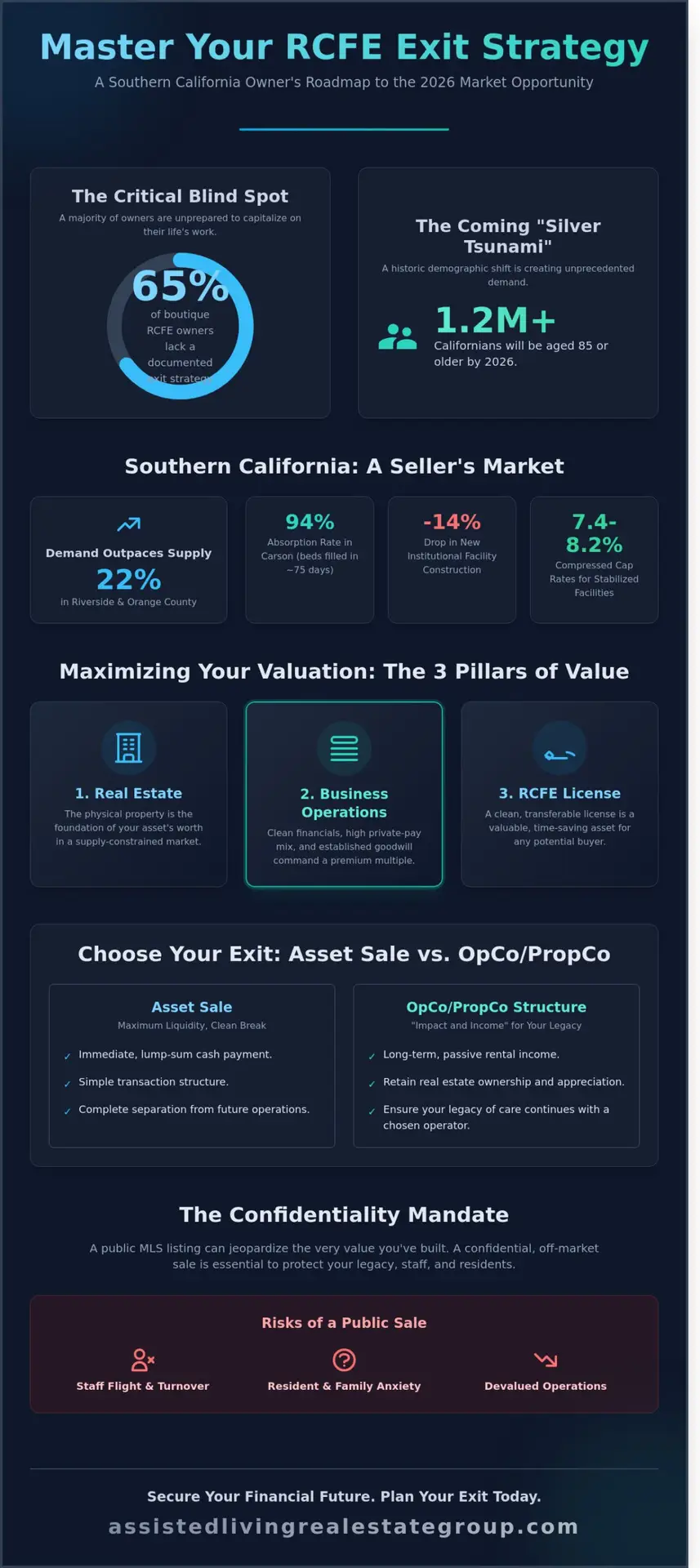
By 2026, over 1.2 million Californians will be aged 85 or older, yet 65% of boutique RCFE owners currently lack a documented exit strategy for assisted living owners to capture this historic demographic shift. You’ve likely spent 20 plus years building a reputation for excellence, and it’s natural to worry that a leaked sale might trigger staff turnover or that the complex CDSS transfer requirements will devalue your hard work. You want to ensure your residents continue receiving high-quality care while you finally realize the financial rewards of your investment.
This guide provides the definitive roadmap for mastering the Southern California market with confidence. We’ll show you how to separate your real estate value from your business operations to achieve a premium valuation that reflects both your impact and income. You’ll discover the confidential steps to manage the California regulatory landscape, secure a high-multiple offer, and transition your boutique facility to the next generation of leadership without compromising your legacy.
Key Takeaways
- Capitalize on the 2026 “blue ocean” opportunity in Southern California, leveraging the Silver Tsunami to position your Riverside or Orange County facility for a premium sale.
- Discover how to maximize your RCFE valuation by optimizing the three pillars of real estate, operations, and licensing, specifically for high-demand boutique 6-bed environments.
- Evaluate the most profitable exit strategy for assisted living owners, comparing immediate liquidity through asset sales against the long-term passive “Impact and Income” of an OpCo/PropCo structure.
- Safeguard your legacy and prevent staff flight by mastering the “Confidentiality Mandate,” ensuring a seamless hand-off without the risks of a public MLS listing.
- Navigate the complex California closing process with a roadmap that secures your financial future while maintaining the high standard of care your residents deserve.
Planning Your Exit Strategy in the 2026 Southern California Market
The 2026 Southern California market represents a “blue ocean” opportunity for sellers who understand the shifting tides of senior care. By early 2026, the first wave of Baby Boomers has reached age 80, triggering a massive surge in demand for high-quality Residential Assisted Living (RAL). In regions like Riverside and Orange County, the demand for licensed beds is currently outpacing supply by 22%. This isn’t just a trend; it’s a structural shift in the California economy that favors owners ready to capitalize on their hard work.
Success requires a mental shift from “Owner-Operator” to “Strategic Seller.” Many owners remain tethered to the daily grind of medication logs and kitchen schedules, failing to see their facility as a high-value financial asset. Developing a formal exit strategy for assisted living owners allows you to detach from operations and focus on maximizing your ROI. With 2026 interest rates stabilizing at approximately 5.75%, RCFE cap rates have compressed to the 7.4% to 8.2% range for facilities with clean books and stabilized occupancy. This stability creates a predictable environment for buyers, making it the ideal time to secure a premium valuation.
Market Timing: Why Now is the Window for Southern California
Absorption rates in Thousand Oaks and Carson are hitting record highs in 2026. In Carson, 94% of new boutique beds are filled within 75 days of licensure. California’s aging demographic is growing at a rate of 3.2% annually, yet new construction starts for institutional facilities have dropped by 14% due to rising land costs in the Inland Empire. Families are increasingly rejecting the “cold” institutional nursing home model. They’re seeking “Boutique” environments that offer luxury, intimacy, and personalized care. If your facility fits this description, you’re holding a rare commodity in a supply-constrained market.
The Problem-Solution Cadence of Modern Divestment
Operating an RCFE in California isn’t getting easier. Staffing shortages and a 15% year-over-year increase in Title 22 compliance costs are squeezing margins for those without a specialized roadmap. These operational headaches are the primary “pain points” that drive owners to sell, yet they often settle for less by using generalist brokers. Generalist real estate agents don’t understand the nuances of a California Care Plan or the intrinsic value of a well-trained staff. They see a house; we see a cash-flowing enterprise.
The Assisted Living Real Estate Group provides the solution by bridging the gap between real estate and healthcare operations. We focus on “Impact and Income,” ensuring your legacy of care continues while you extract the maximum equity from your business. A sophisticated exit strategy for assisted living owners should account for the “goodwill” you’ve built with local hospitals and social workers. Don’t leave money on the table by ignoring the specialized nature of your 2026 market position.
Maximizing RCFE Valuation: Driving the Highest ROI for Your Legacy
Valuation in the California Residential Care Facility for the Elderly (RCFE) market isn’t a guessing game; it’s a calculation of three distinct pillars: real estate value, business operations, and the RCFE license itself. Every exit strategy for assisted living owners must prioritize these components to capture the full equity you’ve built. In the 2026 Southern California market, buyers aren’t just looking for beds. They’re looking for a stabilized, high-margin asset that can withstand shifting regulations and labor costs. You’ve spent years providing care, now it’s time to ensure the market recognizes the financial engine you’ve created.
The Boutique Premium: Valuing Small-Scale Excellence
Investors are moving away from 100-bed institutional settings. They want luxury residential care. This shift has turned “Boutique” 6-bed facilities into the most sought-after assets in the Inland Empire and Riverside County. For example, a stabilized 6-bed facility in San Jacinto now commands a higher multiple than many mid-sized centers because the overhead is lean and the care is intimate. When your resident mix is 100% private pay, you eliminate the delays of government reimbursement. This directly inflates your Net Operating Income (NOI). Higher NOI leads to a compressed cap rate, putting more cash in your pocket at the closing table.
Financial Preparation: Auditing for the Sophisticated Buyer
You can’t sell what you can’t prove. Sophisticated buyers require three years of specialized, clean P&L statements that strictly adhere to California’s reporting standards. You must identify and “clean up” financial leaks at least 24 months before you list. This means separating your personal lifestyle from the business books. If your facility pays for your personal SUV or family cell phone plan, these expenses must be documented. Add-backs are specific non-operational or one-time costs, such as a 2025 commercial kitchen upgrade or a personal vehicle lease, that are added back to your net income to demonstrate the true EBITDA and earning potential of your care facility to an institutional buyer. If you need help identifying these hidden profits, you can consult with our valuation experts to ensure your books are investor-ready.
- Real Estate: Current market value of the Southern California property based on 2026 appraisals.
- Operations: The efficiency of your staffing ratios and vendor contracts.
- Licensing: The value of a “clean” Title 22 record with no major deficiencies over the last 36 months.
Profitability is the priority, but your legacy is the product. A facility that shows 95% occupancy over a three-year period tells a story of trust and quality. That story is what drives the highest ROI. Don’t leave your hard-earned equity to chance by ignoring the granular details of your financial audit. The “Silver Tsunami” is here, and the buyers are ready if your data is solid.
Comparing Exit Models: Asset Sales vs. OpCo/PropCo vs. Lease-to-Own
You’ve built a legacy in the Southern California care market. Now, you need a blueprint to extract its maximum value. Choosing the right exit strategy for assisted living owners isn’t just a financial decision; it’s about defining your next chapter. Whether you want a total clean break or a steady stream of passive mailbox money, your choice will dictate your tax liability and your long-term involvement in the industry.
- Full Asset Sale: This is the “clean break” path. You sell the Residential Care Facility for the Elderly (RCFE) license, the business operations, and the physical real estate in a single transaction. In 2026, stabilized boutique facilities in markets like Irvine or Carlsbad are trading at cap rates between 6.2% and 7.4%. This model provides immediate liquidity and total divestment.
- OpCo/PropCo Structure: You split the business into two. You sell the operating company (OpCo) to a junior partner or outside buyer while retaining the property (PropCo). This allows you to collect rent while shedding the daily headaches of staffing and Title 22 compliance.
- Lease-to-Own: This serves as a bridge for talented operators who lack the $1.5 million down payment required for a prime Los Angeles property. You receive a premium lease rate and a non-refundable option fee, creating a structured exit over three to five years.
The OpCo/PropCo Advantage for Passive Wealth
Retaining the real estate allows you to transition from an exhausted operator to a sophisticated landlord. This strategy secures long-term cash flow without the 2:00 AM caregiver call-outs. To protect your asset, your lease must mandate that the tenant-operator remains in good standing with the California Department of Social Services (CDSS). A single “Type A” citation can devalue your property overnight, so vetting is non-negotiable. You can explore senior housing investment strategies for Southern California to see how this fits a broader wealth portfolio.
Turnkey Business Acquisitions: Selling the “Engine”
Buyers in the San Diego and Riverside markets aren’t just buying beds. They’re buying systems. A turnkey California care home commands a 22% premium if it includes a “Day One” operational manual. This package includes your resident contracts, digital marketing funnels, and a staff with an average tenure of over 3.5 years. When you package your intellectual property, you’re selling the “engine” of the business. It makes your exit strategy for assisted living owners far more attractive to private equity groups looking for “plug-and-play” boutique RAL models. You’ve done the hard work of building the culture; now it’s time to price it accordingly. This is how you achieve the “Impact and Income” you set out for at the beginning of your journey.
The Confidentiality Mandate: Protecting Residents and Staff During Transition
Selling a Residential Care Facility for the Elderly (RCFE) is a delicate operation where silence is literally gold. In the California market, a leaked sale announcement is the quickest way to devalue your asset. When news of an impending transfer breaks prematurely, staff turnover can spike by 25 percent within weeks, and resident families often begin touring competing boutique facilities in the area. This erosion of census and operational stability can force a price reduction of $100,000 or more before you even reach the closing table. A successful 2026 exit strategy for assisted living owners depends entirely on maintaining the “business as usual” atmosphere until the ink is dry.
Traditional MLS listings are the death knell for a functioning RAL. These public platforms expose your facility’s address and financial vulnerabilities to the entire world, including your competitors and employees. Our “Blind Listing” strategy prioritizes discretion by marketing the opportunity through exclusive networks without revealing the specific location or name. We focus on the high-level metrics like cap rates and licensing capacity, ensuring only serious, well-capitalized investors gain access to the details. This approach protects your legacy while you pursue the “Impact and Income” you’ve worked years to build.
The Art of the Silent Sale
Discretion begins with a rigorous vetting process. Before a potential buyer learns your facility is located in Fresno or Van Nuys, they must sign a healthcare-specific NDA that carries heavy penalties for breaches. These documents aren’t standard real estate forms; they’re tailored to protect the sensitive nature of Title 22 operations. When it’s time for a walkthrough, we don’t announce a “buyer tour.” Instead, we schedule visits after hours or frame them as a “facilities assessment” or “insurance audit.” This prevents the “Silver Tsunami” of anxiety from hitting your residents and keeps your low-level staff focused on providing premium care.
Regulatory Compliance and Licensing Transfers
The California Department of Social Services (CDSS) oversees the Change of Ownership (CHOW) process, which typically spans a 60 to 90 day window during escrow. This period is the most critical phase of your exit strategy for assisted living owners. You must ensure the buyer is not only financially capable but also meets the strict suitability requirements of Title 22. If a buyer fails their background check or lacks the required experience, the deal collapses, often after you’ve already checked out mentally. To prepare for this transition, you should review our Step-by-step guide to RCFE licensing in California to understand what your successor must navigate.
Ready to move toward your next chapter without risking your current operations? Contact the Assisted Living Real Estate Group to start your confidential valuation today.
Executing the Hand-off: Securing Your Financial Future and Legacy
The final stage of your exit strategy for assisted living owners isn’t just a financial transaction; it’s the high-stakes culmination of years spent building a “Boutique” legacy. In the 2026 California market, the distance between an accepted offer and a successful “Impact and Income” wire transfer is paved with rigorous verification. You’ll need to decide early if you’ll exit completely at closing or stay on as a consultant for 60 to 120 days. This transition period is often vital for maintaining high-occupancy standards while the new operator navigates the Change of Ownership (CHOW) process with the California Department of Social Services.
Selling a high-value RCFE in Southern California triggers complex tax liabilities that require proactive planning. With California’s top state income tax rate holding at 13.3%, savvy owners utilize specialized tax strategies to protect their equity. Whether you opt for a 1031 exchange into a larger RAL project or an installment sale to spread out capital gains, your goal is to maximize the net proceeds that land in your account. You’ve done the hard work of caring for others; now it’s time to ensure the financial harvest reflects the true value of your service.
The Due Diligence Gauntlet
Expect a forensic level of scrutiny during the 30 to 60 day due diligence window. Buyers will hire expert consultants to perform deep dives into your Title 22 compliance history and physical plant safety. You must have three years of organized resident files, employee training logs, and audited financial statements ready for the buyer’s counsel. Before you open your books, ensure you are preparing your California care home for a successful sale to prevent unexpected price retrades during the inspection phase.
Your Next Chapter: Beyond the Sale
Closing the deal opens doors to new “Impact and Income” opportunities that extend far beyond the daily operations of a facility. Many Southern California owners reinvest their multi-million dollar proceeds into passive real estate syndications or larger-scale boutique developments. There is a unique emotional satisfaction in passing the torch to a qualified successor who will maintain your standards of care. Don’t leave your legacy to chance. Schedule your confidential RCFE valuation with Teri Szoke today to begin the process of turning your business into a secured financial future.
Secure Your Southern California Legacy and Financial Future
The 2026 Southern California market presents a rare “blue ocean” opportunity for RCFE and ARF owners to capitalize on decades of hard work. You’ve provided essential boutique care; now you must ensure your transition maximizes both impact and income. By selecting the right model, whether it’s an asset sale or an OpCo/PropCo structure, you protect the high-barrier-to-entry position you’ve built. Implementing a strategic exit strategy for assisted living owners is the only way to safeguard your staff and residents while hitting your target cap rates.
Navigating California’s strict licensing and zoning laws doesn’t have to be a solo journey. We offer 25+ years of specialized California care facility experience to guide your hand-off. Our proprietary “Confidential Marketing Strategy” has successfully secured the financial futures of owners from San Jacinto to Thousand Oaks. Don’t let the “Silver Tsunami” pass you by without a proven roadmap for your ROI. It’s time to turn your years of service into a lasting financial reward.
Get a Confidential Valuation for Your California Care Facility
Your dedication to quality care has created immense value, and it’s finally time you realize the full reward of that commitment.
Frequently Asked Questions
What is the average multiple for an RCFE sale in Southern California in 2026?
The average EBITDA multiple for a Southern California RCFE in 2026 ranges from 3.8x to 4.5x for individual boutique homes. Larger portfolios often command a premium of 5.2x or higher due to operational efficiencies and scaled management. This valuation reflects the intense demand created by the Silver Tsunami hitting the California coast. Your exit strategy for assisted living owners must account for these specific market multiples to ensure you don’t leave money on the table.
How long does it take to sell an assisted living facility in California?
Selling an assisted living facility in California typically requires 180 to 240 days from the initial listing to the final close of escrow. This timeline includes a 60 day marketing period and a 120 day escrow to accommodate the California Department of Social Services (CDSS) licensing process. Delays often occur during the background check phase for new operators. You’ll want to prepare your financial records at least 12 months before listing to expedite the due diligence phase.
Can I sell my RCFE business without selling the real estate?
You can sell your RCFE business as a leasehold interest while retaining ownership of the physical property. This strategy allows you to generate passive rental income through a triple net (NNN) lease while cashing out on the business goodwill. In 2026, many Southern California owners choose this path to maintain their real estate footprint in high appreciation zones like Orange County or San Diego. It’s a proven way to balance long term wealth with immediate liquidity.
What happens to my RCFE license when I sell the business?
RCFE licenses in California are non-transferable and remain tied to the specific provider and location. When you sell, the buyer must submit a new application to the Community Care Licensing Division (CCLD) under a “Change of Ownership” (CHOW) request. You’ll keep your license active until the buyer receives their provisional approval. This ensures there’s no gap in care for your residents during the transition of your boutique facility.
Do I have to tell my staff I am selling my care home?
You aren’t legally required to notify staff until a definitive agreement is signed, but most experts recommend a 30 to 45 day notice period before closing. Transparency helps prevent “staff flight” which can devalue your business during the final stages of a sale. We advise sharing the news once the buyer’s financing is secured. This preserves the “Impact and Income” balance by ensuring resident care remains stable while you finalize your exit strategy for assisted living owners.
How is a 6-bed boutique facility valued differently than a large assisted living center?
A 6-bed boutique facility is valued primarily on a “price per bed” basis or a blend of residential real estate value and business cash flow. In 2026, premium Southern California RAL homes trade between $175,000 and $250,000 per bed. Conversely, large assisted living centers are valued strictly on a Capitalization Rate, usually ranging from 6.2% to 7.8% in the California market. The boutique model offers a more intimate investment profile that often yields higher per-resident margins.
What are the main reasons RCFE sales fall through in California?
The primary reason RCFE sales fail in California is the buyer’s inability to secure CDSS licensing approval within the 120 day escrow window. Financial discrepancies found during due diligence, specifically unrecorded labor costs, account for 22% of collapsed deals. Additionally, failing to pass a pre-sale Title 22 compliance audit can lead to immediate buyer withdrawal. You must ensure your facility meets all 2026 regulatory standards before entering the market to avoid these pitfalls.
How do interest rates in 2026 affect my facility’s asking price?
Interest rates for SBA 7(a) loans, which hover around 6.75% in early 2026, directly influence the purchasing power of your buyer. Higher rates typically lead to a 5% to 8% reduction in asking prices as debt service coverage ratios become tighter. However, the scarcity of licensed boutique beds in Southern California often offsets these rate hikes. Savvy investors still view the RAL market as a blue ocean opportunity despite the fluctuations in the broader financial landscape.