
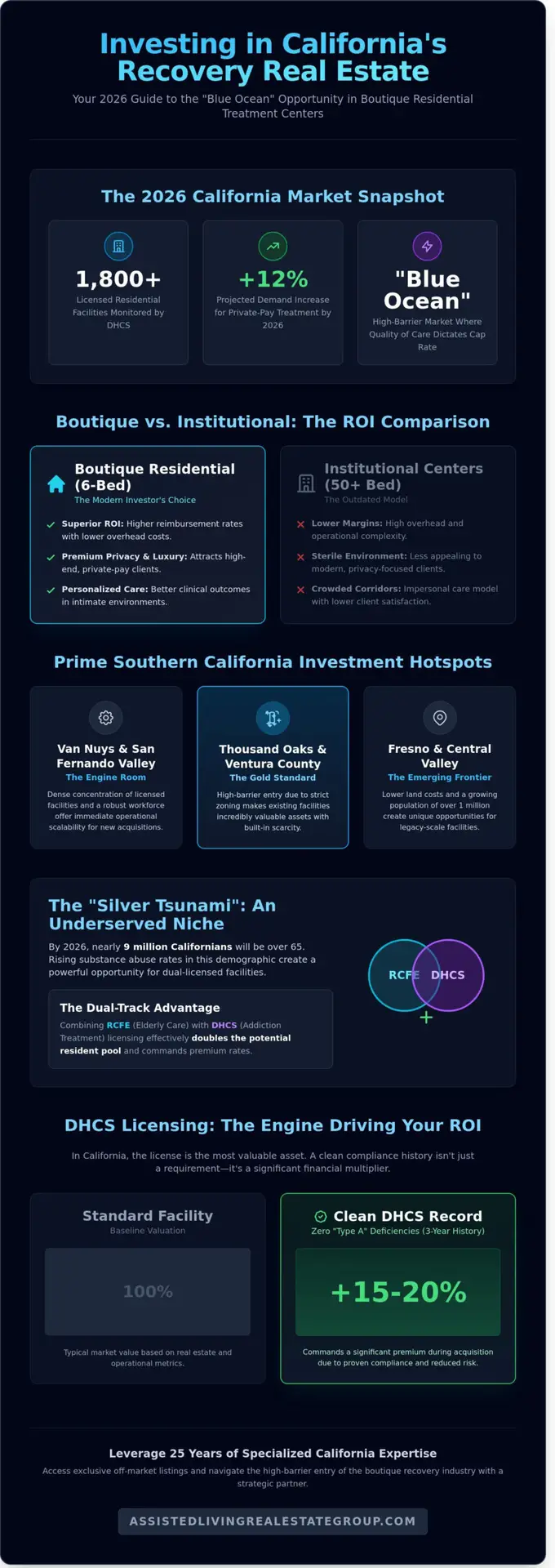
In the high-stakes California real estate market, the most lucrative assets aren’t found in luxury condos or retail strips, but in the specialized “blue ocean” of residential recovery. You likely recognize that the demand for high-quality care is surging across the state, yet the path to entry often feels blocked by a wall of DHCS regulations and strict municipal zoning. Finding a viable drug and alcohol treatment center for sale California requires more than a standard search; it demands a strategic partner who understands the intersection of clinical compliance and real estate ROI. With over 1,800 licensed residential facilities currently monitored by the DHCS, the competition for non-institutional, boutique environments has reached a critical peak in 2026.
This investor guide provides the expert roadmap you need to bypass these hurdles, ensuring you secure a compliant, high-performing facility that delivers both impact and income. We’ll break down the DHCS license transfer process, current valuation metrics for boutique residential sites, and how to identify turnkey opportunities in prime Southern California locations. By the end of this article, you’ll have the clarity to move from a state of curiosity to a state of conviction in your next healthcare investment.
Key Takeaways
- Identify why the 2026 California recovery landscape offers a “Blue Ocean” opportunity for investors seeking to balance high-level financial returns with significant social impact.
- Master the nuances of DHCS licensing and certification to accurately value a drug and alcohol treatment center for sale California and ensure long-term regulatory compliance.
- Discover why boutique 6-bed residential facilities often outperform institutional centers by offering premium privacy and superior ROI through optimized operational expenses.
- Execute a rigorous acquisition roadmap by auditing reimbursement mixes and clinical incident reports to protect your investment within the California market.
- Leverage 25 years of specialized California expertise to access exclusive off-market listings and navigate the high-barrier entry of the boutique recovery industry.
The 2026 California Recovery Market: Demand, Trends, and Opportunities
The 2026 California recovery market represents a sophisticated evolution of the “Impact and Income” philosophy. Investors are no longer settling for sterile, institutional facilities that lack personality and premium margins. Instead, the market is shifting toward boutique residential environments that offer intimacy, luxury, and high-acuity care. This transition is driven by a 12% projected increase in demand for private-pay treatment options across the state by 2026. Savvy entrepreneurs recognize that a drug and alcohol treatment center for sale California is more than a real estate play; it’s a strategic entry into a high-barrier market where quality of care dictates the cap rate.
Southern California remains the definitive “Blue Ocean” for boutique residential treatment. While the market is competitive, the demand for high-end, 6-bed and 12-bed facilities continues to outpace supply. This is because modern clients prioritize privacy and personalized clinical protocols over the crowded corridors of 50-plus bed institutions. By focusing on smaller, luxury environments, operators can secure higher reimbursement rates from private insurance providers while maintaining lower overhead costs compared to massive hospital-style campuses. It’s a model that balances mission-driven care with significant financial returns.
Southern California Market Spotlights
- Van Nuys and San Fernando Valley: This region remains the engine room of California’s residential recovery sector. With a dense concentration of licensed facilities and a robust workforce of certified counselors, it offers immediate operational scalability for new acquisitions.
- Thousand Oaks and Ventura County: These areas represent the gold standard for high-barrier entry. Strict local zoning ordinances limit new development, making any existing drug and alcohol treatment center for sale California in this corridor an incredibly valuable asset with built-in scarcity.
- Fresno and the Central Valley: As coastal markets reach saturation, the Central Valley is emerging as a primary target for larger-scale acquisitions. Lower land costs and a growing population of over 1 million residents in the Fresno metro area provide a unique opportunity for investors to build legacy-scale facilities.
The “Silver Tsunami” and Addiction Treatment
The aging demographic in California is creating a specific, underserved niche in senior-focused recovery. By 2026, the number of Californians aged 65 and older will reach nearly 9 million, and substance abuse rates within this group are rising at an alarming pace. Smart investors are now combining Residential Care Facility for the Elderly (RCFE) expertise with Department of Health Care Services (DHCS) licensing. This dual-track approach allows operators to provide specialized care for seniors who require both addiction treatment and assistance with daily living, effectively doubling the potential resident pool.
The Silver Tsunami effect on California healthcare real estate in 2026 is the rapid convergence of an aging population and rising late-life substance abuse, driving an unprecedented demand for specialized, high-acuity residential environments that command premium rates.
Success in this space requires a roadmap that navigates the complexities of California’s regulatory environment. You don’t just need a building; you need a licensed, operational vehicle that delivers consistent ROI. Whether you’re looking to expand your portfolio or enter the healthcare space for the first time, the 2026 market offers a rare window to achieve significant income while providing a life-saving service to the community.
Navigating DHCS Licensing: The Key to Value in California
The Department of Health Care Services (DHCS) acts as the ultimate gatekeeper for any drug and alcohol treatment center for sale California. Investors often focus on the physical real estate, but the license is the engine that drives the revenue. In the California market, a facility’s valuation is directly tied to its standing with the DHCS. Data from 2024 indicates that facilities with zero “Type A” deficiencies over a three year period command a 15% to 20% premium during acquisition. A clean licensing history isn’t just a legal requirement; it’s your most valuable intangible asset.
Understanding the distinction between “Licensed” and “Certified” is vital for your pro forma. Licensing is a mandatory requirement for any facility providing 24 hour residential non medical services. Certification is a voluntary badge of quality for outpatient programs. While certification is technically optional, it’s a practical necessity for insurance reimbursement. Most private payers in California won’t authorize payments to uncertified providers. This distinction defines your “Impact and Income” potential by determining which insurance contracts you can realistically secure.
Your business model must align with specific ASAM (American Society of Addiction Medicine) levels. These levels dictate the intensity of care you’re authorized to provide. A Level 3.2 license allows for medically monitored withdrawal management, often referred to as detox. This is a high demand, boutique entry point that offers significant ROI due to the acute nature of the care. Conversely, Level 3.1 focuses on low intensity residential services. Choosing the wrong ASAM level for your facility’s footprint can cap your earnings before you even open your doors.
Residential vs. Outpatient Licensing
California Health and Safety Code Section 11834.23 provides a massive advantage for small scale investors. It mandates that residential facilities with six or fewer beds be treated as a single family residence for zoning purposes. This allows you to bypass the restrictive conditional use permits that often kill larger projects. You must still navigate Title 22 regulations, which govern everything from staff ratios to facility safety. This boutique approach mirrors the success found in RCFE Licensing in California, where smaller environments lead to better outcomes and higher margins.
The Licensing Transfer Process
You don’t actually “buy” a license; you acquire the legal entity that holds it. The Change of Ownership (CHOW) process is the most common hurdle for new investors. This vetting period by the DHCS typically lasts between 90 and 120 days. Pitfalls often include incomplete disclosure of “principals” or failing to meet the state’s financial adequacy standards. If you’re searching for a strategic partner to navigate these acquisitions, ensure they’ve reviewed the facility’s last two years of DHCS site visit reports. Any unresolved corrective action plans can delay your closing and drain your initial working capital.
Boutique Residential vs. Institutional Centers: Comparing ROI
Investors looking for a drug and alcohol treatment center for sale California face a strategic crossroads: high-volume institutional facilities or intimate boutique homes. Boutique 6-bed residential facilities command premium daily rates, often 25% higher than larger centers, because they offer the privacy high-net-worth individuals demand. These smaller settings operate under specific residential zoning laws that favor the investor. Per California Health and Safety Code Section 11834.23, facilities serving six or fewer residents are considered a residential use of property. This means you bypass the grueling Conditional Use Permit (CUP) process required for larger commercial sites.
The Boutique Advantage in Southern California
Staff-to-client ratios in boutique settings often sit at 1:3, a stark contrast to the 1:10 ratios found in many institutional warehouses. This intimacy isn’t just a luxury; it drives superior clinical outcomes and justifies “Heart-Centered” premium pricing. These facilities integrate into quiet neighborhoods in Orange County or San Diego, providing a “home-like” environment that reduces the stigma of recovery. Because these 6-bed homes are treated as standard residential units, you can scale quickly without the multi-year zoning battles common in commercial real estate. It’s a faster path to cash flow.
Lower overhead defines the residential model. Operating expenses (OpEx) in a converted luxury home are significantly lower than a commercial building with triple-net leases and industrial utility costs. Savvy investors utilize the “hub and spoke” model to maximize their footprint. They acquire multiple 6-bed “spokes” for residential detox while maintaining one central “hub” for Intensive Outpatient Programming (IOP). This allows you to scale revenue and build a local brand without the massive capital expenditure of a 50-bed hospital facility.
Institutional Risks and Rewards
Larger facilities with 30+ beds in cities like Carson face intense local scrutiny and higher regulatory hurdles. While these centers benefit from economies of scale, they often struggle with a clinical feel that drives away private-pay clients. Data from 2024 shows that boutique centers in California maintain an average occupancy rate of 85%, whereas institutional centers often hover around 70% due to market saturation in the mid-tier segment. In Los Angeles County, boutique residential facilities typically trade at cap rates between 7% and 9%, while institutional centers often see compressed cap rates closer to 5.5% to 6.5% due to higher perceived risk and management intensity.
Is the boutique model still profitable in 2026? The numbers say yes. The shift toward individualized care is a response to a 15% increase in demand for specialized treatment plans over the last three years. When evaluating a drug and alcohol treatment center for sale California, the choice depends on your long-term legacy goals. The boutique model offers a “blue ocean” for those who want to combine high-yield returns with a tangible social impact. You aren’t just buying real estate; you’re acquiring a high-yield clinical asset that delivers both “Impact and Income.”
Acquisition Roadmap: Due Diligence for Treatment Centers
Securing a drug and alcohol treatment center for sale California is a sophisticated maneuver that demands a rigorous verification process. You aren’t just buying real estate; you’re acquiring a licensed healthcare ecosystem governed by the California Department of Health Care Services (DHCS). Success in this niche requires a “trust but verify” mindset regarding every operational metric. Investors must prioritize confidential marketing during this phase to prevent staff turnover or patient census drops, as discretion is the currency of the behavioral health industry. A public listing can spook referral partners, making off-market deals the gold standard for savvy entrepreneurs.
Your financial audit should focus heavily on the reimbursement mix. In the California market, the spread between PPO and HMO collections is vast. High-margin boutique facilities typically target out-of-network PPO clients, where daily rates often exceed state-funded contracts by 40% or more. Beyond the numbers, clinical due diligence is your primary shield against liability. You must review the facility’s DHCS compliance history and every incident report filed over the previous three years. This ensures there are no looming regulatory “death penalties” that could jeopardize your license post-acquisition.
Real estate evaluation in California also requires a specialized lens. ADA compliance is a frequent target for litigation in the state; a facility that isn’t fully accessible can lead to six-figure settlement costs. However, the “Boutique” potential of residential properties remains the most attractive play. Under the Lanterman Act, residential facilities serving six or fewer residents are often exempt from local zoning ordinances that would otherwise block a commercial clinic. This provides a “blue ocean” opportunity to scale in high-value neighborhoods.
Financial and Operational Audits
The heartbeat of a facility’s profitability lies in its Utilization Review (UR) efficiency. You need to analyze the VUR (Value of Utilization Review) to see how effectively the current team converts authorized days into actual revenue. A denial rate higher than 12% is a red flag for poor clinical documentation. Additionally, evaluate the referral network’s diversity. If 80% of leads come from a single digital aggregator, the business is vulnerable. To understand how these metrics compare to other care models, see our guide on how to value your assisted living business.
Closing the Deal in Southern California
Closing a drug and alcohol treatment center for sale California, particularly in hubs like Los Angeles or San Diego, requires specialized escrow companies familiar with healthcare license transfers. The post-closing transition is where most investors fail; retaining the Clinical Director is vital for continuity. Expect a timeline of 120 to 180 days to navigate the complexities of California’s regulatory approvals. This methodical approach ensures your transition preserves both the “Impact and Income” potential of the asset.
Assisted Living Real Estate Group: Your Strategic Partner
Teri Szoke and her team leverage 25 years of specialized California care experience to guide you through the state’s intricate regulatory environment. We don’t just list properties; we engineer successful transitions in a high-barrier-to-entry market. Our proprietary confidential marketing strategy grants you access to off-market listings that never hit public portals. This exclusivity is vital when searching for a drug and alcohol treatment center for sale California, as the most profitable assets often change hands quietly to protect patient privacy and staff morale. We bridge the gap between cold real estate metrics and the heart-centered mission of recovery care.
Success in this sector follows a specific roadmap. We act as your high-level mentor, helping you navigate the Department of Health Care Services (DHCS) requirements while identifying properties with the highest potential for ROI. Our team understands that you’re looking for more than a building; you’re looking for a legacy. By focusing on the “Blue Ocean” opportunities within the California recovery market, we help you avoid the pitfalls of institutional models and move toward a more profitable, intimate approach.
The “Impact and Income” Philosophy
We believe the highest returns come from “Boutique” environments. These intimate, residential-style facilities offer a premium level of care that justifies higher daily rates and yields superior clinical outcomes. Our team focuses on sustainable growth by vetting every buyer and seller for operational continuity. We’ve seen this succeed firsthand through turnkey acquisitions in Fresno and Thousand Oaks, where existing licensure and clinical staff remained intact. This approach ensures that your investment starts generating revenue from day one. You’re doing good while doing well, balancing the analytical mind of an investor with the moral compass of a healthcare provider.
Get Started with a Confidential Consultation
Finding the right drug and alcohol treatment center for sale California requires a search tailored to your specific operational goals. Whether you’re seeking a Level 3.1 clinically managed low-intensity residential service or a more intensive Level 3.5 program, we customize our search based on your ASAM level requirements. Our current list includes verified opportunities across the state, from the Central Valley to the Southern California coast. We provide the technical credibility and the “heart-centered” language needed to navigate this niche successfully. Contact Assisted Living Real Estate Group today to secure your position in this vital industry and begin your journey toward significant financial and social impact.
Securing Your Legacy in the 2026 California Recovery Market
The 2026 California recovery landscape presents a rare blue ocean opportunity for investors who prioritize high-barrier DHCS licensing over generic real estate plays. Success in this niche market requires a precise balance of clinical compliance and boutique operational excellence. You’ve seen how the shift toward residential care models is redefining ROI across the state. Navigating these complexities isn’t a solo journey; it’s a high-stakes acquisition that demands the roadmap of a seasoned partner.
The Assisted Living Real Estate Group brings over 25 years of specialized California care facility experience to your side. We are confidential marketing experts for DHCS-licensed businesses, bridging the gap between RCFE and the recovery sector to maximize your impact and income. If you’re ready to acquire a drug and alcohol treatment center for sale California, don’t leave your due diligence to chance. We provide the technical credibility and market access you need to secure a premium position in the nation’s most lucrative healthcare market.
View Exclusive California Treatment Center Listings
Your vision for high-level care and significant financial returns starts with the right acquisition today.
Frequently Asked Questions
Do I need a medical background to buy a treatment center in California?
No, you don’t need a medical degree to acquire a drug and alcohol treatment center for sale California. Most successful owners act as strategic investors while hiring a licensed Medical Director to oversee clinical operations. California’s DHCS requires specific staffing ratios, but the owner’s role focuses on business growth and maintaining the boutique atmosphere that drives high ROI. You’re building a legacy of care while focusing on your Impact and Income.
What is the average cap rate for a boutique recovery facility in Southern California?
Boutique recovery facilities in Southern California currently command cap rates between 8% and 11% based on 2024 market data. These premium assets frequently outperform traditional multi-family investments because they combine high-end real estate with essential healthcare services. Investors targeting coastal markets like Malibu or Newport Beach often see compressed cap rates due to higher property values, but the blue ocean opportunity remains unmatched in the 2026 landscape.
How long does the DHCS license transfer process typically take?
The DHCS license transfer process generally takes between 120 and 180 days to finalize. This timeline includes the Change of Ownership application and mandatory site inspections by state officials. You’ll need to submit fingerprints and background checks through Live Scan within 30 days of the initial filing. Navigating this high-barrier-to-entry market requires patience, but securing a drug and alcohol treatment center for sale California ensures a protected competitive position.
Can I operate a detox center in a standard residential neighborhood?
You can operate a detox center in a residential neighborhood if it serves six or fewer residents. California Health and Safety Code 11834.23 mandates that these small facilities be treated as residential uses for zoning purposes. This law prevents local municipalities from imposing special use permits that aren’t required for single-family homes. It’s a strategic opportunity to provide boutique, intimate care within quiet, healing environments that larger institutions can’t replicate.
What is the difference between an ARF and a drug treatment license in CA?
An Adult Residential Facility (ARF) is licensed by the California Department of Social Services for individuals with disabilities, while a drug treatment facility is licensed by DHCS. ARFs follow Title 22 regulations and don’t provide clinical addiction services. DHCS facilities follow Title 9 and are specifically authorized to provide detoxification and recovery services. Choosing the right license is critical for your financial model and the specific impact you want to achieve.
How much working capital is required post-acquisition for a 6-bed facility?
Investors should reserve 4 to 6 months of operating capital to cover the initial ramp-up period after acquisition. For a standard 6-bed boutique facility, this typically equates to a liquidity cushion between $150,000 and $250,000. This capital covers payroll for specialized staff and marketing costs while you wait for insurance reimbursements to stabilize. Proper capitalization ensures you maintain high-quality care standards during the critical first 180 days of your new operation.
Are there specific zoning laws for recovery centers in Los Angeles County?
Los Angeles County enforces strict overconcentration rules under California Health and Safety Code 11834.20, which often requires a 300-foot separation between licensed facilities. While state law protects small 6-bed homes, local fire marshals in Los Angeles still require specific R-3.1 occupancy classifications for non-ambulatory residents. Understanding these granular details is the difference between a stalled project and a thriving boutique center. We provide the roadmap to navigate these local hurdles successfully.