
A single “Type A” deficiency isn’t just a regulatory hurdle; it’s a direct hit to your facility’s market valuation. In the high stakes landscape of California senior living, your compliance record is your most valuable financial asset, and overlooking common RCFE licensing violations can quickly erode years of equity. You likely recognize that staying ahead of the California Department of Social Services (CDSS) is a constant challenge. The complexity of Title 22 regulations often leaves investors feeling exposed during unannounced inspections, fearing that a minor oversight could jeopardize a future exit strategy.
This 2026 guide provides a strategic roadmap to protect your investment ROI and your license through proactive compliance. You’ll learn how to avoid the frequent pitfalls of medication management and staff documentation that trigger daily penalties of up to $150. We’ll also explore the direct link between a “clean” record and premium business valuation, ensuring your facility remains a high performing asset in California’s competitive market.
Key Takeaways
- Master the nuances of Title 22 to transform regulatory compliance from a burden into a strategic financial advantage.
- Identify common RCFE licensing violations like medication errors to protect your facility from immediate CDSS penalties and reputational damage.
- Discover how maintaining a clean inspection history preserves your EBITDA multiple and ensures maximum ROI when you’re ready to sell.
- Implement proactive internal audits and robust Plans of Correction to build a resilient, “deficiency-proof” operation that attracts premium investors.
- Learn how specialized brokerage expertise simplifies the complex California relicensing process during a turnkey business acquisition.
Understanding the CDSS Regulatory Landscape in California
The California Department of Social Services (CDSS) acts as the ultimate arbiter of your facility’s reputation and financial viability. For a strategic investor, the CDSS isn’t merely a government bureaucracy; it’s the entity that validates the integrity of your business asset. Their Community Care Licensing Division (CCLD) oversees the state’s approximately 7,500 licensed care homes, ensuring every operator meets the rigorous demands of the law. When these standards aren’t met, the resulting common RCFE licensing violations become permanent, public marks that can erode your equity overnight.
The Role of Community Care Licensing Division (CCLD)
The CCLD monitors California facilities through unannounced inspections, providing a raw look at daily operations. In 2026, evaluators are specifically trained to prioritize resident rights and the quality of dementia care. These professionals look for patterns of neglect or administrative shortcuts that compromise safety. The lifecycle of a citation is swift: it moves from an on-site discovery to a formal report, and finally to the CDSS Transparency Portal. If an investigation finds a “substantiated allegation,” it means the state determined a violation likely occurred based on a preponderance of evidence. This public record is the first place a savvy buyer looks during a turnkey business acquisition.
Title 22 vs. Statutory Requirements
Title 22 is the technical heart of the Assisted living industry within California. While state statutes provide the broad legal framework, Title 22 offers the granular, administrative rules that govern everything from medication storage to the exact wording of resident admission agreements. It functions as the daily operating manual for every successful care home in the state. Title 22 serves as the non-negotiable standard for RCFE licensing, providing the granular operational requirements every California provider must satisfy.
Understanding the distinction between violation types is critical for managing risk. CDSS categorizes deficiencies based on their immediate impact:
- Type A Violations: These represent an immediate risk to the health, safety, or personal rights of residents. They trigger the most severe penalties, including immediate fines of $150 per day if a resident suffers an injury.
- Type B Violations: These involve conditions that are technically non-compliant and could become a danger if left unaddressed.
Frequent Type B citations often signal a lack of oversight, eventually leading to the more severe common RCFE licensing violations that jeopardize your license. By viewing these regulations through the lens of an investor, you can transform compliance from a line-item expense into a competitive advantage that preserves your long-term ROI.
The 5 Most Common RCFE Licensing Violations in California
In the competitive California market, excellence is measured by the precision of your operations. Data from the CDSS suggests that most common RCFE licensing violations are not the result of systemic malice, but of administrative drift. For the strategic investor, these citations represent more than just a fine; they are a signal of operational weakness that can devalue a business during a sale. Understanding these triggers is the first step toward building a resilient, high-yield care environment.
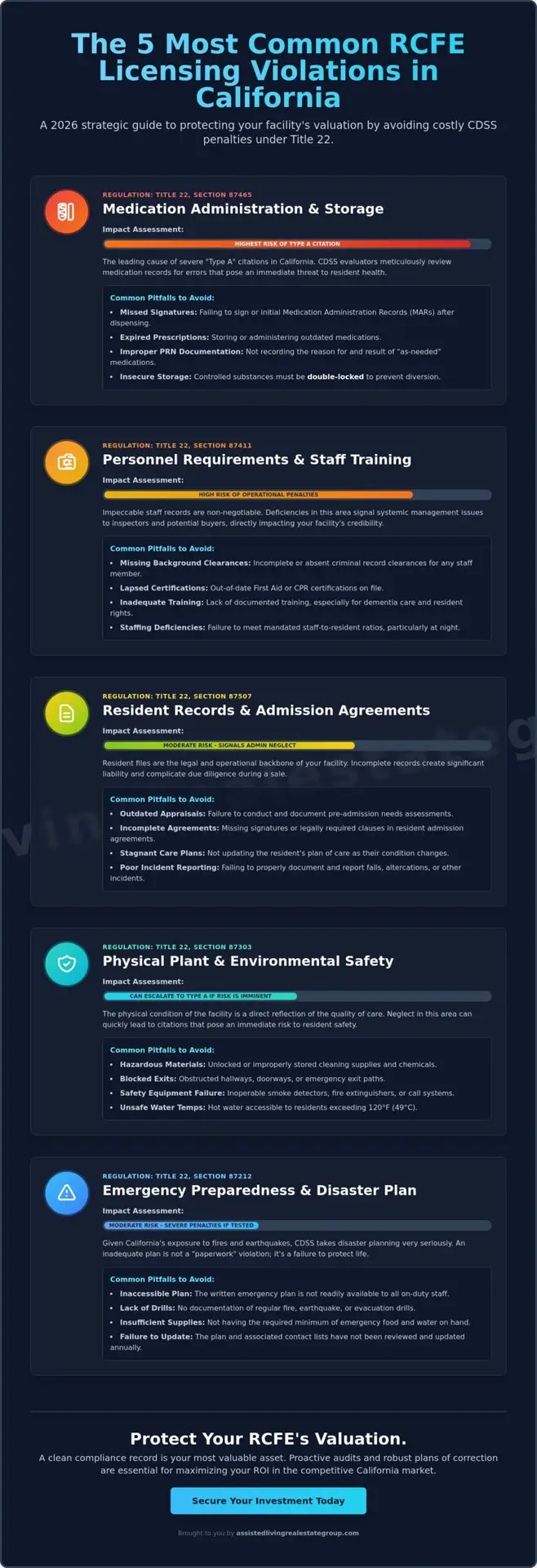
Medication Administration and Storage (Section 87465)
Medication errors remain the leading cause of “Type A” citations in California. Evaluators scrutinize Centrally Stored Medication and Destruction Records with surgical focus. Common pitfalls include missed signatures on Medication Administration Records (MARs), incorrect dosages, and the presence of expired prescriptions. Mismanaging “as needed” (PRN) medications is particularly dangerous. Staff must document the specific resident symptoms that necessitated the dose and the subsequent results. Under the California Code of Regulations for RCFEs, secure storage is mandatory. Controlled substances must be double-locked to prevent unauthorized access and potential diversion.
Personnel Requirements and Staff Training (Section 87411)
Your staff is your greatest liability or your strongest asset. Personnel files must be impeccable to withstand a CDSS audit. Missing background clearances or incomplete first aid certifications are low-hanging fruit for inspectors. Since July 10, 2023, the state has mandated an 80-hour certification training program for administrators, reflecting an increased focus on professional qualifications. Failing to provide specialized dementia care training is a fast track to a citation, especially as the state prioritizes person-centered care. High turnover often leads to “under-staffing” during peak hours, which evaluators view as a fundamental failure to provide required care and supervision.
Physical Plant and Safety Hazards
Maintenance isn’t just about aesthetics; it’s about life safety. Water temperatures must strictly reside between 105 and 120 degrees Fahrenheit. Anything higher is an immediate “Type A” violation due to the risk of scalding. Operators must also maintain rigorous fire safety and disaster preparedness plans, updated for 2026. Common areas and resident bedrooms must remain free of hazards like frayed rugs or blocked exits. These physical plant issues are often the easiest common RCFE licensing violations to fix, yet they remain frequently cited across Southern California facilities.
The mantra of California licensing is simple: if it wasn’t written, it didn’t happen. Documentation failures regarding resident rights, such as privacy and the right to refuse care, frequently appear in inspection reports. Protecting the dignity of your residents is both a moral imperative and a financial necessity. For investors looking to enter this market with a solid foundation, identifying turnkey care home opportunities with established compliance protocols is often the most efficient path to long-term success.
How Violations Impact RCFE Valuation and Saleability
In the high stakes world of California care home investment, your compliance record is a financial ledger. A history of citations creates what industry insiders call a “Compliance Discount.” This isn’t just a regulatory slap on the wrist; it’s a direct reduction in your EBITDA multiple. When a facility shows a pattern of common RCFE licensing violations, savvy buyers see unmanaged risk and future legal liability. They won’t pay premium prices for an asset that carries the weight of a poor CDSS transparency portal record. A clean history, conversely, serves as a powerful proof of concept that justifies a higher asking price and a faster close.
Due Diligence and the Compliance Audit
Sophisticated investors rarely take an operator’s word at face value. During the due diligence phase, they scrutinize the last three years of CDSS inspection reports to identify recurring operational failures. They look for “Type A” deficiencies that suggest systemic neglect or a lack of administrative oversight. A specialized broker uses a pristine compliance record as a primary selling point, framing the facility as a turn-key, low risk opportunity. To understand how these factors play into the broader acquisition process, investors should consult The Ultimate Guide to Buying an RCFE Facility in California for a deeper look at market standards.
Relicensing Risks for New Buyers
The Change of Ownership (CHOW) process in California is a rigorous “fitness” test for new licensees. CDSS evaluators don’t just look at the buyer; they look at the facility’s current standing. If there are unresolved citations or a history of common RCFE licensing violations, the state may issue a conditional license or delay the approval entirely. These delays have a tangible financial cost. Every month escrow is stalled represents lost revenue and increased carrying costs. In extreme cases, a poor compliance record can lead to a deal collapsing entirely because the buyer’s risk tolerance is exceeded by the facility’s regulatory baggage.
Protecting your facility’s reputation during a sale requires a confidential marketing strategy. You don’t want your compliance history to become public gossip before you’ve had the chance to contextualize it for a serious buyer. By maintaining a “clean” record and implementing a robust Plan of Correction for any past errors, you preserve the integrity of your business asset. Ultimately, the intersection of ethics and profitability is where the most successful California investors live. They recognize that compassionate care is the foundation of a high performing, saleable RCFE.
Proactive Compliance: Building a ‘Deficiency-Proof’ Operation
Compliance shouldn’t be a defensive scramble; it’s a strategic offensive that secures your facility’s long-term equity. High-level investors recognize that common RCFE licensing violations are often the result of administrative drift rather than intentional neglect. By implementing a rigorous internal audit framework, you transform your care home into a “deficiency-proof” asset. This proactive stance does more than just satisfy evaluators. It signals to the market that your operation is managed with the precision of a premier boutique, making it a highly attractive target for future acquisition.
The Internal Audit Framework
A successful audit doesn’t require a 100-page deep dive every week. Instead, focus your energy on high-risk sectors like medication management, personnel files, and physical plant safety. Use the CCLD “Key Indicator Tools” (KITs) to predict exactly where an evaluator will focus their attention during unannounced visits. These tools prioritize the specific regulations most likely to impact resident safety. By mirroring the state’s own inspection methodology, you ensure your team is always prepared. Creating a culture of compliance means empowering your administrators and caregivers to view every record as a testament to their care. When documentation is treated as a core value, common RCFE licensing violations become a thing of the past.
Responding to a Citation: The Plan of Correction (POC)
Receiving a citation is not a failure; it’s a test of your operational maturity. When CDSS issues a deficiency, your Plan of Correction (POC) must be swift and sophisticated. Write your POC to address the root cause of the issue without admitting excessive liability. You must outline specific steps to prevent recurrence and establish a clear timeline for completion. A POC is an opportunity to demonstrate operational excellence to future buyers. It shows that you possess the systems to identify, address, and permanently solve operational gaps. Successful implementation often leads to a follow-up visit where a “cleared” status is recorded, preserving your facility’s reputation in the transparency portal.
Investing in staff education and automated med-tracking technology is the final pillar of a resilient operation. Electronic Medication Administration Records (eMARs) virtually eliminate the signature gaps that trigger “Type A” citations. This level of sophistication justifies a premium market position and higher investment returns. If you’re ready to scale your portfolio with assets that already possess these high-level systems, explore our current turnkey business acquisitions to find a facility built for performance.
Navigating Licensing and Compliance in an RCFE Acquisition
California’s regulatory landscape acts as a high-barrier-to-entry filter, separating the amateur from the strategic professional. Navigating this maze requires more than just capital; it requires a roadmap. Common RCFE licensing violations can derail an acquisition before it even begins, turning a promising investment into a regulatory nightmare. Specialized brokerage isn’t a luxury. It’s a necessity for those who want to successfully bridge the gap between high-yield financial investment and refined, compassionate care. Our firm provides the seasoned expertise needed to identify hidden liabilities and secure assets built for long-term significance.
With 25 years of experience in relicensing and facility setup, we understand the nuances of the CDSS “fitness” test. We’ve seen how a single unresolved citation can stall a Change of Ownership (CHOW) and erode a buyer’s confidence. Standard real estate agents often lack the technical depth to interpret a CDSS transparency portal, leading to unforeseen liabilities for the buyer. We prioritize education first, building a foundation of trust before moving into a strategic transaction. This methodical approach ensures that every turnkey business acquisition we facilitate is positioned for immediate operational success.
The Benefit of an Expert Mentor
Assisted Living Real Estate Group does more than just list properties. We vet every listing for compliance risk, ensuring that common RCFE licensing violations are addressed before the deal reaches the escrow phase. By matching property owners with experienced RCFE tenants, we ensure operational continuity and protect the facility’s reputation. This exclusive level of service is designed for the analytical mind of the investor who demands technical credibility. To master the complexities of the current market, review RCFE Licensing in California: The 2026 Investor’s Guide to Success for a comprehensive look at the state’s evolving standards.
Your Next Strategic Step
Know your value. Don’t wait for a CDSS inspection cycle to discover that your facility’s valuation has been compromised by administrative drift. Understanding the link between Title 22 compliance and investment ROI is the hallmark of a visionary professional. We offer specialized consulting services for facility setup and navigating the granular details of California’s regulatory framework. Whether you’re looking to scale your portfolio or exit the market at a premium, the right roadmap is essential. Contact Assisted Living Real Estate Group for a confidential consultation to secure your position in this high-growth market.
Secure Your Legacy in the California Care Market
Mastering the intricacies of Title 22 is the definitive way to separate your facility from the competition. By identifying and correcting common RCFE licensing violations before the CDSS arrives, you transform regulatory pressure into a strategic advantage. You’ve seen how precise medication management and robust staff training records do more than just avoid penalties; they build the operational integrity that sophisticated buyers demand. A clean compliance history is the cornerstone of a premium exit strategy and a resilient portfolio.
Don’t leave your facility’s reputation to chance during the next inspection cycle. With over 25 years of California care industry expertise, our team specializes in confidential RCFE and ARF transactions that maximize investor returns. We have a proven track record in the Southern California market, helping owners bridge the gap between compassionate service and financial success. Whether you’re scaling or preparing for a sale, the right roadmap makes the difference. Maximize your facility’s value—get a confidential RCFE valuation today. Your commitment to excellence is the foundation of a high performing care home.
Frequently Asked Questions
What is the most common RCFE violation in California?
Medication management errors are the most frequent deficiencies cited by the CDSS. These typically involve signature gaps on Medication Administration Records (MARs), expired prescriptions, or improper storage of controlled substances. Operators must also watch for staffing documentation failures, as these are also among the common RCFE licensing violations that evaluators target during unannounced inspections.
How long do RCFE violations stay on a facility’s record?
Citations and inspection reports typically remain visible to the public on the CDSS Transparency Portal for a period of three to five years. While older records may be archived, sophisticated investors and families often look at this rolling window to judge the facility’s operational consistency. Maintaining a clean record during this timeframe is essential for preserving your business’s market valuation.
Can I sell my RCFE if I have outstanding CDSS citations?
You can sell a facility with outstanding citations, but it significantly complicates the escrow process and lowers the sale price. Buyers will often demand a compliance discount to account for the risk and the effort required to clear the record. Unresolved deficiencies can also delay the Change of Ownership (CHOW) process, as the CDSS may withhold license approval for the buyer until the facility meets Title 22 standards.
What is the difference between a Type A and Type B deficiency?
A Type A deficiency represents an immediate risk to the health, safety, or personal rights of residents, such as a failure to secure toxic chemicals or provide required care. A Type B deficiency involves violations that have a potential for risk if not corrected, such as incomplete personnel records. Type A violations carry much heavier immediate penalties and are viewed more unfavorably during the due diligence phase of an acquisition.
How much are the fines for RCFE licensing violations in California?
Fines for serious deficiencies start at $50 per day, per violation, and can reach a maximum of $150 per day if not corrected by the deadline. If a resident’s injury or death results from a deficiency, the state assesses an immediate penalty of $150 per day. Repeat common RCFE licensing violations within a 12 month period can lead to daily fines of $100, while a third violation of the same regulation can result in a $1,000 penalty.
How do I appeal a CDSS citation that I believe is unfair?
Operators can challenge a citation through the Informal Dispute Resolution (IDR) process by submitting a written request to the CCLD regional office. You must provide evidence that the evaluator’s finding was factually incorrect or that the regulation was misapplied. If the IDR doesn’t resolve the issue, you may have the right to a formal administrative hearing, though this requires a high level of technical and regulatory expertise to navigate successfully.
Does a new owner inherit the violations of the previous RCFE licensee?
A new owner receives a unique license number and isn’t legally responsible for the previous owner’s fines, but the facility’s address remains linked to its inspection history in the public portal. Sophisticated buyers treat the previous owner’s record as a reflection of the facility’s operational DNA. This is why turnkey business acquisitions are more valuable when the seller can prove a history of consistent compliance.
What is the ‘Plan of Correction’ (POC) process?
The POC is a formal written document that outlines the specific steps an operator will take to fix a cited deficiency. It must include a completion date that the CDSS evaluator approves. Once the correction is made, the state may conduct a follow-up visit to verify compliance. Successfully clearing a POC is a critical step in demonstrating to future investors that your facility has the systems in place to self-correct and maintain high standards.