
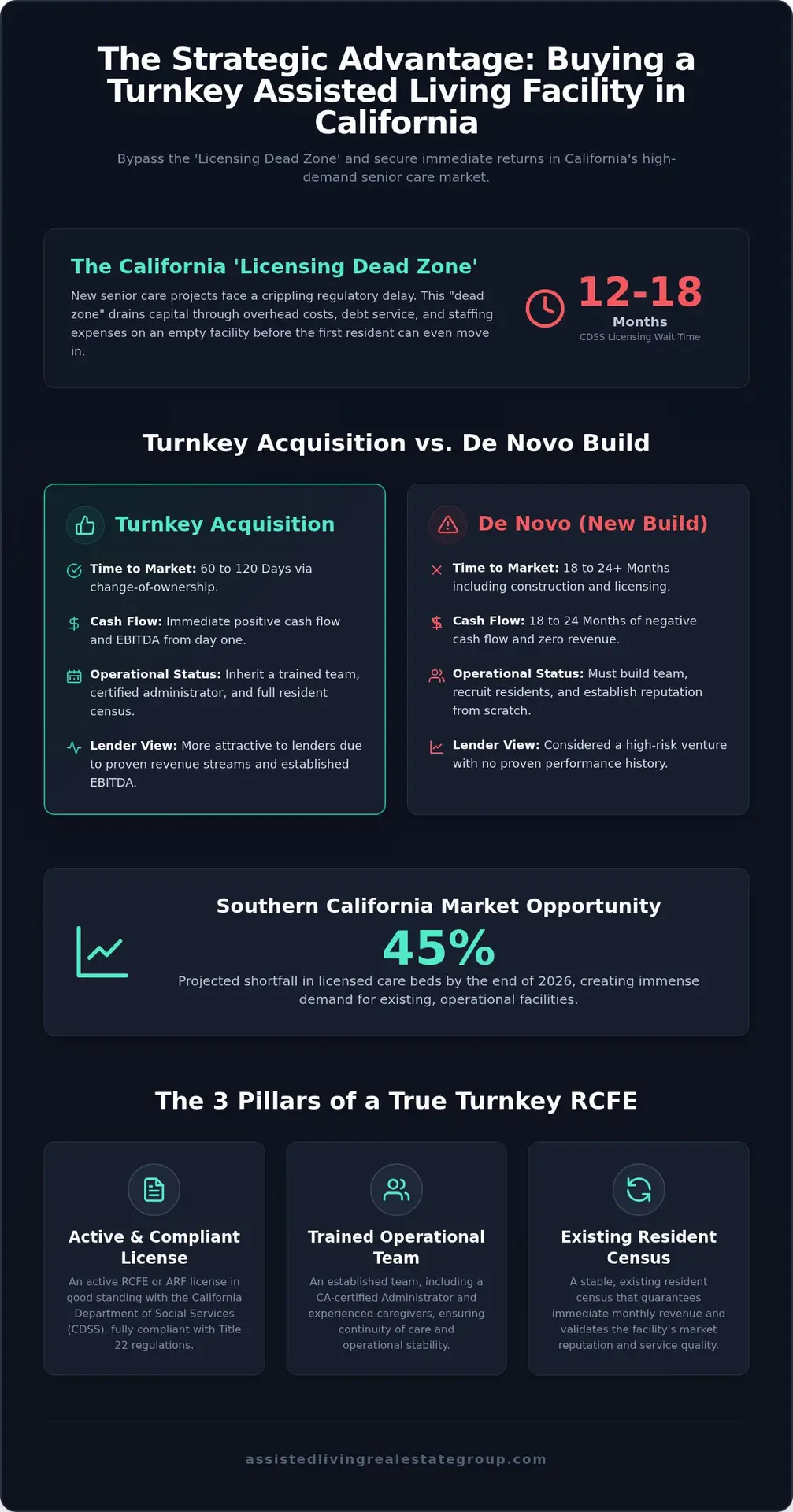
Starting a senior care business in California from the ground up is no longer just a challenge; it’s a financial gamble that most investors simply can’t afford to lose. With RCFE licensing wait times now stretching between 12 and 18 months, the “licensing dead zone” can drain your capital before you ever house a single resident. This is why savvy professionals are shifting their focus toward the strategic benefits of buying a turnkey assisted living facility. By acquiring an established operation, you effectively bypass the regulatory gridlock that keeps your competitors sidelined while securing a foothold in a premium market.
You likely recognize that Southern California faces a projected 45% shortfall in licensed care beds by the end of 2026, yet the prospect of managing two years of negative cash flow is a significant deterrent. This guide will demonstrate how a turnkey acquisition provides immediate cash flow from day one and allows you to inherit a proven reputation and census. We’ll explore the nuances of Title 22 compliance, the advantages of confidential listings, and why a change of ownership is the most efficient roadmap to achieving significant financial returns while providing essential social impact.
Key Takeaways
- Realize the immediate benefits of buying a turnkey assisted living facility by bypassing the 12 to 18 month licensing wait times and securing cash flow from day one.
- Learn how to navigate the complex California Title 22 landscape by acquiring a business with licensing already in place to ensure operational continuity.
- Discover why established EBITDA and proven revenue streams make turnkey RCFEs more attractive to commercial lenders compared to high-risk startup ventures.
- Understand the value of inheriting a trained caregiver team and a full resident census to solve the chronic labor shortages currently facing the California market.
- Gain insights into how confidential marketing strategies protect a facility’s reputation while providing exclusive access to high-quality Southern California assets.
Turnkey Assisted Living: The Strategic Choice
In the California market, a turnkey acquisition isn’t just a physical asset; it’s a pre-validated business ecosystem. To understand the full scope of this model, a comprehensive Assisted Living Overview reveals that these facilities provide essential daily support ranging from basic assistance to specialized memory care. One of the primary benefits of buying a turnkey assisted living facility is the immediate acquisition of a business that is already fully operational, licensed, and staffed. It’s the difference between buying a blueprint and buying a cash-flowing engine. You’re stepping into a role where the infrastructure for compassionate care and financial gain is already built.
California presents unique hurdles for the unprepared. Rigid zoning laws and high development costs in Southern California make ground-up construction a grueling, multi-year process. Strategic investors prioritize turnkey models because they bypass the initial “no-revenue” phase that bankrupts many startups. You aren’t just buying real estate; you’re acquiring a business entity, such as a Residential Care Facility for the Elderly (RCFE) or an Adult Residential Facility (ARF). This entity has already cleared the state’s rigorous Title 22 regulatory hurdles, providing a level of stability that a new build cannot match.
Turnkey vs. De Novo: A Time-to-Market Comparison
Time is your most expensive asset. A de novo project in California often takes 18 to 24 months to reach occupancy. You face site selection, construction delays, and the 12 to 18 month CDSS licensing backlog. Conversely, a turnkey transition typically completes in 60 to 120 days through a change-of-ownership application. This speed eliminates the “lease-up” period where overhead persists while beds remain empty. In the fast-moving Southern California market, these saved months represent significant potential revenue that would otherwise be lost to carrying costs.
The Core Components of a True Turnkey RCFE
A genuine turnkey asset must possess three foundational pillars to justify its premium. First, it requires an active RCFE or ARF license in good standing with the California Department of Social Services (CDSS). Second, it must have a trained operational team, including a CA-certified Administrator and specialized caregivers who understand the facility’s specific culture. Finally, an existing resident census is vital. This census ensures immediate monthly revenue. It allows you to focus on refining the service and increasing the facility’s value rather than struggling to find your first resident.
Financial Advantages: Immediate Cash Flow and Proven Revenue Streams
The financial landscape of California senior care is defined by a stark contrast between those who build and those who acquire. While a startup facility often endures 18 to 24 months of negative cash flow, the primary benefits of buying a turnkey assisted living facility center on immediate EBITDA. You aren’t merely hoping for future returns; you are stepping into a role as a profitable operator on day one. This immediate revenue provides the liquidity necessary to manage the high operational costs unique to California, such as the state’s minimum wage requirements and specialized labor laws.
Paying a premium for an established business is often the most cost-effective path. When you calculate the burn rate of a startup, including debt service on an empty building and the cost of staff training without resident income, the “higher” price of a turnkey asset becomes a strategic hedge. It saves capital in year one that would otherwise be lost to the “licensing dead zone” while waiting for California Senior Care Licensing to process initial applications. Investors gain predictability in several key areas:
- Verified Margins: Access to historical utility costs and food service expenses.
- Contractual Stability: Established relationships with California-based medical supply vendors.
- Occupancy Trends: Data-driven insights into seasonal census fluctuations.
Inheriting a Proven Profit and Loss Statement
A turnkey acquisition allows for a granular audit of historical occupancy rates and resident turnover. This data reveals the facility’s true earning potential under various market conditions. Beyond the top-line revenue, savvy buyers identify hidden value in existing vendor contracts and utility efficiencies that have been refined over years of operation. Historical P&Ls provide a documented roadmap of fiscal performance that effectively de-risks the capital entry for private equity and individual investors alike. If you are looking to secure a stable asset, you can explore our current listings to find facilities with verified financial history.
Financing Perks for Established Facilities
Lenders in the senior housing sector are notoriously risk-averse. They prefer financing established cash flow over optimistic startup projections. Businesses with at least two years of tax returns often qualify for SBA loan programs that offer more favorable terms and lower down payments. Because the real estate often serves as collateral, the underwriting process is significantly more streamlined for a turnkey RCFE than for a speculative development. Understanding the nuances of Financing Your RCFE Purchase: A Buyer’s Guide is essential for leveraging these established assets into long-term wealth.
Navigating the Regulatory ‘Dead Zone’: Licensing and Compliance Stability
California’s regulatory environment creates what industry veterans call a “licensing dead zone.” For a startup, this period represents 12 to 18 months of paying rent, utilities, and insurance without the ability to admit a single resident. One of the primary benefits of buying a turnkey assisted living facility is the ability to bypass this initial application backlog entirely. By utilizing the change-of-ownership (CHOW) process, which typically takes only 60 to 120 days, investors maintain operational continuity. This ensures the facility remains a functioning, revenue-generating business throughout the transition, protecting your capital from the erosion of a long-term startup phase.
California’s Title 22: The Barrier to Entry
Title 22 of the California Code of Regulations establishes some of the most stringent standards for senior care in the nation. It’s a high barrier to entry that requires meticulous attention to detail and significant administrative expertise. When Investing in Assisted Living, professionals often find that the most significant risk isn’t market demand, but the regulatory approval process itself. Inheriting a facility with “Licensing in Place” mitigates the risk of zoning denials or conditional use permit (CUP) hurdles that frequently derail new projects in crowded Southern California municipalities. For a deeper dive into these requirements, see our guide on RCFE Licensing in California: The 2026 Investor’s Guide to Success.
Operational Compliance as an Asset
Compliance isn’t just a legal requirement; it’s a tangible business asset that adds to the facility’s valuation. A turnkey facility comes with a track record of passed Fire Marshal and Social Services inspections, providing peace of mind that a de novo project cannot offer. You aren’t guessing whether the building meets 2026 California seismic or fire safety standards; the proof is in the existing, active license. This “clean” inspection history, often referred to as a deficiency-free record, significantly de-risks the acquisition and simplifies the due diligence process for your legal team.
Beyond the physical structure, you inherit established policies and procedures (P&Ps) that have already been vetted by the California Department of Social Services (CDSS). Creating these manuals from scratch can take months of manual labor and thousands in legal review fees. In a turnkey scenario, these operational frameworks are already in motion, providing a roadmap for the staff and a safety net for the new owner. This operational stability highlights one of the key benefits of buying a turnkey assisted living facility: the immediate mitigation of regulatory and compliance risk.
Staffing and Reputation: Inheriting an Operational Ecosystem
A senior care facility is only as resilient as the team operating within its walls. In the California market, where the statewide minimum wage has reached $16.90 and labor laws are increasingly complex, the human element represents a significant operational hurdle. One of the most critical benefits of buying a turnkey assisted living facility is the immediate acquisition of a functioning human ecosystem. You aren’t just buying a building; you’re securing a team of professionals who have already navigated the learning curve of your specific facility. This continuity is the bedrock of a stable investment, ensuring that the transition of ownership doesn’t compromise the quality of care or the safety of the residents.
Central to this ecosystem is the Administrator. In California, every Residential Care Facility for the Elderly (RCFE) must be managed by a state-certified Administrator who has passed the rigorous California Department of Social Services (CDSS) exam. Finding a qualified leader who understands the nuances of Title 22 is a process that can take months. A turnkey acquisition allows you to retain this vital asset, preserving the facility’s institutional knowledge and regulatory standing. Beyond the internal team, you inherit established referral networks with local Southern California hospitals and placement agencies. These relationships are the lifeblood of your census, providing a steady stream of inquiries that a startup would spend years trying to cultivate.
The Value of a Trained Care Team
Recruitment in the care sector is a costly endeavor. A startup typically faces a six-month recruitment and training campaign before it can reach full operational capacity. By acquiring an existing team, you eliminate these massive upfront costs and reduce the risk of high staff turnover during the sensitive transition period. Existing caregivers are already familiar with the residents’ individualized care plans and the facility’s emergency protocols. This ensures your staff-to-resident ratios remain in total compliance with Title 22 from the moment you take the keys, protecting you from early-stage regulatory scrutiny.
Inheriting Community Trust and Census
Reputation is a tangible asset in the Southern California senior housing market. A full census is the ultimate proof point of a facility’s success and the most reliable indicator of future performance. When you purchase a turnkey RCFE, you inherit the “word-of-mouth” equity built over years of service. Positive Yelp and Google reviews are essential for attracting the modern California family, and an established facility already has these social proofs in place. This trust prevents the “move-out” panic that can occur during a sale, maintaining your revenue stream while you focus on scaling the business. To find an asset with a proven local reputation, explore our exclusive turnkey RCFE listings.
Strategic Acquisition: Finding Your Turnkey RCFE in Southern California
Securing a high-performing asset in the California senior housing sector requires more than a simple search of public business-for-sale portals. High-quality RCFEs are sensitive operations; public listings can often spook residents and trigger staff turnover before a deal even closes. This is why a confidential marketing strategy is the only viable path for serious investors. By working with a specialized brokerage, you gain access to facilities where the transition is handled with surgical precision, protecting the very assets you’re paying to acquire. One of the primary benefits of buying a turnkey assisted living facility through a niche expert is the assurance that the business’s reputation remains intact throughout the change of ownership.
The Southern California market offers diverse opportunities, yet each sub-market requires a tailored approach. From the high-density neighborhoods of Van Nuys to the expanding senior populations in Fresno, local market dynamics dictate your potential ROI. You need to evaluate the local competition, median resident age, and regional labor costs to ensure the facility’s location aligns with your long-term financial goals. A strategic acquisition isn’t just about finding a building; it’s about identifying a market gap that your new facility is perfectly positioned to fill.
How to Identify a Quality Turnkey Opportunity
A true turnkey opportunity rests on three pillars: Licensing, Financials, and the Physical Plant. During your due diligence, you must verify that the RCFE or ARF license is in good standing with the CDSS and that the financial records reflect a stable, consistent census. You also need to inspect the physical plant to ensure it meets current California fire and life safety codes. For a step-by-step breakdown of what to look for during your search, consult our resource on RCFE for Sale: The Ultimate Guide to Buying a Care Facility in California. Verifying these components early prevents you from inheriting “deferred compliance” issues that could drain your reserves.
Partnering with Expert Guidance
Navigating the complexities of California Title 22 requires a mentor who has seen the market evolve over decades. Leveraging Teri Szoke’s 25+ years of Southern California brokerage expertise gives you a distinct advantage in a high-barrier market. This partnership provides access to off-market listings that never hit public marketplaces, allowing you to review exclusive opportunities before they are picked over by the general public. If you’re ready to move from research to action, you can contact Assisted Living Real Estate Group for a confidential consultation to discuss your investment criteria and explore our current portfolio of turnkey facilities.
Securing Your Legacy in California’s Senior Housing Market
The path to sustainable success in the care sector requires a shift from speculative development to strategic acquisition. By choosing a turnkey model, you effectively eliminate the 12 to 18 month licensing dead zone and secure immediate EBITDA. You aren’t just buying a business; you’re securing a legacy of care and financial stability that is already operational. The primary benefits of buying a turnkey assisted living facility lie in this synergy of immediate revenue and inherited community trust.
At Assisted Living Real Estate Group, we bring over 25 years of specialized RCFE brokerage experience to your search. Our exclusive focus on the California regulatory environment and our confidential marketing strategies ensure your investment is protected from the moment of transition. It’s time to move toward an investment model where significant financial returns and tangible social impact coexist. Explore Current Turnkey RCFE Listings in California and take the first step toward a more profitable, mission-driven future.
Frequently Asked Questions
Is it better to buy or build an assisted living facility in California?
Buying an existing facility is almost always the more strategic choice for professionals. Building a de novo facility in Southern California involves a grueling 18 to 24 month timeline before occupancy. In contrast, one of the main benefits of buying a turnkey assisted living facility is the ability to bypass construction delays and zoning hurdles. You step into a cash-flowing operation with an established reputation, avoiding the financial drain of a long-term startup phase.
How long does it take to get an RCFE license in California for a new facility?
Securing a new Residential Care Facility for the Elderly (RCFE) license in California is a lengthy process. Current average wait times for initial applications are estimated between 12 and 18 months. This regulatory backlog creates a period of high overhead without resident income. Investors choose turnkey assets because the change of ownership process is significantly faster, usually concluding within 60 to 120 days, allowing for operational continuity and immediate revenue.
Does the RCFE license transfer to the new owner during a turnkey sale?
Licenses are non-transferable under California law. When you acquire a turnkey facility, you must submit a Change of Ownership (CHOW) application to the California Department of Social Services (CDSS). While the license doesn’t “transfer” in a legal sense, the facility remains operational during the review period. This ensures that the resident census and staff remain in place while the state processes the new owner’s credentials, maintaining the business’s financial health.
What is the typical occupancy rate for a turnkey facility in Southern California?
Quality turnkey facilities in markets like Orange County or Los Angeles typically maintain an occupancy rate of 90% or higher. A stable, full census is often the ultimate proof point of a facility’s operational success. When evaluating a potential acquisition, you should review historical occupancy trends to ensure the revenue stream is consistent. High occupancy reflects strong local referral networks and a solid reputation within the Southern California community.
Can I buy an assisted living business without owning the real estate?
You can certainly operate a care business without owning the underlying property. Many investors utilize lease-to-own care home opportunities or long-term commercial leases to enter the market with lower initial capital. This model allows the operator to focus on the care business and Title 22 compliance while the landlord maintains the real estate. It’s a common strategy for scaling a portfolio across multiple Southern California locations without the burden of heavy mortgage debt.
What are the common pitfalls when buying an existing care home?
One common pitfall is failing to identify “deferred compliance” issues that may not be visible during a standard walkthrough. You might inherit a facility with outstanding Title 22 deficiencies or an administrator whose certification is nearing expiration. Another risk is staff instability; if the transition isn’t handled confidentially, key caregivers may leave. Working with a specialized broker helps mitigate these risks by ensuring a transparent due diligence process and a professional transition.
How do I verify the compliance history of a turnkey facility in CA?
Verification is done through the California Department of Social Services (CDSS) Community Care Licensing Division. You must request a full transparency file which includes past inspection reports, citations, and any plans of correction. Reviewing these documents is vital to understanding the facility’s regulatory standing. This audit ensures you’re acquiring a “clean” asset with a history of compliance, which is one of the essential benefits of buying a turnkey assisted living facility.
Why is confidential marketing used in RCFE sales?
Confidentiality is the cornerstone of a successful care facility sale. Publicly listing an RCFE can cause immediate panic among residents’ families and lead to a mass exodus of staff. By using a confidential marketing strategy, we protect the facility’s daily operations and reputation. This approach ensures that the buyer inherits a stable business with its census and caregiver team fully intact, rather than a depleted asset struggling with a public image crisis.