
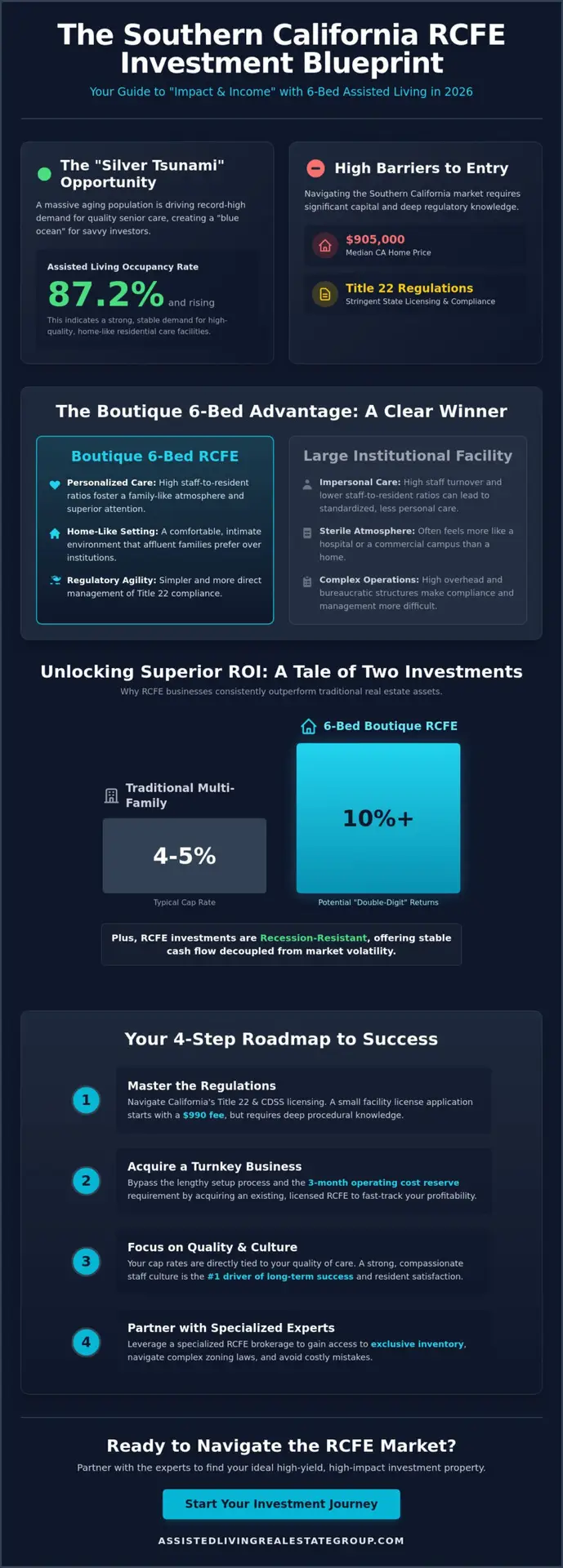
What if the most lucrative real estate investment in 2026 isn’t a traditional multi-family complex, but a boutique six-bed home in a quiet Southern California neighborhood? Identifying a high-performing assisted living on residential care homes company in today’s market requires more than just capital. It requires a strategic roadmap through the state’s rigorous regulatory landscape. You already recognize that the “Silver Tsunami” is driving demand to record highs. However, with California median home prices hitting $905,000 and Title 22 regulations becoming more stringent, the barrier to entry feels higher than ever.
We promise to show you how to navigate these hurdles to acquire a turnkey RCFE business that balances high ROI with compassionate care. You’ll discover the exact steps to master “Impact and Income” while avoiding the costly mistakes that stop most entrepreneurs. This guide provides a comprehensive look at 2026 market data, from the $990 licensing fee for small facilities to the specific zoning secrets necessary to scale your boutique care portfolio successfully across the region.
Key Takeaways
- Discover why the 6-bed RCFE model represents the “blue ocean” of Southern California real estate, offering a boutique alternative to institutional care.
- Learn the strategic indicators of a high-performing assisted living on residential care homes company to maximize your ROI and achieve sustainable “Impact and Income.”
- Master the complexities of California Title 22 regulations and CDSS licensing to navigate the high barriers to entry in the SoCal market.
- Develop a specialized framework for evaluating RCFE acquisitions, focusing on both financial cap rates and the “intangible” staff culture that drives long-term success.
- Uncover the advantages of partnering with a specialized RAL brokerage to access exclusive inventory and expert insights into local zoning laws.
Understanding the Assisted Living on Residential Care Homes Model
In California, a Residential Care Facility for the Elderly (RCFE) serves as the legal foundation for what many call board and care homes. Operating an assisted living on residential care homes company in 2026 means managing a licensed environment where non-medical care is provided to adults aged 60 and older. The Assisted Living Model has evolved from institutional settings toward intimate, residential spaces that mirror the quality of life residents enjoyed in their own homes. This shift is fueled by the “Silver Tsunami,” as Southern California’s aging population reaches a critical mass, creating a massive demand for high-quality, specialized care that large-scale facilities simply cannot provide.
The 6-bed boutique advantage is particularly potent in 2026 for several reasons:
- Higher Staff-to-Resident Ratios: Smaller settings allow for personalized attention that larger institutions can’t match.
- Regulatory Agility: Managing Title 22 compliance is often more straightforward in a smaller, controlled environment.
- Market Demand: Recent data shows assisted living occupancy reaching 87.2%, with a growing preference for “home-like” settings over commercial campuses.
RCFE vs. Institutional Assisted Living
Large commercial facilities often struggle with high staff turnover and a sterile, hospital-like atmosphere. In contrast, the boutique 6-bed RAL model offers a level of intimacy that affluent families in Southern California neighborhoods crave. These residents aren’t just looking for a bed; they’re looking for a legacy of care. From an investment perspective, residential homes offer lower overhead and higher margins than 100-plus bed institutions. Scaling this model allows entrepreneurs to acquire multiple properties, effectively building a portfolio of high-yield assets that remain recession-resistant even as the broader real estate market fluctuates.
The Role of an RCFE Company in 2026
A successful assisted living on residential care homes company must master the dual disciplines of real estate management and healthcare operations. It’s a business where your cap rates are directly influenced by the quality of your staff and your adherence to Title 22 regulations. We call this “Impact and Income.” You’re doing good for the community while doing well for your bottom line. In 2026, the trend has shifted toward turnkey acquisitions because the licensing process for new facilities can be exhaustive. Buying an existing, licensed company allows you to bypass the initial orientation and the three-month operating cost reserve requirement, moving you straight to the profit phase.
Why Residential Care Home Companies are Outperforming in Southern California
Investors often overlook the fact that traditional multi-family cap rates in Southern California have tightened significantly. While a standard apartment complex might yield 4% to 5%, a well-managed assisted living on residential care homes company can often achieve double-digit returns when the business operations are factored into the real estate value. This is the “Blue Ocean” strategy. Instead of competing for low-margin commercial assets, savvy entrepreneurs target high-demand zip codes in coastal Orange County and San Diego. These areas feature a high density of seniors with the private-pay capacity to support premium boutique care, creating a niche market with minimal institutional competition.
Senior housing remains remarkably recession-resistant in the 2026 economy. Unlike retail or office space, the need for high-acuity care doesn’t vanish during a market downturn. With California’s median home price projected to rise 3.6% to $905,000, many seniors are leveraging their significant home equity to fund their stay in a Residential Assisted Living (RAL) environment. This creates a stable, predictable cash flow for owners that is decoupled from standard stock market volatility. Ensuring your facility meets all California Senior Care Licensing standards is the first step to securing this premium asset class and building a lasting legacy.
The Financial Appeal of Boutique Care
Operational efficiency is the hallmark of the 6-bed model. Large institutions face massive overhead from administrative layers, massive marketing budgets, and sprawling facility maintenance. A boutique assisted living on residential care homes company operates with a lean, dedicated team. This lower staffing ratio doesn’t just cut costs; it improves care quality, allowing you to charge premium private-pay rates that exceed the California median of $7,600 per month. In affluent markets like Newport Beach or La Jolla, families prioritize the intimacy and safety of a residential setting over the amenities of a large campus. If you’re ready to explore these high-margin opportunities, you can view our current Southern California listings to see the boutique model in action.
Operational Advantages of the 6-Bed Model
Agility is your greatest competitive advantage. If market demand shifts toward specialized memory care in a specific San Diego suburb, a 6-bed home can pivot its service model and staff training far faster than a 100-bed facility. These homes integrate naturally into high-value residential neighborhoods, avoiding the “institutional” stigma that often drives away discerning clients. You aren’t just buying real estate. You’re acquiring a platform for “Impact and Income” that scales through superior service and local reputation. Small facilities allow for a “micro-campus” approach, where several homes in close proximity share resources while maintaining their boutique charm.
Navigating the Southern California Market: Licensing and Zoning
California’s regulatory environment is the high wall that keeps casual investors out and rewards the committed professional. The California Department of Social Services (CDSS) oversees every assisted living on residential care homes company through its Community Care Licensing Division. To even begin the journey, prospective owners must complete an online orientation, which carries a $54.85 fee as of January 2026. This isn’t just bureaucracy; it’s a quality control mechanism. Investing in Residential Assisted Living requires a deep respect for these standards to ensure both long-term viability and resident safety.
When you purchase an existing RCFE, you aren’t just buying real estate. You’re navigating a complex relicensing process. Because licenses are generally non-transferable in California, a new owner must submit a complete application package while the seller maintains operational responsibility. This transition requires a strategic roadmap to ensure that the facility’s “Impact and Income” remains steady during the change of ownership. Failing to account for the CDSS processing timeline is a common mistake that can stall your ROI for months.
California Title 22 and CDSS Compliance
Title 22 is the definitive operational manual for any RCFE in the state. It dictates everything from resident rights to the $1,000 minimum surety bond required for facilities managing resident finances. If you’re looking for a granular roadmap, our guide on RCFE Licensing in California: The 2026 Investor’s Guide to Success breaks down these requirements. Key hurdles include the 80-hour administrator certification and the mandatory three months of operating costs that must be sitting in a bank account before a license is issued. Compliance isn’t a one-time event; it’s a daily commitment to the highest standards of boutique care.
Local Zoning and Land Use in SoCal
Zoning is where many Southern California projects stall, yet it’s also where the 6-bed model shines. The federal Fair Housing Act and California state law provide a powerful shield for these smaller facilities. In high-density areas like Los Angeles and San Diego counties, a licensed RCFE serving six or fewer residents is legally treated as a residential use of property. This means you don’t typically need the conditional use permits that plague larger institutional developments. Still, city-specific nuances in municipalities like Van Nuys or suburban San Diego require careful due diligence. You must verify that a property hasn’t been flagged for building code violations before finalizing an acquisition for your assisted living on residential care homes company. Success in this market depends on your ability to blend seamlessly into the neighborhood while providing elite, professional care.
Evaluating an Assisted Living on Residential Care Homes Company for Sale
Acquiring an established assisted living on residential care homes company offers a strategic shortcut to cash flow, but only if you look past the curb appeal to the operational engine underneath. In the Southern California market, where the median cost of care has reached approximately $7,600 per month in 2026, the financial health of a facility is often more about the quality of the residents than the number of beds. You must evaluate the EBITDA and cap rates with a critical eye, ensuring the “Impact and Income” promised by the seller is backed by audited profit and loss statements. Confidentiality is the cornerstone of these transactions. If staff or residents learn of a potential sale prematurely, the resulting turnover can decimate the facility’s value before the ink is dry on the purchase agreement.
Key metrics for your evaluation should include:
- Occupancy Rates: Look for facilities maintaining at least 88% occupancy, consistent with 2025 primary market averages.
- Resident Mix: Prioritize private-pay residents over SSI or Medi-Cal to ensure higher margins.
- Staff Longevity: High turnover is a red flag that often points to underlying culture or management issues.
Financial Due Diligence for Care Facilities
Analyzing the financial statements of a residential care home requires a specialized lens. You aren’t just looking at rent; you’re looking at care tiers and ancillary service fees. For a deeper dive into the specific economic drivers of this sector, see our guide on Investing in an Adult Residential Facility in California: The 2026 Southern California Market Guide. Verifying the income streams is crucial, as private-pay rates in affluent Southern California neighborhoods provide the necessary cushion to absorb rising labor costs. Ensure that the current owner has maintained the mandatory three months of operating costs in reserve, as this is a non-negotiable requirement for California licensure.
Operational and Physical Asset Assessment
The physical plant must strictly adhere to California Title 22 standards. During your walkthrough, check for required fire safety clearances, proper bedroom dimensions, and common area accessibility. Beyond the building, evaluate the human capital. Every staff member must have completed the 40 hours of training required before working with residents, and the Administrator must hold a valid 80-hour certification. Review the facility’s history with CDSS by checking for past citations or “Type A” deficiencies. A clean compliance record is a premium asset that justifies a higher purchase price. Ready to begin your acquisition journey? Contact our specialized RCFE brokerage team to review our current exclusive listings.
Why Partner with a Specialized RCFE Brokerage in Southern California
Working with a general commercial real estate broker to buy an assisted living on residential care homes company is a common mistake that often leads to collapsed escrows. These generalists understand square footage and lease rates, but they often lack a grasp of the intricate California Health and Safety Code requirements or the nuances of Title 22 compliance. The Assisted Living Real Estate Group brings 25 years of specialized Southern California experience to the table, acting as a high-level mentor rather than just a transaction coordinator. We understand that in this niche market, the business’s goodwill and its licensing status are just as valuable as the real estate itself.
Most high-performing RCFEs never hit the public market. We specialize in confidential marketing strategies that protect the delicate ecosystem of a care home during a transition. If a facility’s sale becomes public knowledge, you risk a mass exodus of staff and residents, which can plummet the occupancy rate below the 87.2% average seen in late 2025. By leveraging our deep network across Los Angeles, Orange, and San Diego counties, we connect savvy investors with exclusive, off-market opportunities that institutional buyers often overlook. This “Expert Guide” approach ensures you’re entering the market with a competitive advantage.
Expert Guidance Through the Transaction
The escrow process for a residential care facility is a dual-track marathon. You aren’t just closing on a property; you’re coordinating the transfer of a business operation that requires CDSS oversight. This requires a specialized roadmap to ensure the buyer’s application is submitted correctly to avoid the delays that often plague first-time owners. Our team provides the resources needed for a smooth transition, from verifying staff training records to ensuring the physical plant meets the latest 2026 safety standards. For a step-by-step breakdown of this journey, read The Ultimate Guide to Buying an RCFE Facility in California. We don’t just walk away at the close of escrow; we provide the post-sale support necessary for successful relicensing and operational setup.
Your Strategic Partner for Impact and Income
Building a legacy in the Southern California senior housing market requires more than just capital. It requires a vision for “doing good while doing well.” We help you identify boutique environments where you can provide elite quality of life for residents while securing significant financial returns. The “Silver Tsunami” isn’t a crisis for our clients; it’s a “blue ocean” opportunity to create high-margin, heart-centered businesses. As your strategic partner, we ensure your investment reflects both your analytical goals and your moral compass. If you’re ready to secure your place in this high-barrier market, schedule a confidential consultation with Assisted Living Real Estate Group today.
Secure Your Future in the Southern California Boutique Care Market
The “Silver Tsunami” isn’t a crisis to be managed; it’s the premier “blue ocean” opportunity for the savvy 2026 investor. You’ve discovered how the boutique 6-bed model provides a superior alternative to institutional care, allowing for higher margins and deeper community impact. Success in this high-barrier market requires more than just capital. It demands a mastery of California Title 22 regulations and a strategic approach to zoning. Acquiring an established assisted living on residential care homes company is the most direct path to achieving significant ROI while providing an essential service to California’s aging population.
We’ve spent 25 years perfecting our confidential marketing strategy to protect your business’s value during a transition. Our deep expertise ensures you avoid the regulatory pitfalls that stall most acquisitions. Don’t let this unique demographic window close without securing your legacy. Take the next step toward a high-performing portfolio today.
Explore Current Southern California RCFE Listings
The opportunity to do good while doing well has never been more accessible for those with the right roadmap. We’re ready to be your strategic partner in this journey.
Frequently Asked Questions
What is the difference between an RCFE and an ARF in California?
The primary difference lies in the age and needs of the residents served. A Residential Care Facility for the Elderly (RCFE) is licensed specifically for adults aged 60 and older who require varying levels of care and supervision. In contrast, an Adult Residential Facility (ARF) serves adults aged 18 to 59 with physical or mental disabilities. While both operate under the California Department of Social Services (CDSS) oversight, the RCFE model is the standard for those building a boutique assisted living on residential care homes company targeting the senior demographic.
Can I operate a residential care home company in a standard residential neighborhood?
Yes, California state law and the federal Fair Housing Act protect the right to operate small care homes in residential zones. Any licensed RCFE serving six or fewer residents is legally considered a residential use of property. This means you don’t typically need a conditional use permit or special zoning variances to operate in affluent Southern California neighborhoods. This legal protection is what allows boutique homes to integrate seamlessly into high-value communities while maintaining a residential feel.
How much experience do I need to buy an assisted living residential care home?
You don’t need a medical background to own a care home, but you must meet specific state requirements. California requires every facility to have a certified Administrator who has completed an 80-hour initial certification program and passed the state exam. Many savvy investors choose to act as the business owner while hiring a qualified, licensed Administrator to handle the daily Title 22 compliance and care operations. This allows you to focus on the “Impact and Income” of your investment without being tied to 24/7 care duties.
What are the typical profit margins for a 6-bed RCFE in Southern California?
Well-managed boutique facilities in Southern California often see profit margins between 20% and 35% after all operational expenses. With median private-pay costs for assisted living reaching $7,600 per month in 2026, a 6-bed home can generate significant cash flow compared to traditional residential rentals. Your specific ROI will depend on your ability to control labor costs and maintain high occupancy rates, which averaged 87.2% across major California markets in late 2025.
How long does the RCFE licensing process take in California in 2026?
The licensing process for a new assisted living on residential care homes company generally takes between 6 and 9 months. This timeline includes completing the mandatory $54.85 online orientation, submitting a comprehensive application to the CDSS, and passing the final physical plant inspection. If you are purchasing an existing business, you will undergo a “Change of Ownership” process that requires similar documentation but allows the facility to continue operating under the seller’s license until your new license is issued.
What is Title 22 and why is it important for my care home company?
Title 22 is the specific set of California Social Security Regulations that governs the licensing and operation of all RCFEs. It’s the definitive rulebook for everything from staff training requirements to resident rights and fire safety standards. Mastery of Title 22 is essential because non-compliance can lead to “Type A” citations or the loss of your license. It serves as the foundation for the high-barrier entry into the California market, ensuring that only professional, committed operators provide care to our seniors.
Is financing available for buying a residential care facility in California?
Financing is widely available through SBA 7(a) and 504 loan programs, which are popular for RCFE acquisitions because they can cover both the real estate and the business value. Lenders in the Southern California market typically look for a solid business plan and proof that you have the state-mandated three months of operating costs in reserve. Conventional commercial loans are also an option for investors with significant experience or a large portfolio of existing boutique care homes.
Why should I use a specialized broker to sell my care home business?
A specialized broker understands that your business value is tied to its license, staff culture, and resident contracts, not just the physical real estate. We use a confidential marketing strategy to ensure that news of the sale doesn’t cause staff turnover or resident flight, which can happen if a listing is posted on public sites. With 25 years of experience in the California RCFE market, we know how to value the “intangibles” of your company to ensure you receive the maximum return for the legacy you’ve built.