
While traditional real estate sectors face volatility, 85% of strategic investors are betting on a compression of assisted living cap rates across California in 2026. This anticipation isn’t just optimism; it’s a calculated response to the Silver Tsunami as the first wave of Baby Boomers turns 80 this year. You likely recognize that California’s unique regulatory environment and high labor costs, including the $16.90 statewide minimum wage, make national averages irrelevant to your local portfolio. Success in this niche requires more than a standard spreadsheet. It demands a sophisticated bridge between analytical precision and mission-driven care.
This guide provides the roadmap you need to master the financial metrics of California senior housing to maximize your investment returns and operational impact. We’ll break down the latest 2026 cap rate trends and the specific impact of the reinstated Medi-Cal asset limits. You’ll gain a clear framework for calculating true Net Operating Income for RCFEs and the confidence to navigate a purchase or sale in this high-barrier market. By the end of this guide, you’ll understand why a California cap rate is a reflection of both regulatory mastery and strategic vision. It’s time to move from curiosity to conviction.
Key Takeaways
- Master the language of senior housing by understanding how Net Operating Income directly dictates property value in the 2026 California market.
- Follow a rigorous framework to calculate assisted living cap rates that accounts for complex resident care tiers and localized vacancy trends.
- Decode the 2026 trends driving cap rate compression, including the 90% occupancy milestone and the widening gap between supply and demand.
- Evaluate how Title 22 licensing records and facility scale impact your specific valuation, distinguishing your asset from national averages.
- Discover how a confidential marketing strategy ensures a seamless transition while maintaining staff loyalty and resident stability during a sale.
Understanding Assisted Living Cap Rates in the 2026 California Market
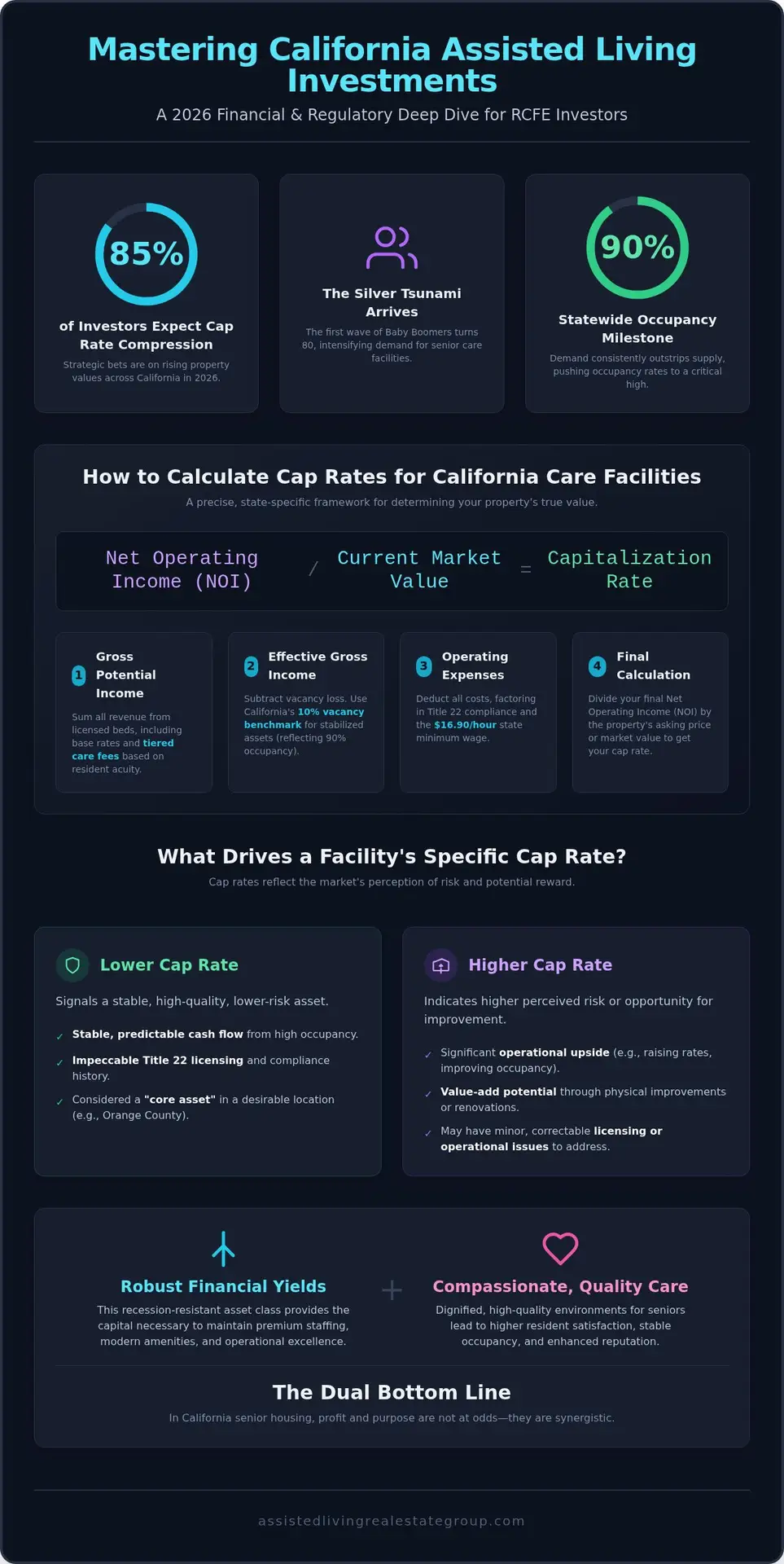
A Capitalization rate is the foundational metric used to determine the value of income-producing real estate by dividing Net Operating Income (NOI) by the current market value. In the specialized world of California senior housing, this isn’t just a number; it’s the primary language of the industry. It translates complex operational data into a clear signal of market health and facility potential. For the strategic investor, mastering assisted living cap rates is the first step toward distinguishing a generic property from a high-performance asset.
The market is moving fast. Verified data from March 2026 shows that 85% of investors expect cap rates to compress throughout the year. This shift reflects a maturing asset class where demand consistently outstrips supply. As the first Baby Boomers reach the critical age of 80 this year, the pressure on California’s existing infrastructure is intensifying. This creates a unique window of opportunity for professionals who can navigate the state’s rigorous regulatory environment while maintaining strong margins.
The Significance of the Cap Rate for RCFE Investors
Small facilities and large centers trade on different scales, but the cap rate provides a universal benchmark. Whether you’re evaluating a boutique 6-bed RCFE in Orange County or a mid-market 30-bed facility in the Central Valley, the cap rate reveals the perceived risk. A lower cap rate often signals a core asset with stable cash flow and high-quality licensing. Conversely, a higher rate might indicate operational upside or the need for physical improvements. Institutional lenders in California rely heavily on these rates to determine loan-to-value ratios. Your cap rate is the key to unlocking favorable financing terms and scaling your portfolio.
Yield vs. Impact: The Dual Bottom Line
Investing in senior housing offers a dual bottom line. It’s a recession-resistant asset class because care isn’t a luxury; it’s a necessity. In Southern California, demographic pressure is particularly intense, driving occupancy rates toward the 90% mark. Strategic professionals understand that robust financial yields aren’t at odds with compassionate care. Instead, healthy margins provide the capital necessary to maintain premium staffing levels and modern amenities. By mastering assisted living cap rates, you ensure your facility can provide dignified, high-quality environments for California’s seniors while delivering the significant returns your portfolio requires. This synergy between profit and purpose is what defines the state’s most successful operators.
How to Calculate Cap Rates for California Care Facilities
Calculating assisted living cap rates requires a granular look at California-specific operational data. You can’t rely on broad national trends when local labor laws and Title 22 regulations dictate your bottom line. The process begins by distilling complex revenue streams into a single, reliable Net Operating Income (NOI) figure. This transparency is what allows sophisticated investors to move from curiosity to conviction.
- Step 1: Calculate Gross Potential Income. Sum the total possible revenue from all licensed beds at current market rates. In California, this must include both the base room rate and the tiered care fees that scale based on resident acuity levels.
- Step 2: Reach Effective Gross Income. Subtract a realistic vacancy factor and bad debt. With California’s statewide occupancy hitting 90% in 2026, a 10% vacancy loss is a standard benchmark for stabilized assets.
- Step 3: Deduct Operating Expenses. Account for every dollar spent on labor, Title 22 compliance, insurance, food, and utilities. You must specifically factor in the $16.90 per hour California minimum wage that took effect on January 1, 2026.
- Step 4: Final Calculation. Divide your final NOI by the current market value or the asking price. The resulting percentage is your cap rate.
Determining Net Operating Income (NOI) Under Title 22
In the California RCFE sector, labor is your largest expense. Title 22 staffing ratios are non-negotiable, and your NOI must reflect the cost of maintaining these professional standards. When valuing an owner-operated ARF, identifying “add-backs” is critical. These are non-operational expenses, like personal vehicle leases or health insurance, that an institutional buyer wouldn’t incur. Properly adjusting these figures ensures you don’t undervalue your business enterprise during a sale. If you’re unsure how your specific expenses compare to the market, a confidential valuation can provide the clarity needed for an informed exit.
Market Value Benchmarking in Southern California
Valuation isn’t just about your facility; it’s about the local neighborhood. Recent sales of comparable RCFEs in Los Angeles and Orange County serve as the primary benchmarks for assisted living cap rates. You must distinguish between the real estate value and the business enterprise value, as California care homes often trade at a premium due to their licenses. According to the Cushman & Wakefield Investor Survey, market sentiment remains bullish for high-quality California assets. Stabilized occupancy represents the point where a facility reaches its sustainable long-term resident count, providing the reliable NOI baseline needed for an accurate market value calculation.
2026 Trends: Why California Cap Rates are Compressing
California’s senior housing market is entering a phase of intense valuation growth. As of the second quarter of 2026, the sector has celebrated its 20th consecutive quarter of occupancy improvement, with statewide figures stabilizing at an impressive 90%. This momentum is the primary catalyst behind the tightening of assisted living cap rates across the state. When demand remains relentless and supply is stagnant, the mathematical result is cap rate compression. It’s a clear signal that the market views these assets as increasingly secure, high-performing vehicles for long-term wealth.
Net absorption is currently outpacing new supply growth in major California hubs. The “Silver Tsunami” isn’t a future threat; it’s a present reality as the first Baby Boomers turn 80 in 2026. In high-barrier markets like San Francisco and San Diego, the difficulty of obtaining new permits means existing facilities hold a dominant position. We’ve already seen this play out with massive transactions, such as the $197 million acquisition of a Northern California portfolio in August 2026. This scarcity drives competitive bidding, pushing valuations higher as institutional capital searches for yield in a supply-constrained environment.
The Impact of Construction Slowdowns
Historic lows in new construction starts have fundamentally altered the landscape. Developing a new facility in California involves navigating a labyrinth of zoning and Title 22 requirements, which often takes years of dedicated effort. Consequently, existing, licensed facilities have become the gold standard for immediate market entry. Turnkey acquisitions allow investors to bypass the high costs and risks associated with ground-up development. If you’re looking to capitalize on this trend, understanding The Ultimate Guide to Buying an RCFE Facility in California is essential for securing a protected asset before prices escalate further.
Investor Sentiment and Market Liquidity
Market liquidity is surging as debt markets stabilize and institutional players return to the table. According to the CBRE U.S. Senior Housing & Care Investor Survey, a significant majority of professionals anticipate further cap rate compression throughout 2026. This sentiment is particularly strong in the Class A segment, where REITs and private equity firms are setting new valuation benchmarks. While Independent Living remains popular, the Assisted Living and Memory Care sectors are seeing the most aggressive bidding due to their necessity-based nature. California remains the primary target for these strategic professionals, as the state’s demographics offer a long-term roadmap for sustained profitability and social impact.
Factors That Influence Your Facility’s Specific Cap Rate
While macro trends set the baseline, the specific valuation of your property hinges on granular operational details. In California’s competitive market, assisted living cap rates vary significantly based on the risk profile of the individual asset. Investors aren’t just buying real estate; they’re acquiring a licensed business enterprise. A facility with a flawless Title 22 compliance record often commands a lower cap rate than a competitor with similar revenue but a history of regulatory deficiencies. A clean record signals a “safe harbor” for institutional capital, effectively reducing the risk premium required by the buyer.
Facility scale also plays a decisive role in the final calculation. A boutique 6-bed RCFE often trades at a different rate than a 30-bed mid-market facility because the buyer pools differ. Smaller homes appeal to owner-operators, while larger facilities attract private equity firms looking for scalable management opportunities. The “Southern California Premium” remains a powerful force in this equation. High-demand areas like Orange County and San Diego often see tighter yields due to extreme barriers to entry and higher monthly service fees. Specialized care licenses, particularly for Memory Care, can justify even lower cap rates. Since memory care services in California can range from $6,500 to $11,500 per month, the higher margins often offset the increased operational complexity.
Operational Excellence and Compliance
There’s a direct correlation between your management systems and your asset’s liquidity. Professionalized operations that utilize digital charting and automated compliance tracking are far more attractive to sophisticated buyers. These systems ensure that NOI is stable and verifiable during the due diligence process. If you’re preparing for an exit, understanding How to Value Your Assisted Living Business is the first step in identifying which operational levers will most effectively compress your cap rate. A well-oiled machine translates to lower perceived risk and a higher sales price.
Physical Asset Quality and Zoning
The physical state of your property acts as either a value driver or a “cap rate expander.” Deferred maintenance increases the perceived risk for a buyer, leading them to demand a higher yield to compensate for future capital expenditures. Conversely, facilities that are fully ADA-compliant and offer modern amenities attract premium bids. In California, RCFE-specific zoning creates a formidable “moat” for existing owners. It’s often easier to acquire an existing facility than to navigate the multi-year process of rezoning a new site. This scarcity of “turnkey” zoned land ensures that high-quality assets maintain a competitive edge. To see how these factors apply to your specific property, you can request a confidential assessment of your facility to benchmark your position against current market standards.
Maximizing Value: Leverage Expert Brokerage for Your California Exit
Navigating a high-stakes exit in California requires more than a generalist real estate agent. You need a strategic partner who understands that assisted living cap rates are a direct byproduct of operational excellence and regulatory compliance. At Assisted Living Real Estate Group, we act as a high-level mentor for owners ready to transition, bridging the gap between the analytical mind of the investor and the moral compass of the care provider. Professional representation doesn’t just facilitate a sale; it drives cap rate compression by presenting your facility as a de-risked, premium asset to institutional buyers.
A public listing can be a liability in the senior care sector. It often triggers resident departures and staff anxiety, which can erode the very value you’ve spent years building. Our confidential marketing strategy protects your facility’s reputation while targeting a curated pool of qualified buyers. This approach ensures operational stability remains intact throughout the transaction. By maintaining resident and staff confidence, we preserve the Net Operating Income (NOI) that justifies a higher sales price in the competitive California market.
Confidential Valuations and Market Timing
The year 2026 presents a unique strategic window for owners. With statewide occupancy rates hitting 90% and a clear supply shortage, demand for licensed facilities has never been higher. Obtaining a confidential business valuation from Teri Szoke allows you to understand your market position without alerting competitors or employees. This is especially vital for those looking to Sell Your Adult Residential Facility in California: The Definitive Guide. Our 25 years of specialized experience ensures that every nuance of your Title 22 record is leveraged to justify the most aggressive assisted living cap rates available today.
Your Next Strategic Move
Moving from curiosity to conviction requires a clear roadmap. The transition from operator to retiree or diversified investor is a significant milestone that demands professional precision. We help you navigate the complexities of RCFE and ARF sales by focusing on a dual bottom line: financial gain and long-term significance. By positioning your asset as an exclusive service provider, we create the momentum necessary to achieve maximum returns. It’s time to transform your years of compassionate care into a legacy of financial significance. Contact us today for a consultation on your RCFE or ARF sale and discover how our specialized roadmap can secure your future.
Securing Your Legacy in the 2026 California Market
California’s senior housing landscape is no longer just about real estate; it’s about mastering the intersection of regulatory compliance and financial yield. You’ve seen how 2026 trends are driving assisted living cap rates lower as institutional demand meets a historic supply shortage. Success requires a precise understanding of your facility’s Net Operating Income under Title 22 and the strategic timing of your market entry or exit. Navigating these complexities alone can be daunting, but the opportunity for a high-impact exit has never been greater.
With over 25 years of specialized California RCFE experience and deep Southern California market expertise, Assisted Living Real Estate Group is your mentor for high-stakes transactions. We utilize a proven confidential marketing strategy to ensure your operation remains stable while we secure the premium valuation your hard work deserves. Don’t leave your transition to chance in this opportunistic climate. It’s time to move from curiosity to conviction. Get a Confidential Valuation for Your California Care Home and ensure your commitment to compassionate care results in a legacy of financial significance.
Frequently Asked Questions
What is a “good” cap rate for an assisted living facility in California in 2026?
A “good” cap rate is subjective but generally reflects the risk profile of the specific asset. In 2026, premium California facilities often trade at lower yields than the national average due to intense demand and limited new supply. A lower cap rate suggests a stabilized, low-risk asset with a clean compliance history. Investors typically look for a balance between immediate yield and long-term appreciation in high-barrier markets like Orange County or the Bay Area.
How do California Title 22 regulations affect my facility’s cap rate?
Title 22 regulations act as a primary risk indicator for assisted living cap rates. A facility with a history of deficiencies or poor staffing ratios represents higher risk, which usually results in a higher cap rate to compensate the buyer. Conversely, a flawless regulatory record reduces the risk premium. Investors view compliance as a moat that protects the business enterprise from administrative penalties, making the asset more liquid and valuable to institutional buyers.
Is it better to have a higher or lower cap rate as a seller?
As a seller, you want a lower cap rate because it results in a higher sales price for your property. Since the cap rate is the ratio of NOI to property value, a lower percentage means the market is willing to pay more for every dollar of income your facility generates. This compression signals that buyers view your business as a secure, high-quality investment. Achieving this requires professionalized management and a verifiable track record of operational excellence.
Can I use national senior housing cap rate averages for my Southern California RCFE?
Using national averages is a mistake that often leads to undervaluing California assets. The national average was 6.2% at the end of 2025, but California’s high real estate values and strict zoning laws typically push local rates lower. Southern California RCFEs operate in a unique ecosystem with specific labor costs and higher monthly service fees. Relying on generic data fails to account for the California context that strategic institutional investors prioritize during the bidding process.
What is the difference between an RCFE cap rate and an ARF cap rate?
RCFEs and ARFs cater to different populations, which influences their risk profile and cap rate. Residential Care Facilities for the Elderly (RCFEs) often see more stable demand due to the aging population, potentially leading to tighter cap rates. Adult Residential Facilities (ARFs) serve a younger demographic with different care needs and reimbursement structures. While both are licensed under Title 22, investors may apply different yield requirements based on the specific operational complexity of the resident population served.
How does occupancy growth in 2026 impact investor cap rate expectations?
Stabilized occupancy reaching the 90% mark in 2026 has significantly compressed investor cap rate expectations. Higher occupancy rates provide a predictable income stream, which reduces the perceived risk for lenders and buyers. As absorption continues to outpace new construction across the state, investors are willing to accept lower immediate yields in exchange for the security of a full house. This trend reinforces the position of California senior housing as a premier recession-resistant asset class for professionals.
Why do Memory Care facilities often have different cap rates than standard assisted living?
Memory Care facilities often command unique assisted living cap rates because they offer higher margins despite increased operational costs. The specialized nature of the care allows for monthly fees that can reach $11,500 in certain California regions. Investors may accept a lower cap rate for these assets because the high-acuity needs of the residents create a sticky customer base and significant barriers to entry for new competitors who lack specialized licensing and trained staff.
What should I do if my facility’s cap rate is higher than the market average?
A higher-than-average cap rate suggests that buyers perceive your facility as a higher risk. To fix this, focus on improving your Net Operating Income through expense management or by addressing deferred maintenance. Professionalizing your Title 22 compliance and charting systems can also de-risk the asset. If you are planning an exit, a confidential valuation can help identify specific operational gaps that are currently expanding your cap rate and depressing your property’s total market value.