
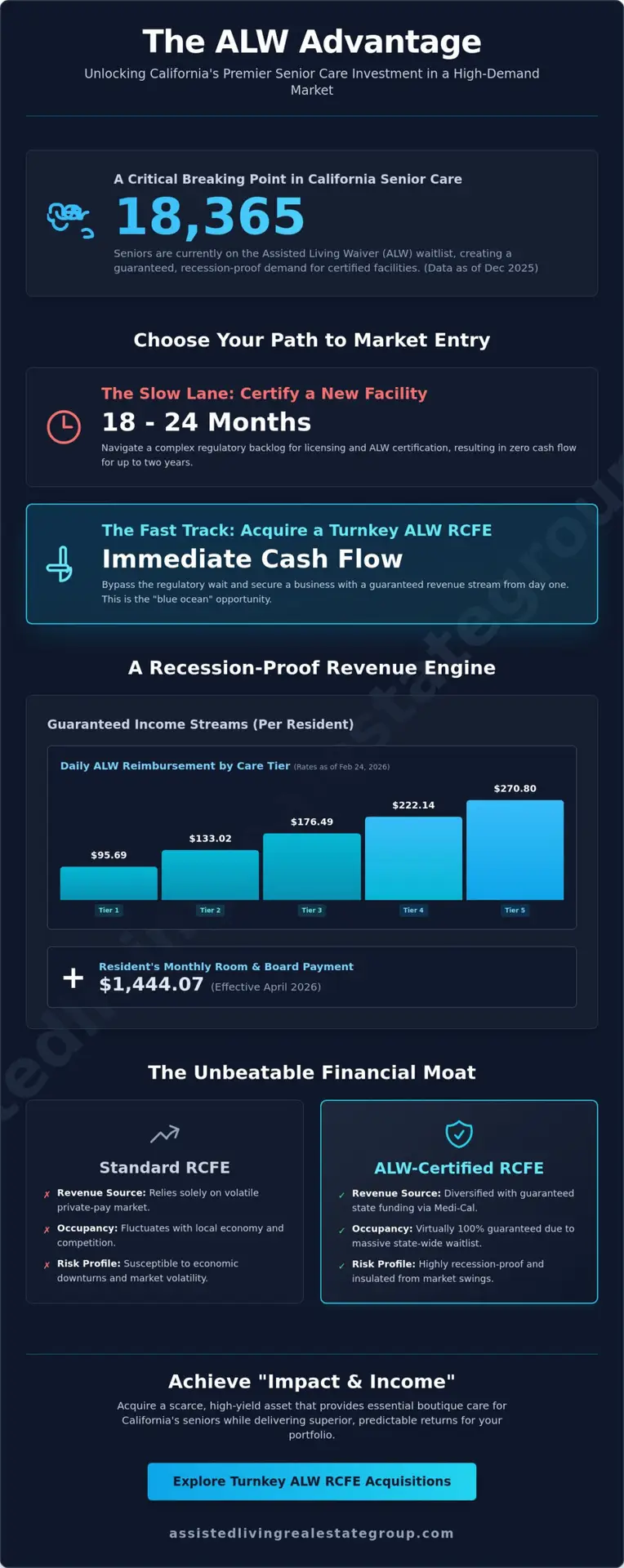
With 18,365 seniors currently on the Assisted Living Waiver waitlist as of December 2025, the demand for high-quality care in California has reached a critical breaking point. You’ve likely realized that while the private-pay market offers high ceilings, it’s also volatile and increasingly crowded. Finding an ALW certified RCFE for sale isn’t just about buying real estate; it’s about securing a turnkey business with a guaranteed revenue stream that bypasses the 18 to 24 month licensing backlog. This is the “blue ocean” opportunity for savvy entrepreneurs who want to scale quickly in a high-barrier market.
The Assisted Living Real Estate Group understands that elite investors want to achieve “Impact and Income” without the headache of mastering complex Title 22 regulations from scratch. We’ll show you how to acquire these scarce assets to maximize your ROI while providing essential boutique care. This guide explores how to leverage current 2026 reimbursement rates, which reach as high as $270.80 per day for Tier 5 care, to build a resilient RAL portfolio in California’s most profitable niche.
Key Takeaways
- Learn how ALW certification transforms a standard Title 22 RCFE into a high-yield asset by unlocking consistent Medi-Cal reimbursements.
- Understand the financial mechanics of the “Impact and Income” model to maintain stable occupancy rates even during economic downturns.
- Discover why acquiring an ALW certified RCFE for sale is the most efficient path to immediate cash flow, bypassing the 18 to 24 month regulatory wait.
- Master the essential due diligence steps for auditing Waiver Provider Agreements and Form LIC 809 reports to protect your boutique care investment.
- Explore the necessity of specialized brokerage to navigate California’s complex licensing landscape while maintaining strict operational confidentiality.
What is an ALW Certified RCFE and Why is it a Premium Asset?
A Residential Care Facility for the Elderly (RCFE) serves as the primary model for California’s senior housing, operating under the strict regulatory oversight of Title 22. While a standard Assisted Living Facility (ALF) typically relies on private-pay residents, an ALW-certified facility is a specialized asset that accepts Medi-Cal reimbursements through the Assisted Living Waiver program. Finding an ALW certified RCFE for sale represents a rare entry point into a market where the state essentially guarantees a portion of your revenue. This certification turns a traditional real estate holding into a government-backed asset because California often restricts the number of new provider slots, creating an environment of extreme scarcity for those looking to enter the space.
Understanding the California Assisted Living Waiver (ALW)
The California Department of Health Care Services (DHCS) manages the ALW program to offer a cost-effective alternative to institutional nursing homes. It bridges the gap for seniors who need high-level care but prefer the intimacy of a “Boutique” home. For savvy investors, the 6-bed Residential Assisted Living (RAL) model is the ultimate strategy. These smaller environments are the preferred choice for ALW participants because they offer a higher quality of life and more personalized attention than 100-plus bed institutions. As of May 2026, the current five-year waiver is active through February 28, 2029, providing a stable regulatory window for new owners to scale their portfolios with confidence.
RCFE vs. ALW-Certified RCFE: Key Differences
The primary differentiator lies in the revenue structure and occupancy security. A standard RCFE is at the mercy of the local private-pay market’s occupancy fluctuations. Conversely, an ALW-certified facility taps into a massive, state-funded pool of residents. With 18,365 individuals on the waitlist as of December 2025, your occupancy risk is virtually eliminated. Operationally, you’ll manage tiered reimbursement rates that, as of February 24, 2026, range from $95.69 to $270.80 per day depending on the resident’s care level. This predictable cash flow, combined with the $1,626.07 monthly SSI/SSP payment, is why an ALW certified RCFE for sale in Southern California often commands a higher cap rate and a significant premium over uncertified properties. You’re acquiring a license to capture “Impact and Income” in a recession-proof niche that serves the 15 specific counties currently eligible for the program.
The Financial Advantage: ROI and Recession-Proof Revenue
Investing in the senior care sector isn’t just a real estate play; it’s a commitment to our “Impact and Income” philosophy. You’re doing good for the community while securing superior financial returns that traditional asset classes simply can’t match. When you evaluate an ALW certified RCFE for sale, you aren’t just buying four walls and a roof. You’re acquiring a recession-proof revenue engine backed by the State of California. This government partnership creates a financial moat that protects your investment from market volatility.
Occupancy is the lifeblood of any rental property, and this is where the ALW model shines. As of December 2025, there were 18,365 individuals on the waitlist for California’s Assisted Living Waiver (ALW) program. This massive backlog effectively guarantees 100% occupancy for certified facilities. Unlike standard residential rentals where you might face “for rent” signs and marketing costs, these boutique homes have a line of residents waiting at the door. You’ll operate with the confidence that your beds will stay full and your cash flow will remain steady.
The 2026 reimbursement structure provides a clear roadmap for your pro forma. Under the rates published on February 24, 2026, daily reimbursements range from $95.69 for Tier 1 care to $270.80 for Tier 5 care. When you combine these state payments with the resident’s monthly room and board payment of $1,444.07, effective April 2026, the gross revenue per bed becomes highly attractive. If you’re ready to explore these numbers in depth, our team can help you identify a turnkey RCFE acquisition that fits your portfolio goals.
The “Silver Tsunami” as a Strategic Opportunity
California is facing a demographic shift that experts call the “Silver Tsunami.” By 2030, the demand for senior housing will reach unprecedented levels, with many industry reports projecting a need for over 200,000 new units. We see a clear trend moving away from cold, institutional nursing homes toward intimate, “Boutique” environments. Seniors and their families now prioritize quality of life and personalized care. By positioning your investment in the RAL (Residential Assisted Living) space, you’re capturing the premium end of this massive market demand.
Analyzing Cap Rates in the ALW Sector
Calculating ROI in this niche requires looking beyond simple rent rolls. While standard multi-family real estate might offer cap rates in the 4% to 5% range, ALW-certified facilities often achieve significantly higher yields due to the service-based revenue component. You aren’t just collecting rent; you’re receiving compensation for high-level care coordination. When comparing an ALW certified RCFE for sale to a traditional apartment complex, the valuation must include the intrinsic worth of the waiver contract itself. ALW certification acts as a hedge against economic downturns because government-backed reimbursements remain constant even when private-pay demand fluctuates. This stability allows you to build long-term legacy wealth while providing an essential service to California’s seniors.
Buying Existing vs. Certifying New: The Turnkey Benefit
Starting a new project from the ground up sounds exciting, but the reality is often a 24 month drain on your capital. Most investors don’t realize that certifying a new facility for the Assisted Living Waiver is a multi-stage process that can take years to finalize. When you find an ALW certified RCFE for sale, you’re effectively buying time. You bypass the grueling wait for new provider slots and start generating revenue from day one. This is the difference between a speculative project and a performing asset.
The “Change of Ownership” (CHOW) process is your strategic shortcut. While you still must meet RCFE licensing requirements through the California Department of Social Services, taking over an existing license is significantly faster than starting from zero. You inherit a business with residents already in place, ensuring immediate cash flow to cover your debt service. You also inherit a trained team. Compliance for the ALW program requires specific care coordination and reporting. Hiring and training a new staff to meet these standards is a massive operational hurdle that turnkey buyers simply don’t face.
The Hidden Costs of New ALW Applications
New applications are deceptively expensive. Beyond the initial licensing fees, which range from $495 for 1 to 3 beds to $1,486 for 15 bed facilities as of 2026, you face “holding costs.” This includes paying a mortgage, utilities, and insurance on an empty building for 18 months. Fire clearances and zoning in Southern California can be notoriously difficult for new builds. In many jurisdictions, existing facilities are “grandfathered” into their locations, making them irreplaceable gold mines that a new competitor couldn’t replicate today.
Turnkey Acquisitions: What to Look For
When evaluating a potential purchase, look beyond the real estate. You’re buying “goodwill” and a proven track record of compliance. Check the physical plant for ADA requirements and Title 22 standards to ensure no major renovations are needed. For a deeper dive into the acquisition process, read The Ultimate Guide to Buying an RCFE Facility in California. This roadmap helps you distinguish between a distressed property and a high-performing boutique home that will deliver immediate “Impact and Income” for your portfolio.
Due Diligence Checklist for ALW Certified RCFE Sales
Acquiring an ALW certified RCFE for sale requires a transition from the mindset of a real estate investor to that of a high-level care operator. You aren’t just buying a property; you’re auditing a complex, regulated care business. The first and most critical step is verifying the Waiver Provider Agreement directly with the Department of Health Care Services (DHCS). If this contract isn’t in good standing or has pending sanctions, the premium value of the asset disappears. You must confirm that the facility is currently authorized to bill for the 2026 tiered reimbursement rates, which range from $95.69 to $270.80 per day.
Next, you must dive into the paper trail of compliance by auditing the ‘Statement of Deficiency’ (Form LIC 809). Review these records for the last 36 months to identify recurring issues. While a single deficiency is common in California’s strict regulatory environment, a pattern of “Type A” violations suggests systemic operational failures that could jeopardize your license transfer. When you review the last 3 years of P&L statements, look for consistency in Medi-Cal reimbursements versus private-pay income. A healthy boutique home should show a stable balance that reflects the $1,626.07 monthly SSI/SSP payment rate effective April 21, 2026.
Finally, confirm the status of the RCFE Administrator. In California, every facility must have a certified administrator who has passed the $100 state exam and paid the $140 initial application fee. If the current license-holder is leaving after the sale, you’ll need a qualified replacement ready to step in immediately to avoid a gap in coverage. If you need a more granular roadmap for this process, consult our RCFE Licensing in California: The 2026 Investor’s Guide to Success. To ensure you’re looking at a vetted, high-performing asset, view our current exclusive listings.
Technical Auditing of the Care Business
Your technical audit should extend to the individual resident files to ensure every participant meets current ALW eligibility criteria. You’re also inheriting a staffing structure; verify that all background checks and the 40 hours of required continuing education are up to date as of 2026. Verifying the ‘Facility Sketch’ (LIC 999) is critical for future expansion because it defines the exact footprint approved by the State for resident care and fire safety. Any unapproved modifications to the physical plant can lead to immediate licensing delays during the Change of Ownership process.
Licensing and Regulatory Verification
Utilize the California Social Services ‘Transparency Website’ to cross-reference the facility’s public record against the seller’s disclosures. This database provides an objective view of inspections and complaint investigations. You must also distinguish between transferable business permits and ‘non-transferable’ local use permits that may expire upon a change of ownership. In the specialized RAL market, missing a single local zoning detail can stall your ROI for months. Our team helps you navigate these hurdles to ensure your “Impact and Income” goals stay on track from the moment of acquisition.
Securing Your Investment with a Specialized RCFE Broker
General commercial brokers often excel at moving warehouses or retail strips, but they fail when confronted with the intricate regulatory layers of the California care industry. They view properties as cold financial assets; they don’t understand the nuances of Title 22 compliance or the critical nature of the DHCS waiver process. When you’re seeking an ALW certified RCFE for sale, you need a mentor who understands that you’re buying a specialized care business, not just a residential structure. Our team brings 25 years of California-specific expertise to the table, acting as your strategic guide through a high-barrier market that others find impenetrable.
The most lucrative opportunities in the Residential Assisted Living (RAL) space often never reach public platforms like LoopNet. These “pocket listings” are traded within a tight-knit network of industry insiders to protect the business’s integrity. We provide you with exclusive access to these off-market assets, ensuring you’re looking at vetted, high-performing facilities before the general public even knows they’re available. This exclusivity is a cornerstone of how we help our clients build a “Boutique” care portfolio that dominates the local Southern California landscape.
The Power of Confidential Marketing
In the senior care world, public knowledge of a sale can be catastrophic. If residents’ families or staff members discover a facility is on the market through a standard listing, the result is often immediate resident flight and high employee turnover. This decimation of occupancy and operational stability can ruin an asset’s value before the ink is dry on a contract. We utilize a sophisticated, confidential marketing strategy that protects the facility’s reputation. We vet every buyer for financial capacity and operational vision, ensuring we match sellers with legacy-minded investors who understand our “Impact and Income” philosophy.
Your Southern California RCFE Roadmap
Our role as your strategic partner extends from the initial valuation through the final close of escrow. We guide you through the complex “Change of Ownership” (CHOW) process, leveraging our deep network of specialized lenders, consultants, and licensing experts who understand the unique valuation of care licenses. This methodical approach ensures your transition into ownership is seamless and your ROI is protected from day one. The “Silver Tsunami” of aging demographics isn’t a crisis; it’s a “blue ocean” opportunity for those with the right roadmap. Explore our current California Assisted Living listings to find an ALW certified RCFE for sale that aligns with your long-term investment goals.
Build Your Legacy in California’s Premier Care Niche
The “Silver Tsunami” isn’t a future threat; it’s a present opportunity for savvy entrepreneurs who understand the immense value of a government-backed revenue stream. By securing an ALW certified RCFE for sale, you position yourself at the intersection of high-yield real estate and compassionate boutique care. You’ve seen how the massive state-wide waitlist creates an occupancy floor that standard rentals simply can’t match. Now it’s time to move from education to execution.
Under the leadership of industry expert Teri Szoke, The Assisted Living Real Estate Group provides the specialized roadmap you need to navigate California’s complex regulatory landscape. We leverage over 25 years of experience to grant you exclusive access to off-market Southern California listings that never hit the public portals. Don’t let the 24 month licensing hurdle stop your momentum when a turnkey solution is within reach. Your journey toward significant financial returns and a lasting social legacy starts with a single strategic partnership.
Secure Your Future in Senior Care: View Our Exclusive ALW Listings
Frequently Asked Questions
Can a new owner keep the ALW certification after a sale?
Yes, the ALW certification can be transferred to a new owner through the state’s Change of Ownership process. While the RCFE license itself is non-transferable, the facility’s status as a waiver provider remains intact as long as the buyer meets DHCS requirements and receives formal approval. Buying an existing ALW certified RCFE for sale is a strategic shortcut that bypasses the multi-year wait for new provider slots.
What is the average reimbursement rate for ALW participants in California for 2026?
Reimbursement is based on a tiered system that reflects the specific care needs of each resident. According to DHCS rates published February 24, 2026, daily payments range from $95.69 for Tier 1 to $270.80 for Tier 5. When you add the resident’s monthly room and board payment of $1,444.07, these boutique facilities generate a predictable and robust revenue stream that is protected by the state budget.
How many beds are typically in an ALW-certified RCFE?
Most boutique facilities in this niche operate as 6-bed residential homes. This specific RAL model is highly favored by state regulators because it provides a more intimate, person-centered environment than institutional settings. While larger facilities exist, the 6-bed model often achieves the best balance of operational efficiency and high-quality “Impact and Income” for private investors.
Do I need a special license to operate an ALW facility?
You need a standard RCFE license from the California Department of Social Services plus an active Waiver Provider Agreement with the DHCS. Operating an ALW certified RCFE for sale requires you to follow both Title 22 regulations and the specific care coordination standards mandated by the waiver program. You must also ensure your administrator maintains their certification with the required 40 hours of continuing education every two years.
Is it better to buy the real estate or just the care business?
Buying both the real estate and the business is the ultimate strategy for securing long-term legacy wealth. Owning the property protects you from lease escalations and gives you full control over the physical plant for necessary ADA or fire safety upgrades. This dual-ownership model ensures you benefit from both the business’s cash flow and the appreciation of prime California real estate.
What happens if the ALW program funding changes?
The current waiver program is approved for a five-year term that runs through February 28, 2029. While all government programs are subject to review, the massive waitlist of 18,365 individuals as of December 2025 indicates a desperate and growing need for these services. The ALW program is a cost-saving tool for California because it’s significantly more affordable for the state than traditional nursing home care.
How long does the escrow process take for an RCFE sale in California?
Escrow for a care facility typically lasts between 60 and 120 days. This timeline accounts for the “Change of Ownership” licensing process, which requires the state to vet the new owner’s qualifications and financial stability. We guide our clients through each step of this methodical process to ensure the transition is seamless for both the staff and the residents.
Are ALW facilities only for low-income residents?
Participants must be Medi-Cal eligible and meet specific income and asset thresholds. For example, the single applicant monthly income limit is $1,836 as of April 2026. However, the program is less about “low income” and more about providing a “nursing facility level of care” in a more dignified, home-like setting. This allows seniors to access premium boutique care regardless of their private financial status.