
In the competitive 2026 California market, the most lucrative real estate isn’t found in traditional residential flips, but within the operational moat of a licensed care home. Finding a high-quality adult residential facility for sale Ventura County requires more than just a capital injection. It demands a strategic understanding of a high-barrier-to-entry niche where ethical care meets institutional-grade returns. You likely recognize that while the demand for specialized care in Ventura is surging, the path to acquisition is fraught with strict Title 22 compliance and complex zoning hurdles that can derail even the most seasoned investors.
We’re here to provide the strategic roadmap you need to secure a turnkey, cash-flowing asset while navigating the specific regulatory demands of the California Department of Social Services. You’ll learn how to identify confidential listings that never hit the public market and understand the impact of the 2025 Title 22 updates on your bottom line. This guide previews current 2026 market valuations, the nuances of the CCLD relicensing process, and the essential steps for maintaining long-term regulatory excellence in Ventura’s unique coastal and non-coastal zones.
Key Takeaways
- Understand the demographic tailwinds and zoning nuances that make Ventura County a premier location for specialized care investments.
- Distinguish between ARF and RCFE models to select the funding structure, whether Regional Center or private pay, that matches your portfolio strategy.
- Secure a competitive advantage by mastering California Title 22 compliance and the latest 2026 regulatory mandates for licensed facilities.
- Learn why finding an adult residential facility for sale Ventura County requires a confidential acquisition strategy to safeguard staff stability and resident trust.
- Leverage specialized brokerage expertise to access off-market, turnkey opportunities that bridge the gap between financial returns and compassionate care.
The Growing Market for Adult Residential Facilities in Ventura County
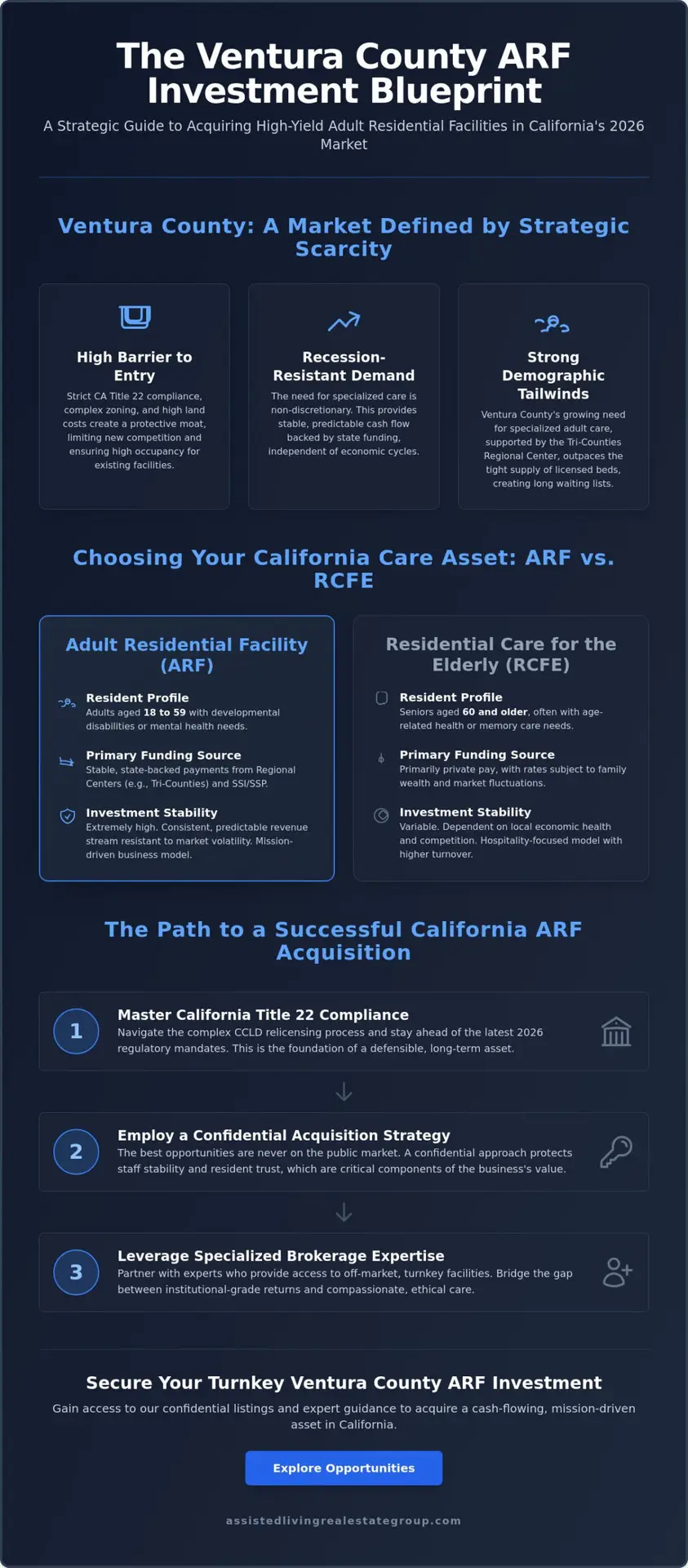
In California’s 2026 care landscape, the Adult Residential Facility (ARF) represents a specialized asset class tailored for residents aged 18 to 59. Unlike traditional senior housing, these facilities cater to individuals with developmental disabilities or mental health challenges. This distinction is vital for investors seeking a Residential Care Models framework that provides stable, non-discretionary income. Finding an adult residential facility for sale Ventura County is increasingly difficult as institutional capital recognizes the high barrier to entry and the recession-resistant nature of these operations. This is a high-stakes niche where seasoned expertise is the only currency that matters.
Inventory remains tight across the 805 area code. In Oxnard, Ventura, and Camarillo, existing facilities are often at full capacity with extensive waiting lists. This isn’t a market defined by surplus; it’s a market defined by strategic scarcity. Properties in Camarillo often feature modern amenities like solar systems and high-end finishes, commanding premium valuations. For the strategic professional, the intersection of social impact and financial performance is clear. You aren’t just managing square footage; you’re facilitating life-changing support for a vulnerable population while securing a high-yield asset.
Ventura County Demographic Shifts and ARF Demand
Ventura County’s unique population profile drives a consistent need for high-quality care. The local community includes a significant number of adults requiring specialized support, many of whom are supported by the Tri-Counties Regional Center. Coastal Ventura County attracts a demographic that values localized, high-tier service, creating a dual-revenue opportunity where private-pay residents and state-funded programs coexist. Demand for these specialized care beds in Southern California is projected to grow steadily through 2030, outpacing new construction due to stringent local zoning laws and high land costs.
The Economic Resilience of Ventura Care Facilities
Licensed care facilities in California offer a unique hedge against market volatility. While other commercial sectors struggle with fluctuating demand, the need for residential care remains constant regardless of the broader economy. Ventura’s high cost of living serves as a protective moat for current owners. High land costs and complex permitting processes prevent a glut of new competitors from entering the market. This ensures that established facilities maintain high occupancy rates and stable cash flows. Acquiring an adult residential facility for sale Ventura County isn’t just a real estate play; it’s a commitment to a mission-driven business model that yields significant long-term significance.
ARF vs. RCFE: Choosing the Right Investment in Ventura
Distinguishing between these two asset classes is the primary step in your due diligence. While both fall under the jurisdiction of California’s Residential Care Regulations, their operational DNA is vastly different. Residential Care Facilities for the Elderly (RCFE) serve those 60 and older, primarily focusing on age-related decline. Conversely, an Adult Residential Facility (ARF) serves residents aged 18 to 59 with developmental disabilities or mental health needs. Identifying a high-performing adult residential facility for sale Ventura County requires you to decide which funding model aligns with your financial objectives.
Revenue models create a significant fork in the road. RCFEs in Ventura often command high private-pay rates, sometimes reaching significant monthly totals for specialized memory care. ARFs frequently rely on a mix of SSI/SSP and Regional Center funding. In Ventura, the Tri-Counties Regional Center provides a stable, state-backed payment stream that isn’t subject to the same market fluctuations as private wealth. This predictability is why many seasoned investors are pivoting away from the high-turnover senior care market toward the long-term stability of adult residential care. It’s a shift from a hospitality-heavy model to one focused on consistent, mission-driven service delivery.
Understanding the ARF Resident Profile
Residents in an ARF aren’t looking for a retirement home; they’re looking for a community that supports their independence. Programs often focus on behavioral challenges or mental health stabilization. Because these residents are younger, the average length of stay is significantly longer than in an RCFE. This translates to lower marketing costs and reduced vacancy risk over a ten-year horizon. However, you must account for staffing models that prioritize active engagement and behavioral support over the passive clinical monitoring often seen in senior settings. Ventura facilities must tailor their environments to facilitate this higher level of engagement.
Financial Comparison: RCFE vs. ARF
Profitability in the 805 area code depends on your specific expense management. RCFEs typically face higher food and medical supply costs, whereas ARFs might see different insurance requirements due to behavioral acuity levels. While an RCFE business in a prime Ventura neighborhood might gross $50,000 monthly from six beds, an ARF can achieve similar net margins through lower resident turnover and more consistent state reimbursements. To navigate these complex spreadsheets, it’s wise to consult with professional care home brokers who understand the local revenue landscape. Ultimately, the ARF model offers a faster path to debt service coverage for investors who value consistent, state-supported cash flow over the volatility of the private-pay market.
Navigating California Title 22 and Ventura County Compliance
Securing an adult residential facility for sale Ventura County is a sophisticated regulatory maneuver, not just a property purchase. The California Department of Social Services (CDSS) serves as the gatekeeper for your operational success. Compliance begins with a granular understanding of California Title 22, Chapter 6. These regulations dictate everything from staff-to-resident ratios to behavioral management protocols. If you’re coming from a traditional residential or commercial background, the intensity of these mandates can be jarring. However, this high barrier to entry is exactly what protects your profit margins once you’re inside the market.
In Ventura County, the Ventura County Fire Department (VCFD) often holds the keys to the deal. A facility can look perfect on paper but fail to secure the necessary fire clearances for non-ambulatory residents. This is the single most common reason why acquisitions fall through in the 805 area code. You must verify that the property’s physical plant aligns with the specific acuity levels you intend to serve before committing capital.
The California Relicensing Process
Buying an existing business doesn’t mean you automatically inherit the license. California law requires a new application for each ownership change. It’s a non-negotiable process that requires meticulous planning to avoid operational gaps. For a deeper dive into the procedural nuances, see our guide on RCFE Licensing in California: The 2026 Investor’s Guide to Success. Managing this interim period is critical. You must ensure residents remain safely cared for while the state processes your new credentials and conducts its site inspections.
Local Ventura Zoning and Fire Clearances
Municipalities like Simi Valley and Thousand Oaks have specific municipal codes that overlay state requirements. You must navigate these local ordinances with precision to ensure your adult residential facility for sale Ventura County remains compliant. The ‘R-3.1’ fire clearance is the gold standard for care homes in Southern California. It signifies that the property meets the rigorous safety standards required for residents who cannot exit independently during an emergency. Without this, your bed capacity and resident acuity levels will be severely limited. Your due diligence must include a direct consultation with the Ventura County Community Care Licensing district office to verify the facility’s standing and any pending citations.
confidentiality and Due Diligence in ARF Transactions
Public listings are often the death knell for a care home’s valuation. When an adult residential facility for sale Ventura County is broadcast on generic real estate platforms, it triggers immediate instability. Staff members fear for their job security and begin seeking alternative employment. Families, sensing a shift in ownership, may move their loved ones to avoid perceived service disruptions. This “flight risk” can erode the very census numbers you’re paying to acquire. Successful investors prioritize confidential marketing strategies that shield the business from public scrutiny until the deal is finalized.
Your due diligence must be conducted with surgical precision. You’re not just buying a building; you’re acquiring a complex operational history. This requires a deep dive into the facility’s “Licensing File” maintained by the California Department of Social Services. You must review every Facility Evaluation Report from the past three years. Pay close attention to Type A citations, as these indicate immediate risks to resident health and safety. If you’re on the other side of the table, preparing your records is just as vital. Read our resource on how to Sell Your Adult Residential Facility in California: The Definitive Guide to understand what buyers look for.
The 5-Step Confidential Acquisition Framework
Executing a California-specific non-disclosure agreement (NDA) is your first line of defense. Once the NDA is in place, you can verify historical census data and Regional Center reimbursement rates. Don’t take verbal assurances at face value. You need to see the actual contracts from the Tri-Counties Regional Center. A physical inspection should be framed as an “insurance walkthrough” or “routine maintenance check” to avoid alerting employees. This stealth approach allows you to identify deferred maintenance that might trigger licensing citations during the ownership transfer. To ensure your search remains discreet, consult with a specialized ARF broker who understands the Ventura market.
Financial Due Diligence: Beyond the P&L
Analyzing staffing patterns is where most novice investors fail. You must compare the actual payroll records against the staffing ratios required by Title 22. If the current owner is understaffed to inflate the net operating income, your post-acquisition expenses will spike immediately. California’s labor market is notoriously tight, and you must account for the high cost of Workers’ Comp and professional liability insurance in Ventura County. These “hidden” costs can fluctuate significantly based on the facility’s prior claim history. Your valuation must separate the real estate’s market value from the business goodwill to ensure the debt service coverage ratio remains healthy under 2026 interest rates.
Securing Your Ventura County ARF Investment
Navigating the final stages of an adult residential facility for sale Ventura County acquisition requires a shift from analytical due diligence to strategic execution. You’ve identified the asset and vetted the compliance history; now you must ensure the transition doesn’t compromise the business’s core value. A specialized RCFE/ARF broker is mandatory in California because they manage the delicate balance between the real estate closing and the state’s relicensing timeline. Without this coordination, you risk a gap in operations that could jeopardize your Regional Center contracts or resident safety. You aren’t just buying a property. You’re assuming a legacy of care that requires professional stewardship.
Accessing the most desirable inventory in the 805 area code often means looking beyond public databases. High-yield facilities are frequently traded as off-market opportunities to maintain the confidentiality essential for staff retention. Once the deal closes, your focus must immediately pivot to resident and staff stability. A smooth transition plan involves introducing the new management team in a way that emphasizes continuity and improved service quality. This is the stage where your investment transforms from a financial entry on a spreadsheet into a tangible social impact within the Ventura community.
Scaling your portfolio is the natural progression for the strategic professional. Once you’ve mastered the operational nuances of a 6-bed facility in a neighborhood like Camarillo, the path to expansion becomes clearer. Moving toward larger Ventura facilities or acquiring a portfolio of smaller homes allows you to centralize administrative costs and leverage economies of scale in food service and staffing. This growth requires a visionary partner who understands the long-term significance of the California care market.
The Value of Specialized Brokerage
The Assisted Living Real Estate Group bridges the gap between complex real estate transactions and the rigorous licensing demands of the California Department of Social Services. We leverage 25 years of Southern California care facility experience to ensure your acquisition is both legally sound and financially optimized. For a deeper understanding of the broader investment landscape, explore our resource on Investing in an Adult Residential Facility in California: The 2026 Southern California Market Guide. We provide the seasoned expertise necessary to navigate a high-barrier-to-entry market with confidence.
Next Steps for Ventura Investors
Your journey toward acquiring an adult residential facility for sale Ventura County begins with defining your specific acquisition criteria. Whether you’re targeting Simi Valley, Thousand Oaks, or the city of Ventura, your financial package must be prepared for the scrutiny of specialized care home lenders. These institutions look for a combination of strong personal credit and a clear understanding of Title 22 operational costs. When you’re ready to move from curiosity to conviction, contact the Assisted Living Real Estate Group for a confidential consultation. We hold the keys to this exclusive market and are ready to guide you through a step-by-step project development process that prioritizes both ethics and profitability.
Mastering the Ventura County Care Market
Success in California’s specialized care sector depends on your ability to navigate the intersection of strict Title 22 compliance and strategic operational management. You’ve seen how the most resilient assets are those protected by high regulatory barriers and secured through discreet, off-market channels. By focusing on the long-term stability of the ARF model, you can build a portfolio that balances significant financial returns with a tangible social impact in the 805 area code. Finding a premier adult residential facility for sale Ventura County is the catalyst for this professional evolution.
Navigating this niche requires a partner with seasoned expertise and a visionary approach. We bring over 25 years of California care facility brokerage experience to your acquisition strategy, offering an exclusive focus on RCFE and ARF business-real estate hybrids. Our team specializes in confidential off-market transactions, ensuring that your investment remains stable from the initial letter of intent through the final relicensing site visit. When you’re ready to move from curiosity to conviction, View Confidential Ventura County Care Facility Listings and secure your place in this premium market. Your future as a strategic care provider starts today.
Frequently Asked Questions
What is the difference between an ARF and an RCFE in California?
The primary distinction lies in the age and needs of the residents served. Adult Residential Facilities (ARF) cater to adults aged 18 to 59 who typically have developmental disabilities or mental health challenges. Residential Care Facilities for the Elderly (RCFE) are designed for seniors aged 60 and older. While both fall under Title 22, ARFs often integrate with the Regional Center system for funding, whereas RCFEs frequently operate on a private-pay model.
Do I need a specific license to buy an adult residential facility in Ventura County?
Yes, you must obtain a facility license from the California Department of Social Services (CDSS) and possess a valid Administrator Certification. The process requires completing a $54.85 online orientation and paying a one-time application fee of $730 to the Department of Health Care Services. You’ll also need to prove financial stability by showing you have at least one month of operating costs readily accessible for an existing facility.
How much does a 6-bed ARF typically sell for in Ventura County?
Valuations for an adult residential facility for sale Ventura County fluctuate based on the real estate value and the business’s gross monthly income. Recent market data shows 6-bed facilities in prime neighborhoods listed for approximately $1.5 million for the property, with the business component valued at an additional $300,000. Larger specialized portfolios in the region have seen asking prices ranging from $2.95 million to $6 million.
Can I buy the business of an ARF without buying the real estate?
You can acquire just the business operations through lease-to-own care home opportunities or straight business-only acquisitions. This strategy allows for a lower entry cost, though you’ll need a long-term lease agreement that satisfies CDSS licensing requirements. Most institutional investors in Ventura prefer the hybrid model to capture the dual benefits of operational cash flow and Southern California real estate appreciation.
How long does the California relicensing process take for a new owner?
The relicensing timeline typically spans three to six months. This period involves a thorough background check, a review of your financial stability, and a physical site inspection by the Community Care Licensing Division. It’s a critical window that requires precise coordination to ensure there’s no disruption in resident care or state reimbursement payments during the ownership transition.
Are there specific zoning laws for care facilities in Thousand Oaks or Simi Valley?
Thousand Oaks and Simi Valley both enforce local municipal codes that govern the density and placement of residential care homes. The most significant hurdle is often the Ventura County Fire Department’s R-3.1 clearance. This specific fire safety designation is mandatory for any adult residential facility for sale Ventura County that intends to house non-ambulatory residents who cannot exit the building independently.
How do I ensure my purchase remains confidential to the residents?
Confidentiality is maintained by utilizing specialized brokers who operate through off-market channels and strictly enforced non-disclosure agreements. You should frame all pre-closing site visits as routine insurance inspections or maintenance walkthroughs. This stealth approach prevents “staff flight” and resident anxiety, preserving the facility’s census and operational stability until the transition is officially announced.
What are the staffing requirements for a California Adult Residential Facility?
Staffing levels are dictated by California Title 22, Division 6, and must be sufficient to provide the care and supervision required by your specific resident population. You must employ a certified administrator and maintain caregiver-to-resident ratios that align with the residents’ acuity levels. 2025 regulatory updates now mandate dementia-aware training facility-wide and require resident reappraisals at least every 12 months to ensure care plans remain current.