
Waiting eighteen months for a California Department of Social Services license isn’t a strategy; it’s a liability that drains capital before you even open your doors. You’ve likely recognized that the demand for senior care across the Golden State is reaching a fever pitch, yet the regulatory barriers have never felt more daunting. Acquiring a turnkey assisted living business California-wide allows you to bypass the labyrinth of Title 22 compliance and the grueling wait times that stall most new ventures. It’s the most efficient route for investors who value immediate operational momentum over bureaucratic delays.
This guide provides the 2026 roadmap for securing high-performing RCFE or ARF assets that are already licensed and profitable. We’ll explore the nuances of the Change of Ownership (CHOW) process and explain how to access exclusive, off-market listings that never reach the public eye. You’ll learn how to bridge the gap between savvy financial investment and compassionate service, ensuring your entry into this high-barrier market is both strategic and seamless. From navigating confidential acquisitions to maintaining operational continuity, we’re providing the blueprint for high-impact growth in the California care market.
Key Takeaways
- Identify why the 2026 demographic shift makes a turnkey assisted living business California-wide the most efficient vehicle for capturing immediate market demand.
- Compare the financial impact of a turnkey acquisition versus a de novo startup; specifically, learn how to avoid the “Cost of Carry” during lengthy licensing delays.
- Perform comprehensive due diligence by evaluating three-year census data and CDSS compliance records to ensure you’re acquiring a high-quality, sustainable asset.
- Streamline your transition through the California Change of Ownership (CHOW) process by understanding the exact regulatory milestones required for a successful transfer.
- Gain exclusive access to off-market RCFE and ARF opportunities through a specialized brokerage that uses confidential marketing strategies to protect business value.
Defining the Turnkey Assisted Living Opportunity in California
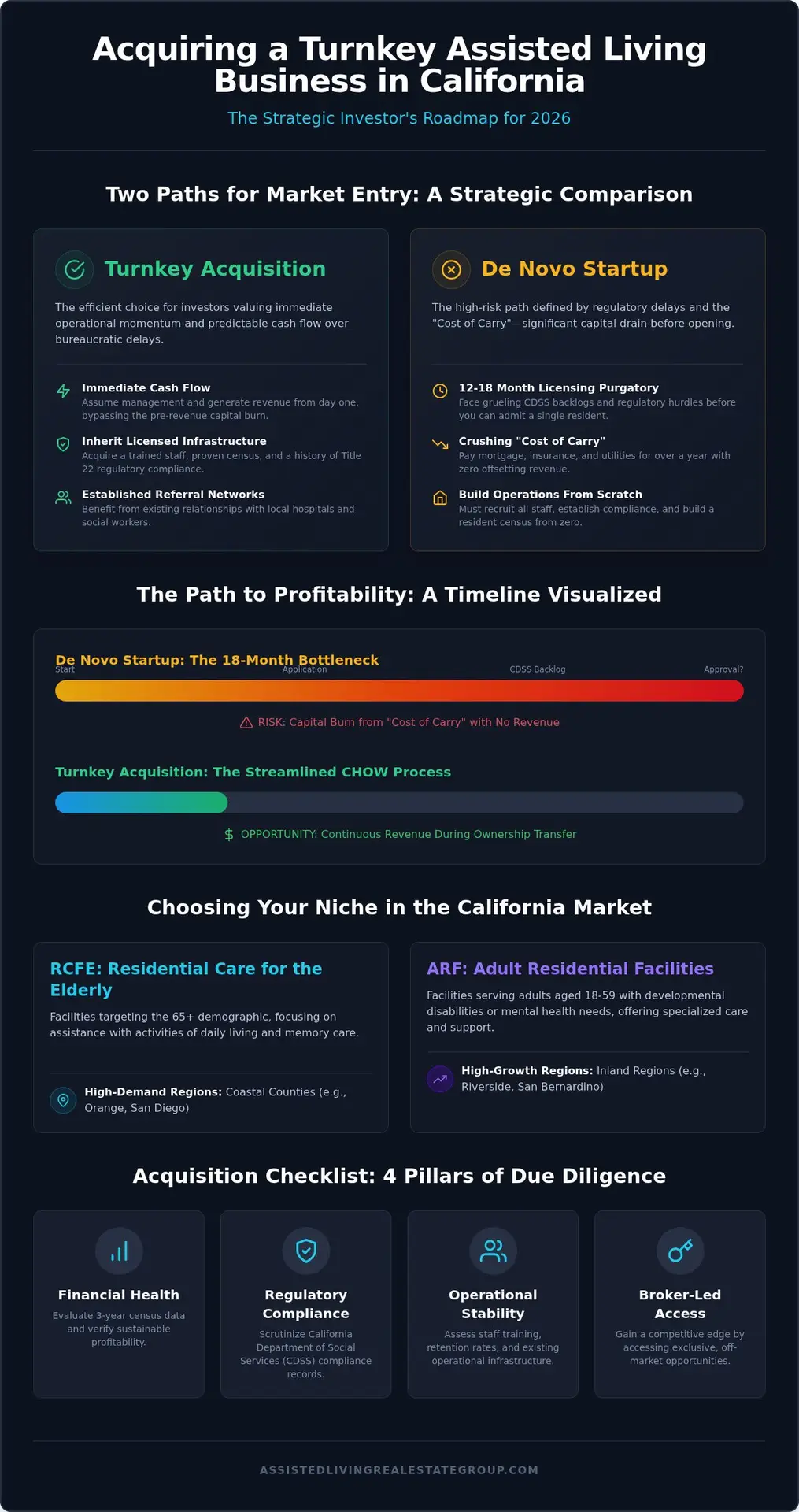
A California turnkey care business is a fully operational, licensed facility that allows an investor to assume management and revenue generation immediately upon the completion of the ownership transfer. This model represents the apex of strategic investment in the care sector. When you acquire a turnkey assisted living business California operators have already stabilized, you aren’t simply purchasing real estate. You’re securing an active business entity with a proven census, a trained staff, and a history of regulatory compliance. By 2026, the demographic shift in the Golden State will reach a critical juncture, as the aging population outpaces the development of new care beds, making existing facilities the most sought-after assets in the market.
RCFE vs. ARF: Choosing Your Niche
Success starts with choosing the right license type for your specific portfolio goals. Residential Care Facilities for the Elderly (RCFE) target the 65 plus demographic, focusing on assistance with activities of daily living and memory care. In contrast, Adult Residential Facilities (ARF) serve adults aged 18 to 59 with developmental disabilities or mental health needs. Market demand varies significantly across different regions:
- Coastal Counties: Orange County and San Diego see intense demand for premium RCFE placements.
- Inland Regions: Riverside and San Bernardino counties often present high-growth opportunities for ARF expansion due to lower entry costs and strong referral networks.
- Scale: Opportunities range from intimate 6-bed residential homes to mid-sized 30 plus bed communities.
The Value of an Existing License
The most critical asset in any transaction is the active license issued by the California Department of Social Services (CDSS). Attempting to start a facility from scratch often leads to a licensing purgatory that lasts between 12 and 18 months. During this period, an investor must carry the full cost of the mortgage, insurance, and utilities without any incoming revenue. Acquiring a turnkey assisted living business California professionals have already vetted eliminates this burn rate. You bypass the grueling initial application process and move straight into the Change of Ownership (CHOW) phase. This ensures day-one cash flow and preserves your capital for operational excellence rather than bureaucratic delays.
Turnkey Acquisition vs. De Novo Startup: A Strategic ROI Analysis
Capital is a finite resource. In California’s competitive care landscape, the decision between building from the ground up or acquiring an existing facility often determines an investor’s long-term solvency. While a de novo startup might appear cost-effective on a spreadsheet, the hidden “Cost of Carry” frequently erodes those perceived savings. Investors who choose a turnkey assisted living business California has already established are effectively buying time, the one asset a startup cannot manufacture. By acquiring an operational RCFE or ARF, you replace eighteen months of pre-revenue expenses with immediate, predictable cash flow.
Bypassing the 12-Month Licensing Delay
The California Department of Social Services (CDSS) currently faces significant backlogs that can stall new license applications for over a year. During this period, a de novo operator must pay for a mortgage, insurance, and utilities without a single resident to offset the burn rate. A turnkey acquisition utilizes the Change of Ownership (CHOW) process, which allows the facility to maintain its resident census and operational status while the new license is processed. This continuity protects the facility’s reputation and ensures that the vital “care bridge” for residents remains unbroken during the transition. Investors seeking to evaluate these high-performing assets often benefit from specialized RCFE brokerage services to navigate these regulatory milestones.
Inheriting an Operational Infrastructure
Staffing remains the most significant operational hurdle in the California care industry. A turnkey facility comes with a team already trained in Title 22 compliance, eliminating the high costs of recruitment and initial certification. You also inherit established referral funnels from local hospitals and social workers who already trust the facility’s care model. These Standard Operating Procedures (SOPs) are road-tested and functional, allowing you to focus on optimizing the business rather than inventing it. This infrastructure provides a layer of security that a startup simply cannot offer in its first year of operation.
While a de novo startup may offer a lower initial entry price, a turnkey acquisition typically achieves a significantly higher net ROI within the first 24 months by eliminating the “dead capital” phase of pre-licensing and renovation. It’s the difference between waiting for a seed to sprout and harvesting an existing orchard.
Evaluating a Turnkey RCFE: Metrics for Strategic Due Diligence
Due diligence in senior care requires a dual-lens approach that balances financial performance with regulatory integrity. When you analyze a turnkey assisted living business California has on the market, the last three years of census and occupancy data provide the most reliable forecast of future stability. While general business brokers often fixate solely on EBITDA, a seasoned care investor prioritizes Net Operating Income (NOI) while simultaneously scrutinizing California Department of Social Services (CDSS) inspection reports. High occupancy rates are meaningless if they’re accompanied by recurring Type A or Type B citations, which indicate systemic operational failures that no amount of financial engineering can fix. In this high-stakes sector, clinical compliance serves as the bedrock upon which all financial profit is built.
The Confidentiality Factor in Senior Care Sales
Publicly listing a care facility is a strategic error that can instantly devalue the asset. When residents or their families see a “For Sale” sign, it often triggers immediate move-outs; similarly, staff members may seek new employment due to fear of the unknown. To mitigate these risks, Assisted Living Real Estate Group manages off-market transactions through a confidential marketing database. This approach uses ironclad Non-Disclosure Agreements (NDAs) to ensure that sensitive business details are only shared with qualified, serious buyers. This protection preserves the facility’s reputation and ensures that the resident census remains stable throughout the acquisition process.
Physical Asset Inspection: Beyond the Real Estate
A turnkey acquisition involves more than just a building; it includes the specialized infrastructure required by Title 22. Your physical inspection must confirm that the facility meets current ADA compliance standards and California fire safety requirements, which are often more stringent for RCFEs. Evaluate the “furniture, fixtures, and equipment” (FF&E) to ensure they’re in good repair and meet the regulatory standards for resident comfort and safety. Critical items to inspect include:
- Commercial-grade kitchen equipment and food storage compliance
- Emergency call systems and fire suppression hardware
- Resident bedroom furniture and specialized mobility aids
Additionally, verify that all zoning and land use permits are specifically tailored for residential care within that municipality. Buying a turnkey assisted living business California requires verifying that the physical plant supports the license’s bed capacity without requiring immediate, costly retrofitting. This granular level of inspection ensures that your capital is invested in a compliant, future-proof asset.
Navigating California’s Regulatory Landscape During Ownership Transfer
The transition of a turnkey assisted living business California investors acquire hinges on a successful Change of Ownership (CHOW) application. Unlike a standard commercial real estate closing, the transfer of an RCFE or ARF is a dual-track process where the financial close must align perfectly with the regulatory handoff. In California, the Department of Social Services (CDSS) doesn’t simply “transfer” a license; the new owner must apply for their own license while the existing one remains active to ensure resident care is never interrupted. This requires a sophisticated understanding of the “Licensee” entity, whether you’re operating as an individual, a corporation, or an LLC.
To successfully navigate this transfer, you must follow a precise sequence that satisfies the Community Care Licensing Division (CCLD). The roadmap typically follows these four critical steps:
- Submit the LIC 200 Application: File the formal application package with your specific CDSS district office, including the required non-refundable fees based on bed capacity.
- Secure Background Clearances: All new officers, directors, and management must complete the Live Scan fingerprinting process and obtain criminal record clearance.
- Update Operational Documents: Submit a revised Plan of Operation and a fresh Admission Agreement that reflects your new management style while maintaining Title 22 standards.
- Complete the Component III Orientation: Participate in the mandatory district office orientation and pass a final facility inspection to demonstrate operational readiness.
Title 22 Compliance and the New Operator
California’s Title 22 regulations are some of the most rigorous in the nation. As a new operator, you’re responsible for ensuring that your management team meets all state mandates from day one. This includes having a designated administrator who holds a current California RCFE or ARF Administrator Certificate. You’ll need to meticulously update the facility’s personnel records and ensure all staff certifications are transferred or renewed under your new entity. For a more detailed breakdown of these requirements, see our guide on RCFE Licensing in California.
Escrow and the Licensing Contingency
Smart investors never close escrow without a “licensing contingency” in place. This legal safeguard ensures that the purchase of the turnkey assisted living business California is only finalized once the CDSS issues a “Letter of Intent to License” or provides formal approval of the CHOW. Specialized RCFE brokers play a vital role here, acting as the liaison between the buyer, the seller, and the licensing evaluator to keep the timeline on track. If you’re ready to explore compliant, high-value assets, you can view our current California listings to find a facility that fits your investment profile.
Securing Your Investment with a Specialized RCFE Broker
General commercial brokers often approach care homes as standard retail assets, a fundamental misunderstanding that can lead to catastrophic licensing failures. When you’re pursuing a turnkey assisted living business California has to offer, you need a partner who recognizes that the real estate is secondary to the operating license. Teri Szoke and her team leverage 25 years of specialized experience to identify “red flag” facilities that might look profitable on a spreadsheet but harbor deep-seated regulatory issues. This seasoned expertise ensures your capital is protected from the moment you sign the letter of intent.
Our role is that of a strategic mentor, guiding you through the complexities of the California care market. We provide exclusive access to a confidential database of off-market listings, ensuring your acquisition remains private and your resident census stays stable. This level of exclusivity is vital in a high-barrier-to-entry market where reputation is your most valuable currency. We bridge the gap between savvy financial investment and the high standards of compassionate care required by state law.
Beyond the Sale: Consulting and Post-Closing Support
Closing the deal is only the first step toward achieving long-term significance and profitability. We provide post-closing guidance to ensure your relicensing and facility setup are handled with precision. This includes connecting you with specialized Title 22 consultants and training providers who can help your team maintain a culture of excellence. For a deeper analysis of the acquisition process, consult The Ultimate Guide to Buying an RCFE Facility in California.
Lease-to-Own: A Flexible Entry Point
For experienced operators looking to scale without immediate heavy capital investment in real estate, we offer lease-to-own care home opportunities. This model allows you to gain operational control and build equity while aligning your real estate investment goals with your cash flow capabilities. It’s a visionary approach for strategic professionals who want to grow their footprint in the California market while maintaining financial flexibility. If you’re ready to explore these exclusive assets, you can View Current California Turnkey Opportunities to see how this model could fit your portfolio.
Strategic Growth in the 2026 California Care Market
The window for capturing high-yield senior care assets is narrowing as demographic shifts accelerate. By choosing a turnkey assisted living business California investors can skip the eighteen-month licensing burn and move directly into revenue generation. This strategy isn’t just about speed; it’s about securing an operational foundation with proven compliance and a stable resident census.
Navigating this high-barrier market requires more than just capital. It demands a specialized partner who understands the intricacies of the CHOW process and Title 22 standards. With over 25 years of specialized RCFE brokerage experience, we provide the roadmap and the confidential marketing strategy necessary to protect your future assets. You have the opportunity to achieve significant financial returns while providing a refined service that changes lives; for investors who value bespoke management in exclusive environments, check out Reubens Choice LLC to explore their premier ranch and bioreserve in the Cape Karoo.
Explore Exclusive Turnkey RCFE Listings in California to begin your transition into a high-performing care asset today. Your vision for a profitable, mission-driven portfolio is within reach.
Frequently Asked Questions
What exactly is a “turnkey” assisted living business in California?
A turnkey assisted living business California investors target is a facility where the real estate, active Licensee entity, and operational infrastructure are sold as a unified package. This means the buyer inherits a functional ecosystem with a pre-existing resident census and a staff trained in Title 22 compliance. It eliminates the startup phase, allowing for immediate revenue collection while the new owner navigates the formal Change of Ownership transition.
How long does the Change of Ownership (CHOW) process take in 2026?
In 2026, the Change of Ownership (CHOW) process typically spans four to six months for completion. This timeline is significantly shorter than the eighteen month wait often required for a de novo facility license. By utilizing a turnkey model, the facility remains operational during this interim period, ensuring that cash flow is maintained and resident care is never interrupted while the state processes the new Licensee application.
Can I buy the business operations without buying the real estate?
Yes, you can acquire business operations without purchasing the underlying real estate through a leasehold acquisition. This structure allows an operator to purchase the “goodwill,” license rights, and equipment while paying rent to the property owner. It’s a capital efficient way to enter the market, and many investors eventually transition these arrangements into a lease-to-own care home opportunity to build long term equity in the asset.
Do I need a special license to own an RCFE if I hire an administrator?
You don’t need a personal administrator certificate to own the business, but the legal entity you form must be approved as the Licensee. While you hold the financial and legal responsibility for the facility, you must employ a California certified administrator to manage daily clinical operations. This allows strategic investors to focus on business growth and portfolio expansion while leaving the technical care management to a qualified professional.
What is the average cap rate for a turnkey 6-bed RCFE in Southern California?
Cap rates for turnkey 6-bed RCFEs in Southern California vary based on the specific county and the facility’s historical Net Operating Income. Industry professionals report that these assets often command a premium due to their high barrier to entry and consistent demand in areas like Orange County. While specific percentages fluctuate with the market, these facilities are generally valued higher than traditional residential real estate because of their specialized business income.
Is it better to buy an RCFE or an ARF for a first-time investor?
The choice between an RCFE and an ARF depends on your specific investment goals and desired demographic focus. RCFEs serve the elderly and often allow for higher private pay rates, especially in memory care niches. ARFs serve younger adults with disabilities and may offer more stable, long term placements. First time investors should evaluate which regulatory framework and staffing model aligns best with their operational experience and local market demand.
How do I ensure the residents stay when I buy the business?
Ensuring resident retention requires a commitment to confidentiality and operational continuity during the sale process. By utilizing a confidential marketing strategy, you prevent the panic that often follows a public listing. Maintaining the existing care staff and keeping daily routines unchanged helps residents feel secure. A seamless handoff ensures that families trust the new management’s ability to maintain the high standards of care they expect.
What are the main “red flags” to look for when buying an existing care home?
Primary red flags include a history of unresolved Type A citations from the CDSS or a volatile resident census over the last twenty four months. You should also look for high staff turnover rates and deferred maintenance on critical fire safety or ADA infrastructure. These issues suggest systemic operational failures that could lead to regulatory scrutiny or unexpected capital expenditures immediately after you take ownership of the business.