
What if monetizing decades of compassionate service didn’t require risking the quiet stability of your care home? For operators across California, selling a family-owned RCFE feels like walking an intense operational tightrope. You’ve built a trusted community, yet the lingering fear of sudden caregiver departures, distressed resident families, or unexpected regulatory bottlenecks can easily paralyze an exit plan. You shouldn’t have to jeopardize your life’s work just to realize its true financial worth.
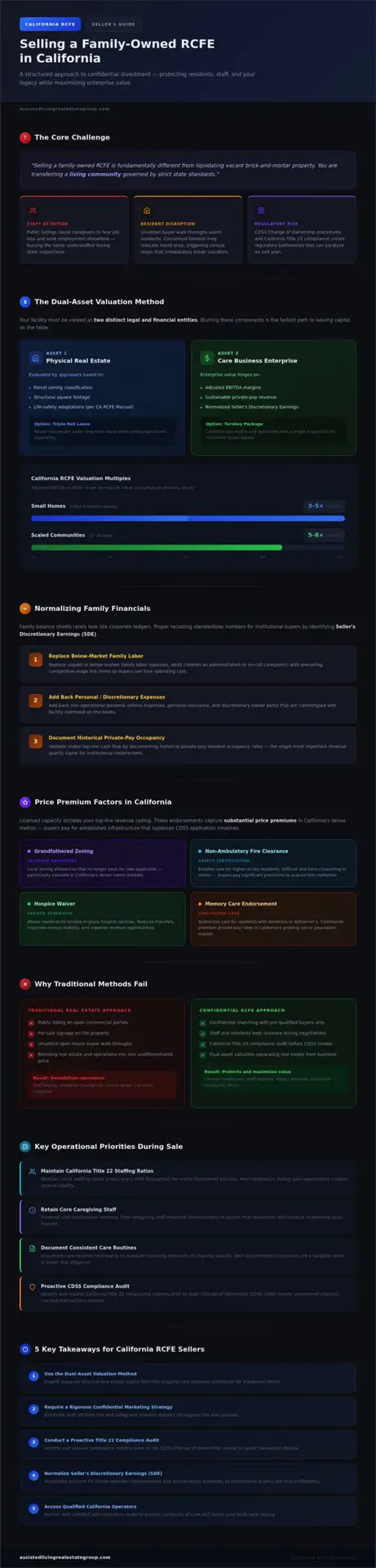
Discover how to structure, value, and execute the confidential sale of your family-owned California care facility while safeguarding your legacy and residents. This guide details how to clearly separate residential real estate from the licensed enterprise, navigate California Department of Social Services (CDSS) Change of Ownership procedures, and quietly match with a pre-qualified buyer who upholds your standards.
Key Takeaways
- Understand the dual-asset valuation method to clearly separate physical real estate equity from ongoing care business operations for maximum enterprise return.
- Discover how selling a family-owned RCFE requires a rigorous confidential marketing strategy to eliminate staff attrition and safeguard resident stability.
- Learn proactive internal audit steps to identify and resolve California Title 22 compliance matters prior to state change of ownership reviews.
- Identify how to normalize Seller’s Discretionary Earnings by accurately accounting for family-operator compensation and discretionary expenses.
- Gain access to qualified California operators and certified administrators ready to protect continuity of care and honor your multi-year legacy.
The Unique Challenges of Selling a Family-Owned RCFE in California
Parting with a residential care home involves far more than signing standard escrow paperwork. For founders, a family care facility represents decades of hands-on compassion, tireless operational oversight, and deep community relationships. When selling a family-owned RCFE, personal emotions and internal family dynamics frequently complicate high-stakes decisions. Relatives often disagree on how to balance physical real estate equity against the value of the ongoing business enterprise. Without a clear strategy, the emotional toll can paralyze sellers, resulting in delayed exits or undervalued transactions that fail to reflect the enterprise’s real market standing.
Balancing Resident Care With Business Divestment
Daily care continuity must remain uncompromised while positioning the asset for divestment. Any perceived disruption can prompt concerned families to relocate loved ones, triggering census drops that immediately erode valuation multiples. As the broader assisted living industry evolved from informal board-and-care homes into a tightly regulated care model, operational standards tightened significantly. Throughout negotiations, operators must satisfy these core operational priorities:
- Maintain strict California Title 22 staffing ratios across every shift.
- Retain core caregiving staff to preserve vital institutional memory.
- Document consistent care routines to reassure incoming operators of ongoing stability.
Why Traditional Commercial Real Estate Tactics Jeopardize Your RCFE
Standard commercial real estate methods fail when applied to California care facilities. Placing a public listing on open commercial portals or displaying signage on the property instantly destabilizes operations. Caregivers fear imminent job loss and seek work elsewhere, leaving the home understaffed during state inspections. Selling a family-owned RCFE is fundamentally different from liquidating vacant brick-and-mortar property. You are transferring a living community governed by strict state standards, where unvetted buyer walk-throughs alarm residents and destroy goodwill before a transaction ever reaches escrow.
Valuing a Family-Run RCFE: Separating Real Estate From the Care Business
Accurately calculating total asset worth requires viewing your facility as two distinct legal and financial entities: the physical real estate and the operational care business. When selling a family-owned RCFE, blurring these two components is the fastest path to leaving capital on the table or triggering friction during commercial buyer underwriting.
Deconstructing the Real Estate and Business Enterprise Split
Owners must determine whether to package the physical property and care operations into a single turnkey acquisition or retain the real estate under a long-term triple-net lease. Appraisers evaluate the residential property based on parcel zoning, structural square footage, and specialized life-safety adaptations detailed in California’s RCFE Manual of Policies and Procedures. In contrast, enterprise value hinges on adjusted EBITDA margins and sustainable private-pay revenue. Typical California 6-bed homes trade at 3 to 5 times adjusted EBITDA plus physical property value, while scaled 15- to 49-bed communities command multiples between 5 and 8 times earnings.
Normalizing Financials for Family Operating Idiosyncrasies
Family balance sheets rarely look like corporate ledgers. Spouses and adult children frequently take minimal salaries for administrator or on-call caregiver duties, while personal expenses often intermingle with facility overhead. Proper recasting standardizes these numbers for prospective institutional buyers:
- Replace unpaid or below-market family labor with prevailing competitive wage line items.
- Add back non-operational personal vehicle expenses, personal insurance, and discretionary owner perks.
- Document historical private-pay resident occupancy to validate stable top-line cash flow.
The Premium of Bed Capacity and Specialized Endorsements
Licensed capacity dictates your top-line revenue ceiling. In California’s dense metros, facilities with grandfathered local zoning allowances, non-ambulatory fire clearances, hospice waivers, and memory care endorsements capture substantial price premiums. Sophisticated buyers willingly pay for established operational infrastructure that bypasses protracted CDSS application timelines. Review our step-by-step roadmap to sell your assisted living facility for full financial audit checklists. If you need clarity on your asset’s market worth, connect with Assisted Living Real Estate Group to benchmark your facility’s dual valuation.
The Step-by-Step Roadmap to Selling a Family-Owned RCFE in California
Moving from an initial valuation to a closed escrow demands a disciplined execution framework. Successfully selling a family-owned RCFE requires coordinating specialized legal counsel, commercial escrow officers, and state regulatory milestones. Without a structured roadmap, procedural oversights can stall closing timelines and jeopardize operating stability.
Navigating CDSS Licensing and Title 22 Requirements
Under California regulations, care facility licenses are strictly non-transferable. A buyer cannot simply assume your existing credential. Instead, the purchaser must complete a formal Change of Ownership (CHOW) review through the California Department of Social Services (CDSS) by submitting a LIC 853 application packet, a process that typically requires 60 to 120 days. Vetting an incoming buyer’s operational background and state administrator credentials beforehand prevents fatal licensing bottlenecks. Consult our complete breakdown of California RCFE licensing guidelines to understand exactly what regulators require from incoming operators.
Structuring Operations Transfer Agreements (OTA) and Escrow
Because CDSS processing times rarely coincide neatly with commercial funding schedules, an Operations Transfer Agreement or Interim Management Agreement bridges the gap. This contractual vehicle allows a vetted buyer to oversee day-to-day management under defined parameters while the formal license remains pending. Specialized care escrow instructions must clearly govern key operational mechanics:
- Proration of prepaid monthly resident fees and ancillary care charges.
- Custodial transfer and reconciliation of resident trust accounts.
- Clear demarcation of employment and regulatory liability across both parties.
Managing Facility Inspections and Fire Safety Clearances
California transactions mandate exhaustive physical and documentary diligence before closing. Facilities must secure clearance from the local fire authority or California State Fire Marshal, confirming compliant emergency egress systems and fire prevention measures for non-ambulatory rooms. Additionally, sellers should audit their Title 22 documentation in advance. Ensuring staff personnel files, criminal record clearances, resident reappraisals, and centrally stored medication logs are impeccably organized guarantees a frictionless inspection by state evaluators.
Protecting Staff, Residents, and Legacy Through Confidential Marketing
Discretion isn’t just a preference when selling a family-owned RCFE. It’s fundamental risk management. Care facilities depend entirely on trust, stable routines, and deeply rooted human relationships. If unverified rumors of a sale leak publicly, caregivers often fear impending job loss and seek employment elsewhere. Sudden staff departures directly jeopardize your California Title 22 staffing ratios and create immediate distress for vulnerable residents. Simultaneously, local hospital discharge coordinators and regional senior placement specialists who hear premature rumors will redirect valuable private-pay admissions to competing facilities. Maintaining strict confidentiality shields your ongoing census, protects staff morale, and preserves the family reputation you established across decades of service.
Vetting Buyers Behind Non-Disclosure Agreements (NDAs)
Never release financial ledgers, floor plans, or licensing records without a tailored non-disclosure agreement in place. Standard commercial contracts are inadequate for licensed care settings because they don’t safeguard sensitive operational data. Before disclosing your facility’s address, confirm that prospective purchasers clear rigorous vetting criteria:
- Verify liquid balance sheets and commercial banking relationships to prove accessible acquisition equity.
- Audit the buyer’s CDSS regulatory track record through state licensing databases to ensure moral fitness.
- Confirm that prospective operators hold current California RCFE administrator certification credentials.
Conducting Discreet On-Site Tours Without Disrupting Operations
Physical inspections require precise orchestration to avoid raising internal alarms. Always schedule buyer property tours during resident activity outings or off-peak afternoon hours when facility traffic is light. Present visiting investors neutrally as facility appraisers, insurance inspectors, or physical plant consultants. Never permit unvetted parties to photograph residents, review daily medication charts, or engage caregivers in unscheduled operational conversations.
Safeguarding your legacy while converting years of compassionate care into real enterprise value demands disciplined oversight. Protect your life’s work and ensure operational continuity by executing a proven confidential marketing strategy with Assisted Living Real Estate Group.
Partnering With a Specialized California Broker to Execute Your Exit
General commercial brokers routinely list strip malls, warehouses, and restaurants. They lack fluency in Title 22 mandates, state staffing formulas, and California Community Care Licensing Division protocols. When selling a family-owned RCFE, partnering with a dedicated care facility brokerage safeguards transaction momentum and captures optimal enterprise value. Specialized intermediaries structure transactions around state regulatory timelines rather than fighting them during escrow closing.
The Strategic Advantage of Niche Eldercare Brokerage
Niche advisors know how to uncover latent balance sheet value that traditional commercial appraisers overlook, such as unbilled care-level adjustments, hospice waiver capacity, and grandfathered physical plant clearances. Review our comprehensive RCFE for sale California analysis to see how institutional buyers assess operational potential. Rather than blasting details across public real estate platforms, specialized brokers utilize proprietary, pre-screened networks of certified California administrators, regional care providers, and healthcare investment groups actively pursuing acquisitions across Los Angeles, Orange County, and San Diego.
Initiating Your Confidential Succession Strategy
Securing maximum financial yield while preserving your family’s caregiving standard requires an intentional, off-market roadmap. Depending on your financial goals, your divestment plan might include a straightforward turnkey business acquisition, an ongoing lease-to-own care home opportunity, or structured seller financing designed to maximize post-retirement income. Assisted Living Real Estate Group leverages 25 years of California care facility brokerage experience under leader Teri Szoke. By uniting property appraisal precision with CDSS relicensing insight, our team helps you transition smoothly to a vetted operator who honors your lifetime of compassionate care.
Secure Your Legacy and Maximize Your Enterprise Value
Successfully selling a family-owned RCFE isn’t simply about executing a commercial transaction; it’s about translating a lifetime of dedicated care into lasting financial freedom. By separating your physical real estate equity from ongoing business operations, protecting staff stability through strict confidentiality, and navigating California Department of Social Services protocols with foresight, you ensure your community thrives long after closing.
You don’t have to shoulder this transition alone. Backed by over 25 years of specialized California senior care brokerage experience, Assisted Living Real Estate Group has facilitated hundreds of confidential ownership transitions. Our team connects you directly with pre-qualified, licensed care home operators who respect your standards and honor your legacy. Take control of your next chapter with complete confidence. Schedule a Confidential RCFE Valuation Consultation to discover your facility’s true enterprise value.
Frequently Asked Questions
Can a family transfer an existing California RCFE license directly to the buyer?
No, a California RCFE license is non-transferable and facility-specific. Under Department of Social Services (CDSS) regulations, a buyer cannot simply take over your existing operating license. The purchasing operator must submit a comprehensive Change of Ownership application (LIC 853) and undergo background reviews, financial checks, and facility walk-throughs to receive their own distinct operating authority.
How do I keep our RCFE sale confidential from staff and residents until closing?
You protect operational confidentiality by executing customized non-disclosure agreements before sharing your facility address or financials with vetted buyers. When selling a family-owned RCFE in Southern California, schedule private buyer walk-throughs during off-peak hours or resident excursions. Introducing visitors neutrally as insurance or physical plant consultants keeps caregivers focused and prevents alarming residents or their families prior to escrow closing.
How long does it take to sell a family-owned RCFE in California from start to finish?
A typical transaction takes between six and nine months across Southern California markets. Finding a pre-qualified buyer usually spans 60 to 90 days, while standard commercial due diligence adds another 30 to 45 days. The primary timeline driver is the CDSS Change of Ownership process, which generally requires 60 to 120 days for state analyst review and final license issuance.
What is an Operations Transfer Agreement (OTA) in an RCFE sale?
An Operations Transfer Agreement is a formal bridge contract that manages the transition between escrow closing and official CDSS license issuance. It grants the qualified buyer authority to manage day-to-day operations under defined covenants. The agreement precisely dictates regulatory responsibilities, care staffing liabilities, and the exact custody of resident trust accounts so neither party carries unallocated risk.
Should our family sell both the real estate and the RCFE business together?
It depends on your retirement timeline and tax objectives. Selling both assets simultaneously delivers a clean, complete exit with immediate liquidity. Alternatively, retaining the physical building and executing a long-term lease with an incoming operator generates predictable passive rental income while liquidating the care enterprise. When selling a family-owned RCFE, specialized valuation clarifies which structure optimizes your after-tax enterprise yield.
What happens to our residents when a new operator acquires the RCFE?
Residents generally remain in place with uninterrupted care. California regulations require timely written notification before an ownership change takes effect, ensuring complete transparency around house rules and care fee structures. A professional succession plan guarantees that care plans, physician orders, and familiar caregiver staffing stay intact, protecting resident well-being and maintaining daily operational stability throughout the handover.
How is the value of a 6-bed family-owned RCFE calculated compared to larger facilities?
Six-bed residential care homes are typically valued at 3 to 5 times adjusted Seller’s Discretionary Earnings plus the underlying appraised real estate value. Larger 15- to 49-bed communities often trade at 5 to 8 times adjusted EBITDA as standalone commercial enterprises. For 6-bed properties, normalizing books for family-member labor and highlighting private-pay occupancy significantly enhances overall transaction multiples.