
What if the most sophisticated real estate play in the Golden State isn’t found in traditional multifamily units, but in the specialized niche of senior housing? You recognize that California’s aging population creates a massive market gap, yet the labyrinth of Title 22 regulations and the specter of operational liability often stall even the most seasoned professionals. It’s a common frustration for those looking at investing in assisted living facilities California; the demand is undeniable, but the path to a truly passive, high-yield investment remains obscured by red tape.
This 2026 guide provides the roadmap to bridge that gap, showing you how to secure stable cash flow through strategic RCFE and ARF investments without becoming a caregiver yourself. We’ll detail how to identify turnkey opportunities and partner with qualified operators to mitigate risk while maximizing long-term appreciation. You’ll discover a refined strategy to achieve significant financial returns while providing the high-quality care our seniors deserve. We’re moving beyond general real estate into a mission-driven asset class where ethics and profitability intersect. Let’s explore how to master this high-barrier market and build a legacy of both wealth and social impact.
Key Takeaways
- Understand why California’s unique demographic shift makes RCFE and ARF properties the most resilient assets in a 2026 portfolio.
- Discover how to transition from a high-touch operator to a passive landlord by utilizing the Triple Net (NNN) lease model.
- Master the complexities of Title 22 regulations to turn California’s high-barrier-to-entry market into your sustainable competitive advantage.
- Learn why investing in assisted living facilities California requires a specialized, confidential marketing strategy to access exclusive off-market turnkey acquisitions.
- Evaluate the financial performance of various facility sizes and the benefits of lease-to-own models for long-term appreciation and social impact.
The California Senior Housing Opportunity in 2026
The “Silver Tsunami” is no longer a distant forecast; it’s a structural reality defining the 2026 California economy. As the state’s aging population grows at a rate that outpaces national averages, the demand for specialized housing has reached a critical tipping point. For strategic professionals, assisted living facilities represent a unique asset class that bridges the gap between high-yield real estate and essential human services. These properties are inherently recession-resilient because they address a non-discretionary need that persists regardless of broader market fluctuations.
In the California context, Residential Care Facilities for the Elderly (RCFE) are the primary vehicles for this investment. Unlike traditional multifamily units, these facilities operate within a high-demand, low-supply environment protected by significant regulatory barriers. Investing in assisted living facilities California allows you to capitalize on this supply-demand gap while securing a legacy of compassionate care and financial stability.
Why California is the Premier Market for Senior Care
The California Department of Social Services (CDSS) maintains some of the most rigorous oversight standards in the nation. While these Title 22 regulations can seem daunting, they serve as a formidable competitive moat for established owners. These rules ensure market stability and prevent the “race to the bottom” often seen in less regulated sectors. In Southern California specifically, the shortage of licensed beds is acute. High land costs and complex zoning make it difficult for new competitors to enter, which naturally drives the value of existing, turnkey acquisitions upward.
RCFE vs. ARF: Understanding the Investment Vehicles
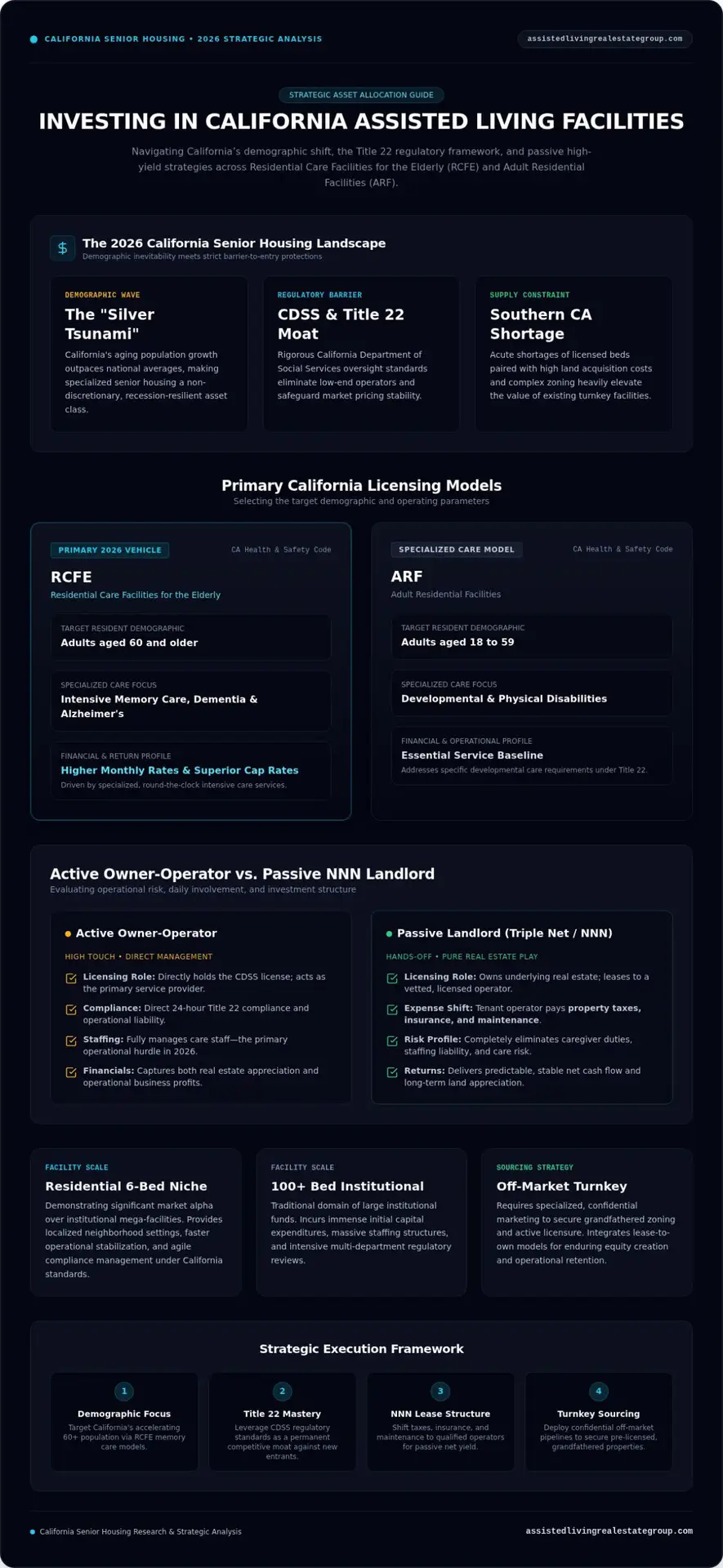
Strategic investors must distinguish between the two primary licensing models to maximize their returns. RCFEs are designed for residents aged 60 and older, frequently focusing on specialized memory care for those with dementia or Alzheimer’s. Because of the intensive nature of this care, RCFEs often command higher monthly rates and offer superior cap rates. Adult Residential Facilities (ARF) serve adults aged 18 to 59 with various developmental or physical disabilities. Both models provide essential services, but the sheer volume of the aging demographic makes RCFEs the standout choice for 2026. Investing in assisted living facilities California requires a clear focus on which demographic your property will serve to ensure long-term portfolio performance.
Active vs. Passive Investing in Assisted Living Facilities
Success in the California senior housing market hinges on a fundamental choice: do you want to run a healthcare business or own a high-performing real estate asset? Many institutional funds focus exclusively on massive, 100+ bed facilities, but the 2026 market shows significant alpha in the residential 6-bed niche. When you begin investing in assisted living facilities California, you’re not just buying a building. You’re securing a licensed use case that is increasingly difficult to replicate. Deciding between being an active owner-operator or a passive landlord will dictate your daily involvement and your ultimate return on equity.
The Owner-Operator Model: High Effort, High Reward
Choosing to be the licensee means you’re stepping into the shoes of the service provider. You’ll be directly responsible for meeting all California RCFE licensing requirements, managing specialized staff, and ensuring Title 22 compliance 24 hours a day. While this model captures both the real estate appreciation and the operational profits, it’s a high-touch commitment. In 2026, staffing remains the primary hurdle for operators. If you have a background in healthcare administration or a passion for direct care, this active model allows for maximum control over the resident experience and the facility’s reputation.
The Passive Landlord Model: The NNN Strategy
The Triple Net Lease (NNN) is the gold standard for investors seeking a hands-off approach. In this scenario, you own the real estate and lease it to an experienced operator who holds the RCFE or ARF license. The tenant becomes responsible for property taxes, insurance, and maintenance, leaving you with a stable, predictable rent check. This model mitigates your operational risk and liability while allowing you to benefit from the long-term value of a property zoned for care. Experienced operators in California are constantly hunting for compliant, well-maintained properties to expand their footprint without the capital heavy-lift of property ownership.
Maintaining the property’s “Care Facility” status is vital for your exit strategy. A home already outfitted with fire sprinklers, ADA ramps, and Title 22-compliant exits is worth significantly more to a future buyer than a standard residential house. To jumpstart your portfolio with immediate cash flow, consider looking into turnkey care home opportunities that already have operators in place. This strategy allows you to skip the lengthy 2026 licensing timelines and move straight to the revenue-generation phase. Investing in assisted living facilities California through a passive lens provides the perfect balance of financial gain and social contribution without the burden of daily management.
Regulatory Moats: Navigating California’s Title 22
Title 22 isn’t just a list of rules; it’s the structural foundation of your investment’s value. These regulations create a formidable barrier to entry that prevents the California market from being flooded with low-quality competition. When you’re investing in assisted living facilities California, you’re buying into a protected asset class. Not every residential property can be converted into a care home. Zoning laws and local ordinances often restrict where these facilities can operate, making existing, compliant locations incredibly valuable. This regulatory scarcity ensures that once a facility is licensed, its market position is naturally defended against new entrants who lack the expertise to navigate the system.
A specialized broker plays a critical role in this process by verifying that a property isn’t just “available” but truly viable for licensing. This includes checking for local saturation limits and ensuring the building’s footprint can accommodate the required upgrades. The California Department of Social Services Community Care Licensing division maintains strict oversight. Having an expert guide to navigate their expectations is the difference between a successful acquisition and a costly, non-compliant mistake.
Title 22 Compliance as an Asset
The physical plant requirements for California care homes are rigorous and non-negotiable. You must account for integrated fire safety systems, specific hallway widths, and ADA-compliant bathrooms. These standards are the “moat” that protects your equity. A “pre-licensed” facility or a property already outfitted for care carries a premium valuation because it saves the buyer months of renovation and inspection headaches. It’s a plug-and-play asset. These properties allow for faster revenue generation and provide a level of refined service that justifies higher resident rates.
The Licensing Application: A Strategic Roadmap
The 2026 licensing timeline requires patience and precision. If you’re acquiring an existing business, the “Change of Ownership” (CHOW) process is your primary focus. Relicensing a facility during a sale is a delicate coordination between the buyer, the seller, and the CDSS. Common pitfalls include incomplete “Part B” applications or failing to secure fire clearances in a timely manner. To avoid these delays, you need a proven roadmap like the one detailed in RCFE Licensing in California: The 2026 Investor’s Guide to Success. By mastering the regulatory landscape, you turn a complex obstacle into a sustainable competitive advantage. Investing in assisted living facilities California is as much about compliance as it is about real estate strategy.
Calculating ROI: Lease-to-Own and Triple Net Models
Profitability in the California senior housing sector isn’t always found in the largest facilities. While institutional investors often chase 30+ bed centers, the 2026 market reveals that the highest alpha frequently resides in the 6-bed residential model. These smaller facilities benefit from lower overhead and a more intimate care environment that attracts premium private-pay residents. When you’re investing in assisted living facilities California, your return on investment is driven primarily by occupancy rates. In Southern California’s dense coastal markets, the chronic shortage of licensed beds ensures that well-positioned properties maintain high resident counts, which directly compounds your long-term yield.
The Lease-to-Own model has emerged as a strategic win-win for both investors and operators. This structure allows an experienced care provider to build equity over time while providing the property owner with a committed, high-quality tenant. Success fees for these complex lease negotiations in California are structured to reflect the specialized nature of the asset, ensuring that the interests of the landlord and the licensee are perfectly aligned. This synergy is what transforms a standard real estate holding into a high-performing healthcare asset.
The Economics of the 6-Bed RCFE
Smaller facilities offer a unique financial advantage: the ability to bypass the complexities of government reimbursement by focusing on private-pay families. These families prioritize refined service and exclusivity, allowing owners to command higher monthly rates. Scalability is achieved not by building bigger, but by clustering multiple 6-bed homes within a single geographic area. This “cluster strategy” allows you to share specialized resources and floating staff across several locations. To understand how this applies to different facility types, explore our analysis on Investing in an Adult Residential Facility in California: The 2026 Southern California Market Guide.
Lease Negotiation Strategies for Investors
A standard commercial lease isn’t sufficient for a licensed care facility. Your agreement must explicitly protect the underlying business license, ensuring that the property remains a compliant RCFE even if the tenant changes. Setting market-appropriate rents requires a deep understanding of the facility’s earning potential, not just the local residential comps. Identifying qualified operators is the most critical step in this process; you need a partner who understands Title 22 as well as you understand the cap rate. If you’re ready to see how these numbers work in practice, you can view our latest California RCFE listings to find your next acquisition.
Partnering for Success in the Golden State
General commercial brokers often struggle with the specialized intricacies of the care industry. They see a building; we see a complex regulatory ecosystem. Investing in assisted living facilities California requires more than just standard real estate knowledge. It demands a deep understanding of the California Department of Social Services (CDSS) and the operational hurdles unique to the state’s legal framework. A mistake during due diligence doesn’t just cost money. It can jeopardize the facility’s license and the stability of its resident base. This is why a specialized partnership is the most critical component of your acquisition strategy.
Our “Confidential Marketing Strategy” is a cornerstone of how we handle high-value transactions. In the RCFE space, a public listing can trigger panic among staff and families, leading to a sudden drop in occupancy and asset value. By keeping transactions off-market, we protect the business’s reputation while connecting sellers with our exclusive database of qualified professionals. With over 25 years of combined experience in California care facilities, we’ve built the relationships necessary to source Southern California listings that never hit the public portals. This exclusivity ensures our clients access the best turnkey opportunities before the general market even knows they exist.
The Specialized Broker Advantage
Working with a specialized consultancy gives you access to a refined network of industry professionals. We don’t just facilitate a sale; we provide comprehensive due diligence support that bridges the gap between real estate metrics and operational viability. This includes analyzing resident care plans and verifying that the physical plant meets the latest Title 22 standards for fire safety and accessibility. For a deeper dive into the specific steps of the acquisition process, consult The Ultimate Guide to Buying an RCFE Facility in California.
Taking the First Step
Your journey toward a recession-resilient portfolio starts with a strategic roadmap. The 2026 market presents a unique window of opportunity as demographic shifts accelerate across the state. Whether you’re an existing owner looking for a confidential valuation or a new investor ready to join our qualified buyer list for upcoming Southern California RCFE listings, the time to act is now. We provide the seasoned expertise required to navigate this high-barrier-to-entry market and achieve significant financial returns. Don’t leave your investment legacy to chance. Contact Teri Szoke and the Assisted Living Real Estate Group today to secure your position in California’s premier senior housing market.
Master the 2026 California Senior Housing Market
The structural shift in California’s demographics has created an unprecedented window for strategic professionals. By mastering Title 22 regulations and choosing the right investment vehicle, you transform a high-touch business into a resilient real estate asset. Whether you pursue the passive Triple Net model or a lease-to-own strategy, the key is navigating the high barriers to entry with seasoned precision. Investing in assisted living facilities California isn’t just about diversification; it’s about securing a legacy of compassionate care and superior financial performance in the nation’s most exclusive market.
Success requires a roadmap that general brokers simply can’t provide. We leverage over 25 years of specialized experience and an intimate knowledge of CDSS regulations to guide you through every acquisition stage. Our confidential marketing strategy grants you access to exclusive Southern California RCFE listings that never reach the public eye. Now is the time to bridge the gap between financial ambition and social impact. Secure Your Position in California’s Senior Housing Market – Contact Us Today to start building your care facility portfolio with confidence.
Frequently Asked Questions
Is investing in assisted living facilities in California profitable in 2026?
Yes, profitability is driven by the acute shortage of licensed beds against a rapidly aging population. Investing in assisted living facilities California remains a top-tier strategy because these assets are recession-resilient. In Southern California, high land costs and strict Title 22 regulations prevent market oversaturation. This creates a supply-demand imbalance that favors owners of existing facilities. By focusing on private-pay residents in 6-bed or larger centers, investors achieve stable cash flow and significant long-term appreciation.
What is the difference between an RCFE and an ARF for an investor?
The primary distinction lies in the age and needs of the residents served. RCFEs cater specifically to seniors aged 60 and older, often including specialized memory care services. ARFs serve adults aged 18 to 59 who have developmental or physical disabilities. For an investor, RCFEs generally offer higher monthly rates due to the intensive nature of elderly care. Both models utilize the same residential real estate footprint but require different operational certifications and staffing levels.
Do I need a license to own the real estate of a care facility in California?
You don’t need a care license to own the underlying real estate, but you must ensure the property remains compliant with physical plant standards. In a passive landlord model, you own the building while an experienced operator holds the RCFE or ARF license. This “licensing the operator” strategy allows you to collect stable rent without the burden of daily care management. However, if you plan to manage the business directly, you must obtain a license from the CDSS.
How long does the RCFE licensing process take in California?
The California Department of Social Services (CDSS) licensing timeline typically ranges from six to nine months for new applications in 2026. This duration includes the time needed for orientation, background clearances, and multiple physical plant inspections. Buying a turnkey facility can significantly shorten this period through a “Change of Ownership” application. We recommend starting the process early and working with a specialized mentor to avoid common paperwork errors that often lead to lengthy administrative delays.
What are the zoning requirements for a 6-bed RCFE in Southern California?
Under California law, a 6-bed RCFE is legally treated as a standard residential use of property for zoning purposes. This means local Southern California municipalities can’t impose special use permits or zoning variances that aren’t required for a typical family home. However, you must still comply with specific fire safety clearances and local building codes. Larger facilities with seven or more residents face much stricter commercial zoning requirements and more complex approval processes from local planning departments.
Can I buy an assisted living facility in California with an SBA loan?
Yes, SBA 7(a) and 504 loans are frequently used for acquisitions that include both the real estate and the business operations. These programs are ideal for owner-operators because they offer lower down payments and longer amortization periods. To qualify, the buyer must demonstrate relevant experience and the facility must meet specific cash flow requirements. We often see Southern California investors utilize these loans to secure turnkey 6-bed homes where the business and property are sold together.
What is a ‘Turnkey’ care facility acquisition?
A turnkey acquisition is a comprehensive purchase that includes the real estate, the business entity, existing staff, and current residents. This model is highly desirable because it provides immediate cash flow from day one. You skip the lengthy startup phase and the “fill-up” period required to reach full occupancy. Our confidential marketing strategy specializes in these off-market opportunities, ensuring a seamless transition that maintains the facility’s reputation and operational stability throughout the sale process.
How do I find qualified operators to lease my care home property?
Finding the right tenant requires access to a specialized database of experienced care providers. General commercial brokers often lack the network to vet operators for Title 22 compliance and operational history. We maintain an active list of qualified buyers and operators looking for compliant properties in Southern California. Investing in assisted living facilities California through a passive model works best when you match property owners with reliable licensees who can ensure long-term property stability.