
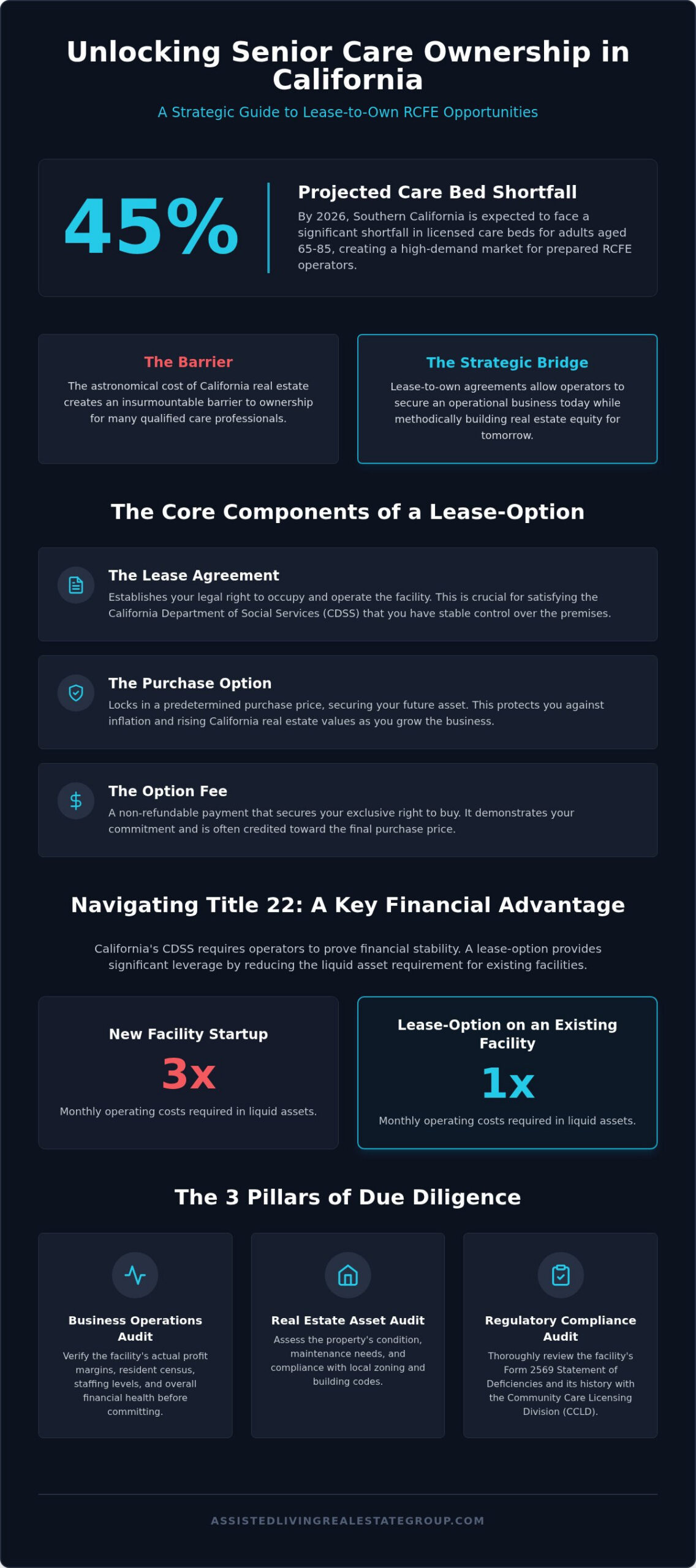
By 2026, Southern California is projected to face a 45% shortfall in licensed care beds for adults aged 65 to 85. This demographic shift isn’t a crisis for the prepared professional; it’s a high-stakes chance to secure lease-to-own care home opportunities in a premium market. You likely recognize the immense potential in the Residential Care Facility for the Elderly (RCFE) sector, yet the astronomical cost of California real estate often creates an insurmountable barrier. It’s frustrating to watch profit margins slip away because of capital constraints or complex licensing hurdles.
We’re here to show you a more sophisticated path. You’ll discover how to leverage lease-option agreements to acquire an operational business today while methodically building real estate equity for tomorrow. This guide breaks down the strategic bridge between leasing and full property ownership within the strict California regulatory framework. We’ll explore how to manage Title 22 disclosures, handle licensing transitions through the Community Care Licensing Division, and position yourself as a market leader in the Golden State’s evolving senior care landscape.
Key Takeaways
- Understand the crucial distinction between operating a licensed care business and owning the underlying California real estate asset to scale operations while securing future property rights.
- Learn how to navigate California Title 22 regulations and CDSS requirements to ensure your license remains compliant during the lease-to-own transition.
- Explore how lease-to-own care home opportunities provide a strategic bridge to full ownership by lowering upfront capital requirements compared to traditional commercial purchases.
- Master the three pillars of due diligence by auditing the business, the real estate, and the facility’s Form 2569 Statement of Deficiencies to protect your investment.
- Discover how specialized brokerage services match high-performance operators with property owners to facilitate a seamless, confidential transition into full ownership.
What are Lease-to-Own Care Home Opportunities in California?
California’s senior care market demands a unique blend of clinical excellence and real estate savvy. For many ambitious operators, lease-to-own care home opportunities represent the most viable bridge to long-term wealth. This model, often called a lease-option, allows a professional to manage a Residential Care Facility for the Elderly (RCFE) as a tenant while securing the exclusive right to purchase the property at a predetermined price. It’s a sophisticated method for decoupling the business’s cash flow from the real estate’s equity until the operator is ready to consolidate both.
This model is surging across the state, particularly in high-barrier regions like Southern California where a 45% shortfall in licensed care beds is projected by 2026. The primary benefit is clear. You gain operational control today with a fixed path to equity tomorrow. You aren’t just paying rent; you’re securing a future asset while the care business generates immediate revenue.
The Core Components of an RCFE Lease-Option
An RCFE lease-option isn’t a standard residential contract. It’s a commercial agreement tailored to the highly regulated world of senior care. It requires a precise alignment of three distinct legal elements:
- The Lease Agreement: This establishes your legal control of the property. Under California law, you don’t need to own the building to be a licensee, but you must prove you have the right to occupy and operate it. This document must satisfy the California Department of Social Services (CDSS) that you have stable control over the premises.
- The Purchase Option: This contract protects your future. It locks in a purchase price today, ensuring that as you grow the business and the property value increases, the gain remains yours. This is your hedge against inflation and rising California real estate costs.
- The Option Fee: This is your skin in the game. It’s the non-refundable payment that secures your right to buy, often serving as a credit toward the purchase price. This fee demonstrates your commitment while providing the owner with immediate liquidity.
Why California Operators Choose the Lease-to-Own Path
Capital is the lifeblood of any care facility. By choosing lease-to-own care home opportunities, operators can preserve their liquid assets for staffing, marketing, and Title 22 compliance upgrades rather than locking everything into a massive down payment. It’s a strategic move. Since obtaining an RCFE license can take between four to eighteen months, this model allows you to begin the process without the immediate pressure of a commercial mortgage.
Testing profitability is essential. You can verify the facility’s actual margins and resident census before committing to a long-term mortgage. This path also helps you navigate California’s high property values in regions where a traditional down payment might be prohibitive. It allows you to build a track record of success that traditional lenders will respect when you eventually exercise your option to buy. You’re essentially proving the business model while the real estate appreciates in your favor.
Navigating California Title 22 Regulations in a Lease-to-Own Model
Success in the California care market isn’t just about maintaining high occupancy; it’s about mastering a complex regulatory environment. The California Department of Social Services (CDSS) maintains a sharp distinction between the property owner and the facility operator. For those pursuing lease-to-own care home opportunities, this distinction is the foundation of your legal standing. Under California Title 22 Regulations, the licensee is the entity solely responsible for the daily health and safety of residents, regardless of who holds the deed to the property.
Your ‘Plan of Operation’ must reflect this reality with precision. When evaluating lease-to-own care home opportunities, your plan must detail how you maintain legal control and meet rigorous staffing requirements. CDSS requires applicants to demonstrate financial stability, typically necessitating three times their monthly operating costs in liquid assets. However, if you’re acquiring an existing, operating facility through a lease-option, this requirement is often reduced to just one month of operating costs. This financial leverage is a significant advantage for strategic investors, but it requires a specialized broker to ensure the lease language satisfies state auditors while protecting your future purchase rights.
Licensee Responsibilities vs. Property Owner Rights
During the lease phase, you hold the RCFE license and bear all operational liability. The property owner remains a landlord with specific real estate rights, but they cannot legally dictate care decisions or resident services. Any change in the “control” of the business or the intent to eventually transfer the real estate must be reported to the Community Care Licensing Division (CCLD). It’s critical to ensure your lease agreement doesn’t violate Title 22 management rules, which prohibit non-licensed owners from exercising substantial control over care operations. Maintaining this boundary is essential for keeping your license in good standing.
The Relicensing Process During Ownership Transition
Transitioning from a tenant to a full owner triggers the ‘Change of Ownership’ (CHOW) process. This isn’t an automatic transfer of rights. You’ll need to navigate a formal application process to ensure there are no operational gaps when you exercise your purchase option. Preventing these gaps is vital because the process to obtain an RCFE license in California can take between four to eighteen months. Understanding RCFE Licensing California requirements early in your lease term prevents costly delays and ensures a seamless transition of the asset. If you’re ready to see how these regulatory structures can work for your portfolio, consult with an RCFE transaction expert today to discuss your acquisition strategy.
Analyzing the Benefits: Leasing vs. Buying vs. Lease-to-Own
Choosing the right acquisition model is a defining moment for any care provider. A traditional lease offers the lowest entry barrier, yet it leaves you vulnerable to escalating rents and provides zero equity. Direct purchasing offers total control but requires a massive capital outlay that can starve your operational budget. Strategic lease-to-own care home opportunities provide a sophisticated middle ground. This model allows you to capture the upside of property appreciation while preserving the liquidity necessary to maintain high-quality care delivery and staffing levels.
The long-term wealth-building potential of this bridge cannot be overstated. By securing a purchase price today, you’re essentially shorting the California real estate market’s inflation. You gain the ability to generate “sweat equity” by improving the facility’s operational efficiency and physical plant. These improvements increase the business value, which you eventually consolidate with the real estate asset at a price locked in years prior. It’s a method of controlling a multi-million dollar asset with a fraction of the traditional down payment.
Financial Flexibility for the Modern Care Investor
Modern investors prioritize agility. In a lease-option structure, a portion of your monthly payment can often be credited toward your eventual down payment. This turns a standard operating expense into a forced savings vehicle for ownership. Locking in your purchase price is vital in a state where Southern California is projected to face a 45% shortfall in licensed care beds by 2026. This scarcity will likely drive property values higher. During the initial years, you also benefit from the tax advantages of deducting lease payments as business expenses while you prepare your balance sheet for a commercial mortgage. It’s a methodical way to build a track record that traditional lenders find irresistible.
Risk Management in Southern California Care Facility Real Estate
Risk mitigation is the hallmark of a seasoned professional. Operating under California Title 22 Regulations requires strict adherence to physical plant standards. A well-structured lease-option includes specific clauses that define who is responsible for major repairs and compliance upgrades. This protects your business license even if the property owner faces financial instability or foreclosure. You must ensure the agreement grants you the right to cure any property-level defaults to keep the facility operational. This level of protection is especially critical when investing in an Adult Residential Facility in California, where the regulatory stakes and market demand are equally high. You’re not just renting a building; you’re securing the future of your professional legacy.
Due Diligence for Lease-to-Own Care Home Opportunities
Success in a lease-option isn’t guaranteed by the contract alone; it’s secured through rigorous due diligence. When evaluating lease-to-own care home opportunities, you must analyze the three pillars of the asset: the real estate, the business operations, and the regulatory standing. Unlike a standard commercial purchase, a lease-to-own structure requires you to step into an active ecosystem. You’re inheriting a reputation, a staff, and a history with the California Department of Social Services (CDSS).
Your first priority is the regulatory audit. You must conduct a thorough review of the facility’s ‘Statement of Deficiencies’ (Form 2569). This document reveals the facility’s compliance track record and any recurring citations. In 2026, documentation deficiencies have become a leading cause of citations for California RCFEs. Reviewing these forms helps you identify if the current operator is struggling with the heightened enforcement of dementia care or infection control standards. If the physical plant doesn’t meet ADA or fire safety codes, you’ll need to negotiate who pays for these upgrades before signing the lease. You don’t want to be surprised by expensive compliance requirements once you’re already operating.
Financial transparency is non-negotiable. Audit the last three years of P&L statements and occupancy rates. A healthy facility typically maintains a high percentage of private-pay residents, as SSI-only facilities often struggle with the rising costs of California labor. You’re looking for a sustainable cash flow that can support both your lease payments and your eventual mortgage obligations. Verify that the revenue reported matches the resident contracts on file.
Auditing the Business and Operational History
Dig deep into the operational files. Review resident contracts to ensure they align with the 2026 transparency laws requiring full fee schedules and rate increase histories. Analyze staff files to verify that every employee has met the mandatory California training requirements. If the current licensee isn’t in good standing, your path to a ‘Change of Ownership’ (CHOW) could be blocked. You need to verify that the reputation you’re leasing is one worth owning. A facility with a history of annual medical visit compliance and regular resident reappraisals is a much safer bet.
The Importance of Confidentiality in Care Home Transactions
Confidentiality is the shield that protects your future investment. Publicly listing a care home can trigger an exodus of staff and residents, destroying the very value you intend to acquire. This is why ALREG utilizes a confidential marketing strategy for lease-to-own care home opportunities. We ensure that the transition remains discreet, protecting the operational continuity that is vital for resident trust. To understand the full scope of this process, consult The Ultimate Guide to Buying an RCFE Facility in California. If you’re ready to find a facility that meets your standards, contact us today for a confidential consultation.
How to Secure Your Care Home Investment with ALREG
Securing a foothold in the California care industry requires more than just capital; it requires a strategic partnership with experts who understand the intersection of real estate and clinical operations. Assisted Living Real Estate Group (ALREG) specializes in bridging this gap. Led by Teri Szoke, our team brings 25 years of combined industry experience to every transaction. We don’t just list properties. We curate lease-to-own care home opportunities that allow high-performance operators to build long-term equity without the immediate burden of a multi-million dollar down payment.
Our process is intentional and methodical. We recognize that every investor has a different risk tolerance and cash-flow requirement. By matching qualified tenants with property owners who are open to lease-option terms, we create win-win scenarios that ensure both operational continuity and financial growth. This isn’t a standard brokerage service; it’s a specialized consultancy designed for those who demand a premium market position.
Strategic Matching: Finding the Right Facility in Southern California
Accessing the right deal in California often means looking where others aren’t. ALREG maintains an extensive database of off-market RCFE and ARF opportunities that never reach the public eye. This exclusivity is vital. It allows us to tailor lease terms to your specific cash-flow needs while protecting the facility’s reputation through our confidential marketing strategy. Whether you’re targeting a 6-bed residential home or a 30-plus bed assisted living community, we provide the roadmap. Our guidance extends beyond the contract, offering support for facility setup and relicensing during the critical lease phase to ensure you’re prepared for full ownership.
Your Roadmap to Ownership Starts Here
Professional representation is non-negotiable in the complex California regulatory environment. You need a broker who understands the nuances of Title 22 as deeply as they understand property valuation. Attempting to move through these processes alone often leads to licensing gaps or unfavorable lease terms that can jeopardize your purchase option. ALREG acts as your strategic partner, ensuring that every clause in your agreement serves your goal of full property ownership. We bridge the gap between your current operational success and your future as a real estate owner.
The path to securing your legacy in the senior care market starts with a single conversation. From your initial consultation to facility walk-throughs and the final closing, our team provides the seasoned expertise you need to succeed. Don’t leave your investment to chance in a high-barrier market. Contact the Assisted Living Real Estate Group today for a confidential consultation and discover how we can help you capitalize on the most exclusive lease-to-own care home opportunities in California.
Securing Your Legacy in California’s Care Market
The projected 45% shortfall in licensed beds across Southern California represents a significant window for strategic expansion. You’ve discovered how lease-to-own care home opportunities provide a vital bridge, allowing you to master operations and Title 22 compliance while methodically building real estate equity. By locking in purchase prices today, you protect your future margins against the inevitable rise of Golden State property values.
Success requires more than just a lease agreement; it demands a partner who understands the intricate balance of business licensing and property acquisition. With over 25 years of specialized experience in RCFE and ARF transactions, we provide the roadmap you need. Our confidential marketing strategy ensures your operational continuity remains intact while you transition toward full ownership. Contact Teri Szoke for a Confidential Consultation on Lease-to-Own Opportunities. The chance to transform your care business into a lasting real estate portfolio is within reach. Let’s start building your equity today.
Frequently Asked Questions
Is a lease-to-own agreement legal for an RCFE in California?
Yes, lease-to-own agreements are perfectly legal for RCFEs in California. The California Department of Social Services (CDSS) requires a licensee to demonstrate legal control of the property, which a lease agreement provides. It’s important that the lease specifically allows for the operation of a care facility. This structure is a cornerstone of many lease-to-own care home opportunities because it separates business operations from property ownership while satisfying Title 22 requirements.
How much of an option fee is typically required for a care home?
The option fee for a care home is a non-refundable upfront payment that secures your exclusive right to buy the property. While specific amounts vary based on the total acquisition price and market demand in Southern California, this fee is a critical component of the transaction. It serves as a credit toward the eventual purchase price. This initial investment demonstrates your commitment to the owner and protects your interest in the real estate asset.
Who is responsible for repairs during the lease phase of a lease-to-own deal?
Repair responsibilities are typically defined within the lease agreement and vary depending on the facility size. In many 6-bed residential RCFEs, the tenant manages daily maintenance and minor repairs to ensure Title 22 physical plant compliance. Major structural issues or roof repairs are often the landlord’s responsibility unless the contract is a triple-net lease. Clear definitions are essential to prevent operational disruptions and protect your future purchase option during the lease-option period.
Can I apply for a new RCFE license while leasing the property?
You can absolutely apply for a new RCFE license while leasing a property. In fact, California law requires you to show proof of property control, such as a signed lease, before the Community Care Licensing Division will process your application. The license is issued to you as the operator, not to the property owner. This allows you to build the business’s value while you work toward exercising your purchase option.
What happens if I decide not to exercise my purchase option?
If you decide not to exercise your purchase option, you typically forfeit the non-refundable option fee. The lease portion of your agreement may continue until its expiration date, or it may terminate depending on how the contract was structured. This flexibility is one of the reasons lease-to-own care home opportunities are attractive to investors. It provides a “test drive” period to verify the facility’s profitability before committing to a multi-million dollar commercial mortgage.
How do I value the business portion of a lease-to-own opportunity?
Valuing the business portion involves analyzing net operating income, resident census, and the quality of care documentation. We look at the “blue sky” value, which includes the facility’s reputation, staff stability, and its history of compliance with the California Department of Social Services. A facility with a high private-pay ratio in a high-demand Southern California neighborhood will command a higher valuation than one relying solely on SSI or Medi-Cal reimbursements.
Are there specific zoning requirements for RCFEs in Southern California?
Zoning requirements in Southern California depend heavily on the facility’s capacity. Under California state law, RCFEs serving six or fewer residents are treated as standard residential properties and cannot be subjected to special local zoning ordinances. However, larger facilities with seven or more beds often require a Conditional Use Permit (CUP) or specific commercial zoning. Navigating these local Southern California municipal codes is a critical step in your initial due diligence process.
How long does the lease-to-own period usually last in senior care?
The lease-to-own period in the senior care sector usually lasts between one and five years. This timeframe provides enough room for the operator to complete the RCFE licensing process, which can take up to eighteen months, and establish a consistent track record of occupancy. It also gives you time to season your financial statements. This duration is designed to ensure you’re in the strongest possible position when you eventually transition to full property ownership.