
A single “Immediate Jeopardy” citation can instantly evaporate the equity in a high-performing care home. In the competitive California market, your due diligence must transcend basic real estate aesthetics; it requires a surgical audit of regulatory integrity. You likely recognize the massive potential of the “Silver Tsunami,” yet the anxiety of inheriting hidden Title 22 liabilities often stalls the acquisition process. Utilizing a professional RCFE inspection checklist for buyers California is the only way to ensure your investment survives the intensified 2026 CDSS enforcement of dementia care and resident reappraisal standards.
This guide provides the framework to move from curiosity to conviction. By leveraging the seasoned expertise of Teri Szoke and her 25 years of specialized brokerage, you’ll learn to identify the physical plant red flags and operational gaps that threaten your ROI. We’ll outline a rigorous “go/no-go” decision model designed to secure a turnkey business acquisition while preserving a multi-million dollar valuation at exit. We’ll also examine critical 2026 signaling system requirements and Title 22 square footage mandates to ensure your next facility is a compliant, high-barrier-to-entry asset. Mastering these granular details is what separates a standard real estate play from a legacy-building investment.
Key Takeaways
- Understand why a standard home inspection is insufficient and how a dual-layered audit of both real estate and Title 22 compliance protects your capital.
- Identify critical physical plant requirements, including specific bedroom square footage and non-ambulatory accessibility standards mandated by California law.
- Learn to decode the LIC 809 and LIC 9099 history of a facility to distinguish between minor administrative errors and systemic risks.
- Utilize a comprehensive RCFE inspection checklist for buyers California to audit personnel files and resident admission agreements before finalizing a turnkey business acquisition.
- Discover how local market nuances in Los Angeles and Orange County impact your due diligence process and the long-term valuation of your care home asset.
Beyond the Foundation: Why RCFE Inspections Require a Specialized Lens
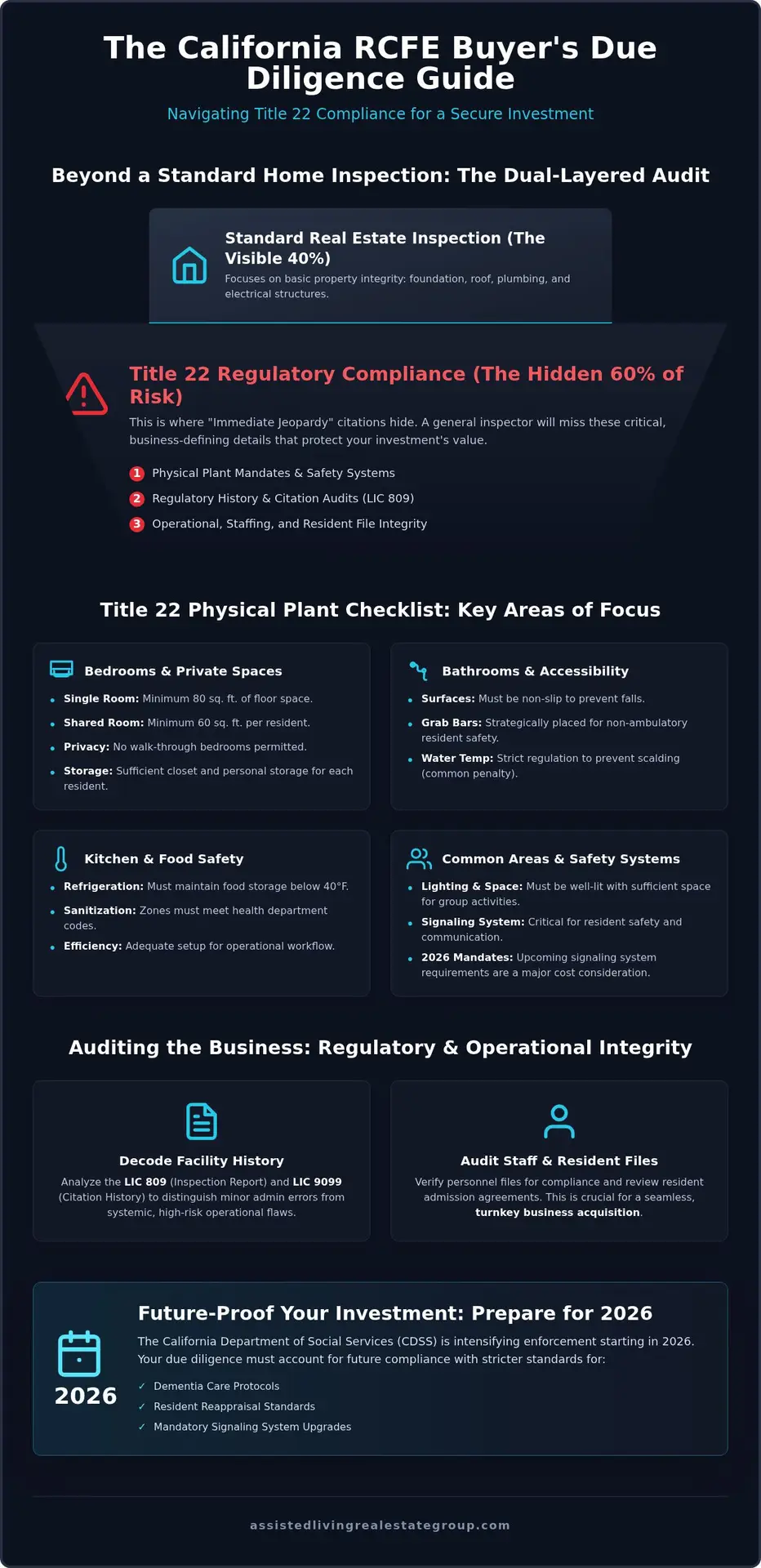
Acquiring a care home in California is a strategic investment in a highly regulated business environment. You aren’t just buying a property; you’re acquiring a “Physical Plant” that must satisfy the California Department of Social Services (CDSS). A standard home inspection focuses on roofs and foundations, but an RCFE inspection is a dual-layered audit. It evaluates the physical real estate alongside Title 22 operational compliance. If you rely on a generalist, you risk missing 60% of the regulatory red flags that could trigger “Immediate Jeopardy” citations or license denials.
Teri Szoke brings 25 years of specialized expertise to this process, bridging the gap between high-stakes brokerage and granular compliance. Her approach ensures that your RCFE inspection checklist for buyers California addresses the specific nuances of the Southern California market. A facility that looks perfect on the surface might harbor hidden operational liabilities that compromise its multi-million dollar valuation at exit. Utilizing a specialized lens allows you to see the property as a regulatory asset rather than just a residential building.
The Dual Nature of the Care Facility Asset
In the context of Residential Care Facilities, the property is a functional healthcare environment. The licensing status dictates the “highest and best use” of the asset. When you evaluate the property, you must consider how the Community Care Licensing Division (CCLD) views the layout. Their inspection timeline often dictates your closing schedule. A facility with a history of non-compliance isn’t just a “fixer-upper” house; it’s a compromised business license that requires a strategic roadmap to rehabilitate. You’re looking for a facility that qualifies for a turnkey business acquisition, not a regulatory nightmare.
RCFE vs. Standard Residential Inspections
Standard residential inspections don’t account for the specialized electrical requirements of 2026-specific signaling systems. These systems are mandatory for resident safety and must be integrated into the facility’s infrastructure. Similarly, plumbing inspections for an RCFE must verify water temperature regulation according to Title 22 standards. Failing to maintain these specific ranges is a common source of heavy civil penalties. The cost of retrofitting a non-compliant residential home into a licensed RCFE is often prohibitive. You must identify these gaps during the due diligence phase to ensure you’re pursuing a truly profitable asset. Using a targeted RCFE inspection checklist for buyers California ensures these high-cost details aren’t overlooked before you sign the contract.
The Physical Plant Checklist: Title 22 Environmental Standards
The “Physical Plant” is more than a building; it’s a clinical environment that must meet rigid California Code of Regulations standards. When you use a professional RCFE inspection checklist for buyers California, you focus on the details that Community Care Licensing Division (CCLD) inspectors prioritize. Bedrooms must meet minimum square footage requirements: typically 80 square feet for a single room and 60 square feet per resident in shared units. Title 22 prohibits “half-rooms” or walk-through bedrooms that compromise resident privacy. Each unit must also provide sufficient closet space and individual storage for personal items to maintain a dignified living environment.
Bathrooms require non-slip surfaces and strategically placed grab bars to accommodate non-ambulatory residents. Common areas must be well-lit and offer “sufficient space” for group activities, ensuring the facility doesn’t feel institutional or cramped. Your kitchen audit is equally vital for risk mitigation. You must verify that refrigeration maintains food storage temperatures below 40°F and that sanitization zones meet health department codes. While commercial-grade appliances aren’t always a requirement for small 6-bed homes, they significantly impact operational efficiency and alignment with senior living industry standards. An inadequate kitchen can lead to frequent citations during annual inspections.
Safety and Signaling Systems
The Signaling System is the critical communication link between resident and staff mandated by Title 22. In 2026, CDSS expects these systems to be reliable, with verified range and battery backups to ensure functionality during power outages. You must also confirm the facility has proper fire clearances for R-3.1 occupancy. This includes verifying smoke and carbon monoxide detector placement and ensuring all exit paths are unobstructed. If you’re unsure about these technical requirements, consulting with our specialized acquisition team can provide the clarity you need before finalizing your purchase agreement.
Outdoor and Perimeter Standards
For facilities serving residents with dementia, perimeter safety is non-negotiable. Gates must have appropriate locking mechanisms or delayed egress alarms that comply with local fire codes and prevent elopement. Landscaping should be beautiful yet functional, free of tripping hazards like uneven pavers, loose gravel, or overgrown roots. Accessible pathways must allow for wheelchair or walker use without restriction to encourage resident mobility. Remember that exterior maintenance serves a dual purpose. It satisfies regulatory safety standards while creating the “First Impression” that drives your future occupancy rates and justifies premium monthly fees. A neglected exterior often signals deeper operational neglect to both regulators and prospective families.
Regulatory Due Diligence: Auditing the LIC 809 and LIC 9099 History
Your regulatory due diligence begins where the physical tour ends. In California, the Community Care Licensing Division (CCLD) maintains a detailed record of every facility’s compliance history. A robust RCFE inspection checklist for buyers California must prioritize a three-year audit of Licensing Program Analyst (LPA) visit reports. You aren’t just looking for a “clean” record; you’re looking for patterns. A single Type B deficiency for a missing administrative document is a minor hurdle. However, a pattern of Type A deficiencies, which indicate immediate risks to resident health and safety, suggests systemic operational failure that could lead to a $10,000 penalty for serious bodily injury.
These reports directly influence your business valuation. A facility with a pristine regulatory history commands a premium because it represents a lower-risk turnkey business acquisition. Conversely, a history of citations allows you to identify “fixer-upper” business opportunities where you can negotiate a lower purchase price based on the projected cost of remediation. Linking compliance history to your cap rate is the hallmark of a strategic professional who understands that in the RCFE market, regulatory integrity is the ultimate currency.
The Paper Trail of Risk
Analyzing the LIC 809 (Facility Evaluation Report) is essential for uncovering recurring staffing or care issues that don’t appear in financial statements. While a seller might claim high-quality care, the LIC 809 provides an objective record of what evaluators observed during unannounced visits. You should also scrutinize the LIC 9099 for complaint history. A long resolution timeline for a complaint indicates poor management or a lack of administrative resources. By cross-referencing these findings with the CCLD Evaluator Manual, you can understand the exact criteria the inspector used to issue the citation. Teri Szoke uses these reports to uncover hidden operational costs, such as the need for increased staffing ratios or specialized training to satisfy 2026 dementia care mandates.
POCs and Asset Protection
The quality of a facility’s Plan of Correction (POC) reveals the seller’s commitment to long-term compliance. Did they solve the issue systemically, or did they just apply a temporary fix to stop the daily penalties? A weak POC is a liability that could lead to repeat violations and an immediate $250 penalty within a 12-month period. For a deeper dive into how these regulations impact your investment strategy, refer to our RCFE Licensing in California Guide. Using a history of deficiencies as a negotiation tool is a sophisticated move. It allows you to protect your capital by ensuring the purchase price reflects the actual regulatory state of the facility. Don’t let a seller’s optimism mask a paper trail of risk that could jeopardize your multi-million dollar valuation at exit.
Operational and Staffing Audits: Ensuring a Turnkey Acquisition
A true turnkey business acquisition relies on the invisible operational infrastructure that keeps the facility running. While the physical plant is the skeleton, the staff and documentation are the lifeblood of the asset. Teri Szoke emphasizes that your RCFE inspection checklist for buyers California must go beyond the walls to audit the personnel and resident files that dictate your daily compliance risk. In 2026, CDSS has intensified its focus on documentation accuracy, making an operational audit the most critical step in protecting your multi-million dollar valuation.
- Step 1: Personnel File Audit. Verify that every employee has current first aid and CPR certifications. Confirm that criminal record clearances or exemptions are on file. An immediate $100 per day penalty applies for each individual working without these clearances.
- Step 2: Resident File Review. Ensure every resident has an updated Physician Report (LIC 602A). Under 2026 enforcement, resident reappraisals must occur after any significant change in condition or at least annually. Admission Agreements must be fully executed and compliant with Title 22.
- Step 3: Plan of Operation Verification. The facility’s written Plan of Operation must match current day-to-day practices. Discrepancies here often signal a facility that has drifted from its licensed mission.
- Step 4: The Shadow Shift. Observe staff-resident interactions and culture. A turnkey operation should have a culture of compassionate care that functions seamlessly without the current owner’s constant intervention.
- Step 5: Staffing Ratio Analysis. Compare existing ratios against Title 22 minimums and current resident acuity levels. If the facility serves high-acuity residents but maintains minimum staffing, you’re inheriting a high-risk liability.
The Administrator and Lead Caregiver Factor
The success of your transition depends on the “key player” risk. You must verify that the Administrator’s Certificate is current and valid through the CDSS. Assessing whether lead caregivers will stay after the sale is vital for asset protection. For investors in Los Angeles or Orange County, a stable team is the difference between a smooth takeover and a chaotic operational collapse. If you want to identify facilities with high staff retention, view our current turnkey business acquisitions to see how we vet operational stability.
Medication Management Audit
Medication errors remain the #1 cause of license-threatening citations in California. Your audit must include a thorough inspection of the “Centrally Stored Medication” area to ensure proper security and temperature control. Review the Medication Administration Record (MAR) for accuracy and gaps. In 2026, evaluators are moving beyond mere paperwork checks to verify that the MAR reflects actual medication delivery. A single significant error can trigger a $500 immediate penalty, making this a high-priority item on your RCFE inspection checklist for buyers California.
Navigating the Southern California Market with Expert Guidance
The Southern California market isn’t a monolith. The Community Care Licensing Division (CCLD) regional offices in Los Angeles, Orange County, and Riverside often emphasize different aspects of Title 22 compliance during their evaluative visits. While one office might prioritize the physical plant’s seismic safety or fire clearance updates, another might scrutinize medication administration records with more intensity. A comprehensive RCFE inspection checklist for buyers California must account for these geographical nuances to avoid unexpected delays in the change of ownership (CHOW) process.
Teri Szoke and her team leverage 25 years of specialized experience to identify facilities with high relicensing potential. This involves looking beyond the current operation to see if the property can support more beds or specialized dementia care waivers that significantly increase the asset’s valuation. These opportunities only exist if the foundation of the business is ethically sound. A thorough inspection is a moral obligation; you’re ensuring the safety of a vulnerable population while securing your financial future. Profitability and compassion aren’t mutually exclusive in this niche; they’re the twin pillars of a successful care home legacy.
Southern California Market Trends for 2026
Southern California is seeing a massive shift toward boutique 6-bed residential care homes. Families in affluent areas like Newport Beach or Pasadena are increasingly rejecting institutional settings in favor of intimate, high-end environments. Local zoning ordinances play a major role in this trend. Some cities have strict limitations on parking or exterior modifications that can impact your expansion plans or relicensing efforts. For a deeper dive into these localized market dynamics, see The Ultimate Guide to Buying an RCFE Facility in California.
Confidentiality During the Inspection Process
Maintaining the integrity of the business during the due diligence phase is vital for asset protection. Our “Confidential Marketing Strategy” allows you to execute your RCFE inspection checklist for buyers California without alarming residents or staff. We manage site visits with extreme discretion, often scheduling them during off-peak hours or framing them as insurance reviews. This protects the facility’s census and staff morale during the sensitive transition period. If you’re ready to explore high-barrier-to-entry opportunities in Southern California, schedule a strategic consultation with Assisted Living Real Estate Group to begin your journey with an expert guide.
Securing Your Legacy in the California Care Market
The 2026 regulatory landscape demands more than a cursory walkthrough; it requires a strategic audit of every Title 22 nuance. By utilizing a specialized RCFE inspection checklist for buyers California, you ensure that your capital is protected against “Immediate Jeopardy” citations and physical plant deficiencies. You’ve learned that a successful acquisition hinges on the intersection of real estate integrity and operational compliance. From auditing the LIC 809 history to verifying 2026-specific signaling systems, every detail contributes to the multi-million dollar valuation you aim to preserve at exit.
Assisted Living Real Estate Group provides the seasoned expertise necessary to navigate this high-barrier-to-entry market. With over 25 years of Southern California RCFE expertise and specialized Title 22 regulatory knowledge, we bridge the gap between financial investment and compassionate care. We are the leader in Confidential Marketing for care facilities, ensuring your due diligence remains discreet and professional. Don’t leave your ROI to chance in a market defined by demographic shifts and untapped potential.
Secure Your RCFE Investment with a Professional Strategic Valuation and take the first step toward a legacy-building acquisition. Your future as a strategic care provider starts with a roadmap designed for excellence.
Frequently Asked Questions
Can I use a standard home inspector for my California RCFE purchase?
You should not rely on a standard home inspector because they lack training in Title 22 regulations. A general inspector focuses on structural integrity, whereas an RCFE acquisition requires an audit of the “Physical Plant” as defined by the CDSS. Specialized brokers identify regulatory red flags like non-compliant signaling systems or improper bathroom clearances. Missing these details can lead to immediate penalties or the inability to relicense the facility after the sale.
What is the most common physical plant deficiency found in California RCFEs?
Water temperature regulation and bathroom safety features are among the most frequent physical plant deficiencies. Title 22 requires specific temperature ranges to prevent scalding, and evaluators strictly check grab bar placement and non-slip surfaces. Using a comprehensive RCFE inspection checklist for buyers California helps you identify these common Type B violations before they escalate into costly “Immediate Jeopardy” citations that threaten your facility’s operational license and multi-million dollar valuation.
How do I verify if an RCFE has a current fire clearance for non-ambulatory residents?
You must review the facility’s license and the most recent LIC 809 reports to confirm fire clearance for non-ambulatory residents. This clearance is granted by the State Fire Marshal and is specific to the building’s occupancy type, usually R-3.1 for small residential homes. Verifying this is critical if you plan to serve residents who cannot exit the building unassisted during an emergency. A specialized broker like Teri Szoke can help you navigate these records during due diligence.
Does a history of Type A citations mean I shouldn’t buy the facility?
A history of Type A citations does not automatically disqualify a facility; instead, it provides a strategic negotiation tool. These citations indicate serious violations that required a Plan of Correction (POC). If the current owner has systemically resolved the issues, the facility may still be a viable turnkey business acquisition. However, if the LIC 809 history shows recurring care or staffing problems, you must factor the cost of operational remediation into your final purchase price.
What are the Title 22 requirements for resident bedroom square footage in 2026?
In 2026, Title 22 mandates a minimum of 80 square feet for single occupancy bedrooms and 60 square feet per resident for shared rooms. These measurements must exclude closets, bathrooms, and alcoves. Additionally, bedrooms cannot serve as a passageway to another room. Ensuring these dimensions are met is vital for your RCFE inspection checklist for buyers California, as non-compliant room sizes can lead to a reduction in your licensed capacity and overall revenue potential.
How does the ‘Physical Plant’ inspection affect the facility’s valuation and cap rate?
The “Physical Plant” compliance directly dictates the facility’s cap rate and final valuation. A facility with zero outstanding deficiencies and modern signaling systems represents a lower risk, allowing it to command a premium price in markets like Los Angeles or Orange County. Conversely, a property requiring significant retrofitting to meet Title 22 standards is a “fixer-upper” business opportunity. Buyers must adjust their valuation downward to account for the capital expenditure needed to achieve full regulatory compliance.
What should I look for in the medication storage area during my walkthrough?
You must verify that the “Centrally Stored Medication” area is double-locked, temperature-controlled, and organized according to resident name. Check the Medication Administration Record (MAR) for gaps or missing signatures, as medication errors are the leading cause of license-threatening citations in California. In 2026, CDSS evaluators are increasingly focused on whether the MAR accurately reflects the actual delivery of care, making this a high-priority item for any serious investor during a facility walkthrough.
How long does a thorough RCFE due diligence inspection typically take?
A thorough due diligence inspection typically requires a full business day for the physical site visit and several additional days for a comprehensive file audit. This process includes reviewing three years of LIC 809 and LIC 9099 reports, auditing personnel files for background clearances, and analyzing resident admission agreements. For Southern California investors, Assisted Living Real Estate Group streamlines this timeline by facilitating confidential access to records, ensuring a professional transition without disrupting daily operations or alarming residents.