
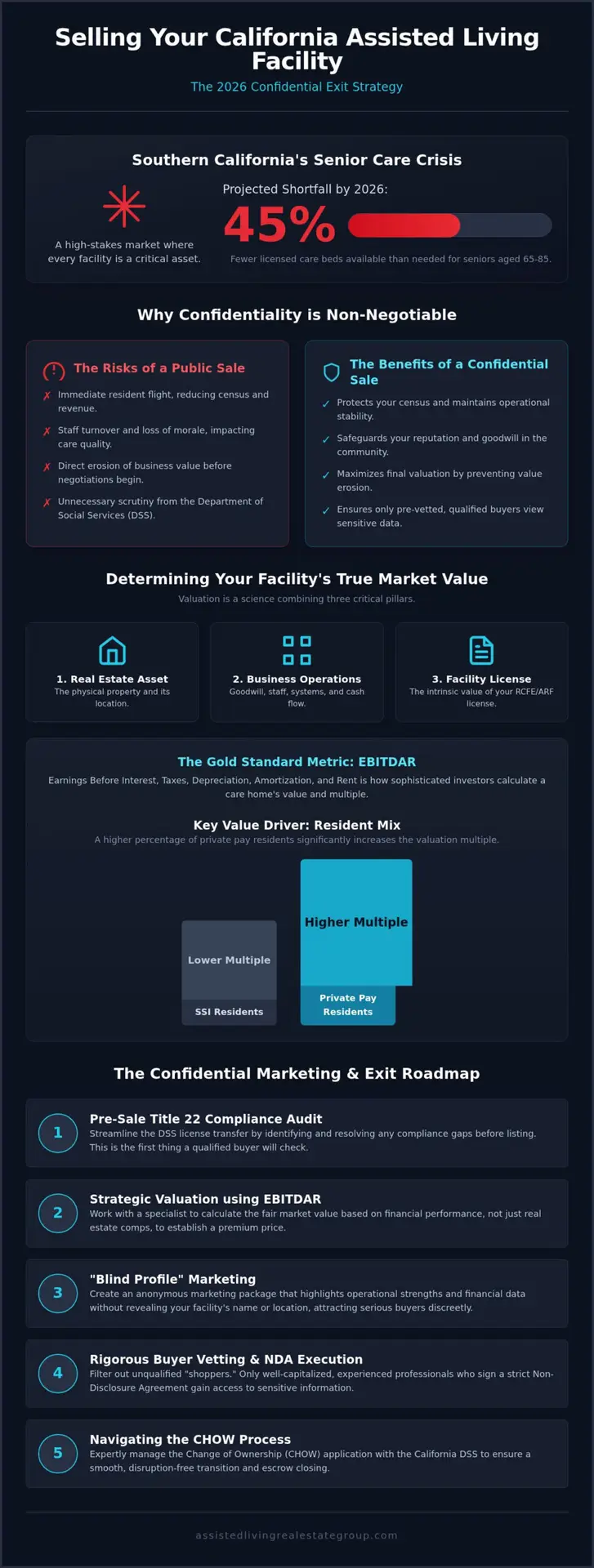
With Southern California facing a staggering 45% shortfall in licensed care beds for seniors by 2026, the demand for established RCFEs and ARFs has reached an unprecedented peak. Yet, for many owners, this massive market potential is overshadowed by the terrifying prospect of resident flight or staff turnover if news of a potential exit leaks. Learning how to sell an assisted living facility confidentially is the only way to safeguard your facility’s legacy and its current market value. In a landscape where Title 22 compliance is non-negotiable and Department of Social Services oversight is tightening, maintaining operational silence isn’t just a preference; it’s a financial necessity.
You’ve spent years building goodwill and providing compassionate care, so it’s natural to feel overwhelmed by the complexities of the CHOW application process or the nuances of valuing a mission-driven business. This 2026 guide promises to demystify the strategic process of exiting your care business while maximizing your valuation multiple and ensuring zero disruption during escrow. We’ll preview the essential steps for vetting buyers, managing updated dementia care standards, and executing a marketing strategy that keeps your reputation intact until the final signature is dry.
Key Takeaways
- Learn why preserving operational silence is the only way to prevent resident flight and maintain your facility’s valuation in California’s high-demand 2026 market.
- Discover how to use EBITDAR as the gold standard for calculating a high-multiple exit that accounts for your real estate, business operations, and license value.
- Master how to sell an assisted living facility confidentially by utilizing the “Blind Profile” method to attract qualified buyers without compromising your location or reputation.
- Understand the critical role of a pre-sale Title 22 compliance audit in streamlining the California Department of Social Services license transfer process.
- Identify why a specialized RCFE broker is essential for navigating the complex intersection of Southern California real estate and compassionate care regulations.
The 2026 California Senior Care Market: Why Confidentiality is Mandatory
Southern California is currently grappling with a projected 45% shortfall in licensed care beds for adults aged 65 to 85. This scarcity has transformed every Residential Care Facility for the Elderly into a high-stakes asset that commands significant investor attention. While the market is aggressive, the “Operational Risk” factor remains your greatest threat. Publicly listing a care home often triggers immediate resident flight and staff turnover, which directly erodes the business value you’ve spent years building. Mastering how to sell an assisted living facility confidentially is the only way to protect your census and your reputation while negotiating a high-multiple exit.
Regulatory shifts in 2026 have made transparency a double-edged sword. New disclosure requirements for pricing and staffing ratios mean that buyers are more informed than ever, but these same requirements can expose operational vulnerabilities if handled carelessly. A strategic, private sale ensures that sensitive data stays within a controlled environment, accessible only to those who have passed a rigorous vetting process.
RCFE vs. ARF: Different Buyer Profiles
Investors in 2026 are diversifying between Adult Residential Facilities (ARF) and RCFEs, but their motivations differ. ARFs often attract those focused on stable, specialized care models, while RCFE licensing commands a significant premium due to the private-pay potential of the aging demographic. A turnkey Southern California RCFE is a prized commodity because it bypasses the years required for new construction and initial licensure. If you are on the other side of the transaction, understanding these nuances is critical, as detailed in our Ultimate Guide to Buying an RCFE Facility in California.
The Impact of Title 22 on Your Exit Strategy
California’s regulatory environment has evolved significantly. With the July 2026 transparency requirements now in full effect, facilities must provide historical regulatory citations and staffing ratios before contracts are signed. Consequently, Title 22 compliance is the first thing a qualified buyer will audit. The Department of Social Services (DSS) oversees the Change of Ownership (CHOW) process with intense scrutiny. Any documentation gaps can stall escrow for months. Unofficial or public listings invite unvetted “shoppers” who lack the expertise to navigate these regulations, potentially flagging your facility for unnecessary DSS attention. Protecting your legacy requires a proprietary vetting process that ensures only sophisticated, well-capitalized professionals view your sensitive operational data.
Determining the Fair Market Value of Your RCFE or ARF
Valuation in the California senior care market is a specialized science that transcends simple real estate appraisals. It rests on three distinct pillars: the physical real estate, the operational business income, and the intrinsic value of the facility license. EBITDAR (Earnings Before Interest, Taxes, Depreciation, Amortization, and Rent) serves as the gold standard for care home multiples. While general commercial agents look at square footage, specialized investors focus on your resident mix. A high percentage of “Private Pay” residents significantly increases your sales price compared to “SSI” (Supplemental Security Income) heavy facilities. This is because private-pay margins offer greater flexibility and higher returns in the current economic climate. Beyond the numbers, the “Turnkey” nature of your operation, including trained staff and documented systems, adds a tangible premium to your final exit price.
Valuing the Business Beyond the Bricks
In Southern California, the “Blue Sky” or goodwill value of an established facility is often its most significant asset. This value is driven by your reputation, referral networks, and historical occupancy rates. Licensed bed capacity is a major driver of value here. An RCFE with a higher bed count in a desirable residential neighborhood often commands a higher multiple because of the inherent barriers to entry for new licensing. If you are operating a specialized facility, you can learn more about these nuances in our guide on how to Sell Your Adult Residential Facility in California: The Definitive Guide.
Financial Preparation for Due Diligence
Successful exits require meticulous financial hygiene. You must organize three years of California-specific P&L statements and tax returns to withstand investor scrutiny. During this phase, identifying “Add-backs” is essential to normalize your income. Add-backs include one-time or personal expenses, such as owner’s health insurance or personal vehicle leases, that are added back to the bottom line to show the true profitability of the business. Discovering how to sell an assisted living facility confidentially begins with an accurate valuation that reflects the premium nature of your operation. Before you approach the market, ensure your documentation aligns with California’s Residential Care Facilities for the Elderly (RCFE) regulations to avoid delays during the audit phase. A professional valuation is the prerequisite for any confidential listing, and you can request a confidential assessment to establish your baseline today.
The Strategic Execution of a Confidential Marketing Plan
Maintaining the integrity of your operation during a sale requires more than just discretion; it demands a “Blind Profile” strategy. This method generates high-level interest by highlighting your facility’s financial performance and geographic region without revealing its specific name or street address. In the competitive Southern California market, this layer of anonymity prevents competitors from poaching your staff or unsettling your resident families. Executing how to sell an assisted living facility confidentially involves a proprietary vetting process that goes far beyond a standard commercial NDA. You need a specialized agreement that addresses the unique sensitivities of care records and employee retention, ensuring that every inquiry is backed by verified proof of funds and relevant care experience.
Exiting a mission-driven business is often an emotional transition. It’s a delicate balance between achieving a high-multiple return and ensuring your residents continue to receive premium care. While the process for selling a healthcare business typically follows a standard roadmap, California’s RCFE and ARF sectors require a more nuanced touch. You aren’t just selling real estate; you’re transferring a legacy of service that demands a buyer who respects both the financial metrics and the human impact of the facility.
Protecting Staff and Resident Stability
Operational continuity is your greatest asset. If staff members sense a transition prematurely, the resulting turnover can cripple your census and devalue the business before you reach the closing table. Site visits must be conducted with extreme caution, often scheduled after hours or disguised as routine insurance inspections or maintenance walkthroughs. The “Business as Usual” mantra must be maintained daily. Strategic timing is everything; you should only announce the sale to your team once the buyer has cleared the major hurdles of the DSS license transfer and escrow is nearing its conclusion.
The Role of Proprietary Buyer Databases
Specialized California brokers don’t rely on public “For Sale” signs or generic listing portals that broadcast your business to the world. Instead, they tap into curated, proprietary databases of pre-qualified RCFE and ARF buyers who are actively seeking turnkey opportunities in Southern California. This exclusive approach actually increases the quality of the offers you receive. By limiting exposure to serious, vetted professionals, you eliminate “tire-kickers” and focus on buyers who understand Title 22 compliance and have the capital to close. Confidentiality doesn’t shrink your market; it refines it to include only those who truly value the premium nature of your care business.
The Roadmap to a Successful Facility Exit in California
A successful exit requires a methodical progression that balances financial gain with regulatory precision. Unlike standard residential real estate, a care facility sale is a dual-track process involving both a business transfer and a real estate transaction. The first step involves a confidential valuation paired with a rigorous Title 22 compliance audit. This audit ensures your facility is “market ready” and won’t be flagged during the buyer’s due diligence or state inspections. Next, we launch the blind marketing phase to a curated list of vetted investors. This is the cornerstone of how to sell an assisted living facility confidentially, as it allows you to test the market without alerting the local community or your current staff. Once a Letter of Intent (LOI) is secured, the focus shifts to vetting the buyer’s care experience and financial capacity before entering the final regulatory hurdles.
Navigating the DSS License Transfer (CHOW)
The Change of Ownership (CHOW) process is the most critical hurdle in your exit strategy. In 2026, the California Department of Social Services (DSS) typically requires a 60 to 90 day timeline for processing license applications. While some general brokers promise a 30 day close, they often ignore the reality of state-mandated wait times. To avoid escrow delays, the buyer must be pre-qualified for an RCFE license before the Asset Purchase Agreement (APA) is even signed. On the day of closing, the license doesn’t simply transfer; the buyer must have their provisional license ready to assume operations. This ensures there is no gap in care or compliance, protecting your legacy and the residents’ well-being.
Escrow and Closing Logistics
Closing a care facility requires a specialized escrow officer who understands the nuances of prorated resident fees and the transfer of resident security deposits. These financial details are sensitive and must be handled with surgical precision to maintain institutional trust. Final walk-throughs are typically conducted after hours to preserve confidentiality until the last possible moment. Only after the funds have cleared and the deed is recorded do you begin the post-closing introduction to staff and families. This sequence ensures that your team feels secure in their new leadership rather than anxious about an uncertain transition. If you are ready to begin this journey, you can start your confidential valuation with our expert team to ensure a seamless transition.
Why Partner with a Specialized California RCFE Broker?
Navigating the sale of a care business requires a partner who understands that your reputation is as valuable as your real estate. General residential or commercial brokers often fail at RCFE transactions because they lack the regulatory depth to manage the intersection of Title 22 compliance and business valuation. Teri Szoke and her team at ALREG bring 25 years of combined experience to the table, positioning themselves as the strategic guardians of your legacy. They don’t just list properties; they curate opportunities for a localized network of Southern California care facility investors who are ready to pay a premium for turnkey operations. Understanding how to sell an assisted living facility confidentially is about more than just an NDA. It’s about having a broker who knows which buyers are truly qualified to step into your shoes without triggering an operational crisis.
The ALREG team bridges the gap between high-level financial metrics and the granular realities of daily care operations. While a general agent might focus on the price per square foot, we focus on the price per bed and the quality of your resident-centered systems. This specialized expertise ensures that your business is presented as a sophisticated investment vehicle rather than just another piece of real estate. By leveraging deep Southern California market data, we align your exit strategy with the current demographic shift, turning market demand into a tangible financial reward for your years of service.
Consulting and Strategy Beyond the Listing
Our work begins long before the first blind profile is sent to a buyer. ALREG provides specialized consulting to help you optimize your facility setup, ensuring your documentation and staffing ratios are beyond reproach before they are audited. Working with a broker who speaks “Title 22” fluently means we can identify and resolve potential compliance red flags that would otherwise derail a sale during the DSS review. Our success stories across the Southern California RCFE market are built on this foundation of preparation. We transform facilities into high-performing assets that stand out to institutional-grade buyers who value administrative excellence and operational stability.
Your Next Step: A Confidential Conversation
The 2026 market offers a unique window of opportunity for owners ready to capitalize on their hard work. Preparing for a high-multiple exit starts with an accurate, no-obligation valuation that reflects the current state of the California senior care landscape. We invite you to begin this journey with a private discussion about your goals and the specific value of your facility’s goodwill. Don’t leave your legacy to chance or an unvetted public listing. Contact Assisted Living Real Estate Group today to secure your future through a strategic, confidential sale process that honors your commitment to care.
Secure Your Legacy in the 2026 California Market
Selling your care business is the culmination of years of dedication and service. Success in this high-stakes environment requires more than just finding a buyer; it demands a surgical approach to valuation and a deep mastery of Title 22 compliance. By prioritizing operational silence, you protect your census and ensure that your transition doesn’t compromise the quality of care your residents expect. Mastering how to sell an assisted living facility confidentially is the difference between a stalled transaction and a high-multiple exit that honors your life’s work.
Our team at Assisted Living Real Estate Group brings over 25 years of Southern California market experience to every negotiation. We serve as specialized RCFE and ARF regulatory experts who bridge the gap between financial investment and compassionate care. Don’t leave your reputation to chance with a general broker who lacks the nuanced vetting process required for this niche market. Request Your Confidential California Facility Valuation today to begin your strategic exit with confidence. Your commitment to excellence deserves a reward that reflects its true impact.
Frequently Asked Questions
How long does it take to sell an assisted living facility in California?
The total timeline for a facility sale in California usually ranges from six to nine months. This period accounts for initial valuation, confidential marketing, and the mandatory 60 to 90 day processing time for the Department of Social Services (DSS) Change of Ownership (CHOW) application. While the real estate transaction might move faster, the business transfer is tethered to these regulatory wait times, ensuring the buyer is fully licensed to assume care on the day of closing.
Can I sell my RCFE business without selling the real estate?
You can absolutely sell the business operations while retaining ownership of the underlying real property. This is a common strategy for owners who want to transition into a landlord role while securing a steady income stream through a long-term lease. In these scenarios, the buyer acquires the “goodwill,” the license, and the operational systems. We often facilitate these lease-to-own care home opportunities to match passive property owners with experienced, qualified operators.
What is the difference between an RCFE and an ARF when selling?
The primary difference lies in the resident demographic and the specific Title 22 regulations governing the license. A Residential Care Facility for the Elderly (RCFE) serves seniors aged 60 and older, whereas an Adult Residential Facility (ARF) focuses on adults aged 18 to 59 with various disabilities. When selling, RCFEs often command a premium due to the massive private-pay demand in the Southern California senior market, while ARFs appeal to specialized investors seeking specific care niches.
Will my residents be forced to move if I sell my facility?
No, the goal of a professional facility transfer is to ensure zero disruption for the residents. By learning how to sell an assisted living facility confidentially, you ensure that the transition happens behind the scenes without causing unnecessary anxiety for families. The new owner assumes the existing residency agreements and care plans. This continuity is essential for maintaining the facility’s census and its overall market value during the escrow period and beyond.
How is the “blue sky” or goodwill of a care facility calculated in CA?
Goodwill is typically calculated by applying a multiple to the business’s EBITDAR, reflecting its reputation and historical occupancy rates. In Southern California, factors such as your referral network, staff longevity, and Title 22 compliance history play significant roles in this calculation. This “blue sky” value represents the difference between the tangible asset value and the total purchase price, acknowledging the years of effort you’ve invested in building a trusted community brand.
Do I need to notify the Department of Social Services before I list my facility?
You aren’t required to notify the Department of Social Services (DSS) simply to list your facility for sale. Formal notification occurs later in the process when the buyer submits their Change of Ownership (CHOW) application. Keeping the listing private is a core part of how to sell an assisted living facility confidentially, allowing you to vet potential successors without triggering premature regulatory audits or unsettling your current resident population before a solid agreement is reached.
What happens to my staff when I sell the business?
Most buyers view an experienced, well-trained team as one of the facility’s most valuable assets and intend to keep them in place. A turnkey business acquisition is highly desirable precisely because it includes the human capital necessary to maintain Title 22 standards. While ownership changes, the staff’s daily routines generally remain the same. We recommend waiting until the license transfer is nearly complete before announcing the sale to minimize turnover and maintain operational stability.
Is 2026 a good year to sell a senior care facility in Southern California?
2026 is an exceptional year for sellers due to the widening gap between the supply of licensed beds and the growing senior population. Southern California continues to see high demand for RCFE and ARF models, particularly those with strong private-pay mixes. With tightening regulatory standards, established, compliant facilities are increasingly rare and valuable. This environment creates a seller’s market where qualified investors are actively seeking high-performing, turnkey assets that offer immediate market entry.