
In the 2026 California residential care market, your labor roster isn’t just a payroll expense; it’s the primary engine of your facility’s valuation. Mastering the nuances of RCFE vs ARF staffing requirements is the difference between securing a high-yield asset and inheriting a regulatory liability. You already know that Title 22 compliance is the bedrock of your operation, yet the shifting landscape of 2026 training mandates and disclosure laws adds a layer of complexity that can stall even the most seasoned investor.
We’ll bridge the gap between financial strategy and regulatory mandates to help you optimize your portfolio. This comparison provides the precise labor cost frameworks and licensing roadmaps you need to make a confident decision between these two asset classes. We will examine the 80-hour RCFE administrator certification alongside the 35-hour ARF initial training requirements, while detailing how the July 2026 ratio disclosure laws impact your bottom line. By the end of this analysis, you’ll have a clear path to maximizing both social impact and investment returns in the Golden State.
Key Takeaways
- Identify the specific certification paths for administrators, comparing the 80-hour RCFE mandate with the 35-hour ARF requirement to streamline your licensing timeline.
- Understand how RCFE vs ARF staffing requirements dictate your operational budget, specifically regarding the July 2026 ratio disclosure laws and mandated training hours.
- Analyze the financial trade-offs between the private pay RCFE model and the tiered Regional Center funding structures typical of California ARF investments.
- Leverage California’s unique fair housing protections for 6-bed facilities to secure prime residential assets in high-demand neighborhoods.
- Determine which asset class fits your management style by evaluating the hospitality-focused nature of elderly care against the clinical service requirements of adult residential facilities.
Defining the RCFE and ARF Landscape Under California Title 22
The California Department of Social Services (CDSS) serves as the primary regulator for the state’s residential care sector. For strategic investors, Title 22, Division 6 isn’t just a set of rules; it’s the operational blueprint for your business. This foundational code governs both models, ensuring that resident safety aligns with your financial objectives. Mastering the nuances of RCFE vs ARF staffing requirements begins with a clear grasp of the specific demographics each license serves. These regulations provide the structure necessary to scale a business that balances technical compliance with compassionate, high-level service.
Age Demographics and Resident Eligibility
Strict age cutoffs define these licenses and dictate your target market. The CDSS maintains clear boundaries to ensure residents receive age-appropriate care:
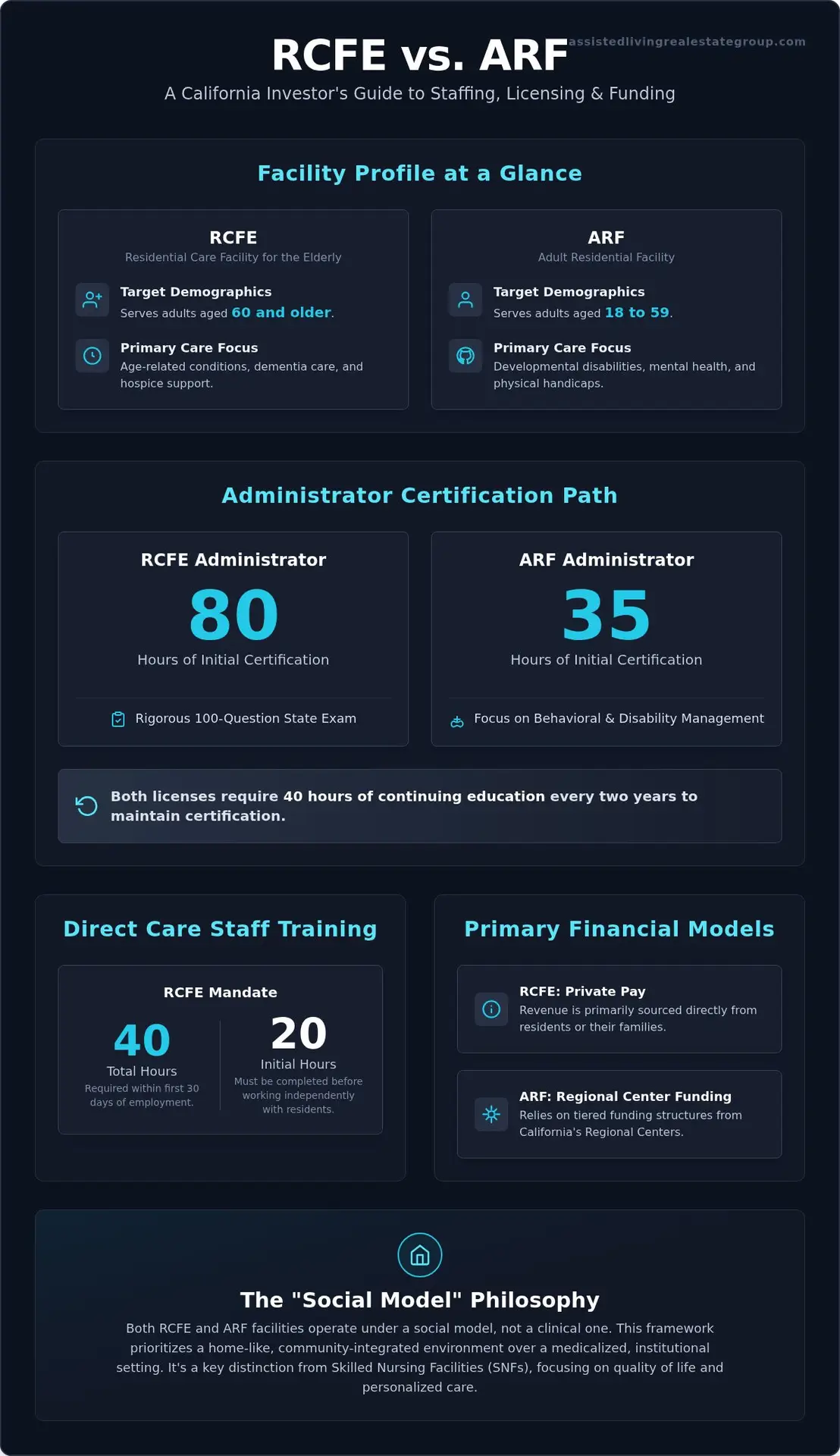
- RCFE: Serves adults 60 and older. Focus is on age-related conditions, dementia care, and hospice.
- ARF: Serves adults 18 to 59. Focus is on developmental disabilities, mental health, and physical handicaps.
While the CDSS occasionally grants age waivers for younger residents, these are rare and require a compelling justification centered on the resident’s specific needs. This demographic split is more than a formality; it determines the specific training modules your staff must complete to remain compliant. Your recruitment strategy must reflect these differences, as the care needs for a young adult with physical handicaps differ vastly from those of a senior in hospice care.
The Social Model vs. Clinical Environments
Both facility types operate under a “social model” framework, which is a critical distinction for your investment strategy. They represent a refined alternative to the institutional, medicalized feel of Skilled Nursing Facilities (SNFs). While SNFs are clinical environments providing 24-hour nursing, Assisted living models like RCFEs and ARFs focus on non-medical, community-integrated care. This model prioritizes quality of life over clinical throughput. It allows for a more intimate, home-like atmosphere that many families prefer.
In Southern California, the term “Board and Care” is the standard industry shorthand for these 6-bed residential properties. Investors find that this model offers a unique opportunity to provide exclusive, personalized service while navigating the complexities of RCFE vs ARF staffing requirements. By positioning your facility as a premium residential care home rather than a medical institution, you can attract a discerning clientele while maintaining a manageable overhead structure. Success in this niche requires a commitment to the social model, where the environment feels like a home and the staff feels like an extension of the family.
Comparing RCFE vs ARF Staffing Requirements and Training
The regulatory burden in California is a filter that separates serious professionals from casual observers. When evaluating RCFE vs ARF staffing requirements, the most immediate hurdle is the administrator certification. For an RCFE, the state mandates a comprehensive 80-hour certification course followed by a rigorous 100-question exam. In contrast, the ARF administrator path requires a 35-hour initial program. While the ARF hours are lower, the focus shifts heavily toward behavioral health and developmental disability management. Both classes require 40 hours of continuing education every two years to maintain licensure.
Administrator Licensing and Continuing Education
The RCFE administrator role is built on a foundation of elderly care, dementia management, and hospice oversight. This 80-hour commitment ensures leadership can handle the complex medical and social needs of the 60+ demographic. ARF administrators, while needing only 35 hours, must master behavioral intervention and the specific mandates of the Regional Center system. Success in these high-barrier markets often starts with identifying turnkey business acquisitions that already have certified leadership in place, allowing you to bypass the initial certification lag.
Direct Care Staff Training Standards
Staffing your facility requires more than just hiring personnel; it’s about curated expertise. For RCFEs, direct care staff must complete 40 hours of training within their first 30 days of employment. Crucially, 20 of those hours must be finished before they can work independently with residents. This training covers dementia care, postural supports, and medication assistance. ARF staff training focuses on behavioral intervention and adaptive skills to support younger adults with varying disabilities. All California residential care employees must also maintain current First Aid and CPR certifications.
Regulatory compliance hinges on your understanding of the California Title 22 personnel requirements, which dictate the specific qualifications for every individual on your payroll. Beyond initial training, all employees must pass a background check through the Caregiver Background Check Bureau (CBCB) before they can have any contact with residents. This is a non-negotiable step in protecting your license and your residents.
The CDSS enforces a “sufficient staffing” rule rather than a fixed ratio for RCFEs. This means you must prove you have enough personnel to meet the specific acuity levels of your residents 24/7. However, for ARFs, Title 22 requires at least one staff member for every three residents who are dependent on others for all activities of daily living during daytime hours. As of July 1, 2026, RCFEs must also provide written disclosures of their actual staff-to-resident ratios to prospective residents. This transparency mandate makes your staffing strategy a critical component of your facility’s marketability and financial health.
Financial Mechanics: Private Pay vs. Regional Center Funding
Your choice of asset class dictates your cash flow architecture and administrative rhythm. In the RCFE sector, the private pay model reigns supreme, offering investors the flexibility of market-based pricing. Conversely, the ARF model operates within the structured reimbursement framework of California’s 21 Regional Centers. While the RCFE model allows for significant margin expansion through premium service tiers, the ARF model offers unparalleled revenue stability and lower vacancy rates due to the state’s persistent undersupply of specialized beds. Understanding how RCFE vs ARF staffing requirements intersect with these funding streams is essential for maintaining a healthy bottom line.
RCFE Economics: Market Rates in Southern California
The RCFE market in 2026 reflects California’s high-barrier entry costs and wealthy demographic shifts. The median monthly cost for a standard assisted living unit in the state has reached approximately $7,000. In high-demand regions like the Bay Area, this median climbs to $8,500, while inland areas offer a more accessible range of $3,000 to $6,000. For investors, this flexibility is a powerful tool against inflation. You aren’t tethered to government caps. Many operators also leverage Long-Term Care Insurance (LTCI) as a reliable revenue stream, though this requires meticulous documentation to satisfy policy requirements. For a deeper dive into the acquisition process, consult The Ultimate Guide to Buying an RCFE Facility in California.
ARF Economics: Regional Center and SSI Reimbursement
ARF profitability is tied to the Regional Center ‘Level’ system, ranging from Level 1 to Level 4. The Department of Developmental Services (DDS) determines these levels based on the resident’s behavioral and clinical needs. Higher levels command higher reimbursement rates but also trigger more intensive RCFE vs ARF staffing requirements. Effective January 1, 2026, the Board and Care SSI/SSP rate for Regional Center clients is $1444.07 per month. While this base rate is lower than private pay, the “Level” add-ons provided by the Regional Center can significantly boost total facility revenue. You’ll find that billing a single state agency is often less labor-intensive than managing individual family invoices, provided you stay current with California Title 22 regulations. This model trades the high-ceiling potential of RCFEs for the predictable, recession-resistant income of the developmental disability services system.
Market Demand and Real Estate Strategy in 2026
California’s demographic shift is no longer a distant forecast; it’s a present reality for the strategic investor. Southern California faces a projected 45% shortfall in licensed care beds for seniors by late 2026. This scarcity creates a massive opportunity for professionals who can navigate the operational hurdles. While the underlying real estate continues to appreciate, the true enterprise value lies in the facility license and your capacity to meet RCFE vs ARF staffing requirements in a tightening labor market. Demand is surging, yet the supply of licensed beds remains stagnant due to high entry barriers.
California fair housing laws provide a unique shield for the 6-bed residential model. These facilities are legally treated as single-family residences, bypassing the restrictive zoning hurdles that often stall larger commercial projects. This protection allows you to embed exclusive, high-margin care services directly into affluent neighborhoods where demand is highest and competition is virtually non-existent. It’s a model that pairs residential real estate stability with the high-yield potential of specialized care.
The Moat of Licensing: Why Barriers to Entry Protect Investors
The “moat” around your investment is reinforced by the California Department of Social Services. Licensing delays at the Centralized Applications Bureau (CAB) often stretch for several months, making existing, licensed facilities incredibly valuable assets. You aren’t just buying a property; you’re buying time and a head start in a supply-constrained market. If you’re looking to capture this momentum, exploring Investing in an Adult Residential Facility in California provides the tactical roadmap needed for the current market. Coastal Southern California remains the most exclusive pocket, where the scarcity of licensed care homes justifies premium service rates.
Facility Size and Scalability
Choosing between a 6-bed residential model and a 16+ bed commercial facility is a strategic decision between simplicity and scale. The 6-bed “board and care” model is the gold standard for many investors, offering lower overhead and a more intimate staff-to-resident ratio. Larger facilities, while offering more beds, trigger complex ADA compliance mandates and stricter fire marshal oversight. As your portfolio grows, managing RCFE vs ARF staffing requirements evolves from a hands-on operational task into a sophisticated management challenge. Success requires a partner who understands the intersection of residential real estate and regulatory compliance.
If you’re ready to capitalize on this supply-demand imbalance, we focus on identifying turnkey business acquisitions that allow you to bypass licensing delays and start generating returns immediately.
Strategic Acquisition: Choosing the Right Asset for Your Portfolio
Your investment journey culminates in a fundamental choice: the hospitality-driven model of an RCFE or the programmatic, clinical focus of an ARF. This decision defines your daily operations and your long-term exit strategy. While both assets offer impressive cap rates in California’s supply-constrained market, they require different management temperaments. An RCFE investor often prioritizes refined service and lifestyle amenities for seniors. Conversely, an ARF investor focuses on behavioral milestones and structured support systems for younger adults. Aligning your personal strengths with the right facility type is the first step toward a sustainable, high-impact portfolio.
Decision Matrix for 2026 Investors
Understanding RCFE vs ARF staffing requirements is vital for accurate financial forecasting. In an RCFE, labor costs are often driven by the “sufficient staffing” rule, where resident acuity dictates your payroll. In an ARF, staffing is more rigid, often tied to specific Regional Center levels and mandated ratios for dependent residents. Mastering these nuances allows you to accurately project labor as a percentage of gross revenue, a metric that varies significantly between the two models. To navigate the specific hurdles of the application process, review our guide on the RCFE License California requirements for 2026.
The Teri Szoke Advantage in Confidential Sales
The care facility market is uniquely sensitive. Publicly listing a facility can trigger staff turnover and resident anxiety, devaluing the very asset you wish to acquire. We specialize in confidential marketing strategies that protect the reputation and stability of every home. With 25 years of combined experience, Assisted Living Real Estate Group bridges the gap between traditional real estate brokerage and the complex world of Title 22 compliance. We don’t just find buildings; we identify turnkey business acquisitions that are ready for immediate operational transition. This specialized expertise ensures that your entry into the California care sector is both strategic and secure.
The 2026 market offers a rare window of opportunity for professionals ready to make a move. Whether you are expanding an existing portfolio or entering the sector for the first time, having an expert guide is non-negotiable. Schedule a confidential consultation for your California care home investment today to explore off-market opportunities that align with your financial goals and social mission.
Securing Your Legacy in California’s Care Economy
The window for strategic entry into California’s residential care sector is narrowing as the supply-demand imbalance intensifies. Success in this high-barrier market requires more than just capital; it demands a deep mastery of Title 22 licensing and a clear understanding of RCFE vs ARF staffing requirements. Whether you choose the hospitality-centric RCFE model or the programmatic stability of an ARF, your ability to navigate these mandates will determine your facility’s ultimate valuation and operational longevity.
At Assisted Living Real Estate Group, we provide the seasoned expertise needed to bridge the gap between financial investment and compassionate care. With over 25 years of California care facility expertise, we offer confidential business and real estate valuations that protect your interests and your reputation. Don’t leave your 2026 investment strategy to chance. Leverage our deep industry knowledge to secure a turnkey asset that delivers both social impact and significant financial returns.
Take the next step in your professional journey and Explore California RCFE and ARF Listings to find an acquisition that aligns with your vision. Your future as a leader in California’s care economy starts with the right strategic partner. We are ready to help you navigate this exclusive market with confidence and precision.
Frequently Asked Questions
Can a single facility be licensed as both an ARF and an RCFE in California?
A facility cannot hold both licenses for the same physical beds. California Title 22 requires operators to choose a specific license based on the primary demographic being served. While you can apply for an age waiver in rare circumstances to keep a resident who has aged out, the facility itself must remain either an RCFE or an ARF. Managing a portfolio with both asset classes requires distinct operational strategies for each.
What is the minimum age for residents in an Adult Residential Facility (ARF)?
The minimum age for an ARF resident is 18. These facilities are designed to support adults between the ages of 18 and 59 who require specialized care for developmental disabilities or mental health needs. Once a resident reaches age 60, they technically age out of the ARF demographic, though operators can sometimes secure an exception from the CDSS to prevent displacement of long-term residents in Southern California homes.
Which type of facility typically has higher staffing costs in California?
Staffing costs are typically higher in ARF facilities, particularly those designated as Level 4. These high-acuity homes must meet strict RCFE vs ARF staffing requirements that often mandate a one-to-three staff-to-resident ratio for daytime hours. While RCFEs operate on a “sufficient staffing” model, the intensive behavioral and physical support required in top-tier ARFs usually results in a larger, more expensive payroll for the strategic investor.
Do I need a medical degree to own an RCFE or ARF in California?
You don’t need a medical degree or nursing license to own or operate these facilities. California’s social model of care focuses on assistance with activities of daily living rather than clinical intervention. You must, however, complete the mandated administrator certification and pass a state exam. Many Southern California investors act as the licensee while hiring a certified administrator to manage the daily RCFE vs ARF staffing requirements and compliance.
How many hours of training does an RCFE administrator need in 2026?
In 2026, a new RCFE administrator must complete an 80-hour initial certification program. This training is followed by a 100-question state exam that covers Title 22 regulations and resident care standards. To maintain this license, you are also required to complete 40 hours of continuing education every two years. This rigorous training ensures that leadership can manage the complex health and safety needs of California’s elderly population effectively.
Is private pay more common in RCFE or ARF facilities?
Private pay is the dominant revenue model for RCFE facilities in California. Families typically pay market rates out of pocket or through long-term care insurance. In contrast, ARF facilities rely heavily on government funding through the California Department of Developmental Services and local Regional Centers. This makes RCFEs more sensitive to local real estate market trends, while ARFs offer a more recession-resistant income stream backed by state budgets.
What is the role of the Regional Center in ARF staffing requirements?
The Regional Center determines the specific “Level” of care required for each resident, which directly dictates your staffing mandates. Higher levels of care come with increased reimbursement rates but also trigger stricter staffing ratios and specialized training needs. Investors must work closely with the Regional Center to ensure their facility remains compliant with the individual service plans developed for each resident, as these plans override general staffing guidelines.
How long does the licensing process take for an RCFE in California in 2026?
The licensing process through the Centralized Applications Bureau (CAB) currently takes several months, often stretching from six to ten months. These delays are why many Southern California investors prefer turnkey business acquisitions over starting from scratch. Buying an existing, licensed facility allows you to bypass the lengthy application queue and begin operations immediately, capturing market demand without the lost revenue of a vacant building waiting for state approval.