
In California’s 2026 market, an RCFE is no longer just a piece of real estate; it’s a high-stakes, dual-asset entity where a single licensing misstep can erase years of equity. You’ve spent a career building a reputation for compassionate care, and the fear of a “For Sale” sign triggering a mass exodus of staff or a 12-month licensing delay is a valid concern. You deserve an RCFE ownership transition plan that honors your hard work while securing your financial future.
We understand that the intersection of Title 22 compliance and market valuation is where most investors feel the most friction. This guide provides the strategic roadmap you need. We’ll explore how to navigate the 2026 regulatory landscape and ensure a seamless Change of Ownership (CHOW) that maintains operational continuity. You’ll learn to accurately value business goodwill, manage the 60-day CDSS decision deadline, and implement confidential marketing strategies that protect your residents’ peace of mind. By the end of this article, you’ll have the clarity to transition your investment with the same precision you used to manage it.
Key Takeaways
- Understand why a California RCFE sale is a dual-track process requiring business relicensing rather than a simple license transfer.
- Learn to maximize your valuation by auditing three years of financials and verifying the accuracy of your Level of Care revenue.
- Execute a seamless Change of Ownership by following a 2026 RCFE ownership transition plan tailored to the latest CCLD approval timelines.
- Protect your investment from resident and staff flight by prioritizing a confidential marketing strategy over high-risk public listings.
- Coordinate your real estate closing with the business transfer using a specialized dual escrow process that ensures operational continuity.
The Strategic Framework of an RCFE Ownership Transition in 2026
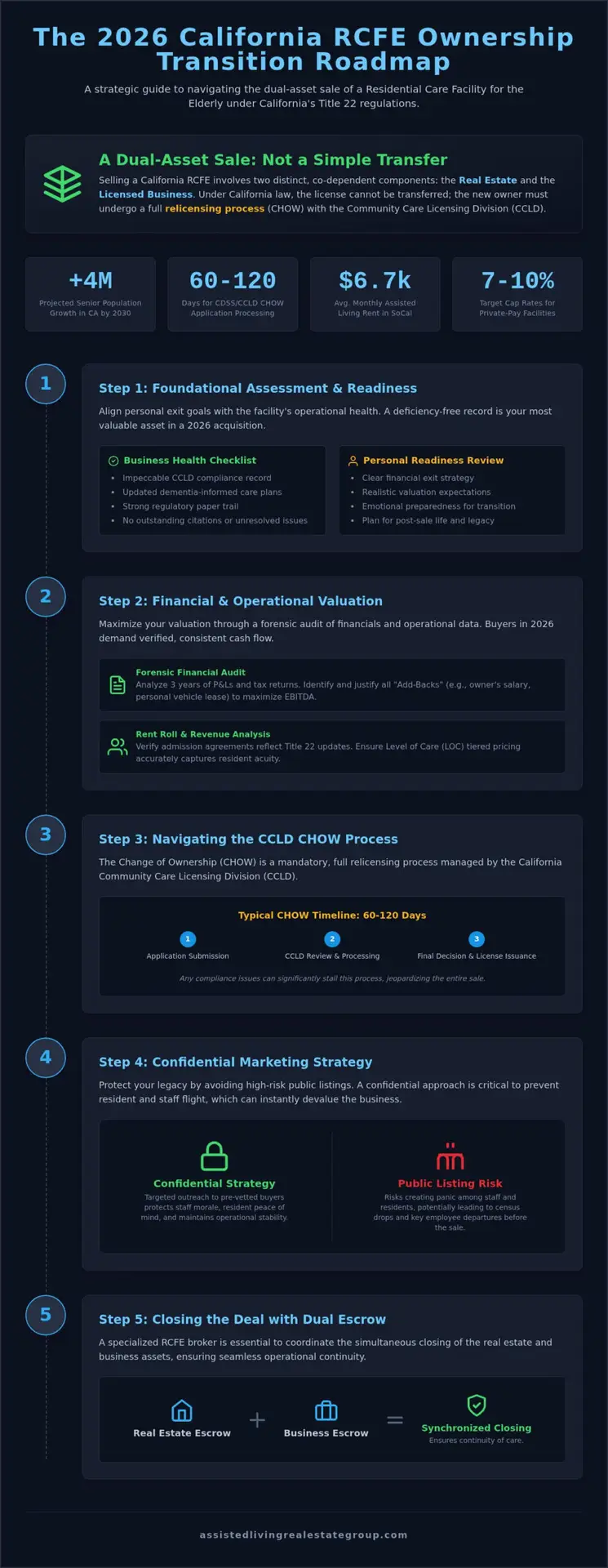
In California, executing a successful RCFE ownership transition plan requires a sophisticated understanding of dual-track asset management. You aren’t just selling a building; you’re orchestrating the relicensing of a highly regulated service entity. Many operators mistakenly believe they can simply “transfer” a license to a buyer. Under California Title 22, this is a legal misnomer. Every change of ownership triggers a full relicensing process through the Community Care Licensing Division (CCLD). If you don’t respect this regulatory boundary, you risk voiding the license and devaluing the entire investment overnight.
The 2026 market presents a unique paradox. While California’s senior population is projected to grow by four million by 2030, the California Department of Social Services (CDSS) has significantly increased enforcement. New standards for dementia-informed care and infection control are now baseline expectations. Success in this environment relies on “Compliance-Driven Profitability.” This means your facility’s value isn’t just tied to its census, but to the strength of its regulatory paper trail. As the broader Residential care industry faces these headwinds, only facilities with impeccable records will command premium multiples.
The Dual-Asset Nature of Senior Care Facilities
An RCFE consists of two distinct components: the real property and the operational business. The real estate provides the physical foundation, but the license is the anchor of the facility’s market value. In Southern California hubs like Los Angeles and San Diego, where assisted living rents average between $6,600 and $6,800 per month, the business goodwill often outweighs the land value. Investors in 2026 prioritize facilities where the operational infrastructure is as robust as the building itself.
Transition Readiness: Personal vs. Business
A successful exit requires you to assess your personal readiness alongside the facility’s operational health. A “clean” record with the CCLD is your most valuable currency. Any outstanding citations or unresolved compliance issues will stall a Change of Ownership (CHOW) application, which typically takes 60 to 120 days to process. The strategic filter for a 2026 acquisition is the seamless alignment of audited financial performance with a deficiency-free record from the Community Care Licensing Division. Without this alignment, your facility remains a liability rather than a legacy.
Financial and Operational Valuation: Preparing for the Exit
Precision in valuation is the difference between a successful legacy and a stranded asset. For a robust RCFE ownership transition plan, you must look beyond the surface of your balance sheet. Investors in 2026 require a forensic audit of three years of P&Ls and tax returns to verify the consistency of your cash flow. In the specialized 6-bed residential care market, identifying allowable “Add-Backs” is essential for maximizing your EBITDA. These often include non-operational expenses like personal vehicle leases, owner’s health insurance, or discretionary travel that are legally run through the business but don’t reflect the facility’s true earning potential.
Labor costs remain the most volatile variable in California’s 2026 economic environment. With the state’s aggressive minimum wage escalations and strict overtime rules, your staffing model must be lean and compliant. We’re seeing facilities that haven’t optimized their shifts or accounted for the 40-hour staff training requirement face significant EBITDA compression. A strategic professional understands that a buyer isn’t just purchasing your revenue; they’re purchasing the stability of your net income in a high-cost state.
Resident Agreement and Revenue Analysis
Your “Rent Roll” is the heartbeat of your facility’s value. We analyze every admission agreement to ensure it reflects 2026 Title 22 updates, specifically regarding dementia care and level of care (LOC) tiered pricing. If your LOC revenue doesn’t accurately capture the increasing acuity of your residents, you’re leaving money on the table. For facilities participating in the Assisted Living Waiver program, you must also account for the specific DHCS Change of Ownership protocols that govern reimbursement continuity. Verifying the stability of your private-pay base is critical, as these residents typically command the 7% to 10% cap rates that investors currently seek in Southern California.
Expense Verification: Beyond the Surface
Expense leakage often hides in vendor contracts and insurance premiums. In 2026, food service costs and medical supplies have felt the sting of inflation, requiring a proactive renegotiation of terms before hitting the market. We also conduct a deep dive into your workers’ comp history; a high experience mod can be a deal-killer during due diligence. Finally, don’t ignore deferred maintenance. A leaky roof or an outdated HVAC system isn’t just a repair cost; it’s a potential DSS citation that could derail your relicensing timeline. Obtaining a professional valuation of your care home early in the process ensures these “hidden” liabilities are addressed before they devalue your investment.
Navigating the California CCLD Change of Ownership (CHOW) Process
The Change of Ownership (CHOW) process is the technical core of your RCFE ownership transition plan. Successfully navigating this phase requires more than just paperwork; it demands a strategic alignment with the Adult and Senior Care Program’s current standards. In 2026, the California Department of Social Services (CDSS) utilizes California’s Centralized Applications Bureau to manage these requests. While a new license can take up to 18 months, a CHOW application for an existing facility typically moves faster. California law provides a statutory 60-day decision deadline for complete applications, though most transitions realistically take 60 to 120 days due to the precision required in the supporting documentation.
A key anchor in this timeline is the Administrator’s Certificate. The new owner or their designated administrator must have completed the 80-hour Initial Certification Training Program and passed the state exam before the CHOW can be finalized. If your administrator’s credentials aren’t current, the entire transition stalls, often at a significant financial cost during the escrow period.
The Licensing Application Timeline
The process begins with the LIC 200, the Application for a Community Care Facility License. You’ll need to submit a comprehensive packet that includes financial statements, a disaster and mass casualty plan, and a detailed Plan of Operation. To avoid the common delays seen at local CCL offices in 2026, ensure your application is “deemed complete” upon first submission. For a deeper dive into the nuances of this process, see our guide on RCFE Licensing in California: The 2026 Investor’s Guide to Success. Every month the application sits in “pending” status is a month of potential revenue lost to administrative friction.
Staffing and Training Compliance
During the escrow period, you must manage any existing “Plan of Corrections” (POC). If the current operator has outstanding deficiencies, the buyer must ensure these are cleared before the state approves the new license. This requires a forensic look at staff personnel files. Every employee must have a current Live Scan background clearance associated with the facility’s specific license number. In 2026, regulators are hyper-focused on dementia care and medication management. You must audit training logs to verify that direct-care staff have completed their mandatory 40 hours of training. Ensuring your Plan of Operation reflects these updated standards isn’t just about compliance; it’s about protecting the operational continuity that justifies your investment’s valuation.
The Confidential Marketing and Staff Retention Strategy
Public listings are the primary deal-killer for California care facilities. When an RCFE is marketed on general real estate platforms, it creates a vacuum of uncertainty that triggers “Census Flight.” Families fear a decline in care quality, and staff begin seeking more stable employment elsewhere. A sophisticated RCFE ownership transition plan prioritizes discretion above all else. By leveraging a specialized broker’s private network of qualified investors, you ensure that only vetted, serious buyers even know the opportunity exists, protecting your facility’s stability during the entire process.
Protecting the Business Goodwill
In the elder care industry, “Goodwill” represents the intangible value of your reputation, your community relationships, and your history of compliance. For a 6-bed facility in 2026, which typically trades at 3 to 5 times adjusted EBITDA plus the real estate value, goodwill is a significant portion of the purchase price. We protect this asset by requiring comprehensive Non-Disclosure Agreements (NDAs) before releasing any sensitive financial or operational data. Site visits are managed with extreme care; we often schedule them as “insurance inspections” or after-hours tours to prevent disrupting the daily rhythm of the home. Maintaining this veil of normalcy is essential to preserving the 90% occupancy rates projected for California senior housing by the end of 2026. If you’re ready to explore a discreet exit, our confidential marketing strategy is the gold standard for protecting your investment.
Communicating the Change to Families and Staff
The “Warm Hand-off” is a strategic communication phase that occurs once all licensing hurdles are cleared. Staffing remains a primary challenge in 2026, with the demand for qualified caregivers far outpacing supply. Announcing a sale too early can lead to a mass resignation, leaving the new owner with a compliance crisis on day one. We advise waiting until the Change of Ownership is nearly finalized to present the new operator as a strategic partner who will continue the facility’s legacy of compassionate care. This approach ensures continuity of care and prevents residents from seeking alternative placements due to a perceived lack of stability. The specialized broker serves as a vital buffer during these sensitive negotiations, filtering communication to ensure that the transition remains professional rather than emotional.
Closing the Deal: Why a Specialized RCFE Broker is Essential
The final phase of an RCFE ownership transition plan is a multi-dimensional feat of coordination. Unlike traditional commercial real estate, these transactions require a “Dual Escrow” structure. One escrow handles the real property, while a concurrent business escrow manages the transfer of the operational entity, resident contracts, and employee records. Failing to sync these two tracks can lead to a “gap in care” that triggers immediate scrutiny from the Community Care Licensing Division. A specialized broker ensures that the real estate closing is perfectly timed with the issuance of the new license or the execution of a management agreement.
We also play a critical role in mediating the “Pro-Forma vs. Actual” revenue debate. In 2026, sellers often price facilities based on pro-forma projections that assume 100% occupancy at premium private-pay rates. However, sophisticated investors and lenders demand valuations based on actual audited performance. We bridge this gap by presenting a data-backed narrative that justifies the investment’s future potential without ignoring the current operational reality. With 25 years of combined industry experience, we navigate the hyper-local nuances of Southern California zoning and the specific R-3.1 fire clearances required for small facilities. This seasoned expertise transforms a high-barrier-to-entry market into a manageable, strategic opportunity.
Post-Closing: The First 90 Days
The transition doesn’t end when the documents are signed. Implementing a management agreement during the license transition period is a common strategy to maintain operational momentum while the buyer awaits final CDSS approval. During these first 90 days, the new owner must hit specific operational benchmarks, such as staff retention targets and compliance audits, to ensure a long-term ROI. For those still in the discovery phase, we recommend reviewing The Ultimate Guide to Buying an RCFE Facility in California to understand the full scope of post-purchase responsibilities.
Your 2026 Acquisition or Exit Strategy
Whether you’re planning an exit or an acquisition, success depends on an actionable 30-60-90 day checklist. This timeline should prioritize a forensic financial audit in the first 30 days, the filing of the CHOW application by day 60, and the final staff “Warm Hand-off” by day 90. If you’re a current owner, a confidential valuation is your first step toward a secure retirement or your next investment. Strategic professionals don’t wait for the market to shift; they prepare their facilities to lead it. To see the current landscape of opportunities, you can browse current CA assisted living listings and start your journey with a partner who understands the intersection of ethics and profitability.
Securing Your Legacy in California’s Senior Housing Market
Mastering an RCFE ownership transition plan requires a sophisticated balance between financial strategy and regulatory stewardship. In California’s 2026 market, success isn’t just about finding a buyer; it’s about protecting the operational integrity of your facility through the 60 to 120 day relicensing window. You’ve learned that a deficiency free record with the CCLD and a strictly confidential marketing approach are non negotiable for preserving your business goodwill and resident census.
Transitioning your investment doesn’t have to be a leap into the unknown. With 25 years of specialized expertise in Title 22 compliance and a proven track record in California care facility sales, we provide the mentorship needed to navigate this high barrier market. Whether you’re preparing for a discreet exit or a strategic acquisition, your focus should remain on the intersection of human impact and financial gain.
Secure Your RCFE Transition Strategy – Contact Our Experts
Your commitment to excellence has built a valuable community, and we’re here to ensure the next chapter of your journey is just as rewarding.
Frequently Asked Questions
How long does an RCFE ownership transition typically take in California?
The process typically takes 60 to 120 days. While new licenses take 6 to 18 months, a Change of Ownership (CHOW) benefits from a 60-day statutory decision deadline for complete applications. Delays often occur if the initial packet is incomplete or if the fire clearance is pending. Having an RCFE ownership transition plan that accounts for these administrative windows is essential for maintaining your pro-forma revenue targets during the escrow period.
Can I sell my RCFE license along with the business?
You cannot legally sell or transfer a license in California. Under Title 22, the license is specific to the individual or entity and the location. The buyer must apply for their own license through the Community Care Licensing Division. The sale actually involves the business goodwill, physical assets, and real estate. The buyer then undergoes the relicensing process to continue operations at that specific site under their own name.
What is a “CHOW” and why is it critical for California care facilities?
CHOW stands for Change of Ownership, the regulatory process used when an existing facility is sold. It’s critical because it allows for a faster licensing timeline compared to a new facility application. In 2026, the CHOW process ensures there’s no gap in resident care while the state verifies the new owner’s financial stability and administrator credentials. This process is the most efficient path for strategic investors seeking to enter the California market.
How do I value my RCFE business separately from the real estate?
Valuation is typically based on a multiple of adjusted EBITDA. For 6-bed facilities, this usually ranges from 3 to 5 times earnings plus real estate. Larger facilities with 15 to 49 beds often trade at 5 to 8 times earnings. You must conduct a forensic audit to identify add-backs like owner-specific expenses. This business value, often called goodwill, is then added to the fair market value of the real property asset.
What happens to the residents during an ownership transition?
Residents remain in the facility, and their care should continue without interruption. California law requires the seller and buyer to coordinate for operational continuity. A well-executed RCFE ownership transition plan includes a “Warm Hand-off” where the change is communicated to families only after licensing is nearly finalized. This prevents census flight and maintains the 90% occupancy levels expected across California by the end of 2026.
Do I need a new fire clearance when buying an existing RCFE?
Yes, a new fire clearance is required for every new license holder. Even if the building was previously cleared, the State Fire Marshal or local authority must conduct an inspection for the new applicant. These inspections typically cost between $300 and $1,500. It’s vital to address any deferred maintenance or safety issues before the inspector arrives to avoid costly delays in your licensing timeline and closing schedule.
What are the most common reasons for RCFE licensing delays in 2026?
Incomplete application packets and background check issues are the most common causes for delay. The Centralized Applications Bureau requires precise documentation, including verified operating capital for at least one month of costs. Delays also stem from administrators failing the state exam or staff training logs being out of compliance with 2026 dementia care standards. Any outstanding “Plan of Corrections” from the seller must be resolved before the state approves.
How can I keep the sale of my care home confidential from my staff?
Discretion is maintained through a confidential marketing strategy. Instead of using public real estate platforms, you should utilize a specialized broker’s private network of vetted investors. All prospective buyers must sign a strict Non-Disclosure Agreement (NDA) before receiving financials. Site visits are often disguised as insurance or maintenance inspections. This protects staff morale and prevents them from seeking other employment due to the fear of ownership changes.