
In the high-stakes world of California senior living, your facility’s valuation is only as strong as your last Community Care Licensing Division (CCLD) report. While many investors focus on occupancy rates, the most savvy professionals know that a single Title 22 violation can strip hundreds of thousands of dollars from a sale price overnight. Utilizing a comprehensive RCFE compliance inspection checklist for sale isn’t just about passing a visit; it’s about proving to a buyer that your business is a turn-key asset with zero regulatory liability.
You’ve likely felt the anxiety of an upcoming inspection, especially with the significant 2025 updates to dementia care standards and resident reappraisal requirements now in full effect for 2026. It’s frustrating to see a lifetime of hard work devalued by a paperwork technicality or a misunderstood regulation. This article promises to demystify the current regulatory landscape, providing you with the strategic roadmap needed to secure a clean bill of health and maximize your facility’s market value. We will explore the critical documentation categories, from LIC 401 operating statements to the latest person-centered care mandates, ensuring your exit strategy is as profitable as it is professional.
Key Takeaways
- Discover why impeccable Title 22 records are the cornerstone of a high-valuation exit strategy in California’s competitive care market.
- Learn how to use a specialized RCFE compliance inspection checklist for sale to identify and remediate “Type A” and “Type B” deficiencies before they reach a buyer’s due diligence team.
- Understand the critical differences between official CDSS CARE Tools and the strategic internal audits required to protect your business equity.
- Master the latest 2026 California regulatory updates, including new dementia care standards and resident reappraisal mandates that impact facility licensing transfers.
- Gain insights into the “curb appeal of compliance” and how a clean regulatory history accelerates the escrow process for RCFE and ARF transactions.
The Strategic Role of RCFE Compliance in California Real Estate
In the competitive landscape of California senior living, the most successful investors view regulatory adherence as a powerful financial lever rather than a bureaucratic burden. Residential Care Facilities for the Elderly (RCFEs) operate at the unique intersection of human service and high-value real estate. In this market, compliance is the ultimate currency of trust. When you maintain a facility that exceeds Title 22 standards, you aren’t just protecting residents; you’re insulating your business equity. California’s high-barrier-to-entry market naturally rewards those who can navigate its complexities, creating a significant valuation gap between compliant operators and those struggling with citations.
Compliance as a Valuation Metric
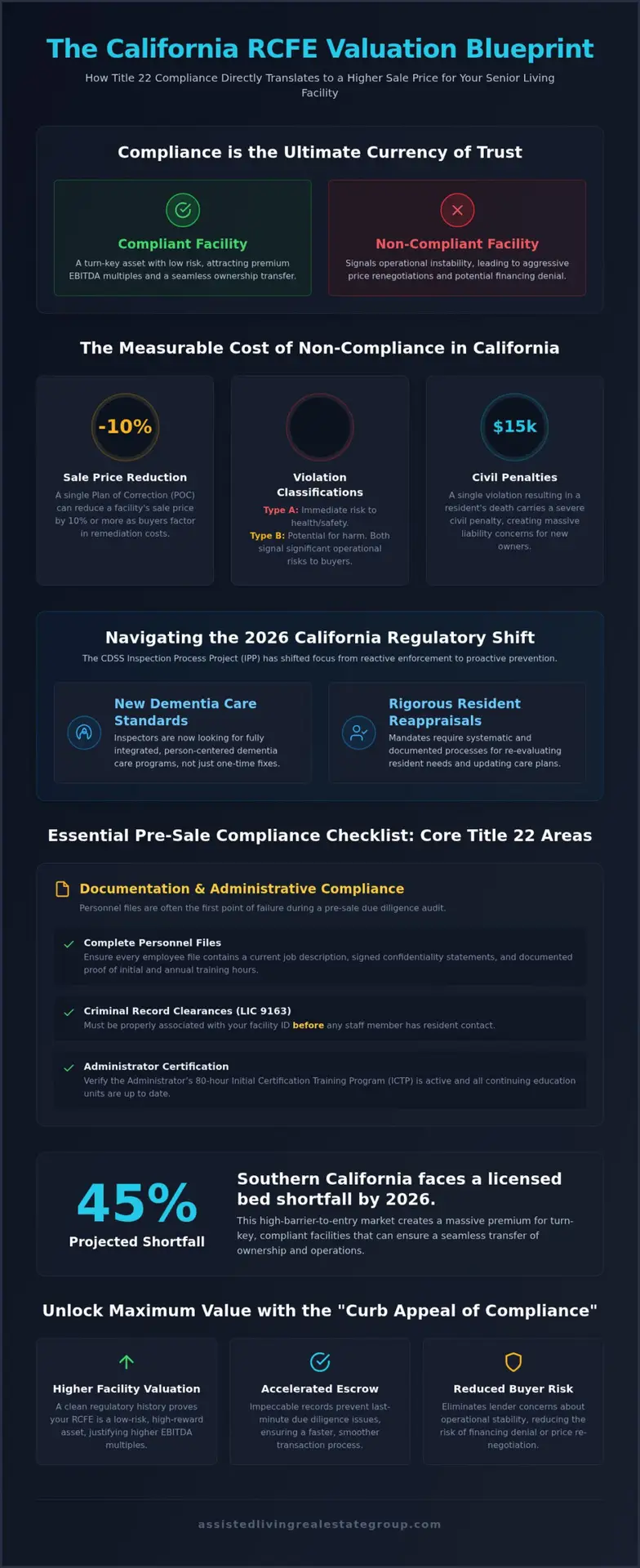
During a facility appraisal, “compliance risk” is calculated by evaluating the likelihood of future litigation and the administrative burden of pending enforcement actions. In Southern California, where a 45% shortfall in licensed beds is projected for 2026, buyers pay a massive premium for turnkey records that allow for a seamless transfer of ownership. The cost of non-compliance is steep. A single Plan of Correction (POC) can reduce a facility’s sale price by 10% or more, as the buyer must factor in the cost of remediation and the risk of heightened CCLD scrutiny. Impeccable records prove that your facility is a low-risk, high-reward asset.
The 2026 Regulatory Landscape for California Care Facilities
The current CDSS Inspection Process Project (IPP) has shifted its focus toward “Prevention,” moving away from purely reactive enforcement. This means licensing analysts are now prioritizing systemic operational health over one-time fixes. With the 2025 regulatory updates now fully active in 2026, inspectors are looking for integrated dementia care standards and rigorous resident reappraisal processes. Title 22 remains the North Star for every strategic investor. In an era where a single violation resulting in a resident’s death carries a $15,000 civil penalty, a comprehensive RCFE compliance inspection checklist for sale is your most effective tool for capturing maximum value in a transaction.
Essential RCFE Compliance Inspection Checklist: Core Title 22 Areas
Precision is the hallmark of a high-value residential care asset. In California, the Community Care Licensing Division (CCLD) evaluates facilities with a level of granularity that can overwhelm the unprepared operator. To secure your investment, you must view your facility through the lens of a Licensing Program Analyst (LPA). An effective RCFE compliance inspection checklist for sale prioritizes the high-risk areas where most citations occur, transforming regulatory requirements into a roadmap for business excellence. Licensing analysts utilize the Official CDSS CARE Tools to evaluate these areas, but an investor’s perspective requires a deeper dive into the documentation that proves long-term stability.
Documentation and Administrative Compliance
Personnel files are often the first point of failure during a pre-sale audit. Every employee file must contain a current job description, signed confidentiality statements, and documented evidence of the required initial and annual training hours. Most importantly, criminal record clearances (LIC 9163) must be properly associated with your specific facility ID before any staff member has resident contact. For the facility owner, ensuring the Administrator’s 80-hour Initial Certification Training Program (ICTP) is active and updated is non-negotiable. Additionally, your Emergency Disaster Plan must reflect current 2026 California standards, including specific evacuation routes and designated relocation sites that have been verified within the last twelve months.
Resident Health and Medication Management (Section 87465)
Section 87465 of Title 22 governs the cental storage and distribution of medications, an area that accounts for a significant percentage of “Type A” citations. Your Medication Administration Records (MAR) must be flawless, with no gaps in signatures or confusing instructions that contradict physician orders. California law requires that a comprehensive functional appraisal and a Physician’s Report (LIC 602A) be maintained for every resident, with mandatory annual updates for all individuals regardless of their cognitive status. Auditing these files for missing signatures or outdated care plans is a critical step in preparing for due diligence. Partnering with a specialist who understands these nuances can streamline your exit strategy. You can consult with the Assisted Living Real Estate Group to ensure your facility is market-ready.
Physical plant maintenance and resident rights form the final pillars of a clean inspection. From ensuring fire clearances are current to verifying that dementia-care modifications like delayed-egress hardware are functioning perfectly, the physical environment must signal safety. Beyond the hardware, the “software” of your facility; the grievance procedures, food service quality, and resident privacy protocols; must be documented and practiced. When these elements align, you don’t just pass an inspection; you present a premium, low-risk business to the market.
Official CDSS CARE Tools vs. Private Self-Audit Checklists
The California Department of Social Services (CDSS) provides the standard framework for inspections, but relying solely on their public documents is a reactive strategy that can cost you at the closing table. While the official CARE Tools are designed for state-mandated enforcement, they aren’t built to help an owner optimize a business for a high-value acquisition. You need to understand the inspector’s playbook while simultaneously executing your own advanced RCFE compliance inspection checklist for sale to ensure no detail is overlooked. In California’s sophisticated care market, the difference between a “pass” and a “premium valuation” lies in the depth of your internal auditing process.
Navigating the CARE Tool Structure
The Community Care Licensing Division (CCLD) uses a tiered approach to site visits. The “Core” tool covers the broad spectrum of Title 22 requirements, while “Focused” tools target specific high-risk areas like dementia care or medication management. If you’re expanding your capacity or relicensing a facility during a transition, the Pre-Licensing tool becomes your primary reference. In 2026, the CDSS Inspection Process Project (IPP) has identified specific priority areas that licensing analysts must scrutinize, including resident rights and infection control. If you aren’t benchmarking your facility’s performance against the data available in the CDSS Data Portal, you’re missing a critical piece of the competitive puzzle. Success requires a proactive stance that anticipates these regulatory shifts before they impact your bottom line.
The Advantage of Strategic Self-Auditing
Official tools are often binary; you either pass or you don’t. They don’t account for the “quality of care” nuances that drive premium EBITDA multiples in Southern California. Professional consulting provides the expert “third eye” needed to uncover blind spots that official tools might miss, such as subtle inconsistencies in resident records or minor physical plant issues that signal neglect to a buyer. A rigorous California Pre-Inspection Checklist should be the foundation of your mock inspections, allowing you to self-correct in a low-stakes environment. This level of preparation ensures that when an LPA walks through your door, they find a facility that operates with military precision and compassionate care.
Preparing for an unannounced CCLD visit is a daily operational requirement, not a one-time event. When you treat compliance as a continuous improvement process, you remove the fear of citations devaluing your business. For those looking to enter this market, understanding these nuances is just as important as the purchase price. You can learn more about this in The Ultimate Guide to Buying an RCFE Facility in California. By mastering both the official state tools and your own proprietary RCFE compliance inspection checklist for sale, you position your facility as a premier asset in a high-barrier market.
Preparing for Sale: California Pre-Inspection Checklist
Preparing for a sale in the California RCFE market requires a transition from daily operational management to strategic asset positioning. While your P&L statements are vital, a sophisticated buyer’s due diligence begins with a forensic audit of your regulatory standing. You must compile a comprehensive “Compliance Binder” that documents the last three years of your facility’s history with the CCLD. This dossier should include every inspection report, all “Type A” and “Type B” citations, and, most importantly, the verified documentation proving every Plan of Correction (POC) was closed on time and accepted by the department.
Mitigating Risk Before Listing
Don’t let a prospective buyer be the one to discover an outstanding citation or an incomplete training log. Conducting a “Mock Survey” using a rigorous RCFE compliance inspection checklist for sale allows you to identify and remediate potential deal-killers in a controlled environment. This proactive cleanup phase is what separates a smooth escrow from a failed transaction. For those managing mixed-use portfolios, you can find specific strategies in our resource on how to Sell Your Adult Residential Facility in California: The Definitive Guide. Identifying these gaps now ensures you maintain the upper hand during price negotiations.
The Buyer’s Perspective: Red Flags in the Checklist
Sophisticated investors view a history of recurring “Type A” citations as a systemic failure in leadership, which often leads to a lower EBITDA multiple or a demand for significant holdbacks in escrow. Staffing ratio violations are particularly damaging; they suggest an inability to manage labor costs while maintaining safety, which is the core of the RCFE business model. Physical plant issues also carry heavy weight. Deferred maintenance in the physical plant is a compliance risk because it signals to licensing analysts that the operator may be cutting corners on resident safety and environmental standards. Engaging a professional facility services provider like Core Group can help ensure your physical plant remains in peak condition, eliminating these red flags for potential buyers.
A top-to-bottom walkthrough should evaluate the “Curb Appeal of Compliance.” This includes checking that all fire extinguishers have current 2026 tags, ensuring grab bars are secure, and verifying that the temperature of the water at the tap meets Title 22 requirements. If you are ready to prepare your facility for the market, contact the Assisted Living Real Estate Group to ensure your regulatory records support your target valuation. By addressing these items before the first showing, you present a turnkey opportunity that justifies a premium price in a high-demand market.
Maximize Your Transaction Success with Assisted Living Real Estate Group
Navigating a California care facility transaction requires more than just a real estate license; it demands a deep mastery of the “business behind the beds.” At Assisted Living Real Estate Group, Teri Szoke and her team bridge the gap between complex Title 22 compliance and commercial success. We understand that in the Southern California market, your facility’s value is inextricably linked to its regulatory health. Our proprietary RCFE compliance inspection checklist for sale is just the beginning of how we de-risk your transaction, ensuring that every administrative record and care plan supports a premium valuation.
Partnering with a specialized brokerage means you’re working with mentors who understand the granular details of the 2026 CCLD standards. We don’t just list properties; we provide customized consulting for facility setup, relicensing, and compliance optimization to fix issues before they ever reach a buyer’s due diligence team. This proactive approach is paired with a confidential marketing strategy designed to protect your facility’s reputation and resident stability throughout the entire sales process. By positioning compliance as a core asset, we transform regulatory hurdles into competitive advantages.
A Specialized Roadmap to Closing
Our 25-year track record in the California senior care sector has taught us that the wrong buyer can be just as damaging to a deal as a “Type A” citation. We meticulously vet every prospective investor to ensure they possess both the financial liquidity and the regulatory capability to successfully navigate the CDSS transfer of ownership process. General residential real estate agents often overlook the nuances of fire clearances or administrator certification requirements, leading to escrow delays or collapses. We provide a refined, exclusive service that anticipates these roadblocks, ensuring a smooth transition that respects both your financial goals and the human values at the heart of your business.
Take the Next Step in Your Care Facility Journey
Whether you are preparing to exit the market or looking to optimize your current portfolio for a future sale, the right guidance is essential. We invite you to a confidential valuation where we can assess your facility’s market position and identify opportunities to maximize your EBITDA multiples through strategic compliance management. Accessing our proprietary checklists and due diligence resources gives you the roadmap needed to navigate this high-barrier-to-entry market with confidence. Don’t leave your investment’s future to chance in an increasingly scrutinized environment. Partner with the RCFE experts at Assisted Living Real Estate Group today to secure your legacy and maximize your returns in the California care industry.
Secure Your Legacy in the California Care Market
Mastering the intersection of Title 22 compliance and real estate valuation isn’t just an operational chore; it’s a strategic necessity for any serious investor. By prioritizing a clean CCLD history and implementing a rigorous RCFE compliance inspection checklist for sale, you’ve positioned your facility as a premium, low-risk asset. We have explored how flawless administrative records and adherence to the latest 2026 dementia care standards directly drive higher EBITDA multiples and ensure a seamless transfer of ownership without licensing delays.
Choosing the right partner to navigate this high-barrier market makes all the difference. Led by industry mentor Teri Szoke, the Assisted Living Real Estate Group brings over 25 years of specialized California expertise to your side. Our proven confidential marketing model ensures your facility’s reputation remains intact while we secure the best possible terms for your exit. Don’t leave your hard-earned equity to chance in a shifting regulatory landscape. Secure your facility’s future with a strategic RCFE consultation and turn your compliance efforts into significant financial rewards. Your commitment to quality care is your greatest asset; let’s ensure the market recognizes its full value.
Frequently Asked Questions
What are the most common Title 22 violations found during RCFE inspections?
Medication administration errors, incomplete personnel records, and outdated resident appraisals are the most frequent violations cited by the CCLD. Licensing Program Analysts (LPAs) often find gaps in Medication Administration Records (MAR) or staff members working without properly associated criminal record clearances. These technical deficiencies signal operational instability to prospective buyers, which is why auditing these specific areas is a priority for any seller.
How often does the CCLD conduct inspections on RCFEs in California?
The CCLD conducts unannounced inspections at least once every two years, but 2026 enforcement priorities often result in annual visits for many facilities. Facilities with a history of serious citations or those currently on probation may face even more frequent monitoring visits. Strategic operators maintain a “market-ready” state at all times to ensure an unexpected visit doesn’t negatively impact a pending sale or valuation.
Can I sell my RCFE if I have an open Plan of Correction (POC)?
You can sell a facility with an open POC, but it often complicates the escrow process and leads to aggressive price re-negotiations. Most sophisticated investors require all Plans of Correction to be closed and verified by the state before they’ll finalize an acquisition. An open POC represents an unknown financial and regulatory liability that can trigger financing denials from specialized lenders.
What is the difference between a Type A and a Type B citation?
Type A citations are the most serious and represent an immediate risk to the health, safety, or personal rights of residents. These violations, such as a failure to provide care or a safety hazard, carry immediate civil penalties of $500 or more. Type B citations are violations of regulations that don’t pose an immediate danger but could become a risk if left uncorrected, such as minor record-keeping errors.
How do I find the official CARE Tools for senior care facilities?
The official CARE Tools are located on the California Department of Social Services (CDSS) website within the Community Care Licensing Division portal. These are the exact documents analysts use to conduct site visits and evaluate facility health. Incorporating these into your RCFE compliance inspection checklist for sale ensures your internal audits align perfectly with state expectations, leaving nothing to chance during a buyer’s due diligence.
Does a clean compliance record actually increase the sale price of my facility?
A clean compliance record directly increases your facility’s valuation by justifying a higher EBITDA multiple. Buyers pay a premium for turnkey operations that don’t require immediate “cleanup” or carry the risk of future state enforcement actions. Impeccable records reduce the buyer’s perceived risk, which leads to faster closing times and more favorable terms during the transaction process.
What is the RCFE administrator’s role during a state inspection?
The administrator serves as the primary liaison and expert guide for the licensing analyst during the entire inspection process. They’re responsible for facilitating the physical plant walkthrough and providing immediate access to personnel files and resident care plans. A knowledgeable administrator who can demonstrate a mastery of Title 22 regulations can significantly influence the analyst’s perception of the facility’s operational quality.
Should I conduct a mock inspection before putting my facility on the market?
Conducting a mock inspection is an essential step in identifying potential “deal-killers” before they’re seen by state analysts or buyers. Using a comprehensive RCFE compliance inspection checklist for sale allows you to remediate documentation gaps and physical plant issues in a low-stakes environment. This proactive approach ensures that your public record remains clean, protecting your facility’s reputation and its ultimate market value.