
The moment a whisper of a sale reaches the hallways of your California care home, your most valuable assets; your dedicated caregivers and loyal residents; begin to look for the exit. It’s a harsh reality that public knowledge of a transition often leads to immediate operational instability and a direct hit to your facility’s valuation. You’ve spent decades balancing the books with the heart of a provider, and you deserve to protect that legacy. We understand that the fear of staff turnover and family anxiety is what keeps many owners from pursuing the exit they’ve earned.
This guide shows you how to secure a high-multiple return while maintaining absolute operational silence. By implementing a specialized strategy for confidential marketing for RCFE sale, you can navigate the complex 2026 DSS licensing hurdles and the typical 60 to 120 day Change of Ownership timeline without alerting the public. You’ll discover the exact roadmap to transition your legacy to a new steward while ensuring your residents receive uninterrupted care and your financial goals are met with precision.
Key Takeaways
- Master the 2026 California valuation model that combines real estate appraisal with business enterprise value to ensure you maximize your exit price.
- Protect your facility’s operational stability by utilizing a confidential marketing for RCFE sale strategy that prevents staff turnover and resident anxiety.
- Identify and resolve potential deal-killers through a pre-listing Title 22 compliance audit focused on current staffing ratios and personnel file standards.
- Learn how to use strategic management agreements to bridge the gap during the 60 to 120 day DSS Change of Ownership (COW) licensing process.
- Discover why a specialized advisor with 25 years of industry experience is essential for navigating the high-barrier-to-entry California care market.
Valuing Your Assisted Living Facility in the 2026 California Market
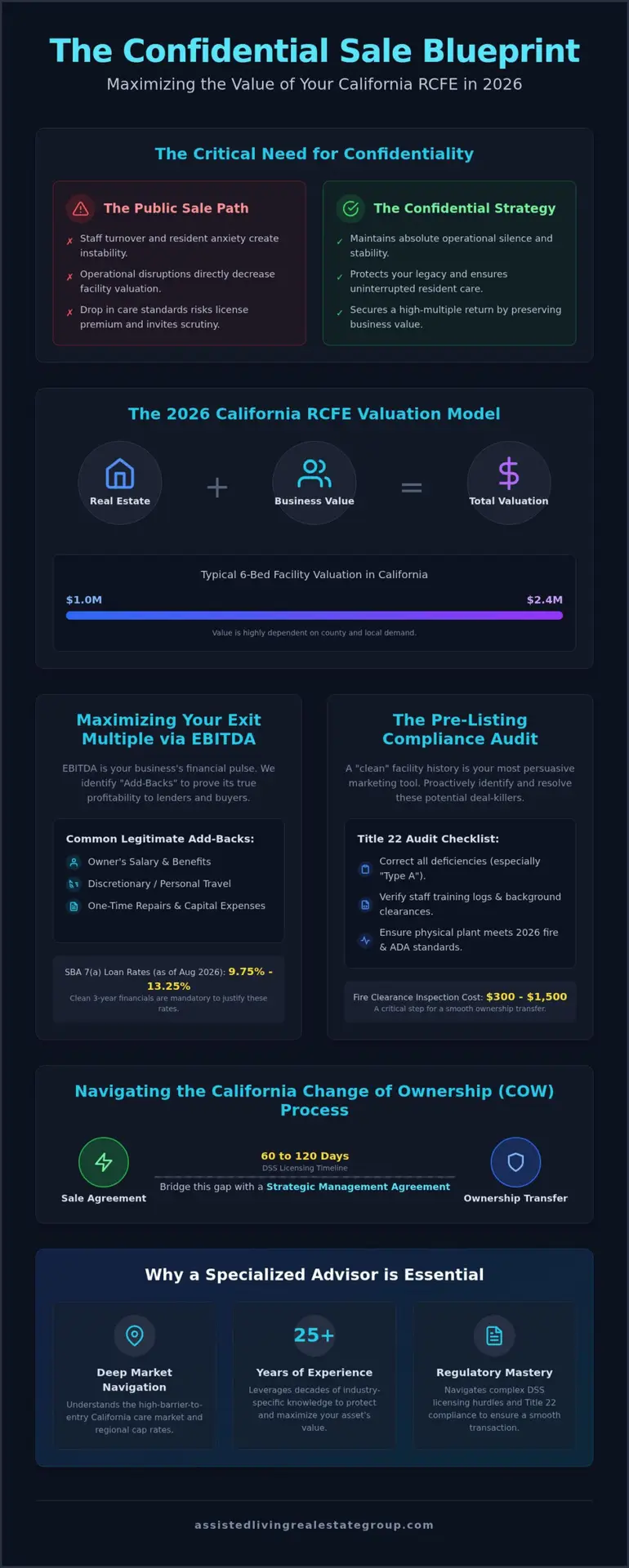
California RCFE valuation is not a simple real estate transaction. It’s a complex calculation where the brick-and-mortar appraisal meets the Business Enterprise Value (BEV). In 2026, savvy investors look beyond square footage to the “Price per Bed” metric, which remains a cornerstone for board and care homes across the state. For a standard 6-bed facility, the combined real estate and business value now typically ranges between $1.0M and $2.4M depending on the county and local demand. This valuation is a delicate balance of tangible assets and the intangible goodwill you’ve built with families and the community.
A deficiency-free license is a gold mine in the current regulatory environment. With the California Department of Social Services (CDSS) aggressively enforcing 2025 regulations regarding dementia care and resident documentation, a turnkey operation saves a buyer months of regulatory headaches and potential “Change of Ownership” delays. This “License Premium” is protected through Assisted Living best practices and a robust history of Title 22 compliance. Without a strategy for confidential marketing for RCFE sale, this premium can evaporate if news of the listing leads to staff departures and a subsequent drop in care standards.
The Role of EBITDA in Senior Care Sales
EBITDA is the pulse of your business value. For owners who aren’t financial analysts, this represents your profit before accounting for interest, taxes, and non-cash items like depreciation. To maximize your exit multiple, we identify “Add-Backs”; these are legitimate business expenses like your own salary, discretionary travel, or one-time repairs that won’t recur for the new owner. SBA-backed buyers now demand a clean, three-year financial history to justify current interest rates, which for SBA 7(a) variable loans can sit between 9.75% and 13.25% as of August 2026. High-quality documentation is the only way to prove your facility’s financial significance to a sophisticated investor.
Real Estate vs. Business Value: The California Split
In Southern California coastal markets, the land often dictates the price more than the care income itself. This creates a strategic choice: sell the entire asset or execute a lease-back. While selling the real estate and business together provides a clean exit, some owners prefer to retain the property as a landlord to secure long-term passive income. Knowing how to value your assisted living business accurately requires looking at regional cap rates and the specific demand shifts in California’s aging population. By 2060, the state’s senior population is expected to grow by 88%, ensuring that well-positioned facilities remain high-demand assets for years to come.
Preparing Your RCFE or ARF for a Successful Sale
Preparation for a high-multiple exit begins long before the first tour. In the specialized California care market, your facility’s value is intrinsically tied to its regulatory standing. A single uncorrected “Type A” deficiency can trigger immediate penalties of $500 and, more importantly, signal a lack of oversight to potential buyers. By conducting a pre-listing Title 22 compliance audit, you identify these deal-killers early. This proactive approach is the foundation of a successful confidential marketing for RCFE sale, as it allows you to rectify issues quietly without alerting staff or families to the impending transition.
Beyond the paperwork, your physical plant must meet the rigorous 2026 fire clearance updates and ADA compliance standards. Fire clearance inspections typically range from $300 to $1,500, and ensuring your facility meets these benchmarks is critical for a smooth California Change of Ownership (CHOW) Process. Buyers seek a turnkey operation where the “Plan of Operation” and resident agreements are organized and ready for the due diligence phase. If you’re unsure where your facility stands, consulting with a specialized care facility advisor can help you prioritize the most impactful improvements.
The Title 22 Compliance Audit
A “clean” facility history is the most persuasive marketing tool you possess. Escrow is often derailed by outstanding deficiencies that buyers; and their lenders; view as high-risk liabilities. You must ensure all staff training logs are up to date and background clearances are fully documented. Live Scan fingerprinting costs, which run between $100 and $200 per person, are a minor investment compared to the confidence a fully compliant personnel file provides to an SBA-backed buyer. This level of preparation ensures that when the due diligence period begins, your operation stands up to the highest level of scrutiny.
Maximizing Curb Appeal Without Tipping Off Staff
Maintaining confidentiality means your “sale prep” must look like standard, high-level upkeep. Focus on maintenance projects that residents and staff interpret as a commitment to their environment rather than a push for an exit. Prioritize the following areas to boost perceived value:
- Common Area Refresh: Update paint and flooring in high-traffic zones to signal a premium care environment.
- Equipment Certification: Ensure all specialized medical or safety equipment is recently certified and functioning perfectly to avoid repair credits during closing.
- Landscaping: Maintain pristine exteriors to create a strong first impression for investors during discreet drive-by viewings.
The Strategic Necessity of Confidential Marketing in California
In the highly competitive California care market, a public listing is often the “kiss of death” for an active facility. The moment your business appears on a general real estate site with a recognizable address, you risk immediate operational erosion. Residents’ families begin touring competing homes, and your best caregivers start updating their resumes. This instability directly compromises the metrics used for Valuing Your Assisted Living Facility, as occupancy and staffing consistency are the primary drivers of your exit multiple. Protecting these assets requires a sophisticated strategy for confidential marketing for RCFE sale that prioritizes discretion over broad exposure.
We utilize a “Blind Listing” approach to reach qualified investors without compromising your privacy. This method markets the opportunity through high-level financial highlights and regional identifiers; such as “6-Bed Memory Care in North San Diego County”; rather than revealing the facility’s name or exact location. Disclosure happens in controlled, tiered stages. We move from a generic teaser profile to a specialized RCFE Non-Disclosure Agreement (NDA), and only after vetting do we grant access to a secure data room. This legal shield is specifically drafted to protect your resident census and personnel records from being used by competitors or causing internal alarm.
Protecting Your Occupancy and Staff Retention
The “Resident Flight” phenomenon is a documented risk where uncertainty leads families to relocate their loved ones before a sale even closes. Confidentiality prevents this panic by keeping the transition internal until a qualified buyer is secured. Your staff should typically only be informed once an “Approval in Principle” is received from the lender or a firm purchase agreement is in place. As your broker, we act as a vital buffer, fielding all inquiries and conducting tours after hours or under the guise of “insurance inspectors” to ensure zero disruption to your daily care routines.
Vetting Potential Buyers for Operational Competency
Not every investor with capital is fit to operate in California. We distinguish between “Financial Buyers” who may lack care experience and “Experienced Operators” who understand the nuances of Title 22. It’s essential to verify a buyer’s ability to be licensed by the DSS before sharing sensitive operational data. We require a comprehensive Proof of Funds (POF) and a professional resume early in the process. This vetting ensures that your time isn’t wasted on “tire-kickers” and that the eventual buyer has the professional roadmap necessary to maintain the high standard of care you’ve established.
Navigating the California Change of Ownership (COW) Process
The Change of Ownership (COW) process is the ultimate test of a deal’s structural integrity. In the 2026 California market, the typical timeline for a license transfer spans 60 to 120 days, though backlogs in the Los Angeles, Orange, and San Diego regional offices can push these windows to their limit. Managing this gap requires more than just patience; it requires a specialized strategy to keep the business operational and the transition invisible. A primary component of our confidential marketing for RCFE sale involves the use of a Management Agreement. This legal instrument allows the buyer to begin overseeing operations or the seller to maintain control under specific terms while the CDSS processes the application, ensuring care standards never waver during the wait.
Your Licensing Program Analyst (LPA) acts as the central gatekeeper during this period. They review the new owner’s suitability and the facility’s ongoing compliance with Title 22. If you want to ensure your transition is handled by experts who understand these regional nuances, it’s time to partner with an RCFE sales specialist who can navigate the bureaucracy on your behalf.
The DSS Application Hurdles
The LIC 200 form is the foundation of the application, but the supporting documentation is where most deals stumble. New licensees must successfully complete Components I, II, and III of the mandatory orientation. Errors in financial projections or missing background clearances for key personnel often trigger “Incomplete” notices. These notices don’t just delay the process; they can lead to an immediate forfeiture of the application fee, which as of July 2026, stands at $495 for 1 to 6 bed facilities and up to $4,950 for larger communities. Precision in the initial filing is non-negotiable for a professional exit.
Escrow and Licensing: Coordinating the Close
Successful RCFE transactions are structured to trigger the close of escrow only upon the receipt of the “Approval in Principle” (AIP) from the DSS. This protects the buyer from taking on a property they cannot legally operate and protects the seller’s valuation. At the close, all resident trust funds must be meticulously transferred, and care fees must be pro-rated to the day of the handover. A final operational walkthrough ensures that all specialized equipment and facility systems are in the condition promised during the due diligence phase, allowing for a seamless transition of care that remains entirely transparent to the residents.
Partnering with a Specialized California RCFE Broker
The sale of a care facility is a high-stakes transition that demands more than a standard real estate license. General commercial brokers often fail to sell adult residential facility California assets because they treat them like generic rental properties. They lack the specialized regulatory roadmap required to navigate the intersection of financial investment and compassionate service. At Assisted Living Real Estate Group, we bring over 25 years of combined industry experience to every transaction. We understand that a successful exit requires a broker who is as fluent in Title 22 compliance as they are in cap rates and EBITDA multiples.
Our proprietary approach to confidential marketing for RCFE sale relies on an exclusive, private database of vetted buyers. This list isn’t composed of casual investors; it’s a curated pool of experienced operators and strategic professionals who understand the high-barrier-to-entry nature of the California market. By bypassing public portals, we ensure your operational privacy remains intact while moving you toward a state of conviction in your exit strategy. This specialized focus allows us to frame your business as a premium market opportunity rather than just another listing.
The Benefits of Niche Expertise
A specialized broker acts as a strategic partner during the most volatile moments of a sale. When a Licensing Program Analyst (LPA) conducts a facility visit during a transition, our seasoned expertise can be the difference between a deal moving forward or collapsing under regulatory scrutiny. We have spent decades building a professional reputation with Southern California DSS regional offices, which provides our clients with an unparalleled advantage. We don’t just sell a business; we mentor the next generation of providers to ensure your legacy of care continues without interruption.
Your Next Steps Toward a Strategic Exit
Your journey toward a significant financial return begins with an accurate assessment of your facility’s position. We invite you to request a confidential valuation to see how your hard work translates into market value in 2026. Our no-obligation consultation process is designed for California facility owners who value refined service and visionary planning. Whether you are ready to list today or are planning for a transition in the coming years, we provide the roadmap to a smooth, profitable retirement. You’ve spent years caring for others; now it’s time to ensure your own financial future is secured with the same level of dedication.
Securing Your Legacy in the California Care Market
The path to a successful exit in California’s 2026 care market requires a precise balance of financial strategy and operational discretion. You’ve seen how Title 22 compliance directly impacts your facility’s valuation and why navigating the 60 to 120 day DSS Change of Ownership process demands expert oversight. Most importantly, you now understand that protecting your staff and residents through a specialized strategy for confidential marketing for RCFE sale is the only way to preserve the asset value you’ve spent years building.
With 25 years of specialized California experience, Assisted Living Real Estate Group provides the proprietary systems and deep expertise in RCFE, ARF, and recovery facility sales you need to transition with confidence. We don’t just find buyers; we identify the right steward for your legacy while ensuring your financial goals are met with technical precision. Take the first step toward your high-multiple exit by partnering with a guide who understands the intersection of ethics and profitability.
Request Your Confidential RCFE Valuation Today
Your dedication to compassionate care has built a significant asset, and it’s time to realize its full potential through a strategic and silent sale.
Frequently Asked Questions
How long does it typically take to sell an RCFE in California in 2026?
The typical timeline for a change of ownership application for an existing, licensed facility in 2026 is 60 to 120 days. This period begins once the California Department of Social Services (CDSS) receives a complete application package. The total duration of a sale, from initial listing to the close of escrow, usually spans four to seven months to allow for vetting, due diligence, and financing hurdles.
Can I sell my care facility if I have active DSS deficiencies?
You can sell a facility with active deficiencies, but they often act as significant deal-killers or leverage for price reductions. Outstanding “Type A” violations are particularly concerning for lenders and may prevent a buyer from securing SBA financing. It’s almost always more profitable to resolve these citations and secure a clean compliance record before initiating the sales process.
What is the difference between selling the business and selling the real estate?
Selling the business involves transferring the operations, resident contracts, and Business Enterprise Value (BEV), while selling the real estate involves the physical land and building. In California, most board and care owners sell both as a turnkey package to maximize their return. However, some sellers choose to keep the real estate and become the landlord, providing a lease to the new business operator for long-term passive income.
When is the right time to tell my employees that I am selling the facility?
The strategic time to inform your staff is after the buyer has received an “Approval in Principle” (AIP) from the DSS. Telling employees too early often leads to immediate turnover as caregivers seek more stable employment elsewhere. By waiting until the licensing transition is nearly certain, you protect your facility’s operational stability and ensure that care standards don’t slip during the final stages of the sale.
How is the value of an assisted living facility calculated in the current market?
Valuation in the 2026 market is a hybrid of the “Price per Bed” metric and a multiple of your adjusted EBITDA. For a 6-bed facility, prices often range between $1.0M and $2.4M when including the real estate. Larger facilities are more heavily weighted toward their business income and the quality of their Title 22 compliance history, which dictates the risk profile for the incoming investor.
What happens to the residents when a Change of Ownership occurs?
Residents typically remain in place and experience no disruption in care because the facility’s staff and “Plan of Operation” are transferred to the new owner. The CDSS requires a seamless transition where the new license is issued as the old one is retired. Maintaining this continuity is essential for the facility’s reputation and ensures that the resident census remains stable throughout the escrow period.
Is a “Blind Listing” really effective at finding qualified buyers?
A “Blind Listing” is the gold standard for finding high-intent investors while maintaining absolute privacy. This approach uses confidential marketing for RCFE sale to highlight financial performance and regional demand without disclosing the facility’s name or address. It forces potential buyers to provide proof of funds and sign a non-disclosure agreement before they receive any sensitive information, filtering out “tire-kickers” early.
Why is California’s Title 22 so critical during the due diligence phase?
Title 22 is the legal framework that governs your license, and any history of non-compliance creates massive liability for a new owner. During due diligence, sophisticated buyers will audit your personnel files, resident reappraisals, and medication logs to ensure you are meeting 2026 regulatory standards. A facility with a documented history of compliance is seen as a premium, low-risk asset that justifies a higher sale multiple.