
In California’s 2026 market, a recovery center isn’t just a business; it’s a specialized real estate asset where regulatory compliance is the primary driver of your final valuation. You likely recognize the immense social and financial potential in behavioral health, but the reality of opaque zoning laws and complex DHCS licensing can stall even the most seasoned professional. Engaging in recovery center real estate investing requires a sophisticated roadmap to navigate the scarcity of compliant facilities in Southern California. It’s frustrating to see market demand rise while you’re trapped behind a wall of bureaucratic red tape.
We agree that the high barriers to entry in this state can feel overwhelming. This strategic guide empowers you to master the complexities of California’s behavioral health real estate market with expert insights on zoning, licensing, and high-yield investment strategies. We’ll show you how to bridge the gap between financial returns and compassionate care while avoiding the common pitfalls of the California regulatory landscape.
We will break down the dual-asset valuation model, explain the impact of clinical autonomy laws, and show you how to secure turnkey or convertible assets that meet the rigorous 2026 standards. From identifying compliant facilities to understanding the valuation of a recovery business versus real estate, this roadmap ensures your investment is both ethical and exceptionally profitable.
Key Takeaways
- Navigate the 2026 DHCS licensing landscape and Title 22 compliance to ensure your facility remains a protected, high-yield asset.
- Master the dual-asset valuation approach by distinguishing between real estate cap rates and operational EBITDA multiples to maximize your investment returns.
- Identify the most lucrative opportunities in recovery center real estate investing by evaluating the strategic advantages of turnkey acquisitions versus RCFE conversions.
- Capitalize on the growing demand within Southern California’s “Recovery Corridor” while adhering to the latest OHCA notification requirements for material transactions.
- Understand why specialized brokerage expertise is vital for managing confidential marketing and protecting a facility’s reputation during a change of ownership.
The Landscape of Recovery Center Real estate Investing in California
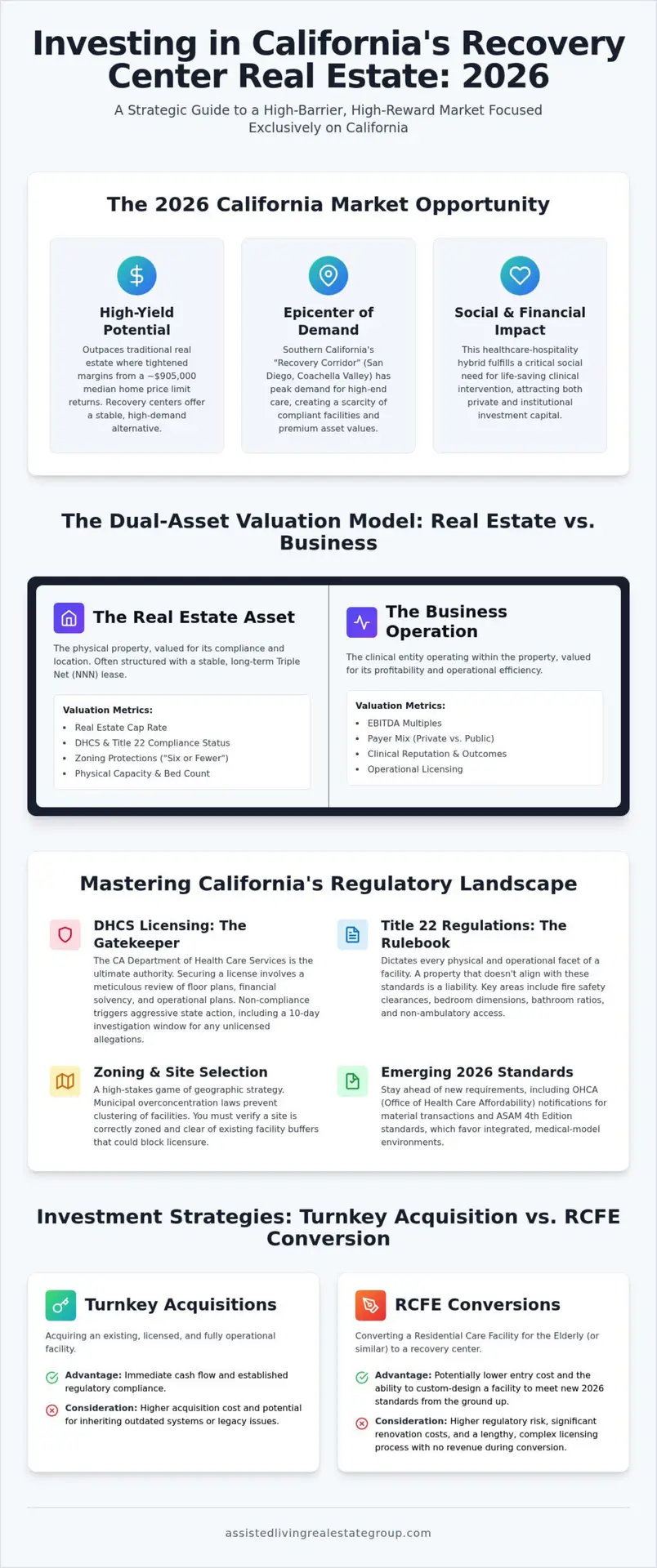
Recovery center real estate investing in California represents a high-barrier, high-reward niche that marries the stability of healthcare with the operational nuances of hospitality. In 2026, this asset class has matured into a sophisticated healthcare-hospitality hybrid, where the physical property serves as the foundation for life-saving clinical interventions. Investors are increasingly moving capital away from traditional multifamily units, where the median home price of $905,000 has tightened margins, and toward specialized care facilities. A residential treatment center provides a unique value proposition: it fulfills a critical social need while offering yields that often outpace general commercial assets. This intersection of social impact and financial performance is driving a new wave of institutional and private interest across the state.
The 2026 Southern California Market Outlook
Southern California remains the global epicenter for behavioral health investment. Demand for residential treatment facilities (RTFs) has reached a new peak in 2026, particularly in San Diego County and the Coachella Valley. This region, now colloquially known as the “Recovery Corridor,” attracts a demographic that prioritizes high-end, person-centered care. State-level healthcare funding has shifted to favor private real estate assets that can accommodate the ASAM 4th Edition standards, which emphasize integrated, medical-model environments. For the strategic professional, this isn’t a crisis of supply; it’s an untapped market potential. The scarcity of compliant, well-located facilities in coastal zones ensures that existing assets maintain a premium market position, justifying higher investment returns for those who hold the keys to this exclusive niche.
Real Estate vs. Business: Understanding the Asset Split
Successful recovery center real estate investing requires a clear distinction between the physical property and the operational business. In California, these are often treated as two separate but symbiotic assets. The real estate is valued based on its zoning, DHCS compliance, and physical capacity, while the business is valued on EBITDA multiples and payer mix. Many savvy investors prefer a “triple net” (NNN) lease model. This structure allows the property owner to collect stable, long-term rent while the facility operator manages the clinical complexities and licensing. Because these assets are so specialized, a general commercial broker often misses the nuances of Title 22 or the specific “six or fewer” zoning protections. Partnering with a specialist ensures that both the real estate cap rate and the business valuation are accurately captured, protecting your capital from the start.
California Regulatory Maze: Zoning, DHCS, and Title 22
The California Department of Health Care Services (DHCS) acts as the ultimate gatekeeper for behavioral health assets. For those engaged in recovery center real estate investing, the physical structure is secondary to its regulatory status. Title 22 regulations dictate every operational facet, from fire safety clearances to specific bedroom dimensions. If a property doesn’t align with these standards, it isn’t a strategic investment; it’s a liability. Identifying “licensed-ready” properties in Southern California requires a deep understanding of municipal overconcentration laws. These regulations often prevent the clustering of facilities, making site selection a high-stakes game of geographic strategy. You must verify that a potential site isn’t just zoned correctly, but also clear of existing facility buffers that could block your licensure.
Navigating DHCS Licensing Requirements
Securing a new license in 2026 involves a meticulous application process where the DHCS investigates everything from floor plans to financial solvency. You’ll face a rigorous 10 day investigation window for any unlicensed allegations, highlighting the state’s aggressive stance on compliance. Design pitfalls, such as inadequate non-ambulatory access or poor bathroom ratios, frequently trigger costly delays. Investors should review our companion piece on RCFE Licensing in California: The 2026 Investor’s Guide to Success for parallel insights into the residential care ecosystem. By mid 2026, the 75 percent cumulative fee increase for SUD facilities has fully integrated into operational budgets, making turnkey acquisitions more attractive than ever.
Zoning and the “Six or Fewer” Rule in California
California Health and Safety Code provides a powerful shield for small residential facilities. Under the “six or fewer” rule, a licensed facility serving half a dozen residents or fewer is legally treated as a residential use of property. This means cities cannot demand special use permits or conditional use permits (CUP) that aren’t required of standard single family homes. It’s a vital protection for investors scaling their portfolios within residential neighborhoods. However, scaling to a 7+ bed facility changes the math entirely. Larger assets often require a CUP, exposing the project to public hearings and local political whims. Navigating these Southern California ordinances requires a partner who understands the local landscape. If you’re looking to identify compliant sites, speaking with a specialized California brokerage can save months of wasted due diligence.
Evaluating Opportunities: Turnkey Facilities vs. Conversions
Deciding between a turnkey acquisition and a conversion is a pivotal choice in recovery center real estate investing. In the current 2026 climate, speed to market is the primary differentiator for high-level investors. While ground-up builds offer the chance for a purpose-built environment, the combination of California’s rigorous permitting process and high construction costs often leads to multi-year delays. Turnkey assets, by contrast, allow you to bypass the initial DHCS licensing wait times, which remain a significant hurdle in Southern California’s competitive zones. These existing facilities often command a premium because they represent a “ready-to-operate” solution in a market where time is the most expensive commodity.
The Turnkey Advantage: Immediate Cash Flow
Acquiring an existing, licensed drug and alcohol facility is often the most efficient path to revenue. The real value in these transactions isn’t just the real estate; it’s the operational history and the active license. However, you must evaluate the “hair” on the deal. This includes reviewing past DHCS audits, potential debt, and compliance history to ensure you aren’t inheriting a regulatory nightmare. For those exploring this route, our guide on RCFE for Sale: The Ultimate Guide to Buying a Care Facility in California provides a robust framework for due diligence that applies across the care facility spectrum. Securing a turnkey asset means you can focus on clinical excellence from day one rather than navigating the uncertainty of a new application.
Conversion Strategies for Residential Properties
Converting an existing Residential Care Facility for the Elderly (RCFE) or an Adult Residential Facility (ARF) into a recovery center is a strategic pivot gaining momentum in 2026. These properties often already possess the “good bones” required for healthcare-hospitality use, such as appropriate bedroom counts and existing staff quarters. To succeed, you must prioritize ADA compliance and California’s specific fire-life-safety requirements, which are non-negotiable for licensure. Converting an ARF to a behavioral health focus typically offers a faster timeline than a standard residential conversion because the infrastructure for 24-hour care is often already in place. This approach allows you to secure assets at a lower entry point while building long-term significance in a high-demand market, effectively bridging the gap between financial investment and compassionate care.
Strategic Due Diligence and Valuation Metrics
Valuation in the 2026 California market requires a sophisticated, dual-layered lens. You can’t rely on standard residential appraisals when the asset’s worth is inextricably tied to its DHCS standing. Successful recovery center real estate investing involves balancing the real estate cap rate with the operational EBITDA multiple. A property might possess excellent physical attributes, but if the operator’s EBITDA doesn’t support at least a 1.5x lease coverage ratio, the asset’s financeability will likely fail under institutional scrutiny. Identifying hidden liabilities, such as pending DHCS investigations or undisclosed financial transfers between treatment programs and sober living homes, is vital to protecting your capital.
Payer mix serves as the silent driver of real estate stability. Facilities that lean heavily on private-pay residents offer far more predictability for property owners than those reliant on fluctuating insurance reimbursements. In Southern California’s “Recovery Corridor,” the stability of your rent roll depends on the operator’s ability to maintain a consistent census without violating the new SB 351 clinical autonomy laws. Before you close escrow, a comprehensive “facility audit” must verify that the physical plant meets the updated ASAM 4th Edition standards now fully enforced across the state.
Financial Metrics for the 2026 Investor
Targeting a realistic ROI in Southern California means looking beyond the surface level “pro-forma” numbers. Investors must account for the 75 percent cumulative increase in SUD licensing fees that has fully phased in by 2026. These operational costs directly impact the tenant’s ability to pay premium rents. We often see “Success Fees” or complex lease structures in California deals that can obscure the true net operating income. Ensuring the lease is structured as a triple-net (NNN) agreement protects the landlord from these rising regulatory costs while securing a predictable yield that bridges the gap between financial investment and compassionate care.
Confidentiality and the Sales Process
Traditional MLS listings are notoriously ineffective for behavioral health assets. Publicly listing a facility often triggers a “census flight,” where families and staff panic at the prospect of a change in ownership. This volatility can destroy the business’s value before the real estate transaction even closes. To avoid this, we utilize a Confidential Marketing Strategy that targets qualified, vetted buyers without alerting the general public. This exclusive approach ensures that the facility’s reputation remains intact and the patient census stays stable during the transition. To ensure your asset is valued accurately and marketed with the necessary discretion, consult with the Assisted Living Real Estate Group for a comprehensive market analysis.
Partnering with a Specialized California Broker
General commercial brokers often approach a behavioral health facility as they would a standard office building or warehouse. This is a fundamental mistake. In the highly regulated world of California care facilities, the value isn’t just in the dirt; it’s in the compliance. Generalists often struggle with the granular nuances of Title 22 and the specific DHCS requirements that dictate a facility’s operational viability. Teri Szoke brings over 25 years of combined experience to the table, positioning her as a high-level mentor for those pursuing recovery center real estate investing. Her expertise bridges the gap between the analytical mind of an investor and the moral compass of a service provider, ensuring every transaction is both financially sound and ethically responsible.
A specialized broker does more than facilitate a sale; they identify off-market recovery center opportunities that never reach the public eye. Because reputation is everything in the behavioral health sector, many of the highest-yield assets are sold through a confidential marketing strategy. This exclusivity protects the existing census while providing strategic professionals with access to a niche, high-barrier-to-entry market. Moving from interest to acquisition requires a guide who understands the Southern California landscape, from the “Recovery Corridor” of Coachella Valley to the coastal enclaves of San Diego.
The Broker as a Strategic Consultant
Post-acquisition success depends on more than just signing the deed. A specialized broker provides guidance on relicensing and facility setup, leveraging a deep network of Southern California operators and investors. This consultancy approach ensures your transition of ownership is seamless and your new asset remains compliant with the latest 2026 state standards. For those looking to diversify their portfolios, reviewing our guide on Senior Housing Investment in Southern California: The 2026 Investor’s Guide provides essential context on the broader care facility ecosystem.
Getting Started with Your California Investment
The first step in your journey is establishing a “qualified buyer” profile. California sellers, particularly in the confidential recovery sector, prioritize buyers who demonstrate financial readiness and a clear understanding of the regulatory landscape. You can request a confidential valuation or a listing overview to see where your capital can make the most significant impact. The opportunity in 2026 is massive, but it requires a specific roadmap to navigate successfully.
When you’re ready to secure a turnkey or convertible asset that aligns with your financial goals and your mission of care, the next step is a direct consultation. Contact the Assisted Living Real Estate Group today to begin your recovery center real estate investing journey with a partner who holds the keys to this exclusive California market.
Securing Your Position in California’s Behavioral Health Market
The transition toward professionalized, investor-backed recovery models in 2026 presents a rare opportunity to bridge financial success with high-impact care. Navigating the DHCS licensing maze and Southern California’s zoning overconcentration laws requires more than general real estate knowledge; it demands a roadmap built on regulatory precision. By mastering the dual-asset valuation model and prioritizing Title 22 compliance, you protect your capital while serving a critical community need. Successful recovery center real estate investing depends on identifying off-market assets and compliant facilities before they reach the public eye.
To navigate this high-barrier market with confidence, you need a partner who understands the nuances of the California care facility sector. Teri Szoke and the Assisted Living Real Estate Group offer over 25 years of specialized experience in navigating DHCS regulations and providing exclusive access to confidential listings. Partner with California’s Specialized Recovery Center Broker today to transform market potential into a legacy of long-term significance. Your next strategic acquisition is within reach.
Frequently Asked Questions
Is a recovery center a good real estate investment in California for 2026?
Yes, a recovery center is an exceptional real estate investment in 2026 because it’s a high-demand, recession-resistant asset class with significant demographic tailwinds. The shift toward medical-model residential treatment centers creates a premium for compliant real estate across the state. While the barrier to entry is high due to DHCS licensing and Title 22 standards, this scarcity protects your long-term valuation. Strategic professionals use this model to achieve steady financial returns while making a tangible social impact.
What is the difference between an ARF and a recovery center in California?
An Adult Residential Facility (ARF) provides non-medical care for adults with disabilities, while a recovery center specifically treats substance use disorders under DHCS licensure. Both fall under the care facility umbrella but require different operational protocols and staff certifications. For real estate investors, an ARF can often be converted into a recovery facility because the basic fire-life-safety infrastructure is similar, though the clinical requirements for addiction treatment in 2026 are more specialized.
Do I need a special license to own the real estate of a recovery center?
No, you don’t need a clinical license to own the physical property, but the facility operator must hold a valid DHCS license. Many investors choose a triple-net (NNN) lease model where they own the real estate and lease it to a licensed provider. This structure separates the property asset from the clinical liability. It’s vital that the lease clearly defines compliance responsibilities to ensure the property maintains its “licensed-ready” status under California law.
How does California zoning affect where I can open a recovery facility?
California’s “six or fewer” rule protects small residential facilities from local zoning restrictions, treating them as standard single-family homes. However, larger facilities with seven or more beds often require a Conditional Use Permit (CUP) and must navigate municipal overconcentration laws. These laws prevent too many facilities from clustering in one neighborhood. Successful recovery center real estate investing requires verifying that a potential site isn’t blocked by these local Southern California buffer zone requirements.
Can I convert a residential home into a recovery center in Southern California?
Yes, you can convert a residential home, provided it meets Title 22 fire-life-safety standards and ADA compliance. Properties with “good bones,” such as multiple ground-floor bedrooms and ample common space, are ideal candidates. In 2026, the conversion process involves coordinating with local fire marshals and the DHCS to ensure the physical plant supports 24-hour care. This strategy is often faster and more cost-effective than ground-up construction in coastal California markets.
What are the typical cap rates for recovery center real estate in California?
Cap rates for California recovery centers typically range from 7 percent to 9 percent, depending on the facility’s location and the operator’s creditworthiness. These yields are generally higher than traditional multifamily assets because of the specialized nature of the property and the regulatory hurdles involved. In 2026, premium assets in the Coachella Valley or San Diego often command tighter cap rates due to high demand and the stability of the “Recovery Corridor” market.
How long does the DHCS licensing process take in California?
The DHCS licensing process in 2026 generally takes between six and nine months from the initial application to the final site visit. This timeline can vary based on the completeness of your documentation and the speed of fire safety clearances. Delays often occur when the physical facility requires structural modifications to meet Title 22 standards. Working with a consultant who understands the current DHCS priorities can help you avoid common pitfalls that stall the approval process.
Why should I use a specialized broker instead of a general commercial realtor?
A specialized broker understands the intersection of real estate valuation and clinical compliance, which a general realtor often overlooks. Behavioral health assets require a deep knowledge of Title 22, DHCS licensing, and confidential marketing strategies to protect the facility’s census. Teri Szoke’s 25 years of experience ensures you aren’t just buying a building, but a viable business asset. For those focused on recovery center real estate investing, specialized brokers provide access to off-market opportunities.