
Your next California RCFE acquisition could be a legacy-defining asset or a $500,000 liability trap hidden beneath a fresh coat of paint. You already know that the Golden State offers some of the highest private-pay rates in the nation, yet the complexity of Title 22 compliance often keeps even seasoned investors on the sidelines. It’s a valid concern; inheriting undisclosed DSS violations can derail your capital before the first resident even moves in. We believe that achieving significant financial returns shouldn’t come at the cost of operational certainty or regulatory risk.
This guide provides the exact roadmap you need to master the 2026 market and ensure a clean license transfer. We’ll show you how to verify true EBITDA and navigate the evolving RCFE staffing requirements California mandates, such as the 40-hour initial training requirement for new direct care staff. You’ll gain a comprehensive framework to audit every physical safety standard and financial metric before closing. We’re moving from broad industry trends to the granular operational details that protect your investment and ensure your facility meets the highest standards of compassionate care.
Key Takeaways
- Analyze the facility’s revenue mix between private-pay, SSI, and Assisted Living Waiver (ALW) programs to verify the long-term stability of your expected cash flow.
- Audit personnel files to ensure full compliance with RCFE staffing requirements California mandates, including LiveScan clearances and mandatory training documentation.
- Identify hidden physical liabilities by focusing on California-specific ADA standards and the “Big Five” commercial inspection categories.
- Navigate the critical regulatory gap between escrow closure and the issuance of a new state license with a specialized transition strategy.
- Leverage a specialized broker to access the Department of Social Services (DSS) Public Information File, uncovering undisclosed regulatory violations before they become your liability.
Why RCFE Due Diligence in California Demands a Specialized Lens
California’s senior care market is a high-stakes environment where precision isn’t just a preference; it’s a requirement for survival. For strategic investors, Residential Care Facilities for the Elderly (RCFEs) represent a unique intersection of high-yield real estate and essential human service. However, the path to a successful acquisition is paved with Title 22 regulations that are significantly more stringent than those in neighboring states. Due diligence in this niche is the systematic verification of a facility’s legal, financial, and operational integrity. In the 2026 market, smaller 6-bed facilities have emerged as power assets, offering high margins and manageable overhead, but they require a tighter audit than ever before.
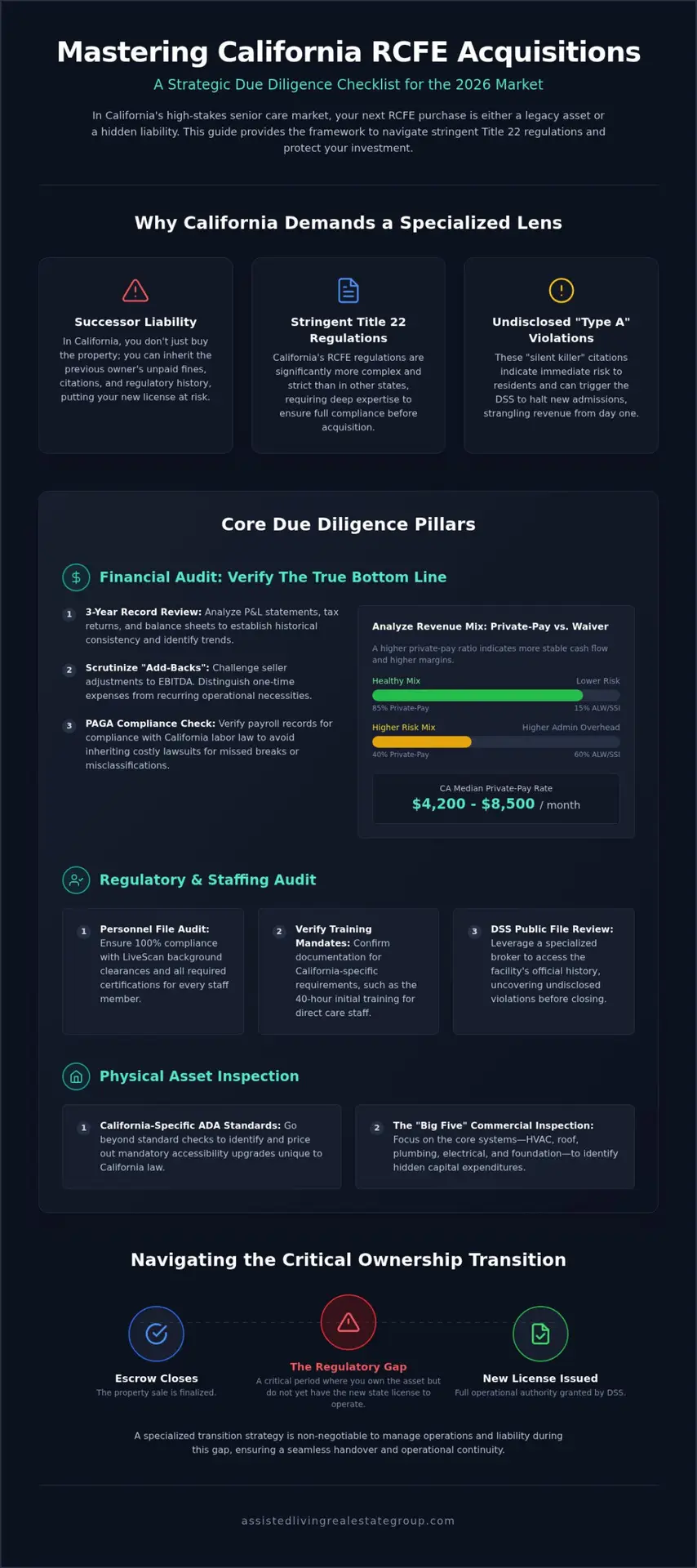
One of the most dangerous pitfalls for a buyer is successor liability. In California, you don’t just buy the building; you often inherit the history of the business entity. If the previous owner has unpaid regulatory fines or a history of citations, those burdens can follow the license to the new owner. This makes a specialized lens essential. You aren’t just looking at the current cash flow. You’re looking for the ghosts of past non-compliance that could haunt your future returns and delay your license transfer for months.
The Cost of Overlooking Regulatory Red Flags
Undisclosed Type A violations are the silent killers of a deal. These citations, which indicate an immediate risk to resident health or safety, can trigger the Department of Social Services (DSS) to implement In Lieu of Service (ILS) restrictions. This effectively halts new admissions, strangling your revenue from day one. Additionally, failing to audit the RCFE staffing requirements California mandates can lead to a financial ripple effect. If you inherit a facility with poor staffing ratios or uncertified administrators, the cost of bringing the operation into compliance can instantly erode your projected EBITDA. A failed audit often leads to increased oversight, which adds an expensive layer of administrative burden to your new venture.
Investment vs. Operation: The Dual Nature of the Audit
A strategic professional recognizes that an RCFE purchase is a two-headed beast. You must audit the physical real estate asset and the business license as separate, yet interdependent, entities. The real estate requires a standard commercial inspection, while the business audit demands a deep dive into resident files and employee records. Before this deep dive begins, executing a robust Confidentiality Agreement is non-negotiable to protect the facility’s reputation and resident stability. RCFE due diligence is the bridge between investment potential and reality.
The Financial Audit: Verifying the Bottom Line
Precision in financial reporting is the hallmark of a secure investment. When you begin your deep dive, a three-year audit of Profit and Loss (P&L) statements, tax returns, and balance sheets is the minimum standard for establishing historical consistency. You aren’t just looking for profitability; you’re looking for the narrative behind the numbers. Strategic investors must scrutinize “Add-backs” with a skeptical eye. Sellers often attempt to artificially inflate EBITDA by removing personal expenses, one-time repairs, or discretionary bonuses that may actually be recurring operational necessities in a 2026 market.
Analyzing the Rent Roll reveals the facility’s vulnerability to reimbursement shifts. In 2026, the median private-pay cost for assisted living in California ranges from $4,200 to $8,500 per month. However, if a significant portion of the revenue is tied to SSI or the Assisted Living Waiver (ALW) program, your operational strategy must account for lower margins and higher administrative overhead. A specialized RCFE broker acts as your first line of defense during this verification phase, helping you distinguish between sustainable revenue and temporary occupancy spikes.
California’s legal environment is notoriously litigious, making PAGA (Private Attorneys General Act) compliance a non-negotiable audit item. A single misclassified employee or a missed meal break can result in six-figure penalties that a buyer might inadvertently assume. When you analyze the payroll, look beyond the hourly rate. You must ensure the facility is meeting all RCFE Staffing Requirements California demands while maintaining a financial buffer for the wage escalations slated for the coming year. This dual focus on regulatory adherence and financial health ensures that your capital is protected from day one.
Revenue Integrity and Occupancy Verification
Don’t take a spreadsheet at face value. Cross-reference bank deposits with resident contracts to ensure the revenue isn’t padded with non-recurring income or security deposits. Evaluate the acuity levels of the current resident mix; if residents require high-level care without a corresponding increase in fees, your margins will shrink as staffing needs rise. Analyzing historical vacancy rates allows you to project a realistic 2026 cash flow that accounts for natural resident turnover.
Expense Scrutiny: The Hidden Leaks
RCFE Staffing Requirements California: Regulatory & Operational Audits
Regulatory adherence is the bedrock of a facility’s valuation. While financial audits reveal the past, a regulatory audit predicts the future stability of your license. Your first priority must be the Public Information File maintained by the Community Care Licensing Division (CCLD). This file contains the facility’s compliance history, including every citation and substantiated complaint from the last several years. Ignoring these records is a recipe for disaster; they are the primary indicator of whether a facility is a well-oiled machine or a liability waiting to explode. You must also check for any pending litigation or unresolved complaints filed with the Long-Term Care Ombudsman to ensure no legal storms are gathering on the horizon.
When you move into the personnel files, the scrutiny must be surgical. Every employee record must contain a LiveScan clearance, current TB testing results, and detailed logs of mandatory training. You must verify that the seller has met the specific RCFE staffing requirements California mandates, particularly the 40 hours of initial training required for all direct care staff within their first 30 days. In the 2026 regulatory climate, missing paperwork is often interpreted by inspectors as training that never happened. This can lead to immediate fines and a tarnished reputation during your ownership transition. Documented evidence of RCFE staffing requirements California adherence isn’t just about safety; it’s about protecting the business entity you’re working so hard to acquire.
Title 22 Staffing and Administrator Compliance
Success starts with the leadership. You must verify that the Administrator Certificate is valid and that the required 40 hours of continuing education units (CEUs) are fully documented for the 2026 cycle. Review the facility’s Plan of Operation to ensure it reflects actual staffing ratios that match the current resident acuity levels. For a deeper look at maintaining these standards post-acquisition, consult our guide on RCFE Licensing in California. A mismatch between your Plan of Operation and daily reality is a fast track to a DSS citation.
Staff Training and Quality Dimensions
Operational excellence is found in the details of daily care. Review medication management logs (MARs) for systemic errors; frequent omissions or signature gaps often trigger deeper, more invasive audits. You must also evaluate caregiver training to ensure the 16 hours of hands-on training are properly logged, as outlined in the current staff training requirements. In facilities with a Memory Care designation, checking for specific elopement protocol training is essential to mitigate the high-risk nature of cognitive care and ensure resident safety.
Physical Asset Inspection: Real Estate and Safety Codes
A facility’s physical plant is the silent partner in your operational success. While your financial audit establishes the deal’s value, the physical inspection determines its viability. You must schedule a commercial inspection that prioritizes the Big Five: the roof, HVAC systems, plumbing, electrical, and the foundation. In California’s seismic and climate-sensitive environment, these aren’t just maintenance items; they’re structural safeguards for your residents and your capital. Any identified deferred maintenance should be viewed as a direct deduction from the purchase price during final negotiations.
Beyond basic structure, your facility must adhere to strict California ADA standards. This includes verifying the precise slope of ramps, the width of doorways for wheelchair access, and the placement of bathroom grab bars. Simultaneously, you must audit fire safety systems against the current California Fire Code, ensuring that smoke detectors, sprinklers, and pull stations are not only present but fully functional and recently certified. Physical deficiencies are a top reason for license delays, often stopping a transfer in its tracks before the DSS ever reviews your operational plan.
The physical layout also dictates your labor efficiency. A poorly designed floor plan can inadvertently increase the RCFE staffing requirements California necessitates for your specific facility, as you may need extra personnel to maintain required line-of-sight supervision in fragmented spaces. To ensure your physical plant doesn’t become a barrier to entry, partner with an expert RCFE real estate advisor who understands these technical nuances.
Zoning and Use Permits
Confirm that the property holds a valid Conditional Use Permit (CUP) if required by the local municipality. You must verify that the number of beds licensed by the DSS aligns perfectly with local zoning allowances to avoid future legal entanglements. Don’t overlook the search for any Notice of Building Code Violations from the city or county, as these can prevent the clean title transfer necessary for your acquisition.
The 2026 Safety Standard Audit
Recent California legislation now mandates specific backup power sources or designated Cooling Center capabilities to protect residents during extreme heat events or public safety power shutoffs. Your inspection must also confirm that Memory Care fencing and egress points are fully compliant with the latest elopement protocols. These 2026 standards are non-negotiable for maintaining your license in good standing and ensuring the highest level of resident safety.
Closing the Deal: Transitioning from Audit to Ownership
Closing a California RCFE transaction is where the analytical rigor of the audit meets the strategic reality of ownership. You’ve spent weeks verifying every ledger and personnel file; now you must synthesize those findings into a final negotiation strategy that protects your capital. This phase isn’t just about the purchase price. It’s about ensuring the transition doesn’t disrupt the delicate ecosystem of the facility. A specialized broker acts as the essential filter here, ensuring that critical 2026 regulatory updates or undisclosed liabilities aren’t overlooked in the rush to close.
Maintaining absolute confidentiality during this transition is a high-wire act. If staff or residents sense instability, you risk a mass exodus before you even take the keys. You must inform your team and families with a message of continuity and improved care, rather than just a change in management. This is particularly vital when discussing RCFE staffing requirements California mandates. Employees need to know that their training and certifications remain valid and that the new ownership values their hard-earned compliance. A sudden drop in staff morale can lead to turnover that instantly compromises your required ratios.
The period between escrow close and the issuance of your new license is a critical gap. In 2026, Department of Social Services (DSS) processing times remain a complex maze. You’re often managing the facility under the seller’s license through a formal management agreement. This requires a high level of trust and a clear legal framework. Without a specialized guide to navigate this “re-licensing maze,” this transition can become a financial sinkhole. Your goal is a clean transfer that preserves the facility’s reputation while you wait for the state to finalize your credentials.
Finalizing the Purchase Agreement
Your purchase agreement must be a fortress. Ensure that all Representations and Warranties specifically cover the verified due diligence data, from financial accuracy to RCFE staffing requirements California compliance. Setting up an Escrow Holdback is a strategic move to cover potential undisclosed liabilities or regulatory fines found post-closing. For a complete roadmap of this process, consult The Ultimate Guide to Buying an RCFE Facility in California. This ensures your investment is protected against the “ghosts” of past non-compliance.
Post-Closing: The First 90 Days
Success in the first quarter depends on the immediate implementation of the Plan of Operation you verified during the audit phase. This is the time to build a proactive relationship with your local CCLD analyst, signaling a new era of transparency and compliance. By demonstrating a firm grasp of Title 22 standards from day one, you establish a foundation for long-term significance and profitability. If you’re ready to secure your position in this exclusive market, Contact Assisted Living Real Estate Group for a confidential consultation and let us guide you through every granular detail of your next acquisition.
Secure Your Legacy in California’s Senior Care Market
Successful RCFE acquisition in 2026 requires more than just capital; it demands a surgical approach to due diligence that bridges the gap between high-level investment and compassionate service. You’ve seen that verifying financial integrity and auditing physical plant safety are essential steps to protect your bottom line. We’ve also highlighted why meeting the precise RCFE staffing requirements California mandates is the only way to ensure a clean license transfer and long-term operational stability. Failing to account for these granular details can turn a promising asset into a regulatory burden.
Don’t leave your capital to chance in this high-barrier-to-entry market. With over 25 years of specialized care facility experience and more than 100 successful RCFE transactions managed, we provide the seasoned expertise needed to navigate the Southern California market. It’s time to turn demographic shifts into your strategic advantage. Secure Your Investment with a Confidential RCFE Consultation today and take the first step toward a high-impact, high-return portfolio. Your roadmap to excellence starts here.
Frequently Asked Questions
How long does the due diligence process typically take for a California RCFE?
The due diligence process for a California RCFE typically spans 30 to 45 days. This window provides enough time to conduct a commercial inspection of the physical asset and a thorough audit of the business records. It’s an intentional, methodical period where you move from curiosity to conviction by verifying every financial and operational claim made by the seller.
Can I review resident files before I sign a purchase agreement?
You generally cannot review resident files until a formal purchase agreement and a non-disclosure agreement are in place. Resident records contain protected health information that is strictly governed by privacy laws. Once you are under contract, you’ll audit these files during the contingency period to verify resident acuity levels and the accuracy of the current rent roll.
What is the most common deal-killer found during RCFE due diligence?
Undisclosed Type A violations and serious regulatory citations from the DSS are the primary deal-killers. These issues signal systemic operational failures that can block a license transfer or lead to immediate admissions bans. If the due diligence process uncovers a history of non-compliance that the seller hasn’t addressed, the risk to your capital often outweighs the potential returns.
Do I need a separate environmental report (Phase I) for a 6-bed residential care home?
Most commercial lenders in California require a Phase I Environmental Site Assessment even for 6-bed facilities. This report protects your investment by identifying potential soil or groundwater contamination that could lead to massive cleanup costs. While it feels like a formality for a residential property, it’s a standard requirement for securing professional financing in a commercial transaction.
What happens to the RCFE license during the sale of the business?
The RCFE license itself does not transfer from seller to buyer. California law mandates that the license is specific to the operator and the location. You must submit a full application to the Department of Social Services for a new license. The sale typically closes only when the state confirms your application is complete and a tie-in period is established.
How do I verify the sellers cash income if it is not on the tax returns?
Professional investors prioritize documented revenue over undocumented cash claims. If income isn’t reflected on tax returns or verified through bank deposits, it shouldn’t be included in your valuation or EBITDA calculations. Relying on off-the-books cash is a dangerous strategy that compromises your financial transparency and makes the asset difficult to finance or resell.
Is a Title 22 audit different from a standard business audit?
A Title 22 audit is a regulatory deep dive that goes far beyond a standard financial review. It focuses on adherence to the California Code of Regulations, specifically verifying that your operation meets the RCFE staffing requirements California demands for resident safety. While a business audit looks at the bottom line, a Title 22 audit ensures you have the legal right to operate.
Why should I use a specialized RCFE broker instead of a standard commercial realtor?
Specialized RCFE brokers hold the keys to a niche, high-barrier-to-entry market that general realtors simply don’t understand. They act as your strategic partner, identifying hidden operational gaps and ensuring the facility meets all RCFE staffing requirements California before you commit capital. This level of seasoned expertise is the difference between a successful license transfer and a costly regulatory failure.