
In the competitive 2026 market, a turnkey RCFE for sale in California isn’t just a property; it’s a strategic “triple-asset” acquisition of real estate, an operational license, and immediate resident cash flow. You probably recognize that the barrier to entry in this sector is exceptionally high, often defined by a grueling 12 to 18 month licensing lag and the complexities of Title 22 compliance. It’s a daunting landscape where the fear of inheriting hidden regulatory issues can stall even the most ambitious investment plans.
This guide will show you how to navigate these obstacles to acquire a fully operational, licensed Residential Care Facility for the Elderly. We’ll explore the essential steps to verify a facility’s operational health and value both the business and real estate components simultaneously. By the end of this article, you’ll have a clear roadmap to securing a compliant, recession-resistant asset that bypasses the startup struggle and delivers long-term social impact alongside significant financial returns.
Key Takeaways
- Understand why acquiring a turnkey RCFE for sale in California allows you to bypass the 18-month licensing lag and generate immediate cash flow.
- Learn the financial mechanics of a Change of Ownership (CHOW) and why turnkey assets often yield a faster time-to-profit than starting from scratch.
- Discover the essential steps for auditing CDSS public files to identify “Type A” citations and protect your investment from hidden compliance risks.
- Master the dual-valuation approach that accounts for both specialized real estate modifications and the intrinsic value of a ready-to-transfer operational license.
- Find out how a confidential marketing strategy protects your resident census and operational stability during the transition process.
What Defines a Turnkey RCFE for Sale in California?
In the sophisticated landscape of California senior housing, the term “turnkey” is frequently used as a marketing buzzword, yet for the strategic investor, it carries a very specific regulatory weight. A true turnkey RCFE for sale California represents the convergence of three distinct assets: the underlying real estate, a valid license from the California Department of Social Services (CDSS), and a functioning operational ecosystem. This isn’t merely a building with “potential.” It’s a high-performance vehicle where the engine is already running, the crew is at their stations, and the passengers are on board. You’re acquiring a legacy of care and capital that is ready for immediate optimization.
Identifying a genuine turnkey opportunity requires looking past the aesthetic finishes of a property. A vacant facility, regardless of how modern its renovations may be, is not turnkey. Without a resident census and an active license, you’re facing a significant “lease-up” period where operational expenses will inevitably outpace income. A true turnkey asset allows you to bypass this financial drain. It ensures that your investment remains cash-flow positive from the moment the title and license transfer. This “Day One” advantage is the primary reason why seasoned professionals prioritize these acquisitions over new developments.
The 2026 Turnkey Standard in California
The modern standard for a premium facility has evolved significantly. In 2026, a facility isn’t truly turnkey unless it incorporates advanced digital health record integration to ensure seamless care coordination and regulatory transparency. This technological backbone is essential for maintaining compliance with Title 22 regulations, which govern everything from medication management to resident rights. Beyond technology, the continuity of care depends on existing staff contracts. These professionals understand the unique needs of their residents and provide the stability required for a smooth ownership transition. A turnkey RCFE is a fully compliant, cash-flowing senior care business.
Why Investors Target Turnkey over Startups
Time is a non-renewable resource, and in California, time is often measured in administrative delays. Starting a new facility from the ground up typically involves a 12-month wait for licensing alone, during which you’re paying for real estate and overhead without any revenue. By acquiring an existing Residential Care Facility for the Elderly, you bypass this regulatory purgatory. You inherit an established community reputation and existing referral networks with local hospitals and discharge planners. This built-in trust is an intangible asset that no amount of marketing spend can replicate overnight. It’s the difference between struggling to find your first resident and managing a thriving, full-capacity home that delivers both purpose and profit.
The Anatomy of a Turnkey RCFE Investment
Investing in a turnkey RCFE for sale California requires a sophisticated understanding of how diverse asset classes converge into a single revenue stream. Unlike traditional commercial real estate where the building is the primary value driver, an RCFE’s worth is anchored in its operational readiness and regulatory standing. You aren’t just buying a residential structure; you’re acquiring a specialized healthcare environment equipped with Title 22 compliant infrastructure. This includes everything from commercial grade kitchen equipment to California mandated fire sprinkler systems and ADA compliant modifications that would be prohibitively expensive to retrofit in a new startup.
The most critical component of the turnkey definition is the business license in a ready to transfer state. While the license itself is issued to a specific provider, the fact that a facility is currently operational and in good standing with the CDSS significantly streamlines the Change of Ownership (CHOW) process. This regulatory continuity ensures that the facility’s resident census remains stable, protecting your immediate cash flow. Without this continuity, you’re merely purchasing a house with potential, not a high performance business.
Valuing the Resident Census and Cash Flow
The resident census is the heartbeat of your investment. In California, the ratio of private pay residents to those on SSI (Supplemental Security Income) drastically alters your EBITDA. Private pay residents in 2026 often contribute upwards of $7,350 per month, while SSI rates are significantly lower. When analyzing a 6-bed facility, which typically commands a price point between $1.0 million and $2.4 million when real estate is included, every vacant bed represents a substantial percentage of lost revenue. For larger 15+ bed facilities, the valuation becomes even more sensitive to occupancy trends and staff to resident ratios. For a deeper dive into these metrics, consult The Ultimate Guide to Buying an RCFE Facility in California.
The Intangible Assets: Reputation and Staffing
Beyond the balance sheet, you must evaluate the facility’s reputation and human capital. A clean CDSS public file, free of “Type A” citations, is a premium asset that justifies a higher acquisition price. Long-term caregivers are equally vital; they hold the institutional knowledge and personal relationships that prevent resident churn during a transition. Verifying existing referral agreements with local California hospitals and hospice agencies ensures that your pipeline for new residents remains robust. If you’re ready to explore high-performing assets, you can view our current turnkey business acquisitions to find a match for your portfolio goals.
Turnkey vs. New Facility Setup: A 2026 ROI Comparison
Choosing between acquiring a turnkey RCFE for sale California and launching a startup is a decision between immediate market velocity and long-term customization. While the initial capital outlay for an established facility is undeniably higher, the total time to profit is significantly shorter. Investors who choose the turnkey path are essentially buying time. In a state where the 65+ population now exceeds 6 million, the ability to serve this demographic immediately is a powerful competitive advantage that a startup simply cannot match during its first year of existence.
The regulatory path also differs wildly between these two models. A startup requires a fresh application through the California Department of Social Services (CDSS), a process that currently takes between 6 and 12 months for approval. During this window, your capital is locked in real estate and overhead with zero return. Conversely, a turnkey acquisition utilizes the Change of Ownership (CHOW) process. This allows the facility to remain operational and cash-flow positive while the administrative transition occurs, providing a proven proof of concept that mitigates your investment risk from day one.
The True Cost of the ‘Startup Lag’
The “startup lag” is a silent profit killer for many California investors. You’re responsible for carrying costs, including the mortgage, utilities, and high-limit liability insurance, all while the facility sits empty. Hiring is equally challenging; top-tier caregivers rarely wait for a facility to pass its final fire clearance before seeking employment. Turnkey acquisitions typically reach full profitability within 30 to 60 days, whereas new facility setups often face an 18 to 24 month climb to reach a stable break-even status.
When a Startup Might Beat a Turnkey Buy
There are specific scenarios where a ground-up setup is the superior strategic move. If an existing turnkey facility is outdated and requires excessive CAPEX to meet 2026 standards, the cost of renovation might exceed the cost of new construction. Custom-building also allows you to design for high-acuity niches, such as advanced Memory Care, which may require specific architectural layouts not found in older residential conversions. For those looking at broader residential care models, Investing in an Adult Residential Facility in California provides a detailed look at how these specialized niches perform in the Southern California market. Ultimately, your choice depends on whether you value immediate cash flow or the ability to build a bespoke brand from the floorboards up.
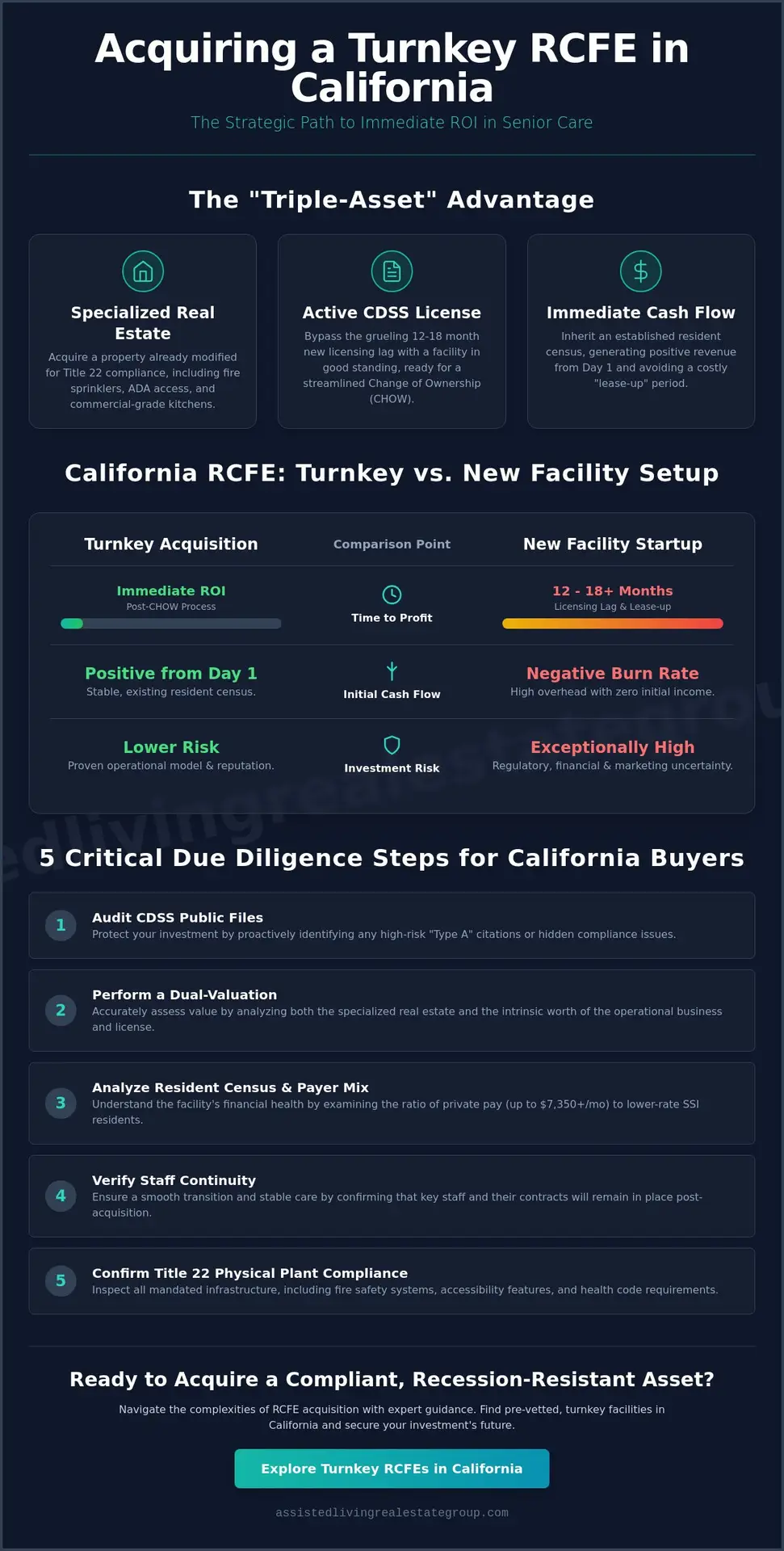
5 Critical Due Diligence Steps for Turnkey Acquisitions
Due diligence for a turnkey RCFE for sale California is a multi-dimensional operation that goes far beyond a standard commercial real estate inspection. Because you’re acquiring an active healthcare ecosystem, your investigation must bridge the gap between financial performance and regulatory integrity. You aren’t just verifying the stability of the walls; you’re verifying the stability of a license and the safety of the residents within. Any oversight during this phase can transform a high-yield asset into a significant legal liability.
- Audit the CDSS Public File: Request the facility’s complete history from the California Department of Social Services. You’re looking for “Type A” citations, which represent immediate risks to resident health and safety. Recurring issues in these files suggest systemic operational failures that a simple “turnkey” label won’t fix.
- Financial Forensic Review: Move past basic profit and loss statements. You must verify resident ledgers against actual bank deposits to ensure the reported income is accurate and consistent. In the California market, discrepancies here often hide resident churn or uncollected fees.
- Physical Title 22 Inspection: Ensure the facility meets specific fire and safety codes, including mandated sprinkler systems and ADA-compliant pathways. A “turnkey” property must be ready for a surprise state inspection on day one.
- Staffing Contract Review: California’s wage-and-hour laws are exceptionally strict. Review existing employment agreements to identify potential liabilities related to overtime, meal breaks, or misclassification of independent contractors.
- Resident Agreement Audit: Confirm that every resident contract is current, legally binding, and compliant with the latest California legislative updates. These contracts are the foundation of your future cash flow.
Navigating the California License Transfer
The defining hurdle for turnkey buyers is the “Change of Ownership” (CHOW) process. Unlike a fresh application, which can leave a building vacant for 12 months, a CHOW allows for a smoother transition of the existing resident census. However, you must avoid the “unlicensed operation” trap. This occurs when a buyer takes over daily operations before the CDSS has officially processed the transfer. You also need to ensure your designated Administrator holds a valid California certification. With application fees ranging from $495 for small homes to over $4,950 for larger facilities, getting the paperwork right the first time is a financial necessity. For a granular breakdown of these regulatory requirements, see our guide on RCFE Licensing in California.
Environmental and Zoning Verification
Success in the Southern California market requires strict adherence to local municipal codes which can sometimes be more restrictive than state law. You must confirm that the facility’s current use is fully permitted and check for any pending zoning changes in the neighborhood. A surprise rezoning could block your plans for future expansion or bed-count increases. If you want to ensure your prospective acquisition meets these rigorous standards, explore our current Turnkey Business Acquisitions for vetted opportunities that align with your strategic goals.
Securing Your Investment with an RCFE Specialist
General commercial brokers often fail to grasp the human element inherent in senior care. They treat a turnkey RCFE for sale California as just another piece of income-producing real estate, focusing on square footage while ignoring resident census volatility or the nuances of Title 22 compliance. At Assisted Living Real Estate Group, we bridge this gap by leveraging 25 years of California-specific expertise. We don’t just sell buildings. We facilitate the transfer of complex, mission-driven businesses. Our deep roots in the state allow us to source exclusive, off-market turnkey deals that never reach public listing sites.
Securing a turnkey RCFE for sale California requires more than a standard real estate agent; it requires a strategic partner who understands the intersection of ethics and profitability. We recognize that these facilities are high-barrier-to-entry assets that demand a specific roadmap to navigate successfully. By positioning ourselves as expert guides, we ensure that you aren’t just buying a property, but acquiring a legacy of care that is positioned for significant financial returns.
Confidentiality: The Key to a Successful Transition
Publicly advertising a care home for sale is often a recipe for operational disaster. When families or staff members see a facility listed on a generic business brokerage site, it triggers immediate anxiety. This often leads to resident “flight” and staff turnover, both of which erode the very cash flow you’re trying to acquire. Our “Confidential Marketing Strategy” ensures the facility’s reputation remains untarnished throughout the sale. We vet every potential buyer for financial capacity and operational experience before disclosing sensitive data. This protective layer ensures a seamless transition where the residents and staff remain stable throughout the process.
Your Roadmap to a Turnkey Future
The journey from your initial consultation to holding the keys in hand requires a methodical, step-by-step approach. We guide you through the complexities of the California market, providing support for relicensing and operational optimization long after the sale is finalized. Our goal is to ensure your acquisition isn’t just a transaction; it’s a sustainable investment in the future of senior care. Whether you’re targeting a 6-bed board and care or a larger community, our specialized roadmap minimizes friction and maximizes your long-term ROI. You can start your journey today and view our exclusive turnkey RCFE listings in California to find the asset that matches your strategic vision.
Mastering Your California Senior Care Portfolio
The window for strategic entry into California’s senior care market is wide, yet it requires a roadmap that balances financial rigor with regulatory precision. You’ve seen how a turnkey RCFE for sale California offers a distinct advantage, bypassing the 12-month licensing lag and securing immediate resident cash flow. By focusing on the “triple-asset” model of real estate, license, and census, you can build a portfolio that’s both recession-resistant and socially significant.
Success hinges on navigating the “Change of Ownership” process and conducting forensic due diligence on CDSS records. Our team leverages over 25 years of combined experience in California care facilities and specialized Southern California market knowledge to source exclusive, off-market opportunities. As confidential marketing experts, we ensure your transition is seamless and your reputation remains untarnished during the acquisition process.
Secure Your Turnkey RCFE Investment: Browse Exclusive California Listings
The aging demographic shift is your opportunity to lead in a market that rewards expertise and compassion. We’re ready to help you secure a legacy of care and capital.
Frequently Asked Questions
What does ‘turnkey’ mean for an RCFE for sale in California?
A turnkey facility is a “triple-asset” acquisition that includes the specialized real estate, an active CDSS license, a trained staff, and a current resident census. This model ensures your capital is immediately active. Instead of waiting through a 12 month licensing lag, you step into a cash-flowing senior care business that is fully compliant with Title 22 regulations from day one of ownership.
Can I operate an RCFE in California without being the licensed Administrator?
Yes, you can own a turnkey RCFE for sale California as the licensee without personally holding an Administrator certificate. You must, however, employ a certified Administrator who is responsible for the facility’s daily operations and resident care. While you provide the strategic vision and capital, your Administrator ensures the facility meets all state mandated health and safety standards.
How long does it take to transfer an RCFE license during a sale?
The Change of Ownership (CHOW) process in California typically takes between 60 and 120 days. This is significantly faster than the 6 to 12 month wait for a brand new license. During this transition, management agreements often allow the facility to remain operational. This ensures there is no disruption in resident care or the facility’s monthly revenue stream during the administrative handoff.
Does a turnkey RCFE sale always include the real estate?
Most turnkey transactions in the California market include both the business and the real estate, but it isn’t a universal rule. Some opportunities are “business only” sales where you acquire the operations and license while leasing the property. Other structures include lease-to-own opportunities. Investors usually prefer the combined model because it offers the security of a tangible asset alongside the business’s high-yield income.
What are the common red flags when buying an existing care home?
Major red flags include frequent “Type A” citations in the CDSS public file or a history of recurring compliance issues. High staff turnover and a rapidly declining resident census also signal operational instability. You should be wary of any discrepancies between the resident ledgers and actual bank deposits. These gaps often suggest that the facility’s reported EBITDA is inflated or that resident churn is being hidden.
How do I value the ‘business’ portion of a turnkey RCFE?
The business portion of a turnkey RCFE for sale California is valued based on a multiple of its EBITDA, adjusted for the resident payor mix. Private pay residents command a higher valuation than those on SSI because they offer superior margins. For a standard 6-bed facility, the business value typically ranges from $150,000 to $400,000. This is calculated separately from the value of the specialized residential real estate.
Are there financing options specifically for turnkey assisted living facilities?
SBA 7(a) and 504 loans are the most common financing vehicles for these acquisitions in California. These programs are ideal because they can cover both the real estate and the business goodwill. Conventional commercial lenders and specialized healthcare financing firms also provide capital. Most lenders will require a 20% to 30% down payment and will look for a certified Administrator to be part of the transition team.
What is the average occupancy rate needed for a turnkey RCFE to be profitable?
Most 6-bed facilities require an occupancy rate of at least 65% to 75% to reach a break-even point. This depends heavily on your resident acuity levels and whether you’re serving the private pay market. To achieve a significant return on investment, you should aim for 90% to 100% occupancy. Turnkey assets make this easier because they come with established referral networks already in place.