
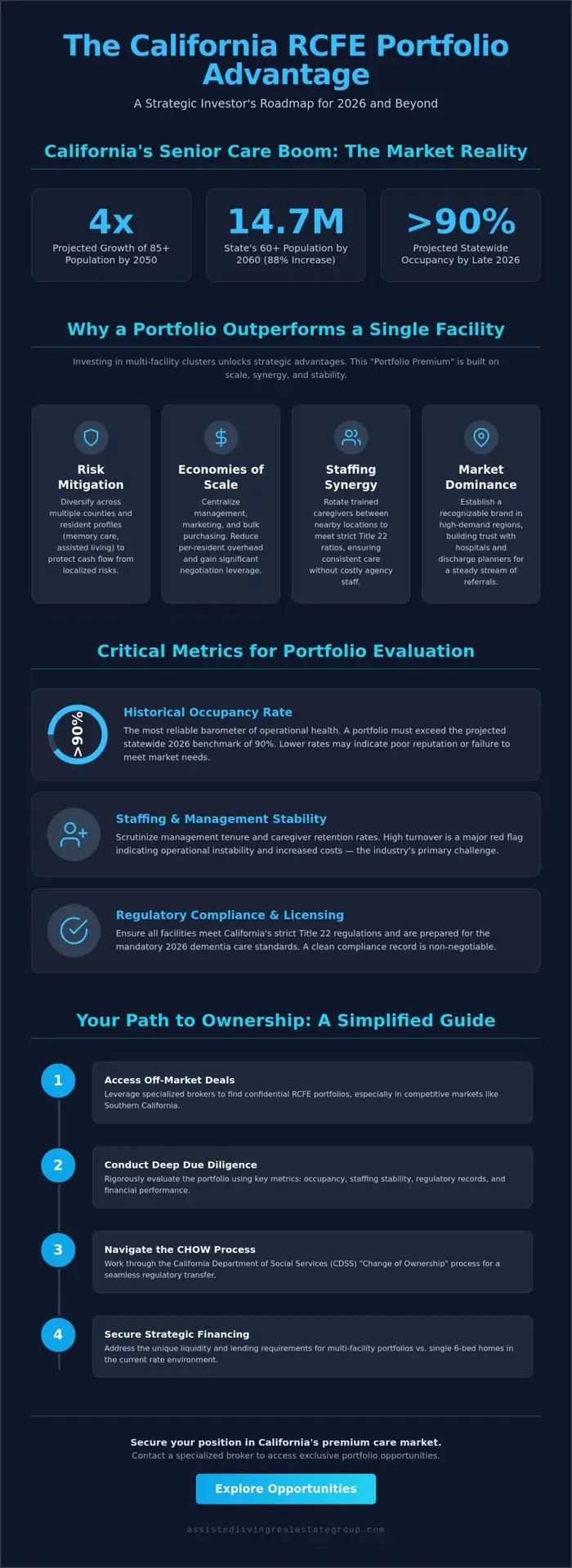
In a state where the 85-plus population is on track to nearly quadruple by 2050, the most significant investment returns in senior care aren’t found in single-site operations, but in strategic, multi-facility clusters. You’ve likely realized that the high barrier to entry created by California’s Title 22 regulations keeps the competition at bay, but it also makes finding a viable RCFE portfolio for sale feel like a daunting task. You’re right to be cautious about overpaying for underperforming assets or struggling with the state’s strict 2026 dementia care standards and mandatory staff training requirements.
We’re here to bridge the gap between your financial goals and the compassionate care these residents deserve. You’ll learn how to navigate the current acquisition landscape to secure a cash-flowing portfolio that offers both operational synergy and significant risk mitigation through geographic diversification. This guide provides a comprehensive roadmap for 2026, covering everything from the latest administrator certification fees to the specific liquidity requirements the Community Care Licensing Division demands for new owners. By the time you finish reading, you’ll have the clarity needed to transition from a curious observer to a convicted, strategic professional in California’s premium care market.
Key Takeaways
- Analyze how scaling into multi-facility clusters provides immediate market share and operational synergy compared to single-site acquisitions.
- Identify the specific “Portfolio Premium” metrics and historical occupancy benchmarks necessary to evaluate an RCFE portfolio for sale accurately.
- Navigate the California Department of Social Services (CDSS) “Change of Ownership” (CHOW) process to ensure a seamless regulatory transfer.
- Contrast the financing requirements for single 6-bed homes versus larger portfolios within the current 2026 interest rate environment.
- Leverage confidential, off-market deal flow through specialized brokers to secure exclusive opportunities in the competitive Southern California market.
The Strategic Advantage of Acquiring an RCFE Portfolio in California
The demographic shift in California isn’t a distant forecast; it’s our current reality. By 2060, the state’s population aged 60 and older will swell to 14.7 million. This represents an 88% increase from 2016 levels. For the strategic professional, this isn’t a social crisis. It’s a massive, untapped market potential. Acquiring an RCFE portfolio for sale allows you to capture this demand at scale. While individual facilities offer a starting point, a portfolio provides immediate market dominance in high-demand regions like the San Francisco Bay Area or West Los Angeles. You aren’t just buying real estate; you’re securing a critical piece of the state’s healthcare infrastructure.
Investing in Residential care facilities through a multi-site model offers a unique level of resilience. Unlike traditional commercial real estate, senior housing is driven by biological necessity rather than economic whim. Even during periods of market volatility, the need for licensed beds remains constant. This asset class successfully bridges the gap between sophisticated financial investment and compassionate, mission-driven care. In the Southern California market, operational synergy becomes your greatest asset. By clustering facilities, you create a recognizable brand presence that builds trust with local hospitals and discharge planners, ensuring a steady stream of high-acuity referrals.
Economies of Scale in Senior Care
Managing a cluster of homes across California unlocks efficiencies that single-site operators simply can’t match. Centralized management allows you to spread administrative salaries and marketing budgets across dozens of beds, significantly reducing your per-resident overhead. You’ll gain massive leverage in bulk purchasing for medical supplies, PPE, and food services. In a 2026 market where staffing remains the industry’s primary challenge, a portfolio allows you to rotate trained caregivers between nearby locations. This flexibility ensures you meet strict Title 22 ratios without the high cost of external nursing agencies.
Risk Mitigation Through Diversification
A single facility is vulnerable to localized issues, but a portfolio offers a protective shield. Spreading your investment across multiple California counties, such as Orange County and the Inland Empire, protects your cash flow from regional economic dips. You can also diversify resident profiles. By offering specialized memory care in one location and boutique assisted living in another, you capture different segments of the private-pay market. This multi-license approach creates a safety net. It ensures that a temporary dip in occupancy at one site doesn’t compromise the financial health of your entire investment.
Key Metrics for Evaluating an RCFE Portfolio for Sale
Evaluating a multi-site investment requires a shift in perspective from individual asset analysis to systemic performance. The “Portfolio Premium” is a tangible value added to a group of facilities that operate with shared resources and a unified brand. In California’s high-barrier market, this premium reflects the immense effort required to secure multiple licenses and build a cohesive staff. When you analyze an RCFE portfolio for sale, you aren’t just looking at bedrooms and bathrooms. You’re assessing a pre-integrated operational engine designed for scale. This integrated approach is what allows strategic professionals to outperform single-site competitors who lack the same administrative leverage.
Historical occupancy rates serve as your most reliable barometer for operational health. With statewide senior housing occupancy projected to exceed 90% by the end of 2026, any portfolio falling below this benchmark suggests underlying issues. It might indicate a poor reputation with local California discharge planners or a failure to adapt to rising resident acuity. High occupancy is the lifeblood of your cash flow. It validates that the facilities are meeting the market’s needs. As highlighted in Harvard’s Housing America’s Older Adults report, the intensifying demand for specialized care makes these high-occupancy assets increasingly scarce and valuable.
Staffing remains the most significant challenge for the assisted living industry in 2026. You must scrutinize the management tier and caregiver retention rates across the entire portfolio. High turnover leads to inconsistent care and frequent Title 22 citations, which can jeopardize your licenses. A quality portfolio should have a stable layer of middle management capable of overseeing daily operations without constant owner intervention. This stability ensures that the “compassionate care” side of the business remains intact while you focus on the “financial investment” side. If you’re looking for assets that already meet these high operational standards, consider reviewing our latest turnkey business acquisitions.
Financial Performance and EBITDAR
EBITDAR is the gold standard for valuing California senior care businesses because it isolates operational performance from real estate costs. This is essential when a portfolio contains a mix of leased and owned facilities. You’ll want to analyze rent coverage ratios to ensure each site can comfortably meet its obligations. Look for “upside potential” by identifying facilities where current rents are below the statewide median of $7,350 for assisted living or $6,500 to $11,500 for memory care. Adjusting these rates to market value can significantly boost your portfolio’s valuation.
Zoning and Facility Capacity
Never assume that a licensed RCFE is automatically compliant with local municipal zoning. You must verify that each facility in the portfolio adheres to specific California city or county land-use laws. Evaluate the potential for bed-count expansion under current Title 22 rules. For instance, converting a 6-bed home to a 10 or 15-bed facility can dramatically improve your economies of scale. Be vigilant about “non-conforming” uses that might be “grandfathered in” for the current owner but could be revoked upon a change of ownership.
Navigating California’s Regulatory Environment at Scale
The California Department of Social Services (CDSS) acts as the ultimate gatekeeper for every RCFE portfolio for sale. Navigating their oversight at scale requires more than just a passing familiarity with the rules; it demands a strategic mastery of the Community Care Licensing Division’s (CCLD) expectations. When you acquire a multi-facility cluster, you’re stepping into a complex regulatory hand-off known as the Change of Ownership (CHOW) process. This isn’t a simple “transfer” of paper. Each facility requires a fresh application where you must demonstrate your operational competence and financial stability. As of 2026, the state requires applicants to show they have at least one month of operating costs readily available in cash or credit for each existing facility they intend to acquire. This ensures the business stays solvent during the transition.
Title 22, Division 6, Chapter 8 dictates every granular detail of your operation, from the 2026 dementia care standards to the mandatory resident reappraisals every 12 months. Managing these requirements across a portfolio means your centralized corporate office must be an engine of compliance. A single “Type A” deficiency, which represents an immediate risk to resident health or safety, can trigger state-wide scrutiny across all your locations. Maintaining a clean record isn’t just about ethics; it’s about protecting the valuation of your entire investment. Your designated administrators must be certified through the 80-hour Initial Certification Training Program and pass the 100-question state exam with at least a 70% score. Scaling doesn’t mean cutting corners; it means standardizing excellence.
Corporate Licensing vs. Individual Facility Permits
Using a centralized California business entity to hold your licenses offers significant administrative advantages. It allows you to standardize your 40-hour staff training programs and medication management protocols across all sites, ensuring a consistent level of care. However, licensing delays are common during portfolio acquisitions. You must plan for a transition period where the seller remains the licensee of record while your applications move through the CCLD backlog. For a deeper dive into these requirements, see our guide on RCFE Licensing in California.
Compliance Audits During Due Diligence
Your due diligence must include a rigorous review of the last three years of CDSS inspection reports for every facility in the portfolio. Don’t just look for isolated incidents. Search for systemic compliance issues that suggest a breakdown in management. If multiple sites show recurring issues with fire and disaster preparedness or staff training documentation, it indicates a cultural problem that will cost you both time and money to fix. A specialized consultant can help you verify the regulatory standing of each site, ensuring you don’t inherit a portfolio on the verge of a license revocation or a “Type A” penalty.
Financing and Valuing Multi-Facility RCFE Investments
Financing a single 6-bed facility is often a residential-commercial hybrid play. Scaling to a 50-bed RCFE portfolio for sale requires a transition into sophisticated institutional lending. You’re no longer just buying a house; you’re acquiring a complex operational entity with high-acuity revenue streams. Lenders in 2026 look for a debt service coverage ratio (DSCR) that accounts for both the real estate and the volatile nature of care-related labor costs. In this high-stakes environment, your ability to demonstrate financial stability is paramount. California regulations now require buyers of existing facilities to prove they have at least one month of operating costs in liquid reserves, a factor that must be baked into your initial capital stack.
Specialized appraisals are mandatory for these transactions. A generalist appraiser will often miss the “Business Value,” which is the intangible worth of the licenses, the referral networks, and the trained staff. In California’s premium markets, the real estate value might be $2 million, but the business value could add another 30% to 50% to the total appraisal based on EBITDAR multiples. If you fail to separate these components, you’ll likely struggle with loan-to-value requirements. You need an appraiser who understands that an RCFE is a specialized care business first and a piece of real estate second.
SBA Loans vs. Conventional Financing
SBA 7(a) loans remain a popular choice for portfolios under $5 million, especially with the current 2026 prime rate sitting at 6.75%. These loans allow you to finance the business acquisition and the property together, often with lower down payments. Once you cross the 50-bed threshold or seek to acquire larger 16-plus bed facilities, you’ll likely need to pivot to conventional commercial mortgages. Conventional rates in June 2026 typically range from 5.38% to 8.75% depending on the asset’s location and occupancy history. For a more granular look at single-site entry points, explore The Ultimate Guide to Buying an RCFE Facility in California. To see how these numbers apply to current market opportunities, browse our latest RCFE sales listings.
Portfolio Valuation Models
Valuing a multi-city portfolio requires a Weighted Average Cap Rate. A facility in San Francisco commands a different premium than one in the Central Valley due to staggering differences in median monthly costs. In 2026, Bay Area assisted living averages $6,500 to $8,500, while the Inland Empire stays between $4,500 and $5,800. Your valuation must account for these regional cost-of-living variances and the “blue sky” value of an established, reputable brand. This goodwill represents the years of trust built with California discharge planners and the community, which translates directly into faster fill rates and higher sustained occupancy.
Securing Your Investment with a Specialized California RCFE Broker
Generalist commercial brokers often fail because they view an RCFE as just another retail or office asset. They don’t grasp the granular nuances of California’s Title 22 compliance or the high-stakes nature of resident care. When you’re pursuing an RCFE portfolio for sale, you need a partner who speaks the language of both the boardroom and the care home. A specialized broker acts as your strategic mentor, navigating the delicate intersection of financial gain and social contribution. We ensure that the transition of multiple licenses doesn’t disrupt the continuity of care, which is vital for maintaining the business value and reputation you’re paying to acquire.
The broker’s role extends far beyond simply matching a buyer with a seller. It involves a sophisticated management of the Change of Ownership (CHOW) process with the California Department of Social Services. A specialized intermediary understands how to package your financial stability and operational experience to meet the CCLD’s 2026 requirements. By facilitating this regulatory hand-off, a dedicated RCFE broker mitigates the risk of licensing delays that can bleed a portfolio’s cash flow during escrow. You’re not just buying beds; you’re buying a roadmap to successful, long-term operation in a high-barrier market.
Accessing Off-Market Portfolios
The most lucrative California RCFE portfolios are never found on public listing sites. Publicly advertising a sale can destabilize a facility, leading to caregiver departures and resident family anxiety. This is why we prioritize a confidential marketing strategy. Our exclusive “pocket listings” come from decades of industry relationships across the state. Assisted Living Real Estate Group sources these opportunities by identifying owners ready to exit before they ever hit the open market. This gives you first-mover advantage in a competitive Southern California landscape where demand for licensed capacity is at an all-time high.
The Path to Closing: A Strategic Roadmap
Moving from a Letter of Intent (LOI) to final licensing approval requires a methodical communication rhythm. We manage the complex multi-facility escrow, ensuring that all CDSS requirements are met without stalling the transaction. This includes verifying that every site has its fire clearance, 2026 dementia care training documentation, and administrator certifications in order. We bridge the gap between your vision for scale and the practical realities of California’s regulatory environment. To begin your journey into this exclusive asset class, schedule a confidential consultation with Teri Szoke to discuss your specific investment criteria and our current off-market inventory.
Elevating Your Position in California’s Care Economy
Scaling into multi-facility clusters is the definitive path to achieving significant financial returns while delivering tangible social impact. You’ve learned how operational synergy and geographic diversification protect your capital from localized volatility. Mastering the 2026 CDSS licensing requirements ensures your assets remain high-performing engines of care. This transition from individual facility management to portfolio-level oversight is where the most sophisticated investors find their competitive edge.
Securing a premier RCFE portfolio for sale requires the specialized roadmap that only a seasoned strategic partner can provide. With over 25 years of exclusive California senior care expertise, we leverage deep relationships with regulatory bodies and a confidential marketing strategy to protect your operational integrity. These off-market opportunities represent the pinnacle of the state’s senior housing market. We bridge the gap between financial investment and the compassionate care residents deserve, ensuring your acquisition is both profitable and purposeful.
Your legacy in California’s care economy is waiting. Browse Exclusive California RCFE Portfolios for Sale. The opportunity to scale with conviction has never been more urgent.
Frequently Asked Questions
How is an RCFE portfolio valued differently than a single facility?
Portfolios often command a “Portfolio Premium” because they offer immediate market share and pre-integrated operational systems. While a single home is valued primarily on its local EBITDAR and real estate, a portfolio valuation accounts for centralized management efficiencies and the rarity of holding multiple licenses in a high-barrier market. You’re paying for a turn-key engine of care that already possesses the administrative leverage necessary to outperform smaller, isolated competitors.
Can I buy an RCFE portfolio in California without a license?
You can acquire the business entity and real estate without personally holding an RCFE administrator’s license, but you must employ a certified administrator for each facility. The California Department of Social Services requires the corporate entity to be licensed, and the designated administrator of record must have completed the 80-hour Initial Certification Training Program. This allows you to focus on the financial investment while seasoned professionals manage the daily compassionate care.
What are the typical cap rates for senior care portfolios in Southern California?
Cap rates for multi-facility portfolios in Southern California typically range from 7% to 9% depending on the acuity of care provided and the specific county. Premium assets in coastal Orange County or West Los Angeles often see tighter caps due to superior rental rate growth and high demand. These rates reflect the stability of the asset class and the significant barriers to entry that protect your investment from sudden market saturation.
How long does the change of ownership process take for a multi-facility deal?
The Change of Ownership process for a multi-facility portfolio generally takes between 120 and 180 days to complete. This timeline accounts for the Community Care Licensing Division’s rigorous review of your corporate application, financial stability verifications, and individual site inspections. It’s a methodical process that requires a strategic roadmap to ensure your capital remains protected while the state verifies your ability to maintain Title 22 compliance across all locations.
What is the minimum number of beds required to be considered a portfolio?
Industry professionals in the California market generally define an RCFE portfolio for sale as a cluster of three or more facilities under common ownership. Investors typically target portfolios that offer a high enough bed capacity to justify a centralized management tier. This scale allows you to spread administrative and marketing costs across a larger resident base, which is the key to unlocking the economies of scale that drive superior returns.
Are SBA loans available for buying multiple care homes at once?
SBA 7(a) and 504 loans are frequently used to acquire multiple facilities, provided the total transaction stays within current SBA lending limits. These programs are ideal for smaller portfolios where the investor intends to be active in the management of the business. For larger acquisitions, you’ll likely transition to conventional commercial lending or private equity, which offers the flexibility needed for high-volume, multi-city expansions across the state.
How do I maintain confidentiality when selling a large RCFE portfolio?
Confidentiality is maintained through a specialized marketing strategy that utilizes strict non-disclosure agreements and “pocket listings” rather than public portals. This approach prevents staff turnover and resident anxiety by ensuring only qualified, vetted investors gain access to sensitive operational data. By keeping the sale quiet, you protect the reputation of the business and ensure that the “blue sky” value of your brand remains intact throughout the transition.
What is the difference between an RCFE and an ARF portfolio for investors?
RCFEs serve residents aged 60 and older with assisted living or memory care needs, while Adult Residential Facilities (ARFs) serve adults aged 18 to 59 with various disabilities. RCFEs typically command higher private-pay rates and are more directly influenced by the massive aging demographic shift in California. This makes RCFE portfolios a more common target for strategic professionals looking to leverage the long-term market potential of the state’s senior population.