
Your greatest protection in the 2026 market isn’t a high interest rate or a low cap rate; it’s the very regulatory barrier that keeps your competitors on the sidelines. While amateur investors are deterred by complex Title 22 updates and the new transparency requirements effective July 2026, seasoned professionals recognize that these requirements secure the value of premier California care home investment opportunities. You likely understand that the demand for specialized senior housing is surging, yet finding a compliant, off-market RCFE in Southern California feels increasingly difficult as cap rates continue to compress.
This guide will show you how to cut through the red tape of RCFE and ARF licensing to secure a resilient, mission-driven asset that balances high-yield financial returns with deep social impact. We’ll analyze why the “6-bed” residential model often outperforms institutional settings by providing the personalized care that 2026 families demand. You’ll also gain a clear roadmap for identifying turnkey business acquisitions that include valid licenses, allowing you to bypass the lengthy initial application process and enter the market with conviction and a defined competitive advantage.
Key Takeaways
- Capitalize on the unprecedented growth of California’s 65+ demographic to secure a recession-resistant asset class within a high-demand market.
- Evaluate the unique advantages of RCFE and ARF models to find the specific California care home investment opportunities that align with your financial goals.
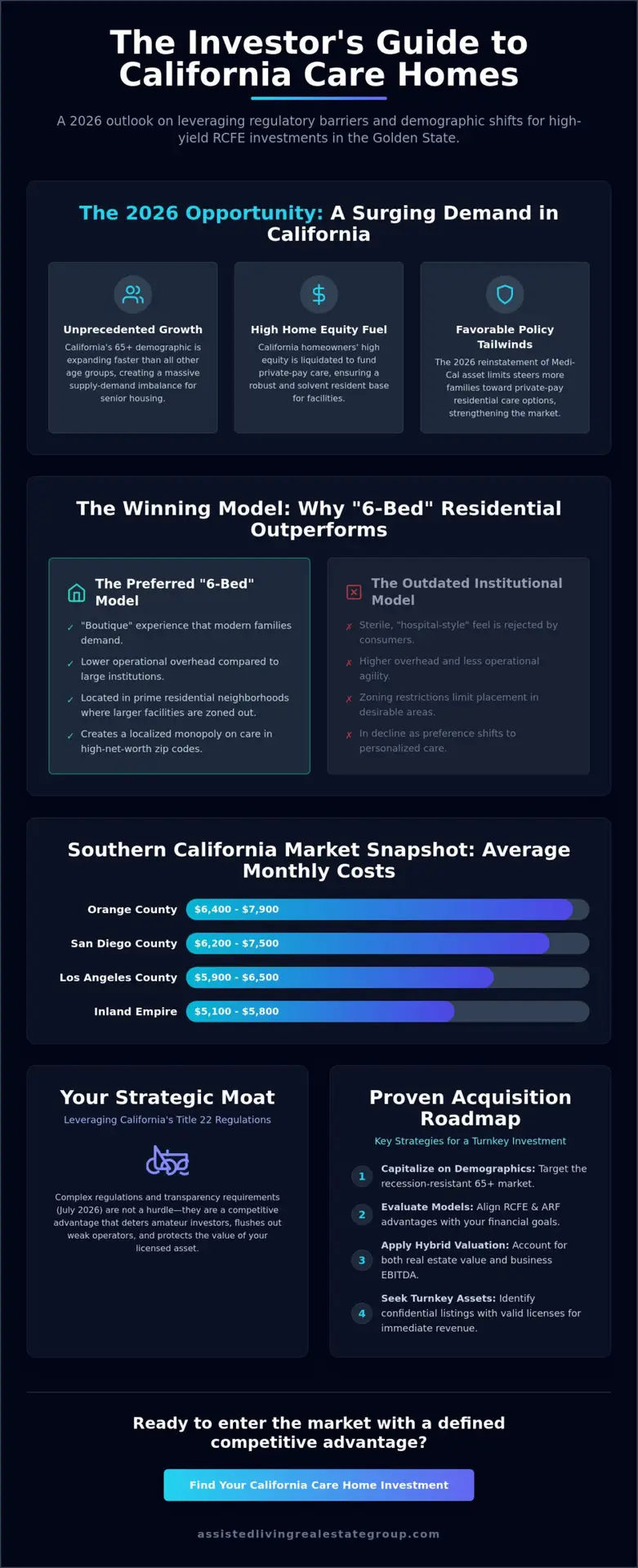
- Leverage California’s Title 22 regulations as a strategic moat that limits competition and preserves the long-term value of your licensed facility.
- Apply hybrid valuation techniques that account for both physical real estate and business EBITDA to ensure you don’t overpay for cash-flowing assets.
- Follow a proven acquisition roadmap to identify confidential, turnkey listings that offer immediate operational revenue and a valid license.
The 2026 California Senior Housing Landscape
California’s demographic landscape is undergoing a permanent transformation. The state’s 65 and older population is expanding at a rate that outpaces all other age groups; this shift is creating a massive supply-demand imbalance. For the strategic professional, this represents one of the most compelling California care home investment opportunities in decades. Senior housing isn’t just a real estate play. It’s a “need-driven” asset class. Unlike traditional multifamily units that fluctuate with the broader economy, the demand for high-quality care remains constant regardless of market shifts. In fact, senior care real estate historically outperforms traditional residential portfolios during economic volatility because the service provided is a necessity, not a luxury.
Demographic Drivers in the Golden State
The aging population in California is not just a statistic; it’s a market force. With the national population aged 80 and over projected to grow by 36.6% over the next decade, California’s urban centers are feeling the pressure first. This surge is met by a unique financial catalyst: the wealth transfer effect. California homeowners hold some of the highest home equity levels in the nation. As this generation transitions into care, this equity is liquidated to fund private-pay services, ensuring a robust and solvent resident base for well-positioned facilities. This momentum is supported by the reinstatement of Medi-Cal asset limits on January 1, 2026, at $130,000 for individuals, which clarified the financial landscape for families planning long-term care, often steering them toward private-pay residential options. For those looking to optimize their wealth strategies during this transition, check out SurePath Advisors for expert insights on tax-free retirement income.
Institutional vs. Residential Models
We are witnessing the steady decline of the “hospital-style” nursing home. Modern families are rejecting the sterile, institutional feel of large-scale facilities in favor of Residential Care Facilities that offer a “boutique” experience. These smaller, community-integrated settings provide the personalization and dignity that today’s consumers demand. For the investor, the 6-bed residential model offers significant agility. These assets typically have lower overhead than large institutions and can be located in prime residential neighborhoods where larger facilities are zoned out. This creates a localized monopoly on care within high-net-worth zip codes.
Southern California Market Dynamics
Success in 2026 requires a granular understanding of regional demand. Southern California remains the primary engine for high-yield California care home investment opportunities. The data reflects significant pricing power in specific pockets:
- Orange County: Leads the region with monthly costs ranging from $6,400 to $7,900.
- San Diego County: Shows strong resilience with monthly rates between $6,200 and $7,500.
- Los Angeles County: Remains a high-volume market with costs averaging $5,900 to $6,500.
- Inland Empire: Represents a growing “value” play with rates between $5,100 and $5,800.
The competitive advantage belongs to the investor who can identify off-market assets in these high-demand zones before they hit the open market. While rising wages and the July 2026 transparency requirements create a higher bar for entry, they also serve to flush out undercapitalized operators, leaving more room for strategic professionals to dominate the landscape.
Understanding RCFE and ARF Investment Vehicles
Identifying the right California care home investment opportunities requires a precise understanding of the two primary licensing vehicles: RCFE and ARF. While both models utilize residential real estate to provide care, their target demographics and revenue drivers differ significantly. The strategic investor doesn’t just buy a house; they acquire a licensed business platform designed to serve a specific California community. According to the 2026 Seniors Housing Investor Survey, 86% of institutional and private investors plan to expand their portfolios this year, with a heavy focus on specialized care models that offer higher margins than traditional rentals.
RCFE: The Premier Choice for Senior Care Investors
Residential Care Facilities for the Elderly (RCFE) represent the “sweet spot” for California investors. These facilities serve residents aged 60 and older who require assistance with activities of daily living but don’t need 24/7 clinical nursing. The primary advantage of the RCFE is the private-pay market. With California’s assisted living costs reaching a median of $7,798 per month in 2026, the RCFE model allows owners to capture high-end revenue in standard residential neighborhoods. You can scale your service tiers from basic assisted living to high-acuity memory care, which commands a premium due to the specialized staffing and dementia standards enforced by the state.
ARF: Diversifying Your Care Portfolio
Adult Residential Facilities (ARF) provide a powerful alternative for those looking to diversify. These homes serve adults aged 18 to 59 with developmental, mental, or physical disabilities. While the RCFE market focuses on the “silver tsunami,” the ARF market offers incredible stability. Residents in ARFs often stay for decades rather than years, leading to lower turnover costs and predictable cash flow. While the regulatory framework overlaps with RCFE standards, the ARF license requires a different administrator certification and focuses on social rehabilitation and community integration. Diversifying into ARFs can hedge against the shorter residency cycles common in senior care.
The “6-bed model” remains the gold standard for new and seasoned investors alike. This capacity allows you to operate within a standard single-family home while maintaining a valid license. It offers a unique regulatory advantage: 6-bed facilities are often exempt from certain local zoning hurdles that plague larger institutions. However, for those looking to scale, the transition to 30+ bed assisted living centers allows for greater operational leverage and centralized management. If you’re evaluating which model fits your capital requirements, reviewing current RCFE and ARF sales can help you Benchmark per-bed valuations in your target county. Whether you choose the agility of a 6-bed home or the scale of a larger center, the key is securing a turnkey asset with an active license to ensure immediate revenue generation.
Navigating California Regulatory Moats: Title 22 and Beyond
In the competitive world of California real estate, a high barrier to entry is an investor’s most reliable defense. While amateur investors often shy away from the state’s rigorous oversight, strategic professionals view these regulations as a “regulatory moat” that protects their market share. California’s strict rules prevent the market from becoming oversaturated with low-quality operators, ensuring that premium California care home investment opportunities maintain their value over time. Understanding the nuances of California’s Title 22 Regulations for RCFEs isn’t just about avoiding citations; it’s about mastering the playbook for a profitable and stable facility.
Zoning and local ordinances in Southern California add another layer of complexity. While state law often protects the 6-bed residential model from certain local zoning restrictions, navigating the specific land-use rules in counties like Orange or San Diego requires seasoned expertise. You aren’t just managing a property; you’re operating a highly regulated business entity that must coexist with local community standards. This complexity is exactly why established facilities command such a premium in the 2026 market.
The Licensing Advantage
One of the most critical decisions you’ll make is whether to start a new facility or acquire an existing one. Buying a turnkey business with a valid license is almost always superior to starting from scratch. The initial licensing process in California can take 12 to 18 months, during which you’re often paying a mortgage on an empty building. By purchasing an existing operation, you benefit from a “Change of Ownership” (CHOW) process, which allows for a smoother transition of the business entity. To master this transition, you must understand the specific steps of RCFE licensing in California, which ensures your investment begins generating cash flow on day one.
Compliance as a Value Add
Don’t view the Department of Social Services (DSS) as an adversary. In the care home industry, compliance is a tangible asset. High compliance scores and a clean regulatory history directly correlate to higher facility valuations and faster occupancy rates. When you invest in the “human” side of the business by maintaining superior staffing ratios and rigorous training programs, you’re effectively de-risking your asset. In 2026, families are more informed than ever; they use public licensing reports to vet facilities. A facility that exceeds Title 22 standards doesn’t just provide better care; it secures a premium market position that justifies higher per-bed rates and delivers resilient California care home investment opportunities for your portfolio.
Valuation and ROI: The Financial Anatomy of a Care Home
Valuing a care home requires a sophisticated departure from standard residential appraisals. You aren’t just buying square footage; you’re acquiring a cash-flow engine. The industry standard is the Hybrid Valuation Model, which combines the fair market value of the real estate with a multiple of the business EBITDA. This dual-layered approach is why California care home investment opportunities often yield superior returns compared to traditional multifamily assets. When you analyze a facility, you must look beyond the curb appeal to the “per-bed” revenue potential, which in high-demand markets like Orange County can reach up to $7,900 per month.
Operating expenses are the most critical variable in your ROI calculation. In 2026, labor remains the largest line item. With the California statewide minimum wage at $16.90 and Los Angeles reaching $18.42 as of July 1, 2026, your staffing model must be lean and efficient. Beyond wages, you must budget for 24/7 care coverage, specialized dietary needs, and rising insurance premiums. However, the premium rates commanded by high-acuity services often more than offset these costs. For those looking to diversify their cash flow, investing in an Adult Residential Facility in California offers a different expense profile with longer-term resident stability.
Calculating Your Potential Returns
Cap rates in the California care sector are experiencing compression as institutional interest intensifies. While 85% of investors expect cap rates to decrease further in 2026, well-managed facilities still offer attractive spreads over the cost of capital. Financing these acquisitions usually involves a mix of SBA 7(a) or 504 loans and conventional commercial lending. As of June 2026, conventional commercial mortgage rates typically range from 5.51% to 8.76%. A “Value-Add” play, such as upgrading a standard RCFE to offer specialized memory care, can significantly increase your Net Operating Income and overall asset valuation.
The Power of Confidential Marketing
The most lucrative California care home investment opportunities rarely appear on public listing sites. Publicly listing a facility can trigger resident departures and staff turnover, which directly erodes the business value you’re trying to buy. Confidential marketing is the gold standard for high-level transactions. It protects the stability of the care environment while ensuring that only qualified, strategic buyers gain access to the data room. Working with a specialized broker allows you to access this exclusive, off-market inventory of RCFE and ARF assets. If you’re ready to review verified financial data on current listings, you can browse our available RCFE sales and acquisitions to find your next strategic asset.
Strategic Acquisition: Your Roadmap to a Turnkey Investment
Securing high-yield California care home investment opportunities requires more than capital; it demands a methodical approach to the acquisition lifecycle. The 2026 market is fast-moving. Investors who hesitate during the due diligence phase often lose out to more prepared strategic professionals. To navigate this high-barrier landscape, you must follow a roadmap that prioritizes regulatory compliance and operational continuity from the first site visit to the final licensing transfer.
Your journey begins with a clear definition of your investment criteria. A 6-bed facility in a residential Orange County neighborhood serves a different financial objective than a 30-bed assisted living center in the Inland Empire. Once your target bed count, location, and care level are defined, the process moves through several critical stages:
- Secure Specialized Brokerage: Partner with a firm that understands the intersection of real estate and Title 22 business operations.
- Deep-Dive Due Diligence: Review three years of EBITDA, verify current staffing ratios, and inspect the physical plant for ADA and fire clearance compliance.
- Escrow and Licensing: Navigate the Change of Ownership (CHOW) process with the California Department of Social Services (CDSS) to ensure a seamless transition.
- Operational Transition: Implement your management systems while retaining the existing care team to preserve resident stability.
The ALREG Difference in Southern California
Success in this niche is built on access. Leveraging 25 years of specialized experience, ALREG provides investors with a gateway to turnkey business acquisitions that are positioned for immediate cash flow. We specialize in identifying off-market assets that never reach the public MLS, ensuring you can acquire a facility without the disruption that public listings often cause to staff and residents. For a deeper look at the specific steps required to enter this market, consult The Ultimate Guide to Buying an RCFE Facility in California.
Closing the Deal
Finalizing your investment involves more than a wire transfer. For new operators, we often facilitate lease-to-own care home opportunities, providing a lower-risk entry point into the industry. Before closing, a comprehensive pre-opening checklist must be completed. This includes verifying that all administrator certifications are current and that the facility meets the latest 2026 dementia care standards enforced by the state.
Your acquisition is the beginning of a long-term strategy. Whether you’re securing your first RCFE or scaling a diversified portfolio of California care home investment opportunities, the goal is to build a mission-driven asset that delivers both social significance and financial resilience. By following a structured roadmap and utilizing expert guidance, you can confidently navigate the complexities of the California market and secure your place in this essential industry.
Secure Your Legacy in California’s Care Economy
The transition toward boutique, residential care in the Golden State isn’t a passing trend; it’s a structural realignment of how we care for our aging population. By mastering the nuances of Title 22 and leveraging hybrid valuation models, you transform regulatory complexity into a sustainable competitive advantage. These California care home investment opportunities represent a rare intersection where financial precision meets profound social impact. You’ve seen how the 6-bed model offers agility and how specialized memory care can drive NOI, yet the final step requires a partner with the keys to this exclusive market.
Success in this niche requires a guide who understands both the physical real estate and the intricate business licensing requirements. With over 25 years of specialized RCFE and ARF brokerage experience, we provide confidential access to off-market Southern California inventory that never reaches the public eye. Our deep expertise in both real estate and Title 22 business licensing ensures your transition into ownership is seamless, compliant, and positioned for immediate growth. Explore Exclusive California Care Home Listings today to begin your journey toward a resilient, mission-driven portfolio. The 2026 market is ready for strategic leaders who act with conviction.
Frequently Asked Questions
Is an RCFE a good investment in California for 2026?
Yes, an RCFE remains a premier asset class due to the “Silver Tsunami” and the recession-resistant nature of the service. With the population aged 80 and over projected to grow by 36.6% this decade, demand for California care home investment opportunities is consistently outpacing supply. Investors benefit from high home equity among California seniors, which supports a robust private-pay market even during broader economic shifts.
What is the difference between an RCFE and an ARF in California?
The primary difference is the age of the resident population served under California law. A Residential Care Facility for the Elderly (RCFE) serves those 60 and older, while an Adult Residential Facility (ARF) serves adults 18 to 59 with developmental or physical disabilities. While both use residential real estate, the regulatory standards and administrator certifications differ to meet the specific social and medical needs of each group.
How much cash flow does a 6-bed RCFE typically generate?
Cash flow is determined by the “per-bed” rate minus operating expenses like staffing and food. In high-demand areas like Orange County, where monthly costs range from $6,400 to $7,900, a 6-bed facility can generate significant gross revenue. However, your net income depends on precise management of labor costs, which are influenced by the 2026 California minimum wage of $16.90 per hour.
Do I need a special license to invest in a California care home?
You don’t need a personal license to own the real estate, but the business entity must hold a valid license from the California Department of Social Services. If you plan to manage the facility yourself, you must complete an 80-hour certification for an RCFE or a 35-hour certification for an ARF. Most investors hire a certified administrator to handle daily operations while they focus on the asset’s financial performance.
What are the biggest risks of investing in assisted living real estate?
Regulatory non-compliance and labor volatility are the primary risks in this sector. Failure to adhere to Title 22 standards can lead to citations that decrease your facility’s valuation and occupancy. Additionally, the rising cost of care providers, especially in cities like Los Angeles where the minimum wage reaches $18.42 in July 2026, requires disciplined financial oversight to maintain healthy profit margins and resilient California care home investment opportunities.
How do I find off-market RCFE listings in Southern California?
The most profitable opportunities are found by working with a broker who specializes in confidential marketing. Because public listings can cause staff turnover and resident departures, the highest-quality facilities are sold off-market to protect the business’s stability. A specialized consultancy with a deep network in Southern California can provide access to these exclusive, pre-vetted listings that aren’t available on the public MLS.
Can I buy a care home business without owning the real estate?
Yes, you can acquire the business operations and the license while leasing the physical property from the owner. This “business-only” or lease-to-own model is a common entry point for investors who want to minimize initial capital expenditure while capturing the high EBITDA of a care facility. It allows you to focus on operational excellence before eventually exercising an option to purchase the real estate at a later date.
What does Title 22 mean for California care home investors?
Title 22 is the section of the California Code of Regulations that governs the licensing and operation of community care facilities. For an investor, it serves as both an operational playbook and a “regulatory moat” that prevents the market from being flooded with low-quality competitors. While the rules are strict, they protect your investment by ensuring a high standard of care that maintains the asset’s long-term value.