
Your RCFE license isn’t just a regulatory checkbox; it’s the final gatekeeper standing between your capital investment and a thriving, mission-driven enterprise. For many California investors, mastering the RCFE pre-licensing inspection checklist California feels like an unpredictable trial where a single misplaced grab bar or an outdated firearm policy can trigger months of costly delays. You’ve likely spent significant resources preparing your facility. The stress of managing high-level capital while waiting for Community Care Licensing Division approval is a burden no strategic professional should carry alone.
We understand that the path to a 100% compliant facility requires more than just luck. It demands a strategic, expert-led approach to Title 22 physical plant standards. By aligning your facility with the 2026 updates, you can move from a state of curiosity to one of absolute conviction. This guide provides a granular roadmap through the latest California requirements, covering everything from slip-resistant flooring mandates to the new facility-wide dementia care standards. You’ll learn exactly how to navigate the Licensing Program Analyst’s expectations so you can begin operations and start delivering refined, compassionate care to California’s seniors without the setback of a Type A deficiency.
Key Takeaways
- Master the role of the Licensing Program Analyst (LPA) to successfully navigate the final on-site validation required by the CDSS.
- Utilize a comprehensive RCFE pre-licensing inspection checklist California to ensure your physical plant meets every 2026 Title 22 standard, from slip-resistant flooring to pool safety.
- Organize a definitive Facility File and personnel records that demonstrate immediate operational readiness and deep regulatory compliance.
- Implement a strategic 48-hour mock inspection to identify and rectify potential Type A deficiencies before the official visit.
- Discover how maintaining a clean licensing record from day one maximizes your facility’s long-term resale value and investment returns.
Navigating the California RCFE Pre-Licensing Inspection: Your Final Hurdle
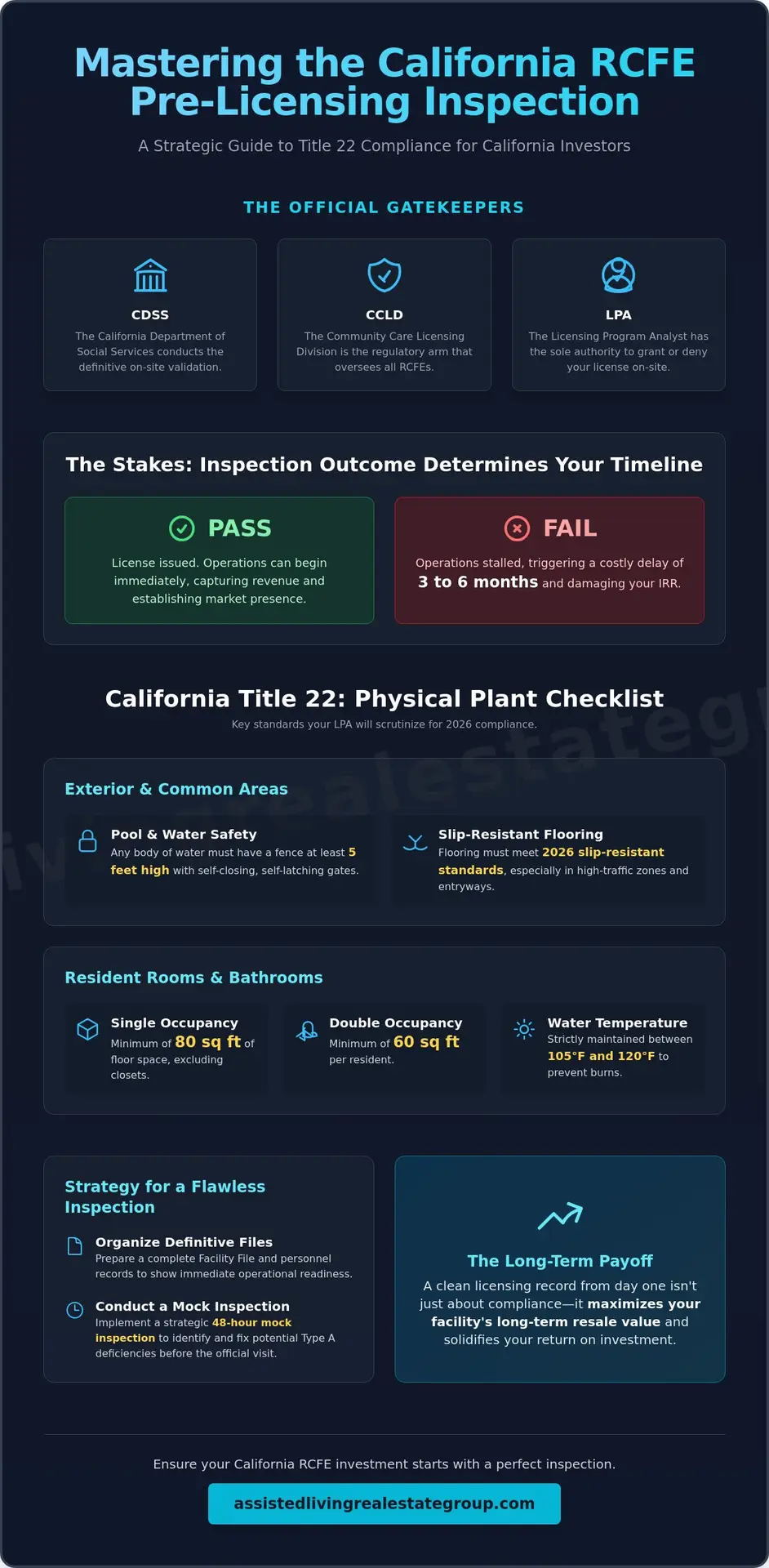
The pre-licensing inspection is the definitive on-site validation conducted by the California Department of Social Services (CDSS). It’s the precise moment where your strategic planning meets regulatory reality. This isn’t a casual visit; it’s a rigorous assessment where every square foot of your property is scrutinized against Title 22 standards. Utilizing a precise RCFE pre-licensing inspection checklist California is no longer optional; it’s a survival requirement for the modern investor who values both time and capital.
The Licensing Program Analyst (LPA) acts as the primary gatekeeper in this process. They don’t just check boxes; they evaluate the operational integrity of your facility to ensure it can provide safe, dignified care. Their decision carries total weight. A positive report triggers the issuance of your license, while a negative one can stall your revenue for months. You aren’t just passing a test; you’re proving that your high-capital investment is a viable, safe environment for California’s aging population.
The Role of the Community Care Licensing Division (CCLD)
The CCLD operates as the regulatory arm of the CDSS, tasked with overseeing all Residential Care Facilities for the Elderly (RCFE) across the state. Your assigned LPA has the legal authority to grant or deny your license based on this single walkthrough. It’s vital to remember that this inspection is entirely separate from your local fire marshal’s clearance. While the fire marshal focuses on egress and suppression, the LPA focuses on the holistic safety and operational readiness of the physical plant. They are looking for a seamless alignment between your documented policies and the actual physical environment.
Why 2026 Standards Require a Higher Level of Diligence
The regulatory climate in 2026 has shifted toward heightened enforcement and granular oversight. New Title 22 updates now mandate stricter climate control systems and robust backup power solutions to protect vulnerable residents during California’s frequent grid stresses. There is also a profound move toward person-centered care environments. This means the LPA will look for more than just “clinical” compliance. They want to see a home-like atmosphere that promotes resident autonomy while maintaining strict safety protocols.
Precision matters. A failed inspection doesn’t just hurt your pride; it typically delays your ability to accept residents by three to six months. In a high-barrier market, that’s a massive hit to your internal rate of return. A perfect inspection on the first attempt sets a standard of excellence that defines your brand’s reputation from day one. It signals to families and placement agents that your facility is a premium, high-level choice in a competitive landscape.
Physical Plant Standards: Creating a Compliant and Compassionate Environment
Transforming a residential property into a high-yield care environment requires more than aesthetic upgrades; it requires surgical precision. Your RCFE pre-licensing inspection checklist California must start at the property line. This includes ensuring exterior grounds are safe and professionally maintained; for example, a high-quality irrigation setup from Aquamax Sprinkler Systems can prevent the hazards associated with manual watering while boosting curb appeal. California law also mandates that any pool or body of water be secured by a fence at least five feet high with self-closing, self-latching gates that open away from the water. Inside the facility, common areas must balance luxury with safety. Lighting must be bright enough to accommodate elderly vision, while flooring must meet the 2026 slip-resistant standard, particularly in high-traffic zones and entryways.
Bedrooms aren’t just sleeping quarters; they’re private sanctuaries that must meet strict Title 22 dimensions. Single rooms require at least 80 square feet of floor space, while double rooms need 60 square feet per resident, excluding closets and bathrooms. Every room must have direct window access for light and ventilation. In the bathrooms, the margin for error is zero. Maintaining a meticulous RCFE pre-licensing inspection checklist California ensures you don’t overlook grab bar placement or water temperature limits. Water must be strictly maintained between 105°F and 120°F. Temperatures above this range are a major Type A deficiency that can halt your licensing process instantly.
Safety and Security: The Non-Negotiables
Smoke detectors and carbon monoxide alarms must be interconnected and functional in every sleeping room and hallway. All toxic chemicals, including simple cleaning supplies, must remain under lock and key at all times. A unique California requirement involves self-closing doors on exits leading to high-risk areas, like garages, to prevent resident wandering. You can verify these specific walkthrough requirements using the official CDSS Pre-Licensing Inspection Tool to ensure your facility mirrors the analyst’s expectations.
Kitchen and Food Service Compliance
The kitchen is the heart of the home, but to the CDSS, it’s a high-stakes utility. Refrigerators must maintain 40°F or below, with a visible thermometer inside. You must demonstrate a 7-day supply of non-perishable food and a 2-day supply of perishables on the day of inspection. This isn’t just about compliance; it’s about operational resilience. If you’re looking to acquire a property that already meets these rigorous standards, consider exploring turnkey business acquisitions to bypass the initial construction hurdles and move straight to resident placement.
Administrative and Operational Readiness: Beyond the Physical Building
While a pristine physical plant creates the first impression, your administrative infrastructure secures the license. The RCFE pre-licensing inspection checklist California extends deep into your record-keeping systems. An LPA will expect to see a meticulously organized Facility File that contains your latest insurance certificates, business licenses, and the comprehensive Disaster and Mass Casualty Plan (LIC 610). This document must be readily accessible; it’s your blueprint for resident safety during California’s wildfires or seismic events. You’re not just proving you have a building; you’re proving you have a sophisticated, resilient operation.
Medication management is another high-scrutiny area. You must have clearly defined policies for storage, logging, and destruction. All medications must be centrally stored in a locked container, and your Medication Administration Records (MAR) templates must be ready for use. Understanding the nuances of California RCFE Laws and Regulations is critical here. If your destruction policy doesn’t align with current Title 22 standards, it signals a lack of operational maturity that can trigger further investigation into your management capabilities.
The Essential Paperwork Checklist
Your RCFE Administrator Certificate must be current, valid, and prominently posted within the facility. The analyst will compare your Plan of Operation against the actual physical layout of the home to ensure consistency. You’ll also need to present finalized admission agreement templates and a resident register. These documents form the legal backbone of your relationship with future residents and their families. They must be error-free to reflect the premium service model you intend to provide.
Staffing and Training Documentation
Personnel records are a non-negotiable component of the pre-licensing process. You must prove your 24-hour supervision capability with draft staffing schedules that meet Title 22 ratios. Every initial hire needs documented fingerprint clearances, health screenings, and current First Aid and CPR certifications. Don’t overlook the Criminal Record Statement for every adult living or working in the home. This level of diligence protects your residents and your investment, ensuring you enter the market with a clean, professional slate and a RCFE pre-licensing inspection checklist California that is fully satisfied.
Avoiding “Type A” Deficiencies: Strategy for the Day of Inspection
The day your Licensing Program Analyst (LPA) arrives is the culmination of your strategic vision. It’s the moment your investment transitions from a project to a regulated care environment. Success on this day doesn’t happen by accident; it’s the result of a rigorous, proactive approach. Conducting a comprehensive mock inspection exactly 48 hours before the scheduled visit is your strongest defense against unnecessary delays. By running through your RCFE pre-licensing inspection checklist California one last time, you can identify the minor oversights that often lead to “Type A” deficiencies, which are immediate threats to resident health and safety.
Professional etiquette is your secret weapon. View the LPA as a specialized partner rather than an adversary. Transparency and cooperation can often turn a potential deficiency into an “on-the-spot” correction. If the analyst identifies a minor issue, fix it immediately while they’re still on-site. This level of responsiveness demonstrates your operational maturity and commitment to excellence. If a finding is disputed, remain professional and document your evidence. You have the right to appeal through the CCLD Regional Office, but resolving concerns during the walkthrough is always the most efficient path to licensure.
Top 5 Most Common Pre-Licensing Mistakes
- Water Temperature Variance: Water must be strictly between 105°F and 120°F. Even a single degree outside this range is a major compliance failure.
- Incomplete Emergency Readiness: The Disaster and Mass Casualty Plan (LIC 610) must be fully signed, dated, and accessible to all staff.
- Unsecured Hazards: Yard tools, cleaning supplies, or even decorative items with sharp edges must be removed or locked away.
- Medication Storage Errors: Medicine cabinets must be locked, even if the facility has no residents yet.
- Missing Postings: Emergency contact numbers and the facility license (or pending application) must be displayed in a prominent common area.
How to Manage the Walkthrough Like a Professional
Enter the inspection with a dedicated “Inspection Toolkit” containing a calibrated thermometer, a tape measure, and a high-powered flashlight. Take detailed notes alongside the LPA to document every comment and suggestion. This isn’t just about compliance; it’s about building a “clean” licensing record that will be invaluable when you eventually decide to explore RCFE Sales or expansion. Asking for clarification on “Type B” items, which are technical violations, ensures you can reach 100% compliance before the analyst even leaves your driveway. This methodical approach transforms a high-stress event into a controlled, professional victory.
From Pre-Licensing to Profit: Leveraging Your California RCFE Investment
Securing your license is the definitive pivot point where your capital investment transforms into a high-performance business. The rigor you applied to the RCFE pre-licensing inspection checklist California does more than satisfy the CDSS; it establishes the baseline for your facility’s market valuation. In the 2026 regulatory environment, a “clean” licensing record is a premium asset. It signals to sophisticated placement agents and families that your operation is managed with surgical precision. This reputation for excellence is what drives high occupancy rates and justifies the premium service fees that California’s affluent aging demographic is prepared to pay.
Strategic professionals view the pre-licensing phase as the foundation of their exit strategy. Whether you are operating a six-bed boutique home in Orange County or a larger community in Los Angeles, your compliance history is public record. Investors looking for turnkey business acquisitions prioritize facilities that demonstrate a history of zero Type A deficiencies. By mastering the physical plant and administrative standards now, you are effectively “pre-selling” the integrity of your business for a future high-multiple exit. This long-term significance is why expert mentorship is vital during the initial development phase.
Maximizing the Value of Your Licensed Business
While some choose to build from the ground up, many strategic investors realize that a turnkey acquisition can be significantly faster than a new license application. A new license can take up to 12 months to secure, whereas a change of ownership typically concludes in 60 to 120 days. For those currently in the application phase, our RCFE Licensing in California: The 2026 Investor’s Guide to Success provides the necessary roadmap to accelerate your timeline. When it eventually comes time to sell, utilizing a confidential marketing strategy is essential. This ensures your resident census remains stable and your staff stays focused while we identify the right high-net-worth buyer for your asset.
Your Strategic Partner in California Senior Care
Navigating the Southern California market requires more than just a real estate license; it requires a deep understanding of the intersection between ethics and profitability. Teri Szoke and her team function as specialized consultants, offering mentorship that extends far beyond the initial transaction. We help you transition from a state of curiosity about the market to a state of absolute conviction in your operational model. If you are just beginning your journey, The Ultimate Guide to Buying an RCFE Facility in California is your first step toward market entry. The opportunity presented by California’s demographic shift is massive, but it requires a specific roadmap to navigate successfully. Contact us today for a confidential consultation on your RCFE investment and secure your position in this exclusive, high-barrier market.
Mastering the Transition from Compliance to Operational Excellence
Executing the RCFE pre-licensing inspection checklist California with precision is the definitive step toward joining an exclusive market of strategic care providers. You’ve seen that Title 22 compliance isn’t just a regulatory hurdle; it’s the foundation of your facility’s long-term valuation and operational integrity. By aligning your physical plant with 2026 standards and maintaining meticulous administrative records, you position your high-capital investment for maximum occupancy and a high-multiple future exit.
The journey from initial licensure to a successful sale requires a partner who understands the intersection of compassionate care and financial return. With over 25 years of specialized experience in the Southern California market, our team provides the high-level mentorship necessary to navigate complex transactions. We utilize confidential marketing strategies to protect your business value while ensuring you achieve significant financial gain. Secure Your RCFE Investment with Expert Brokerage Guidance and build a refined, premium care enterprise that serves California’s seniors with dignity. Your vision for a successful care home starts with the right roadmap.
Frequently Asked Questions
What is the most common reason for failing an RCFE pre-licensing inspection in California?
Water temperatures outside the mandatory 105°F to 120°F range are the most frequent cause for failing the RCFE pre-licensing inspection checklist California. Analysts also frequently cite unsecured toxic chemicals and missing grab bars in bathrooms as high-priority failures. These “Type A” deficiencies represent immediate safety risks that halt the approval process until you provide documented proof of correction, often delaying your opening by several weeks.
How long does the RCFE pre-licensing inspection take to complete?
A standard inspection typically takes between two and four hours to complete. The duration depends largely on the number of licensed beds and the complexity of your physical plant. Smaller six-bed facilities move faster; however, larger communities require a more extensive walkthrough of multiple wings, common areas, and specialized kitchen facilities. Having all your documentation organized in a single Facility File can significantly streamline this process.
Do I need a fire clearance before the pre-licensing inspection can happen?
Yes, you must secure fire clearance from your local fire marshal before the CDSS will schedule your final walkthrough. The Licensing Program Analyst (LPA) requires confirmation that your facility meets all California fire safety codes, including proper egress and suppression systems. This clearance is a non-negotiable prerequisite that ensures the physical building is fundamentally safe for senior occupancy before the state evaluates your operational readiness.
Can I have residents in the home during the pre-licensing walkthrough?
No, it’s illegal to have residents living in the facility during the pre-licensing inspection. You cannot provide care or supervision to residents before your RCFE license is officially issued and in your possession. While the facility must be fully furnished and operationally ready to demonstrate compliance, it must remain vacant of residents until you receive formal approval and your license number from the CCLD.
What happens if the LPA finds a “Type A” deficiency during the inspection?
A Type A deficiency triggers an immediate requirement for correction and will stop the issuance of your license. The LPA will issue a formal report detailing the violation, and you must submit a written plan of correction. In most cases, a follow-up visit or detailed photo documentation is required to verify that the hazard has been eliminated before your application can move to the final approval stage.
Is there a fee for the California RCFE pre-licensing inspection?
There is no standalone fee for the inspection itself, as the cost is included in your initial CDSS application fee. For a 1-6 bed facility, this application fee is $495, while larger facilities pay tiered rates such as $990 for 7-15 beds. These fees cover the entire administrative process, including the analyst’s time for the site visit and the subsequent review of your RCFE pre-licensing inspection checklist California.
How much water and food must I have on hand for the inspection?
You must demonstrate a seven-day supply of non-perishable food and a two-day supply of perishable items on the day of inspection. Additionally, California regulations require a one-week supply of potable water, typically calculated at one gallon per resident per day. The LPA will inspect your pantry and storage areas to ensure these supplies are fresh, properly stored, and sufficient for your maximum licensed capacity.