
In California’s 2026 market, a turnkey ARF isn’t just a physical property; it’s a pre-validated regulatory ecosystem that allows you to bypass the years of friction usually required to launch a facility. If you’re searching for a turnkey ARF business for sale, you’ve likely realized that the true value lies in the existing licensure and the professional team already in place. Speed is your greatest asset. You understand that while the demand for Adult Residential Facilities is surging, the barrier to entry remains high due to strict Title 22 enforcement and the daunting licensing transfer timeline.
This guide will show you how to identify high-performing assets in competitive Southern California pockets and evaluate them through the lens of the latest regulatory updates. You’ll discover how to secure off-market deals that others miss and minimize the gap between purchase and operational control. We’ll explore the critical steps to managing the transition, from handling the $50 orientation fees to ensuring your new acquisition meets the dementia-aware standards now required facility-wide under the 2025 updates. By aligning your portfolio with these standards, you achieve the ultimate balance of purpose and profit.
Key Takeaways
- Identify the critical distinctions between ARF and RCFE licensing to ensure your acquisition targets the correct California demographic.
- Learn why a turnkey ARF business for sale provides a competitive edge by offering an operational team and existing Title 22 compliance.
- Analyze the financial interplay between Private Pay and Regional Center funding to optimize your facility’s revenue in high-demand markets.
- Navigate the standard 60 to 90 day due diligence period with a roadmap designed to verify regulatory standing before the close of escrow.
- Access exclusive off-market opportunities by partnering with specialized care brokers who understand the intersection of ethics and profitability.
What Defines a Turnkey ARF Business in California?
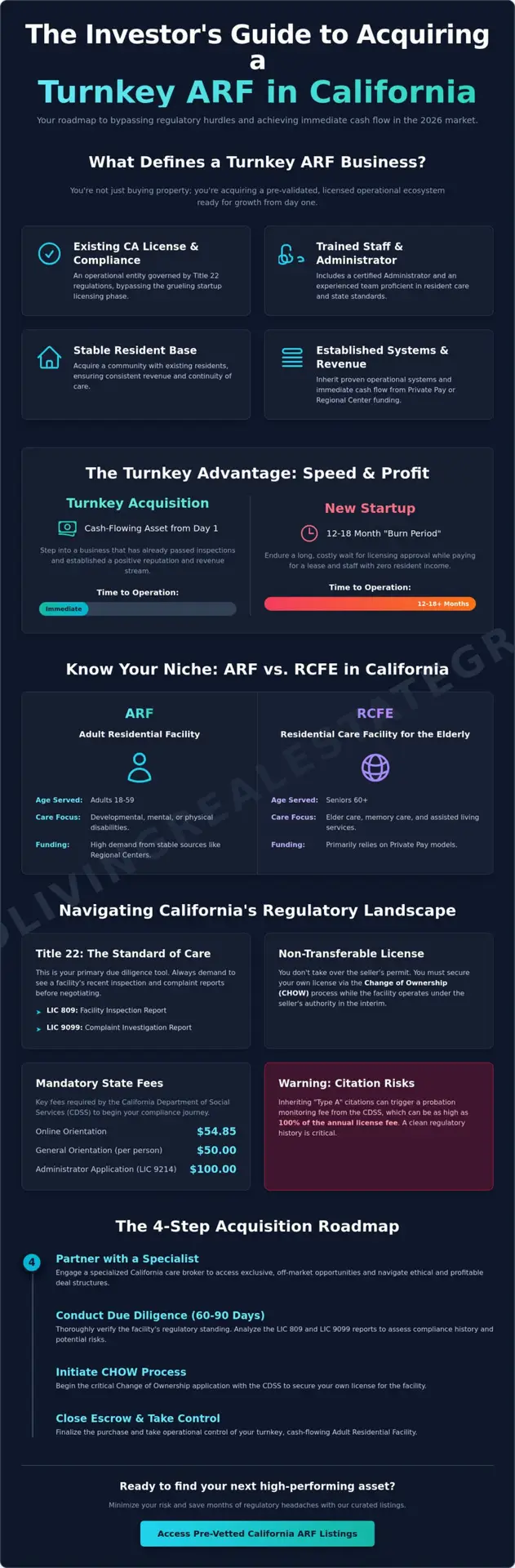
In California, an Adult Residential Facility (ARF) is a specialized Residential Care Facility governed by Title 22 regulations. These facilities provide 24-hour non-medical care to adults aged 18 through 59 who may have developmental, mental, or physical disabilities. When you evaluate a turnkey ARF business for sale, you aren’t just buying real estate; you’re acquiring a licensed operational entity. A true turnkey acquisition includes a trained staff, a stable resident base, and established systems that ensure continuity of care from day one. This immediate operational capacity bypasses the grueling 12 to 18 month licensing window required for new startups, allowing you to focus on growth rather than bureaucratic hurdles.
The financial advantage of a turnkey acquisition is significant. Instead of enduring a “burn period” where you pay for a lease and staff without resident income, you step into a cash-flowing asset. You inherit a business that has already passed its initial inspections and established its reputation within the local community. This pre-validated regulatory ecosystem is the most secure way to enter the California care market while ensuring a positive social impact.
ARF vs. RCFE: Understanding the California Niche
The primary distinction lies in the age of the population served. While a Residential Care Facility for the Elderly (RCFE) serves seniors 60 and older, an ARF focuses on a younger demographic with unique service requirements. In Southern California, the demand for ARFs is surging, particularly for facilities catering to behavioral health or developmental disabilities. Investors often prefer ARFs because they tap into consistent funding streams, such as Regional Centers, which can offer more stability than purely private-pay models. Regulatory differences also impact your bottom line. All new owners must complete an online orientation and pay a fee of $54.85, followed by a general orientation fee of $50.00 per person. These small but mandatory steps are the foundation of your compliance journey.
The Anatomy of a Turnkey Operation
A successful turnkey transition hinges on the Administrator. Under California law, every facility must have a certified Administrator who has submitted the LIC 9214 form and paid the $100 application fee within 30 days of passing their exam. In a turnkey deal, you inherit an Administrator who already understands the facility’s culture and the residents’ specific needs. You must also evaluate staff longevity and training. High-performing facilities retain employees who are already proficient in Title 22 standards, including the 2025 updates regarding resident reappraisals every 12 months. Keeping this team intact is the most effective resident retention strategy. It maintains the human connection that defines high-quality care while protecting your investment’s cash flow during the ownership transition.
Navigating California’s Regulatory Landscape for ARF Sales
Mastering California’s Regulatory Landscape is the single most important hurdle for any serious investor. The California Department of Social Services (CDSS) doesn’t just issue permits; they enforce a living standard that defines your operational success and long-term liability. When you identify a turnkey ARF business for sale, you’re looking for an asset that has already integrated these complex mandates into its daily rhythm. You must remember that California licenses are non-transferable. You don’t simply take over the seller’s permit. Instead, you undergo a Change of Ownership (CHOW) process. This requires you to secure your own license while the facility continues to operate under the seller’s authority during the interim period.
Strategic investors prioritize assets with a clean regulatory history. This minimizes the risk of inherited “Type A” citations that could trigger a probation monitoring fee, which CDSS sets at 100% of the annual fee. If you’re looking for a smoother path to entry, exploring pre-vetted ARF listings can save you months of regulatory headache and potential licensing delays.
Title 22 Compliance: The Non-Negotiable Standard
Title 22 compliance is your primary due diligence tool. You should demand to see the facility’s recent LIC 809 (Facility Inspection Report) and LIC 9099 (Complaint Investigation Report) early in the negotiation. These documents reveal the history of the facility and how effectively the current owner resolved past issues. A clean record suggests a robust Plan of Operation. This is the foundational document you’ll need to update for your own application. For 6-bed facilities, physical plant requirements are strict. Ensure the property meets all fire clearance standards and accommodates the 2025 Title 22 updates regarding resident reappraisals before you sign an LOI.
The Re-Licensing Timeline in 2026
In 2026, the re-licensing timeline in Southern California typically spans 60 to 120 days. This depends heavily on the volume at your local regional office in pockets like Riverside or Los Angeles. Delays often occur when buyers submit incomplete application packets or fail to pay mandatory fees, such as the $54.85 online orientation fee or the $100 administrator certification fee. To bridge the gap between purchase and operational control, many investors use an interim management agreement. This allows the business to continue generating revenue while the CDSS processes your paperwork. For a deeper look at how these timelines compare to other care categories, review our guide on RCFE Licensing in California. Managing this period with precision ensures that your cash flow remains uninterrupted while you transition into full operational authority.
Financial Evaluation: Revenue Drivers for CA ARFs
Evaluating the financial health of a care facility requires looking far beyond a standard rent roll. When you analyze a turnkey ARF business for sale, you’re assessing a sophisticated revenue mix that balances private-pay residents with state-funded programs. Cash flow is king. In high-demand pockets like Riverside, a 6-resident facility can generate approximately $21,000 in monthly gross income. Meanwhile, facilities in higher-cost areas like Richmond in Contra Costa County have reported gross monthly incomes as high as $42,000. These figures illustrate the massive impact of geographic location and resident acuity on your bottom line.
While the California Department of Social Services oversees the licensing that permits you to operate, your actual revenue is dictated by the “Level of Care” tiers assigned to each resident. Higher acuity residents require more intensive staffing, but they also command significantly higher monthly rates. You must audit the existing expense structure with precision. Labor remains your largest line item, followed by specialized insurance and the rising costs of regulatory compliance, such as the mandatory $25 fee for any change of capacity requests.
Regional Center Dynamics in Southern California
Regional Centers play a pivotal role in the California ARF ecosystem by providing a consistent stream of resident placements and funding. For many owners, this state-backed revenue offers a layer of financial security that private-pay models lack. Vendorization is the process where a new owner is approved to receive these funds. It’s a critical step in the acquisition timeline. If the facility you’re eyeing is already vendorized, you inherit a valuable relationship with the local Regional Center. Understanding these nuances is essential for long-term success, as detailed in our market guide on investing in an ARF. This funding model ensures that even during economic shifts, your occupancy remains stable.
Valuing the Business vs. the Real Estate
Valuing a turnkey ARF business for sale involves a dual-layered approach. You aren’t just buying a building; you’re buying an EBITDA-generating machine. Standard valuations typically use a multiplier of the business’s earnings plus the fair market value of the real estate. Look for “hidden” value in facilities with under-market rents or those currently operating at low occupancy. If a facility has empty beds, you have an immediate opportunity to increase the asset’s value through strategic placement. During due diligence, ask the seller for three years of profit and loss statements and current resident care agreements. This data confirms the stability of the income and highlights any potential for operational optimization after you take control.
The Acquisition Roadmap: From LOI to Closing
Once you identify a turnkey ARF business for sale that aligns with your investment goals, the transition from evaluation to execution begins with a specialized Letter of Intent (LOI). Drafting an LOI for a turnkey ARF business for sale requires more than just a purchase price; it must explicitly account for the “Change of Ownership” (CHOW) process and the dual-track nature of the escrow. You aren’t just buying land; you’re buying a regulated service. Your agreement should define the 60 to 90 day due diligence window required to verify the facility’s standing with the CDSS and ensure all resident files are compliant with Title 22 standards.
Coordinating with the California Department of Social Services during escrow is vital. While the real estate transaction might close relatively quickly, the business transfer remains contingent upon your successful licensure. This “dual-track” escrow requires a specialized approach where funds are often held until the CDSS acknowledges the application. To navigate these complexities successfully, many professionals start by reviewing current turnkey ARF opportunities that have already undergone initial screening for regulatory health.
The Importance of Confidentiality in ARF Sales
Public listings are the enemy of stability in the care industry. If staff members or residents discover a facility is for sale through a generic marketplace, it can trigger immediate turnover and resident anxiety. This instability directly devalues the asset you’re trying to buy. A specialized care broker manages this risk by using “blind” profiles, which describe the financial performance and geographic pocket without revealing the specific address until a non-disclosure agreement is signed. Maintaining this veil of secrecy protects the facility’s culture and ensures you inherit a stable, high-functioning team. For those looking at adjacent care models, the same principles apply, as explored in The Ultimate Guide to Buying an RCFE Facility in California.
Staff and Resident Transition Planning
Success in the first 100 days depends on your transition strategy. You don’t just show up on Day 1 and start making changes. Stability is the goal. Strategic buyers utilize a “shadowing” period during the final weeks of escrow. This allows you to learn the operational rhythm, understand resident preferences, and build rapport with the Administrator. When the change is finally announced, it should be presented as a commitment to continued excellence rather than a corporate takeover. By ensuring continuity of care, you protect your license standing and the long-term significance of your investment. This methodical approach transforms a simple transaction into a legacy of compassionate service.
Why Partner with a Specialized California Care Broker?
High-barrier markets require specialized keys. General commercial brokers often treat care facilities as standard Title 1 real estate assets, overlooking the intricate Title 22 mandates that dictate the business’s actual value. When you search for a turnkey ARF business for sale, you’re looking for a regulated ecosystem where the license, staff, and resident care agreements are in perfect alignment. A specialized broker doesn’t just find you a building; they find you a pre-validated investment. We provide access to exclusive, off-market listings in high-demand Southern California pockets that never reach public portals, ensuring you aren’t competing for picked-over assets.
Navigating the dual-escrow process is where expert guidance becomes indispensable. You’re managing two simultaneous tracks: the real estate closing and the business transfer. Any misalignment between these two can result in costly delays or even the loss of your CDSS application standing. At Assisted Living Real Estate Group, we bridge the gap between the analytical mind of the investor and the operational needs of the provider. We ensure that every document, from the Plan of Operation to the updated resident reappraisal records, meets the 2026 enforcement standards before you commit your capital.
Beyond the Listing: Strategic Consulting
The acquisition is only the first step. Our role as your strategic partner extends into the critical relicensing period post-acquisition. As a leading RCFE Broker in California, our team understands the nuances of facility setup and the specific requirements of Southern California’s regional offices. We leverage 25 years of specialized care facility experience to help you navigate the transition of the Administrator and the retention of a Title 22-trained team. This seasoned expertise ensures your new asset maintains its operational rhythm while you focus on scaling your portfolio.
Securing Your Legacy in California Care
Investing in California’s care market is a commitment to both financial significance and human value. The 2026 demographic shift presents an unprecedented opportunity for strategic professionals to secure high-performing assets that serve a vital social need. By acquiring a turnkey ARF business for sale, you position yourself at the intersection of ethics and profitability. You aren’t just buying a cash-flowing asset; you’re securing a legacy of compassionate care in a market with a massive, untapped potential. To begin your journey, schedule a confidential consultation with Teri Szoke. Let’s identify the right roadmap for your California acquisition and ensure your transition into the care industry is both seamless and successful.
Securing Your Position in California’s Care Economy
Acquiring a care facility in California is more than a real estate transaction; it’s a strategic move into a high-barrier, high-reward market. By focusing on established assets, you bypass the friction of startup licensing and step directly into a cash-flowing ecosystem. Success hinges on your ability to navigate Title 22 regulations and manage the delicate transition of staff and residents with absolute confidentiality. You’ve seen that a pre-validated regulatory environment is the ultimate foundation for scaling your portfolio.
Finding the right turnkey ARF business for sale requires a partner who understands the intersection of ethics and profitability. With over 25 years of specialized experience in the California market, we provide the expert guidance and exclusive confidential marketing strategies needed to secure high-value assets. We help you navigate the complexities of dual-track escrows and ensure your portfolio is positioned for the massive demographic shifts ahead.
Your journey toward a significant social and financial impact starts with the right roadmap. Take the first step today and View Exclusive Turnkey ARF Listings in California to see how we can help you build a legacy of care. The opportunity in 2026 is yours to claim.
Frequently Asked Questions
Can I buy an ARF in California without prior care experience?
Yes, you can acquire an Adult Residential Facility as an investor without having a background in direct care. While the owner doesn’t need prior experience, California law requires that the facility’s daily operations are managed by a certified Administrator. This individual must have passed the state exam, submitted the LIC 9214 form, and paid the $100 application fee to ensure the business remains in compliance with Title 22 standards.
How long does it take to transfer an ARF license in California?
The Change of Ownership process typically takes between 60 and 120 days to complete. This timeline depends on the efficiency of your local regional office and the accuracy of your application packet. Because licenses are non-transferable, you’ll need to secure your own license while the facility continues to operate under the seller’s authority during the interim period to avoid service interruptions.
What is the difference between an ARF and an RCFE for an investor?
The primary difference lies in the age and needs of the residents you serve. ARFs cater to adults aged 18 to 59 with various disabilities, whereas RCFEs are dedicated to seniors 60 and older. From an investment perspective, ARFs often benefit from stable Regional Center funding streams, while RCFEs frequently rely more heavily on private-pay structures and the growing demand for specialized memory care.
Is financing available for turnkey ARF businesses in California?
Lenders frequently provide SBA and conventional commercial loans for care facility acquisitions. Financial institutions prioritize a turnkey ARF business for sale that demonstrates consistent cash flow and a clean regulatory history. You should be prepared to present three years of profit and loss statements and recent inspection reports to prove the asset’s viability and secure favorable terms for your acquisition.
What are the staffing requirements for a 6-bed ARF in Southern California?
California regulations require 24-hour non-medical supervision provided by a team trained in Title 22 standards. As of 2025, staff must also be proficient in dementia-aware practices, even if the facility doesn’t have a dedicated memory care unit. Staffing levels must always be sufficient to meet the specific “Level of Care” needs of your residents, which directly impacts your facility’s operational costs and revenue potential.
Do I need to own the real estate to operate a turnkey ARF?
You don’t need to own the physical property to run a successful care business. Many investors utilize lease-to-own opportunities or long-term commercial leases specifically designed for care facilities. If you choose to lease, your agreement must be structured to satisfy CDSS requirements, ensuring you have the necessary control over the physical plant to maintain licensing standards and resident safety.
What happens to the residents when I buy an existing ARF business?
Residents typically remain in the facility during a turnkey acquisition to ensure continuity of care. This stability is vital for maintaining the business’s value and its standing with the California Department of Social Services. A well-executed transition plan includes a shadowing period where you learn the residents’ routines, which helps prevent the anxiety that can lead to move-outs during an ownership change.
How do I verify if a turnkey ARF is in good standing with the CDSS?
You can verify a facility’s standing by requesting and reviewing its LIC 809 and LIC 9099 reports. These documents provide a transparent history of facility inspections and any complaint investigations conducted by the Department of Social Services. When evaluating a turnkey ARF business for sale, these reports are your most valuable due diligence tools for identifying potential Type A citations or recurring compliance issues.