
What if the most valuable part of your facility isn’t the real estate, but the “Regulatory Shield” you’ve spent years constructing? Many owners mistakenly believe the Southern California median home price of $880,000 sets the ceiling for their exit; however, your operational efficiency is what truly dictates your multiple. If you are focused on how to increase RCFE sale price California buyers are willing to pay, you must shift your focus from simple property value to your EBITDA and clinical reputation. With over 6 million seniors in California and only 8,000 licensed facilities, the demand for high-performing, premium assets has never been more intense.
You’ve likely felt the weight of California’s 90-day rate notice law and wondered if it might dampen your valuation during a transition. It’s a valid concern, just like the fear that staffing turnover could erode your hard-earned equity. This guide provides the strategic roadmap to master the financial levers that drive 3.0x to 4.5x EBITDA multiples for service businesses in our state. We’ll detail how to institutionalize your operations, leverage fee-for-service models, and determine whether selling your business and real estate together or separately will maximize your final payout while protecting your legacy and your residents.
Key Takeaways
- Understand the “Hybrid Value” model to ensure you’re capturing the full worth of both your real estate and your licensed business entity.
- Learn how to manage the 2026 SB 1406 90-day notice requirement to normalize resident rates and optimize your EBITDA before entering the market.
- Discover how a pristine Title 22 compliance history and pre-sale self-audits can eliminate buyer leverage and protect your asking price.
- Identify the specific physical upgrades, such as ADA-compliant modifications, that generate the highest return on investment in the California market.
- Explore confidential marketing techniques for how to increase RCFE sale price California experts use to attract high-net-worth buyers while maintaining facility stability.
The Valuation Framework: How RCFE Exit Value is Calculated in California
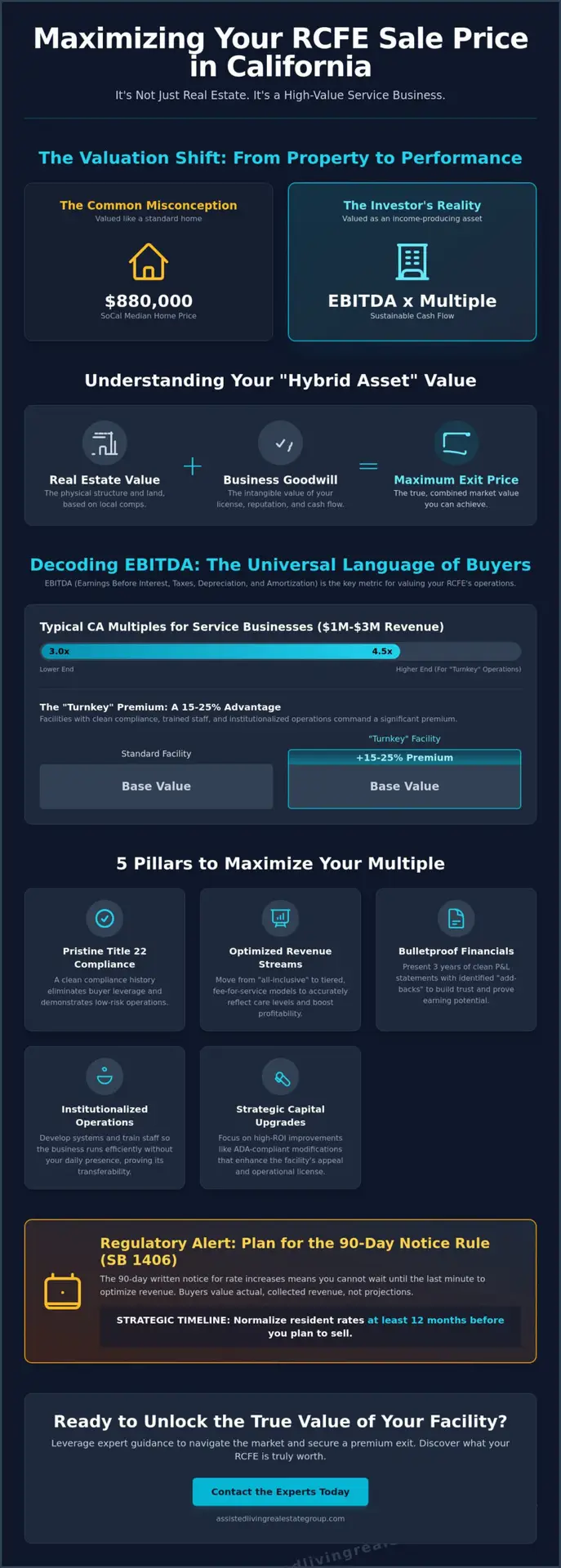
In the competitive California market, your facility isn’t just a property; it’s a sophisticated “Hybrid Asset.” This means your exit value is a calculation of the underlying real estate and the intangible goodwill of the business operation. To understand how to increase RCFE sale price California investors are willing to offer, you must master the interplay between these two components. While a standard home in Southern California might sell based on comparable residential sales, Residential Care Facilities for the Elderly (RCFEs) are valued primarily as income-producing entities. Success lies in shifting the buyer’s perspective from square footage to sustainable cash flow.
Institutional buyers and private equity groups focus on EBITDA. This metric, which stands for Earnings Before Interest, Taxes, Depreciation, and Amortization, serves as the universal language for CA buyers. In 2026, service businesses with revenues between $1M and $3M are trading at multiples of 3.0x to 4.5x EBITDA. In high-demand zones like Orange County or San Diego, compressed “Cap Rates” mean buyers accept lower immediate yields for the security of a stable, needs-based asset. A truly “Turnkey” operation, featuring a clean Title 22 compliance record and fully trained staff, frequently commands a 15-25% premium over distressed or semi-operational facilities because it reduces the buyer’s immediate risk and administrative burden.
Separating Real Estate Value from Business Goodwill
Appraisers in California look at your facility through two distinct lenses. The first is the physical structure’s value, which often aligns with local residential benchmarks, like the $880,000 median price seen in Southern California. The second lens is the “Bed Value.” For a 6-bed facility, the business goodwill is often calculated as a premium per licensed bed. In contrast, larger assisted living centers with 75 to 100 beds are evaluated strictly on their Net Operating Income (NOI). Maximizing your exit means proving that your business generates significantly more cash flow than the real estate would as a simple rental property. This distinction is vital for capturing the full equity you’ve built.
EBITDA Optimization for the 2026 Market
Your financial statements must be bulletproof to survive professional due diligence. When you analyze how to increase RCFE sale price California buyers prioritize, it becomes clear that financial clarity is the ultimate leverage. You must identify “add-backs” to reveal the true earning potential of your facility. These are one-time or personal expenses, such as a specific vehicle lease or non-recurring repairs, that won’t carry over to the new owner. Normalizing your financials involves presenting three years of clean, verifiable P&L statements. This transparency builds the trust necessary to secure top-dollar offers, proving your facility is a high-yield investment rather than a management burden.
Optimizing Revenue Streams: Rate Structures and the 90-Day Notice Rule
The regulatory environment in 2026 demands a more disciplined approach to revenue management. SB 1406 has extended the written notice requirement for rate increases to 90 days, a significant shift from previous years. This means your strategic timeline for a sale must account for this three-month delay before any revenue adjustment reflects on your bottom line. If you are looking for how to increase RCFE sale price California investors will respect, you cannot rely on “pro-forma” projections. Sophisticated buyers discount projected revenue heavily; they want to see actual collections. By normalizing your rates 12 months before an exit, you ensure your trailing financials showcase a high-yield, stable business rather than a collection of legacy contracts that underperform the current market.
Moving away from “all-inclusive” pricing is a critical step toward protecting your margins. Tiered pricing models allow you to bill for the actual intensity of care provided, ensuring that high-acuity residents aren’t eroding your profitability. This level of granular financial reporting signals to a buyer that your facility is professionally managed and scalable. It transforms your operation from a simple care home into a sophisticated investment vehicle.
The 12-Month Rate Increase Roadmap
A successful exit begins a year before the listing. First, conduct a comprehensive local market survey to identify where your current rates sit relative to competitors in your specific California county. Second, issue the required 90-day notice to residents as mandated by Health & Safety Code 1569.655. Finally, you must document the increased Net Operating Income (NOI) for at least two full quarters. This tangible proof of revenue growth is the most effective way to justify a higher valuation multiple during negotiations.
Diversifying Revenue Beyond Basic Care
Capturing maximum value requires looking beyond the monthly room rate. Implementing formal “Level of Care” (LOC) assessments ensures you’re billing for every minute of nursing assistance and medication management provided. You can also introduce ancillary income streams, such as incontinence supply programs or specialized activity fees. When considering how to increase RCFE sale price California operators often overlook the impact of specialization. Pursuing a specialized memory care certification can justify rates up to 30% higher than standard assisted living in California. If you’re unsure where your facility stands in today’s market, reaching out to an expert for a confidential portfolio review can clarify your path to a premium exit.
Institutionalizing Operations: Mitigating Regulatory Risk for Higher Multiples
Buyers in the 2026 market aren’t just purchasing a building; they’re buying your compliance history. A “clean” Title 22 record is your most potent negotiating tool because it represents a lack of future liability. When you consider how to increase RCFE sale price California investors are willing to pay, you must view your regulatory standing as a financial asset. Any lingering “Type A” or “Type B” deficiencies act as an immediate discount on your valuation. Professional investors will use your CDSS inspection history to chip away at your asking price during due diligence. By conducting a rigorous self-audit before you list, you eliminate their leverage and prove your facility is a low-risk, high-reward acquisition.
High staff turnover is another red flag that screams operational instability. In California, where labor laws are stringent and the cost of training is high, a stable team is a significant competitive advantage. Buyers look for facilities where caregivers are invested in the mission. Retention directly impacts your EBITDA by lowering recruitment costs and improving the resident experience. When the staff stays, the residents stay, and the valuation grows. If you want to understand how to increase RCFE sale price California experts recommend, focus on creating a workplace culture that retains talent.
The Pre-Sale Regulatory Audit
Review your last three years of California Department of Social Services (CDSS) inspections with a critical eye. Ensure every staff file is updated to meet 2026 standards, which require 40 hours of training within the first 30 days of employment. If your administrator’s certification is nearing its two-year renewal, ensure the 40 hours of continuing education are documented. Correcting these administrative gaps now prevents a “fire sale” atmosphere later. Investors want to see that your facility runs like a well-oiled machine, independent of your daily presence.
Standard Operating Procedures (SOPs) as an Asset
Institutionalizing your knowledge into a “Business-in-a-Box” manual creates immense value. This manual should include documented dietary plans, emergency evacuation procedures, and resident admission workflows that strictly follow the 2026 RCFE Regulations & Health and Safety Codes Manual. A transferable administrator who can stay through the transition is a massive asset. Insights from The Ultimate Guide to Buying an RCFE Facility in California suggest that buyers prioritize facilities with documented workflows. Professional SOPs justify a premium multiple because they guarantee the continuity of care that protects both residents and the buyer’s investment.
Strategic Capital Improvements: Enhancing the Real Estate Asset Value
The physical structure of your facility is the vessel for your business cash flow. While EBITDA and regulatory compliance dictate your multiple, the real estate asset provides the floor for your valuation. In the high-stakes Southern California market, curb appeal isn’t just about aesthetics; it’s about signaling exclusivity and refined service to high-net-worth buyers. If you are analyzing how to increase RCFE sale price California investors will pay, you must view capital improvements as strategic multipliers rather than mere expenses. A well-executed renovation can remove the “reasons to say no” that buyers use to chip away at your price during the inspection period.
Functional upgrades often yield the highest return on investment. Widened doorways and ADA-compliant walk-in showers aren’t just accessibility features; they expand your market by allowing you to accept higher-acuity residents who require more intensive care. Similarly, addressing deferred maintenance is vital. A $10,000 roof repair or HVAC update performed before the listing can prevent a $50,000 price reduction during the due diligence phase. Buyers over-calculate the cost and headache of repairs, so delivering a pristine property protects your equity.
High-Impact Interior Refurbishments
Modern RCFE interiors should feel like boutique hotels rather than clinical nursing homes. Replacing dated, porous carpeting with high-durability, non-slip luxury vinyl plank (LVP) is a priority for infection control and ease of maintenance. This change alone transforms the visual appeal and air quality of the facility. Additionally, transitioning to circadian-rhythm-supportive LED lighting can improve resident sleep patterns and mood. These sophisticated details demonstrate to a buyer that you’ve built a premium service model that justifies higher resident rates.
Outdoor Living and California Lifestyle Features
The California lifestyle is a major selling point for families choosing a care home. Optimizing secure outdoor spaces, often referred to as “Wander Gardens,” is essential for memory care facilities. These areas must be both beautiful and functional, utilizing drought-tolerant, high-end landscaping that thrives in the Southern California climate while minimizing water costs. Every outdoor exit and gate must meet the latest CA Fire Marshal requirements for RCFEs to ensure a seamless transfer of the license. If you’re ready to identify which upgrades will move the needle for your specific property, consider a professional asset evaluation to prioritize your capital spend.
Technology integration has become a standard expectation for the 2026 buyer. High-speed Wi-Fi, smart monitoring systems, and a fully integrated Electronic Health Record (EHR) system add tangible value. These tools suggest that the facility is modern, efficient, and ready for a smooth operational hand-off.
The Professional Exit: Leveraging Confidential Marketing to Secure Premium Offers
A public “For Sale” sign is the fastest way to devalue a residential care facility. In the tight-knit California care community, rumors of a sale can trigger immediate staff flight and resident move-outs, eroding the very EBITDA you’ve worked to build. If you want to know how to increase RCFE sale price California experts recommend, you must prioritize a “stealth” marketing approach. By keeping the transition confidential, you maintain operational stability and preserve the premium multiple that a high-performing, fully-occupied facility commands. The 2026 market is a definitive “Seller’s Market,” as the oldest Baby Boomers turn 80, but capturing that value requires a surgical approach to the exit.
The “Escrow Dance” in California is uniquely complex due to the intersection of real estate law and CDSS licensing requirements. A general commercial broker often lacks the technical vocabulary to explain “Bed Value” or “Regulatory Shields” to a lender, which can stall or kill a deal during the financing stage. You need a partner who can screen for “Qualified Buyers” with the liquid capital and experience to pass the state’s rigorous background checks. This ensures you aren’t wasting time with “Tire Kickers” who want to browse your proprietary rate structures without the financial means to close.
The Power of Confidentiality
Maintaining a quiet sale process is about protecting your most valuable assets: your people and your reputation. Using strict Non-Disclosure Agreements (NDAs) allows you to share sensitive financial data only with vetted, high-net-worth individuals. This prevents “Staff Flight” by ensuring your caregivers feel secure in their roles until a firm deal is in place. It also avoids the “Going Out of Business” misconception that often plagues public listings, keeping your census high and your revenue predictable throughout the transition.
Choosing the Right Brokerage Partner
General commercial brokers fail to understand the nuances of Title 22 or the specific 2026 RCFE licensing fees that impact a buyer’s pro-forma. Success requires a partner with 25+ years of California-specific experience who understands the local market from San Diego to Sacramento. This specialized expertise is the difference between a standard sale and a record-breaking exit. For a deeper dive into the process, review our How to Sell Your Assisted Living Facility in California: A 2026 Strategic Guide. If you’re ready to see the true potential of your asset, contact Teri Szoke for a confidential valuation of your RCFE to begin your journey toward a clean, lucrative exit.
Timing is everything. With the current demographic shifts and the relative scarcity of licensed facilities in the state, your 2026 exit window is a rare opportunity to capture maximum equity. By institutionalizing your operations and leveraging a confidential marketing strategy, you don’t just sell a business; you transfer a legacy of care that justifies a premium price.
Securing Your Legacy: The Path to a Premium California Exit
The window for a high-multiple exit in the California market is currently open. You’ve learned that maximizing your valuation requires a synchronized focus on EBITDA normalization, Title 22 compliance, and strategic capital improvements. By navigating the 90-day rate notice law and institutionalizing your workflows, you transform a simple residential care home into a sophisticated, turnkey investment asset. Mastering how to increase RCFE sale price California investors are eager to pay is the final step toward capturing the full equity of your life’s work.
Capturing this value requires a specialized brokerage partner who understands the nuances of our state’s regulatory environment. With 25 plus years of exclusive focus on the California senior care market, we’ve successfully guided owners of 6-bed and mid-sized facilities to high-multiple exits. Don’t leave your legacy to chance. Request a Confidential Valuation and Exit Strategy Consultation today to see the true market value of your facility. Your commitment to compassionate care has built a significant asset; it’s time to ensure you receive the financial reward that reflects your contribution.
Frequently Asked Questions
How is an RCFE valued differently than a standard residential home in California?
An RCFE is valued as a “Hybrid Asset” combining the physical real estate with the intangible goodwill of a licensed business. Unlike a standard home sale based on local neighborhood comps, an RCFE valuation relies on EBITDA and the “Bed Value” of the facility. Professional buyers look at the cash flow stability and the regulatory history of the license. This sophisticated approach ensures the price reflects the facility’s ability to generate significant investment returns.
Can I increase my RCFE rates right before I put the facility up for sale?
You can increase your rates, but you must strictly adhere to SB 1406’s 90-day written notice requirement. Strategic owners implement these increases at least six months before listing to show how to increase RCFE sale price California buyers through documented revenue. Because buyers value actual collections over pro-forma projections, having two quarters of the higher rate on your financial statements is essential for securing a maximum exit multiple.
What is the average Cap Rate for an assisted living facility in Southern California?
Cap rates in Southern California for assisted living assets currently range between 6% and 8% depending on the facility size and location. High-demand areas like Orange County often see rate compression because of the massive demographic shift and limited supply of licensed beds. These lower cap rates signify a premium market position where investors are willing to pay more for the security of a needs-based, high-barrier-to-entry asset.
Do I need to be present for the CDSS licensing transfer during the sale?
The seller must be actively involved in the licensing transition, as the California Department of Social Services (CDSS) requires a specific “Change of Ownership” process. While you don’t physically hand over a license, you must maintain operational compliance until the buyer receives their own license. This transition period is a critical phase of the “Escrow Dance” where seasoned expertise ensures that the facility remains stable and residents are protected.
What are the most common deal-killers in a California RCFE transaction?
The most frequent deal-killers are unresolved “Type A” deficiencies and non-verifiable financial statements. If a buyer’s due diligence team discovers staffing files that don’t meet the 2026 training requirements or undocumented “add-backs” in your profit and loss statements, they will likely withdraw or demand a heavy discount. Maintaining a clean Title 22 record and providing three years of transparent financials are the best ways to protect your equity.
How long does it typically take to sell an RCFE in the current California market?
A typical transaction for a California RCFE takes between 6 and 12 months from the initial listing to the close of escrow. This timeline accounts for the confidential marketing phase, the buyer’s due diligence, and the 90 to 120 days often required for the CDSS license application process. Strategic planning and professional brokerage support can streamline this schedule by ensuring all documentation is ready for immediate review by qualified buyers.
Should I sell my real estate and the RCFE business to the same buyer?
Selling the business and real estate together is generally the most effective way to capture the maximum “Hybrid Value” of the asset. This approach appeals to institutional investors who want full control over the operations and the property. However, some owners choose to sell the business while retaining the real estate to create a long-term lease-to-own care home opportunity, which can provide a steady stream of passive income.
Does having a memory care waiver increase my sale price?
Having a memory care waiver significantly increases your sale price by allowing you to serve a higher-acuity demographic. These specialized services justify rates that are often 30% higher than standard board and care, which directly boosts your EBITDA. When exploring how to increase RCFE sale price California operators find that these waivers create a “Regulatory Shield” that makes their facility more exclusive and attractive to sophisticated healthcare investors.