
The most lucrative real estate opportunity in California right now isn’t found in high-rise apartments; it’s hidden within the walls of a six-bed boutique residential care facility. While the “Silver Tsunami” creates massive demand for senior housing, 2026 brings new challenges like the $16.90 statewide minimum wage and rigorous Title 22 compliance. Understanding RCFE financials is no longer just about tracking expenses; it’s about mastering the art of the “Impact and Income” model to secure high-margin private-pay revenue in a competitive market.
You likely recognize that balancing high-quality care with a 10% to 20% net profit margin requires more than just a standard P&L. We promise to help you master the complexities of California valuations and show you how to accurately separate property value from business goodwill. This guide provides a clear framework for valuing boutique assets, analyzing current ALW reimbursement rates that reach up to $270.80 per day, and building a sustainable legacy in the California market. We’ll start by breaking down the specific operational costs and cash flow strategies that define the state’s most successful care homes.
Key Takeaways
- Learn how to treat your facility as a dual-asset class, balancing California real estate appreciation with high-margin boutique business operations.
- Gain a competitive edge by understanding RCFE financials through a detailed breakdown of the “Labor Elephant” and unique Title 22 operational costs.
- Master the “Two-Check” valuation system to accurately separate your property’s cap rate from the business goodwill of your residential assisted living facility.
- Implement a rigorous 5-step financial verification process to ensure resident contracts and census data match the revenue reported on the P&L.
- Discover how to scale your California portfolio from a single 6-bed home to a multi-site operation using strategic lease-to-own opportunities.
The Financial Landscape of California RCFEs in 2026
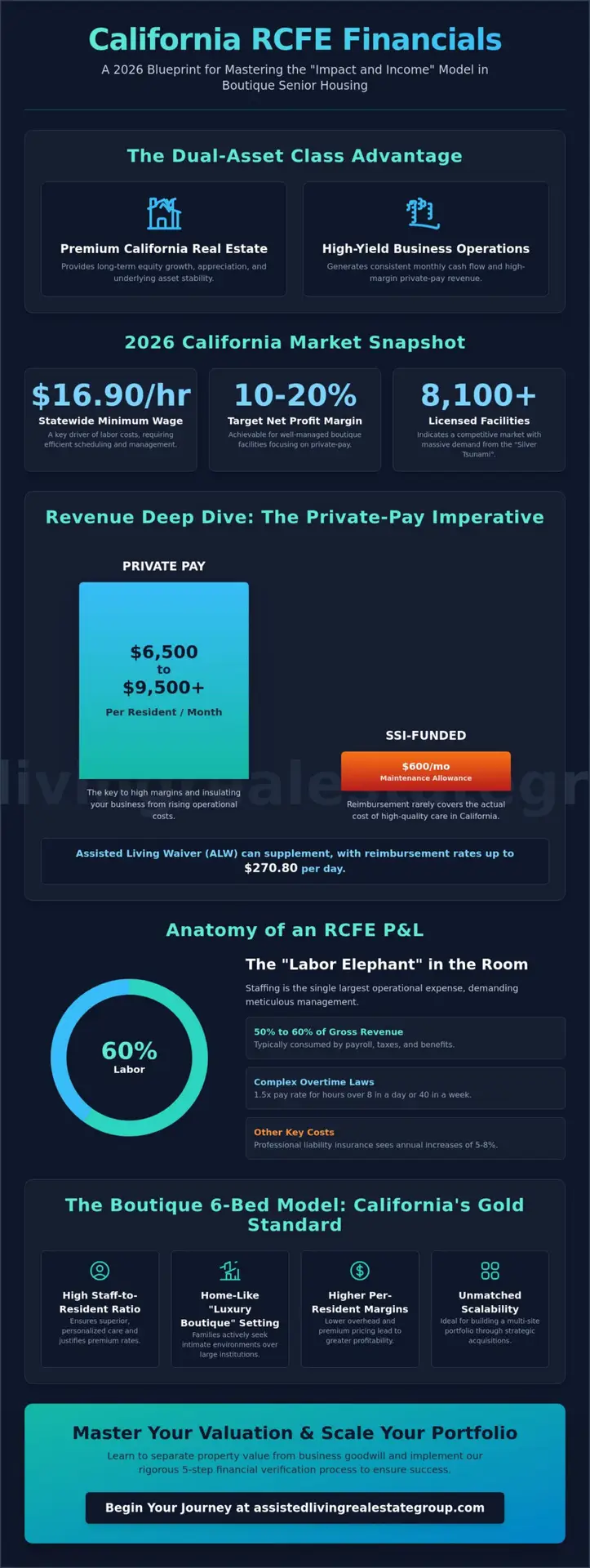
Investing in California senior housing requires a shift in perspective. You aren’t just buying a business; you’re acquiring a dual-asset class that combines a high-yield operational entity with premium California real estate. Success in this sector hinges on understanding RCFE financials as two distinct yet symbiotic engines. The underlying property provides long term equity growth and stability, while the business operations generate consistent monthly cash flow. In 2026, the “Silver Tsunami” isn’t a distant forecast. It’s a current reality. With over 8,100 licensed facilities across the state, the demand for high-quality care has reached a fever pitch, creating significant upward pressure on private-pay rates.
The numbers don’t lie. While the statewide minimum wage has climbed to $16.90 per hour as of January 1, 2026, savvy operators are maintaining healthy margins by focusing on Net Operating Income (NOI) rather than just top-line revenue. We believe in the “Impact and Income” philosophy. Financial health isn’t a sign of greed; it’s the prerequisite for superior care. Without a robust bottom line, you can’t afford the top-tier staffing and luxury amenities that define California’s best boutique homes. A well-managed facility in today’s market should aim for a net profit margin between 10% and 20%, but achieving this requires a surgical approach to cost management and resident selection.
Gross Revenue Drivers: Private Pay vs. SSI
In high-cost regions like Orange County and Los Angeles, the revenue mix is the most critical factor for ROI. Investors who prioritize 100% private-pay residents often see monthly rates ranging from $6,500 to over $9,500 per bed in boutique settings. Relying on SSI-funded residents is increasingly difficult in the current landscape. Since the 2026 Maintenance Need Allowance for individuals is set at just $600 per month, the remaining reimbursement rarely covers the actual cost of high-quality care in California. Most successful Residential Care Facilities for the Elderly (RCFEs) now focus exclusively on the private-pay market to insulate themselves from inflationary pressures and rising labor costs.
The Profitability of the Boutique 6-Bed Model
The 6-bed boutique model remains the gold standard for profitability and intimacy. These facilities often outperform 50-plus bed institutional centers on a per-resident margin basis because they lack the massive corporate overhead and complex management layers. Families in 2026 are actively seeking “Luxury Boutique” environments where the staff-to-resident ratio is high and the setting feels like home rather than a hospital. This intimacy justifies premium pricing, allowing operators to capture a higher percentage of gross revenue as profit. The boutique 6-bed model represents the true “blue ocean” of California senior housing investments in 2026, offering a high-barrier-to-entry niche with unmatched scalability through multi-site portfolios.
This principle of specialized service and operational excellence is also key in other industries; for example, to see how Jagelo Haulage manages container logistics in the UK, click here.
Anatomy of an RCFE P&L: Revenue Streams and Title 22 Costs
Your P&L is more than just a spreadsheet; it’s the operational heartbeat of your facility. Understanding RCFE financials requires a granular look at the unique fixed and variable expenses that define the California market. While your real estate costs may remain fixed, your operational expenses are subject to the shifting tides of state regulations and inflationary pressures. In 2026, a successful P&L must account for everything from specialized dietary needs to the rising cost of professional liability insurance. These insurance premiums often see annual increases of 5% to 8% in the California care sector, making proactive risk management a financial necessity rather than a luxury.
Labor remains the most significant “elephant” in the room for any California care home operator. With the statewide minimum wage at $16.90 per hour as of January 1, 2026, staffing costs typically consume 50% to 60% of your gross revenue. Managing a 24/7 care environment means navigating complex overtime laws where every hour worked over eight in a single day or 40 in a week triggers a 1.5x pay rate. This makes efficient scheduling and staff retention paramount. According to the California Department of Aging, the level of care provided must be tailored to the specific needs of residents, which directly impacts your staffing ratios and, consequently, your bottom line.
Operational Expenses: Beyond the Basics
Running a boutique 6-bed facility involves hidden costs that many first time investors overlook. Food costs for high-quality, resident-centered dining now average between $7 and $10 per resident per day. Utilities for a residential home operating as a commercial entity can also be 20% higher than standard residential rates due to constant climate control and industrial laundry needs. Mastering RCFE Licensing in California is the most effective way to ensure your facility avoids the five-figure fines that can decimate a boutique home’s profitability. Regulatory compliance costs, including administrator certification renewals and mandatory staff training, should be line items that you review quarterly.
Staffing Ratios and the Bottom Line
The financial difference between employing “awake” night staff versus “sleep-over” staff is substantial under California labor law. While sleep-over staff may seem cost-effective, Title 22 requirements for higher-acuity residents often mandate 24/7 awake care. If you choose to be an owner-operator, you might save on an Administrator’s salary, but you sacrifice the ability to scale your portfolio. Hired management typically costs between $4,000 and $6,000 monthly for a boutique facility, yet it allows you to focus on strategic growth. If you’re looking to bypass the initial setup hurdles, exploring turnkey acquisitions can provide a clearer picture of established staffing costs and historical P&L performance.
Valuation Mastery: Separating Real Estate from Business Operations
Successful investors in the California care market avoid the common mistake of viewing a facility as a single asset. Understanding RCFE financials requires a “Two-Check” approach where the real estate and the business operations are valued and often purchased as separate entities. This distinction is critical because it allows you to apply different financial metrics to each component. While the property is valued based on comparable residential sales and local market appreciation, the business is valued on its ability to generate consistent cash flow through a valid license and a stable resident census.
In the 2026 market, a “Turnkey Premium” is standard for facilities that are already licensed and occupied. You can expect to pay a 20% to 30% premium for a turnkey operation compared to a vacant, unlicensed property. This added value stems from the avoidance of the “licensing vacuum,” the 6 to 10 month period where an operator pays a mortgage and overhead without any resident revenue. Intangible assets also carry significant weight in your valuation. A facility with a spotless California Department of Social Services track record and a documented waitlist of private-pay residents represents a lower risk profile, justifying a higher purchase price and a more aggressive cap rate.
Real Estate Valuation in Southern California
Property values for care homes in regions like San Diego or Riverside aren’t just based on square footage. Using our guide on Investing in an Adult Residential Facility in California can help you benchmark how “use value” impacts your appraisal. An RCFE-zoned home often commands a higher price than its neighbor because it has already cleared the high bar for fire sprinklers, ADA-compliant ramps, and widened doorways. These upgrades are sunken costs that a new buyer won’t have to fund, adding immediate equity to the real estate side of the transaction.
Calculating Business Goodwill
When you move to the business side of the ledger, the focus shifts to EBITDA multipliers and Seller’s Discretionary Earnings (SDE). In 2026, California RCFEs typically trade at multiples of 3x to 5x SDE, depending on the stability of the staff and the quality of the resident contracts. You must normalize the P&L to remove one-time expenses or personal owner benefits to see the true earning potential of the facility. Business goodwill represents the net present value of future cash flows secured by a valid RCFE license. By isolating these figures, you can ensure your investment aligns with your goals for both Impact and Income.
Financial Due Diligence: Avoiding Hidden Pitfalls
Acquiring a California care facility without a rigorous audit is like flying a plane through a Southern California marine layer without instruments. You might see the top-line revenue, but understanding RCFE financials at a professional level means looking past the surface. A 5-step verification process is mandatory for any serious investor. This involves cross-referencing the last 36 months of P&Ls against actual bank statements, auditing resident contracts, reviewing payroll records for CA labor compliance, inspecting the physical plant for deferred maintenance, and scrutinizing regulatory records for financial red flags.
Deferred maintenance is a silent profit-killer, especially in older residential neighborhoods in Los Angeles or the Inland Empire. A roof that is 20 years old or an HVAC system nearing its end of life can instantly wipe out your first two years of NOI. Beyond the building, you must audit the “Staffing File.” California’s labor environment is litigious. If a previous owner misclassified employees as independent contractors or failed to pay the $16.90 minimum wage plus required overtime, you could inherit significant wage-and-hour liabilities. Ensure all employees have been paid according to California’s strict 24/7 care mandates before closing escrow.
The Resident Contract Audit
Don’t assume the revenue on the P&L is sustainable. Check for “Rate Creep,” where long-term residents are paying legacy rates that no longer cover the actual cost of care in 2026. You need to know if the current $8,500 monthly rate is a standard private-pay agreement or if it includes “Level of Care” add-on fees that might disappear if a resident’s acuity changes. Analyze the stability of the census. If three of the six residents are over age 90, your turnover risk is high, which will lead to costly marketing expenses and vacancy gaps in your cash flow.
Regulatory Financial Compliance
Financial health is tied directly to regulatory standing. Review the “Statement of Deficiencies” (LIC 809 or LIC 9099) from the past three years to see if the state has flagged the facility for money mismanagement. California law requires facilities to maintain a surety bond if they handle resident safeguarded funds, and a missing bond is a major red flag. Using a comprehensive Due Diligence Checklist for Buying a Care Home ensures you don’t miss these critical details. If you want to ensure your acquisition is built on a solid foundation of Impact and Income, contact our strategic partners to review your potential deal today.
Scaling for Success: Strategic Acquisitions and Exit Planning
Scaling a California care portfolio requires a fundamental shift from the mindset of an operator to that of a strategic investor. While a single 6-bed boutique facility can provide a comfortable lifestyle, true wealth is built by systemizing your operations across multiple sites. Understanding RCFE financials at scale means recognizing that your administrative overhead per bed decreases as you expand, allowing for higher overall EBITDA. The lease-to-own model has emerged as a powerful, low-capital entry point in 2026, permitting experienced operators to secure a facility’s cash flow today while locking in a purchase price for the real estate tomorrow.
Maximizing the value of your legacy requires a disciplined “Financial Cleanup” phase, ideally starting 24 months before you intend to exit. Buyers in the Southern California market are looking for “clean” books where personal expenses are strictly separated from business operations. They want to see consistent occupancy and a documented history of private-pay rate increases that keep pace with the $16.90 minimum wage. Because the RCFE market is highly confidential, a specialized broker is essential. They ensure your resident stability remains intact by marketing the opportunity without alerting staff or families until the proper due diligence milestones are met.
Exit Strategies for RCFE Owners
Preparing for a top-dollar sale involves more than just showing a profit. You must demonstrate that your facility can run without your daily presence, proving the business has “goodwill” independent of the owner. A transparent track record with the California Department of Social Services is your most valuable intangible asset during negotiations. For a detailed, step-by-step roadmap on navigating this complex process, you should How to Sell Your Assisted Living Facility in California to understand how to position your boutique brand for maximum ROI.
The Volatility Hedge: Why RCFEs are Recession-Resistant
Senior housing remains one of the most resilient asset classes because it is “needs-based” rather than “wants-based.” Families don’t stop requiring professional care for their loved ones during economic downturns. During past California recessions, boutique RCFEs maintained higher occupancy rates than traditional multi-family or retail sectors. This stability, combined with the underlying value of Southern California real estate, creates a unique hedge against market volatility. If you are ready to achieve “Impact and Income” in this blue ocean market, partner with Teri Szoke and the Assisted Living Real Estate Group to find your next high-ROI facility.
Securing Your Legacy in California’s Boutique Care Market
The window for high-margin entry into the California residential assisted living market is wide, but it requires a precise roadmap to navigate successfully. Understanding RCFE financials means more than just balancing a checkbook; it involves mastering the dual-asset nature of the business and the underlying real estate. By focusing on private-pay revenue and managing the $16.90 statewide minimum wage through efficient staffing, you can achieve the “Impact and Income” you desire. These strategies ensure your facility remains profitable while providing the high-quality care California families demand.
The Assisted Living Real Estate Group brings over 25 years of specialized California care industry experience to your side. We are experts in confidential, off-market marketing strategies that protect your business while identifying the highest-ROI opportunities in the state. Whether you want to acquire your first 6-bed boutique home or scale a multi-site portfolio, our seasoned expertise ensures you avoid common due diligence traps. Your journey toward a meaningful legacy starts with the right strategic partner. Explore Current RCFE Listings in Southern California today to find your next investment. The “Silver Tsunami” is your blue ocean opportunity.
Frequently Asked Questions
Is owning an RCFE in California profitable in 2026?
Yes, well-managed California facilities typically achieve net profit margins between 10% and 20% of gross revenue. Profitability is driven by the massive demand for boutique care and the ability to command premium private-pay rates in high-income regions like Orange County. While labor costs are rising, the “Impact and Income” model ensures that high-quality care remains a sustainable and lucrative investment for savvy operators.
How much cash reserve is required to open an RCFE in California?
Industry experts recommend that prospective owners have at least $50,000 to $60,000 in liquid capital before starting the application process. You must also demonstrate that you have at least three months of operating expenses in a business bank account to satisfy initial licensing expectations. This financial cushion is vital for covering overhead during the months it takes to reach full occupancy with private-pay residents.
What is the average net profit margin for a 6-bed RCFE?
A net profit margin of 10% to 20% is the standard benchmark for a 6-bed boutique facility in the current market. Understanding RCFE financials requires recognizing that while these smaller homes have higher per-resident staffing costs, they lack the massive corporate overhead of institutional centers. This intimacy allows for higher monthly rates, often ranging from $6,500 to $9,500 per bed, which protects the bottom line.
Can I buy the RCFE business without the real estate?
Yes, you can acquire the business operations and licensing rights through a lease-to-own or business-only acquisition. This model allows you to purchase the business goodwill while paying rent to the property owner, significantly lowering your initial capital requirement. It’s an excellent strategy for experienced administrators who want to scale their portfolio without the immediate debt of a multi-million dollar real estate purchase.
How do California labor laws affect RCFE profitability?
California labor laws mandate a $16.90 per hour minimum wage as of January 1, 2026, which typically makes staffing your largest expense at 50% to 60% of revenue. Strict overtime rules require 1.5x pay for any hours worked over eight in a single day. Operators must use precise scheduling and focus on staff retention to prevent turnover costs from eroding their 10% to 20% profit margins.
What is the “Silver Tsunami” and how does it impact my investment?
The “Silver Tsunami” describes the rapid increase in the aging Baby Boomer population, which is currently creating a “blue ocean” of demand for senior housing. With over 8,100 licensed RCFEs in California, the market is struggling to keep pace with the number of seniors requiring specialized care. This demographic shift guarantees high occupancy rates and allows boutique operators to maintain strong pricing power in the private-pay sector.
How is an RCFE business valued compared to a standard house?
An RCFE is valued as a dual-asset class, meaning it’s worth significantly more than a standard residential home. While the real estate follows local market trends, the business is valued using a multiplier of 3x to 5x Seller’s Discretionary Earnings (SDE). A licensed, occupied facility often commands a “Turnkey Premium” of 20% to 30% over a vacant property due to the immediate cash flow it generates.
What are the main financial risks of RCFE ownership?
The primary financial risks include regulatory non-compliance fines and unexpected workforce shortages that drive up wages. Understanding RCFE financials involves mitigating these risks by maintaining a clean Title 22 record and conducting rigorous due diligence during the acquisition phase. A single “Statement of Deficiencies” or a misclassified employee can lead to five-figure penalties that disrupt your cash flow and long-term ROI.