
Would you trust a general residential agent to manage a transaction where a simple 60-day notification error could jeopardize your license and your entire investment? In California’s high-stakes market of over 8,100 licensed facilities, treating an assisted living sale like a standard home closing is a recipe for disaster. The core benefits of using a specialized RCFE broker lie in their ability to bridge the gap between complex Title 22 regulations and sophisticated financial modeling. You’ve worked hard to build a boutique care environment. You deserve a partner who understands that you’re selling a legacy, not just a building.
We agree that the current “Silver Tsunami” offers a blue ocean opportunity for savvy entrepreneurs to achieve both impact and income. However, the anxiety surrounding staff turnover and the 90 to 120-day CHOW application process is real. This guide demonstrates how a niche expert secures your maximum ROI on both the business and the real estate while ensuring total confidentiality. We’ll examine the specific roadmap required to navigate California’s 2025 regulatory updates and execute a seamless ownership transition.
Key Takeaways
- Understand why viewing your facility as a hybrid asset is the first step toward capturing the blue ocean opportunity in California’s aging demographic shift.
- Explore the core benefits of using a specialized RCFE broker who speaks the language of Title 22 and understands the nuances of pre-qualifying healthcare-focused buyers.
- Learn how to apply the Three-Pillar valuation method to ensure your property and business operations yield the maximum possible return.
- Gain a clear roadmap for the 120-day CHOW process to prevent administrative delays and maintain total operational continuity during the sale.
- Discover why a confidential marketing strategy is non-negotiable for preserving your facility’s reputation and protecting resident stability throughout the transaction.
The Unique Complexity of RCFE Transactions in California
An RCFE isn’t just a piece of real estate; it’s a sophisticated, living machine. In California, selling or acquiring a Residential Care Facility for the Elderly (RCFE) involves two distinct yet inseparable components: the physical property and the state-mandated operational business. One of the primary benefits of using a specialized RCFE broker is their ability to value both halves of this equation with surgical precision. As of May 2026, California houses over 8,100 licensed facilities, the highest number in the nation. This density creates a “blue ocean” for those who understand the mechanics of impact and income, but it’s a minefield for the uninitiated. An RCFE broker acts as a dual-expert, masterfully balancing the rigid requirements of healthcare regulation with the financial complexities of commercial real estate.
The “Silver Tsunami” is no longer a distant forecast; it’s a current reality driving national senior housing occupancy toward 90% in 2026. In California, this demographic shift has intensified the demand for specialized care, especially as resident acuity rises. Investors aren’t just buying square footage. They’re acquiring a platform to solve a social need while generating significant returns. This intersection of California Department of Social Services (CDSS) oversight and traditional property law requires a guide who understands that a Title 22 violation can be just as fatal to a deal as a cracked foundation. You need a partner who recognizes that the 60-day notification period for a change of ownership is a hard regulatory wall, not a flexible suggestion.
Beyond Brick and Mortar: The Business Component
When you list a facility, you’re marketing a turnkey operational legacy. Generalist agents often focus solely on price-per-square-foot, completely missing the “goodwill” value of a stable resident base and a trained staff. In the California market, the license itself is a high-barrier-to-entry asset. With facility licensing fees reaching up to $3,469 for larger sites and a 120-day processing window, an existing license carries immense intrinsic value. A specialized broker ensures this business component is reflected in the final valuation, capturing the true ROI of the operation.
The Southern California Regulatory Environment
The landscape in Los Angeles and Orange County is particularly tight due to local zoning and “over-concentration” laws. In these high-demand zones, the distance between facilities can dictate whether a new license is even possible. Success requires intimate knowledge of local Community Care Licensing Division (CCLD) offices and their specific regional nuances. Because supply is constrained and demand is growing, specialized brokers leverage these local hurdles to position boutique facilities as premium investments. This expertise is why savvy investors prioritize the benefits of using a specialized RCFE broker to navigate the specific hurdles of the Southern California market.
Specialized RCFE Broker vs. Traditional Real Estate Agent
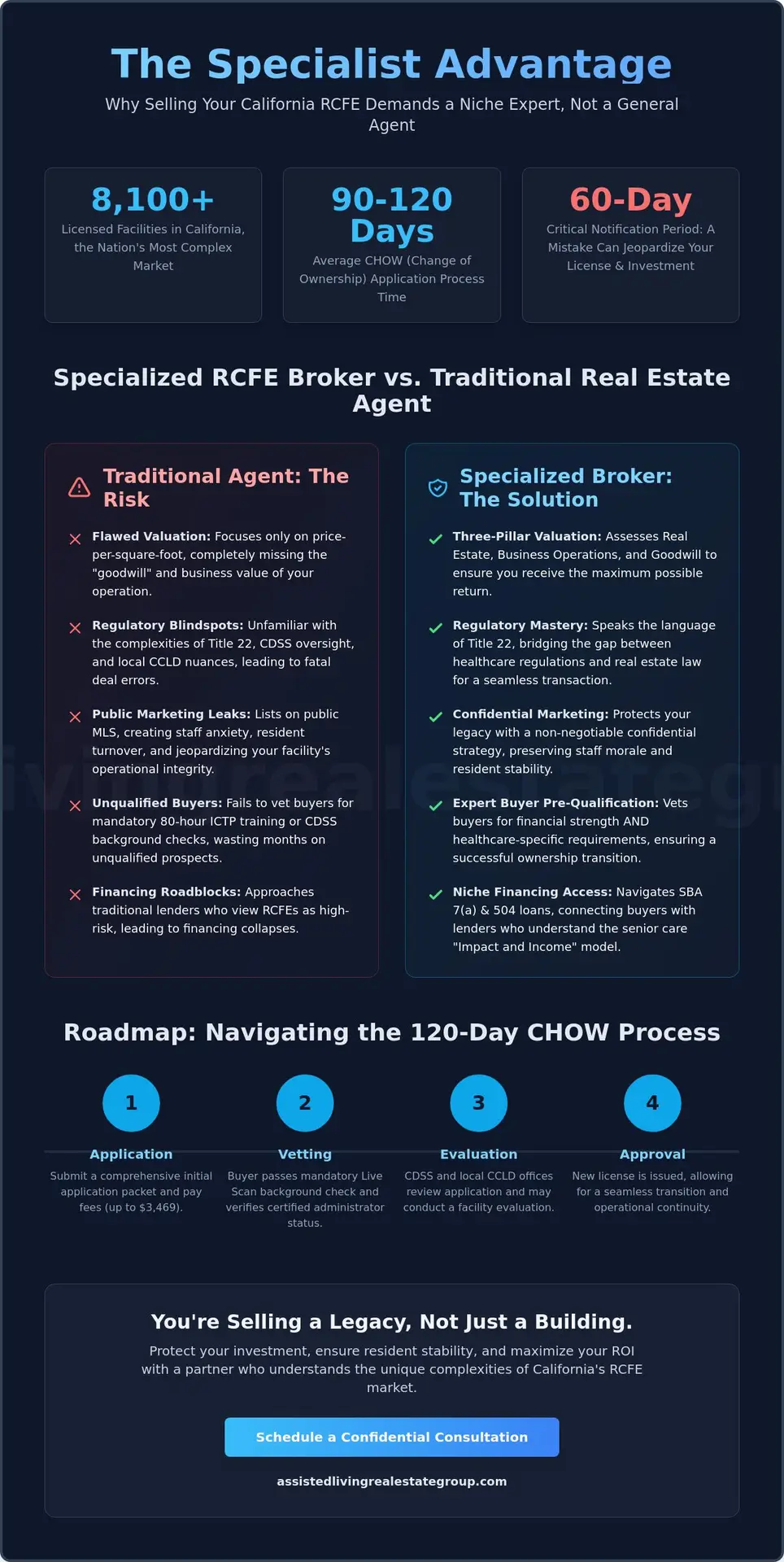
Using a standard commercial agent to sell your care facility is like hiring a general practitioner to perform heart surgery. It’s risky. Traditional real estate agents specialize in square footage and school districts, not the regulatory intricacies of California’s Title 22. When a generalist lists an RCFE on the public MLS, they often inadvertently trigger a wave of staff anxiety or resident turnover. One of the key benefits of using a specialized RCFE broker is the protection of your facility’s operational integrity through confidential marketing. We’ve seen countless transactions collapse in the eleventh hour because a traditional agent didn’t realize the buyer lacked the necessary 80-hour ICTP training or couldn’t pass a mandatory CDSS background check.
Buyer Qualification and Financing Hurdles
Traditional lenders often view RCFEs as high-risk ventures because they don’t understand the “Impact and Income” model. A specialized broker knows which niche lenders focus on the senior care space and can navigate the complexities of SBA 7(a) or 504 loans for these hybrid assets. Beyond the money, we verify the buyer’s human capital. In California, a successful transition requires the new owner to pass a Live Scan background check and have a certified administrator in place. If a buyer hasn’t paid their $100 exam fee or submitted their $140 initial application packet, the deal isn’t just delayed; it’s dead. We pre-screen for these specific regulatory milestones long before escrow opens to ensure a seamless handoff.
Marketing for Maximum Impact and Income
Boutique care environments require a specific type of investor who values quality of life as much as cap rates. We don’t just blast your listing to the masses. Instead, we tap into a curated network of “boutique” care investors who are ready to pay a premium for a well-run operation. We present your facility through a lens of seasoned expertise, highlighting the business’s goodwill and the property’s potential for high-return “RAL” positioning. This strategic alignment is one of the primary benefits of using a specialized RCFE broker. If you’re ready to see how your facility measures up, you can explore our turnkey acquisition strategies to understand what high-level investors are currently seeking in the California market.
Maximizing ROI Through Specialized Valuation and Confidentiality
Pricing a care facility based on standard residential “comps” is a million-dollar mistake. In the sophisticated 2026 market, one of the most significant benefits of using a specialized RCFE broker is access to a three-pillar valuation model. We don’t just look at the brick and mortar. We analyze the real estate, the business operations, and the intrinsic value of the license as a single, cohesive asset. A specialized broker calculates EBITDAR, representing Earnings Before Interest, Taxes, Depreciation, Amortization, and Rent, to isolate the true operational efficiency of the business from the underlying real estate structure. This granular approach ensures that you aren’t leaving money on the table by ignoring the “goodwill” you’ve built over years of service.
Effective valuation requires a deep dive into the facility’s financial health and compliance history. When Navigating RCFE Transactions, an expert guide looks for specific value-drivers like high-acuity care capabilities or specialized dementia programs that justify premium rates. With the average monthly cost of assisted living in Los Angeles projected to reach $6,281 in 2026, even a small increase in occupancy or per-resident revenue significantly impacts the final sale price. You can learn more about the specific math involved by reviewing our guide on how to value an assisted living facility.
Confidentiality as a Value-Driver
Confidentiality isn’t just about privacy; it’s a strategic tool to protect your census. If news of a sale leaks prematurely, it often triggers a “flight to safety” among residents’ families and staff members. This turnover immediately erodes the value of the business you’re trying to sell. We use strict NDAs and private, vetted buyer pools to ensure that operations remain business-as-usual until the ink is dry on the escrow papers. By maintaining total secrecy, we protect the facility’s reputation and ensure the buyer inherits a stable, profitable legacy.
Analyzing Cap Rates in the 2026 California Market
The California RCFE market has seen national senior housing occupancy approach 90% this year, creating a seller’s market for high-quality assets. Cap rates for boutique RAL environments remain aggressive because investors recognize the long-term stability of the “Silver Tsunami.” National rent growth stabilized above 4% year-over-year at the end of 2025, giving operators more pricing power than ever before. A specialist uses these macro trends to justify a premium price for a turnkey business acquisition, positioning your facility as a high-yield opportunity in a blue ocean of demand. This level of market insight is why the benefits of using a specialized RCFE broker are essential for maximizing your final ROI.
Navigating California’s Title 22 and the CHOW Process
The Change of Ownership (CHOW) process in California is a rigorous administrative marathon that extends far beyond a simple deed transfer. It’s a high-stakes handoff vetted by the Centralized Applications Bureau (CAB). One of the core benefits of using a specialized RCFE broker is their ability to manage the mandatory 60-day written notification period required for both residents and the licensing agency. Missing this window doesn’t just delay your closing; it can trigger regulatory red flags that jeopardize the entire transaction. The LIC 200 form serves as the critical gatekeeper in California RCFE sales, requiring exhaustive documentation to prove the new operator’s financial and ethical fitness to hold a license.
During the interim period between escrow closing and the issuance of a new license, many transactions utilize a Management Agreement. This legal bridge allows the buyer to oversee operations while the seller remains the licensee of record. However, these agreements must be structured with seasoned expertise to avoid violating Title 22’s non-delegable responsibilities. A specialized broker ensures this period is handled with total confidentiality and legal precision, protecting your legacy and ensuring the facility remains a “boutique” environment of care. If you want to ensure your facility is positioned for a successful handoff, consult with our strategic partners to review your current compliance status.
Compliance Audits Before the Sale
We act as pre-emptive inspectors to identify Title 22 violations before they reach a buyer’s due diligence team. As of January 1, 2025, RCFEs must conduct resident reappraisals at least annually or upon any significant change in condition. We verify that your records are pristine and that your Plan of Corrections (POC) history is clean. In the 2026 market, facilities must also meet updated fire and life safety codes to pass the final pre-licensing inspection. Identifying these hurdles early is one of the primary benefits of using a specialized RCFE broker.
The Licensing Transition Roadmap
Avoiding a “licensing gap” is essential for maintaining revenue and resident trust. We guide new owners through the mandatory 80-hour ICTP course and ensure they are prepared for the $100 state-proctored exam. From submitting the $140 initial administrator application to paying the $750 Medi-Cal provider fee for waiver-certified facilities, we provide a step-by-step roadmap. For a comprehensive breakdown of these requirements, explore our guide on securing an RCFE license california to understand the full scope of the 120-day application window.
The Assisted Living Real Estate Group Advantage
Success in the California care market isn’t accidental. It’s the result of a specific, intentional roadmap. At The Assisted Living Real Estate Group, we leverage over 25 years of specialized experience within the California RCFE market to ensure our clients don’t just survive the transaction; they thrive. We understand that the benefits of using a specialized RCFE broker extend far beyond a simple listing. Our team operates as a high-level consultancy, bridging the gap between cold financial metrics and the heart-centered mission of boutique senior care. We specialize in the Impact and Income model. This is where savvy investors capitalize on the Silver Tsunami by providing premium, intimate care environments that command higher returns and offer superior quality of life.
Our approach is fundamentally different from a traditional brokerage. We don’t just sell real estate; we facilitate the transfer of a legacy. By focusing on boutique RAL environments, we help Southern California investors navigate a high-barrier market with precision and confidence. We provide the technical credibility needed to handle cap rates and zoning while maintaining the moral compass required for healthcare. This dual-layered expertise is one of the primary benefits of using a specialized RCFE broker when you’re ready to exit or expand your portfolio.
Expert Guidance for Every Stage
We provide a steady, persuasive rhythm of support from the initial valuation to the final CHOW approval. Our team understands that a public listing on the MLS is often the worst strategy for a sensitive care facility sale. Instead, we utilize a proprietary buyer database that connects sellers with vetted, high-net-worth investors who specifically seek care home operations. This exclusive network ensures your transaction remains confidential while maximizing your final ROI. If you’re looking for your next investment opportunity, you can explore our current RCFE for sale listings to see the caliber of facilities we represent.
Your Next Steps in the RCFE Market
The 2026 market offers a blue ocean of opportunity for those with the right roadmap. Whether you’re selling a six-bed facility in Orange County or acquiring a large-scale RCFE in Los Angeles, you need a strategic partner who holds the keys to this niche market. Don’t leave your legacy to chance or a generalist agent who doesn’t know Title 22. We’re ready to help you achieve significant financial returns while making a tangible social impact. Schedule your confidential consultation today. and let’s discuss how to maximize the value of your care facility investment.
Secure Your Legacy in the California Care Market
Navigating the sale of a care facility requires more than a standard real estate license; it demands a mastery of the 120-day CHOW process and the nuances of Title 22 compliance. We’ve explored how a specialized approach protects your census through total confidentiality and maximizes ROI by valuing the business’s goodwill alongside the physical property. One of the primary benefits of using a specialized RCFE broker is having an expert guide who understands the “Impact and Income” model. With over 25 years of combined experience in California care facilities, our team ensures your transition is seamless and professional. The “Silver Tsunami” isn’t a crisis to fear but a blue ocean opportunity for those with the right strategic partner. Don’t leave your hard-earned legacy to a generalist. Contact the Assisted Living Real Estate Group for a Confidential Valuation and take the first step toward your next successful acquisition or exit. You’ve built a boutique environment of care; now let’s help you realize its full financial potential.
Frequently Asked Questions
What is the difference between an RCFE broker and a general commercial broker?
An RCFE broker specializes in the intersection of Title 22 regulation and commercial real estate. A generalist often misses the 60-day notification requirement or fails to pre-qualify buyers for the mandatory 80-hour ICTP certification. One of the core benefits of using a specialized RCFE broker is their ability to navigate the Centralized Applications Bureau (CAB) while maintaining the facility’s census and operational integrity.
Can I sell my RCFE license separately from the real estate in California?
No, an RCFE license is non-transferable and belongs to the specific entity and location for which it was issued. While you can sell the business operations and “goodwill” as a separate asset class from the physical land, the new owner must still undergo the full 120-day CHOW application process to obtain their own license. We help structure these deals to ensure the business value is captured even if the real estate is leased.
How long does the Change of Ownership (CHOW) process usually take?
The California Department of Social Services typically takes 90 to 120 days to process a CHOW application once submitted. This timeline does not include the mandatory 60-day written notice that must be provided to all residents and the local licensing office before the effective date of the sale. We coordinate these overlapping windows to prevent revenue gaps and ensure a seamless transition for the boutique care environment.
Why is confidentiality so important when selling a care home?
Publicly listing a facility can lead to immediate staff poaching and resident flight, which directly erodes your business value. Families often view a sale as a sign of instability, potentially leading to a drop in census before escrow closes. We use private networks and strict NDAs to keep the transaction quiet, ensuring you maintain your “Impact and Income” until the handoff is complete.
Do specialized RCFE brokers help with financing for buyers?
Yes, we connect buyers with niche lenders who understand the senior housing sector’s unique cap rates and RAL business models. Traditional banks often struggle with the hybrid nature of care facilities, but we work with SBA 7(a) and 504 lenders who recognize the stability of California’s 89.1% occupancy rates. This financial bridge is one of the key benefits of using a specialized RCFE broker to close complex deals.
How is an RCFE business valued compared to the real estate?
The business is valued based on EBITDAR and the “goodwill” of the operation, while the real estate is valued based on comparable commercial sales and income potential. We use a three-pillar method to ensure the total price reflects the facility’s license value and its ability to generate premium boutique rates. This approach often results in a significantly higher valuation than a standard residential appraisal would provide.
What are the zoning requirements for an RCFE in Southern California?
Facilities with six or fewer residents are generally treated as residential properties under California law, but larger facilities face complex local zoning and “over-concentration” rules. In high-demand areas like Los Angeles, the distance between existing facilities can prevent new licenses from being issued. We analyze these local CCLD boundaries and municipal codes to ensure your facility remains a compliant, high-barrier-to-entry asset for future investors.
Can a specialized broker help me if my facility has current Title 22 violations?
Yes, we conduct pre-sale compliance audits to help you resolve violations before they become deal-breakers during due diligence. As of January 1, 2025, RCFEs must adhere to new annual resident reappraisal standards and person-centered dementia care rules. We help you implement a Plan of Corrections (POC) to ensure your facility is “sale-ready,” protecting your legacy and ensuring the buyer sees a well-managed, high-return operation.