
Your California RCFE is at its most vulnerable the moment you decide to sell it. You’ve spent years building a boutique care environment where an 88% occupancy rate isn’t just a statistic; it’s a testament to your legacy. You likely worry that if word of a transition leaks prematurely, your best caregivers will panic and your residents’ families will start looking at the 7,800 other licensed facilities across the state. In the California care sector, a confidential business sale agreement isn’t just a legal formality. It’s an operational necessity to preserve your “Impact and Income” during a high-stakes exit.
We’ll show you how a specialized agreement safeguards your reputation and ensures staff stability while navigating new 2026 regulations like SB 351. You’ll learn the exact roadmap to vetting buyers quietly, keeping your financial data secure, and ensuring your boutique facility transitions to a partner who respects the culture you’ve created. This guide provides the strategic framework you need to achieve a secure, quiet sale at maximum valuation without compromising the quality of life for those in your care.
Key Takeaways
- Understand how a specialized confidential business sale agreement protects more than just financials, safeguarding resident care plans and proprietary operational models.
- Discover the “No-Contact” provision that prevents prospective buyers from disrupting your boutique facility’s stability with unannounced visits.
- Learn why generic NDAs leave California owners vulnerable by failing to address license-specific successor liability and intangible care home assets.
- Explore the confidential marketing strategy that uses strategic “Teasers” to gauge buyer interest while maintaining total anonymity for your staff and residents.
- Capitalize on the “Blue Ocean” of the aging demographic by securing a vetted buyer who respects the high-level quality of life you’ve established.
What is a Confidential Business Sale Agreement in the California Care Sector?
A Non-Disclosure Agreement (NDA) in the context of a California care facility is far more than a standard legal template. It’s a shield. In the RCFE and ARF sector, a confidential business sale agreement acts as the primary defense against operational destabilization. It specifically outlines how sensitive data, including resident care plans, employee salary files, and proprietary boutique care models, are shared with potential investors. This document ensures that your facility’s internal mechanics remain private until a buyer is fully vetted and committed.
The “Silver Tsunami” is bringing a massive wave of aging Californians, with the 65-plus demographic expected to reach 14.7 million by 2060. While this creates a “blue ocean” of opportunity for sellers, it also increases the risk of market noise. Rumors of a sale can cause a “resident flight” or lead to key staff members quitting out of uncertainty. A specialized agreement ensures that your facility’s 88% average occupancy remains stable while you seek a high-value exit. It establishes a professional “Expert Guide” relationship between you, your broker, and the buyer, prioritizing the “Impact and Income” you’ve worked hard to build.
Why Confidentiality is Non-Negotiable for RCFE Owners
In high-demand markets like Los Angeles or Orange County, your reputation is your most valuable intangible asset. If families hear through the grapevine that a sale is pending, they often move their loved ones to one of the other 7,800 licensed facilities in the state to avoid perceived instability. This loss of census directly impacts your valuation. Premium boutique facilities in California command median monthly rates between $7,100 and $7,600; even a small dip in occupancy can slash your cap rate during negotiations. Secrecy is the foundation of a “blue ocean” exit strategy because it allows the seller to maintain a position of strength and high valuation without the market perceiving the sale as a distress signal.
Key Parties Involved in the Agreement
A robust agreement clearly defines the roles and responsibilities of everyone involved in the transaction. The “Disclosing Party” is the seller, while the “Receiving Party” is the potential buyer or investor group. In the California market, these entities are often structured as specific LLCs or corporations registered with the Secretary of State, and the agreement must reflect these legal identities accurately. Your specialized broker acts as the strategic partner who enforces these standards, acting as a gatekeeper for sensitive operational data. This is critical because selling an RCFE involves more than real estate; you’re transitioning a license for specific bed capacities, such as a 6-bed boutique home or a 50-bed assisted living community, which requires a high level of discretion during the CDSS licensing transfer process.
Essential Clauses for Protecting Your RCFE or ARF Business
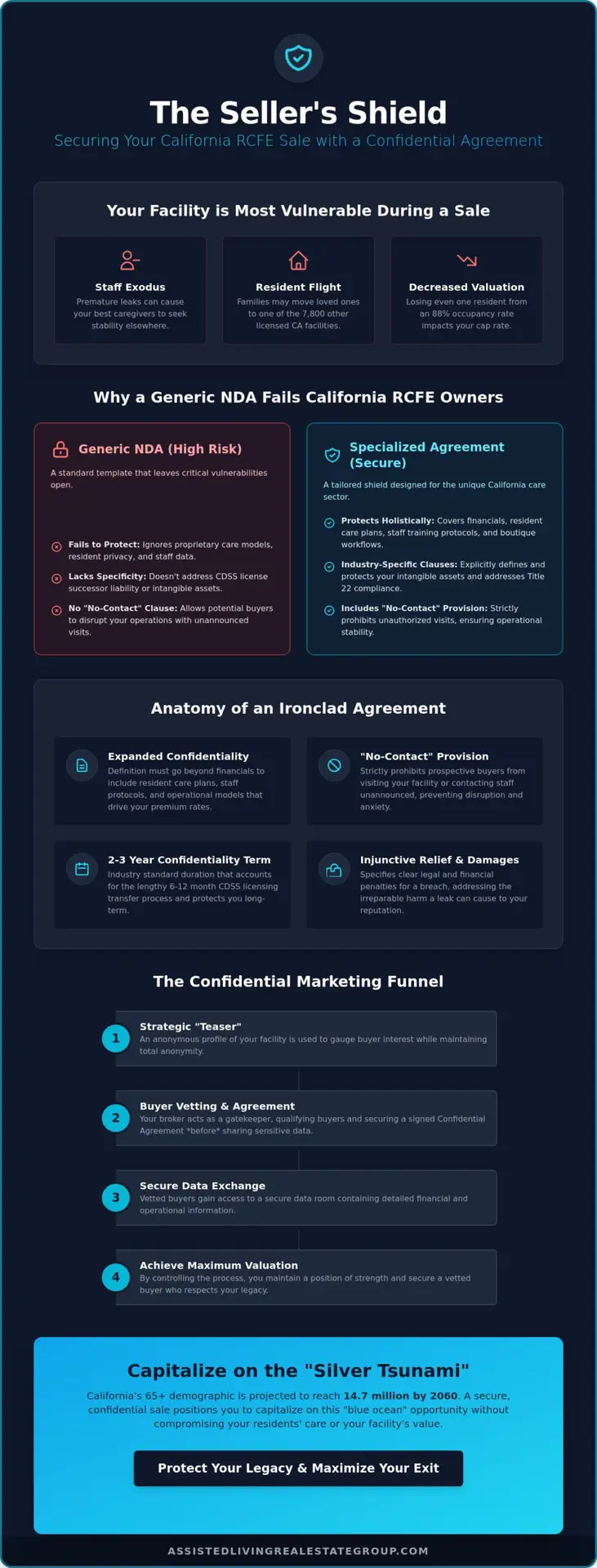
A standard legal template doesn’t account for the delicate ecosystem of a California care home. When drafting a confidential business sale agreement, the definition of “Confidential Information” must expand beyond simple profit and loss statements. It must encompass your proprietary resident care plans, specialized staff training protocols, and the unique “boutique” operational workflows that allow your facility to command premium rates. In a market where California assisted living occupancy averages over 88%, protecting the data that drives those numbers is vital for maintaining your valuation.
One of the most critical additions is the “No-Contact” provision. This clause strictly prohibits prospective buyers from visiting your facility unannounced or contacting your staff directly. In a 6-bed or 15-bed community, a stranger asking questions about the building’s infrastructure or layout can trigger immediate anxiety among residents and employees. For California senior housing assets, a 2-3 year confidentiality term is the industry standard. This duration accounts for the lengthy CDSS licensing transfer process, which often extends 6 to 12 months. If a breach occurs, the agreement should stipulate injunctive relief and liquidated damages to address the irreparable harm a leak causes to your facility’s local reputation.
Protecting Resident Privacy and Title 22 Compliance
Compliance with California’s RCFE sale regulations is a mandatory part of your exit strategy. During the due diligence phase, you must share census data to prove your revenue, but you cannot reveal Personally Identifiable Information (PII) of residents without violating Title 22 privacy standards. A properly structured agreement ensures that buyer due diligence activities are strictly partitioned from sensitive resident records until the final stages of the transaction. Your confidentiality clauses serve as a legal bridge that aligns your business interests with California’s rigorous regulatory privacy standards for elderly care.
The Non-Solicitation Clause: Safeguarding Your Staff
The Southern California healthcare labor market remains incredibly competitive, with owners facing 15 to 40% increases in operational costs like insurance. If a deal falls through, you cannot risk a prospective buyer “cherry-picking” your facility manager or your most experienced caregivers. A robust non-solicitation clause prevents this predatory behavior. It should explicitly cover your administrative staff and facility managers, ensuring your “Impact and Income” foundation remains intact even if a specific buyer doesn’t close. If you are concerned about maintaining this balance, implementing a confidential marketing strategy can help vet buyers before they ever gain access to your internal team’s data.
Why Generic NDAs Fail California Assisted Living Owners
A generic NDA is a paper shield in a digital storm. Most business owners mistakenly believe a standard California Association of Realtors (C.A.R.) form provides enough coverage for their RCFE exit. It doesn’t. While those forms work for a standard residential transaction, they lack the surgical precision required for the California care sector. A specialized confidential business sale agreement must address “Successor Liability” nuances that are unique to CDSS-licensed facilities. If a buyer mishandles information during the 90-day notice period required by AB 1415, the seller faces the regulatory fallout, not just a lost deal.
High-performing care homes are built on intangible assets. Your boutique branding, your specific resident-to-staff ratios, and your community reputation are what drive your 5-8% cap rates. Generic forms fail to protect these “soft” assets, often treating them as mere footnotes to the real estate. When you follow the professional steps to sell your California business, you realize that your operational “Impact and Income” requires a document that filters for strategic partners, not just the highest bidder. A specialized broker understands that the goal isn’t just a high ROI; it’s finding a successor who respects the legacy you’ve built.
The Difference Between Real Estate and Business Confidentiality
A standard C.A.R. form is designed to sell a building, not a specialized RAL operation. You aren’t just selling four walls and a roof; you’re selling a turnkey revenue stream with a complex licensing structure. A generic agreement often fails to separate the property lease or sale from the underlying RCFE business operation. This lack of clarity can lead to “over-disclosure” too early in the process. You need a framework that protects your boutique identity while allowing for the rigorous financial due diligence necessary to justify a premium valuation in Southern California high-demand markets like Orange County or San Diego.
Vetting Buyers Before Disclosure
The most effective way to maintain secrecy is through a “Blind Profile” approach. This marketing strategy highlights the facility’s strengths, such as an 89% occupancy rate in a prime Los Angeles zip code, without revealing the specific address. Before any sensitive data is released, we require a signed confidential business sale agreement and verified Proof of Funds (POF). This process filters out “tire kickers” who are simply fishing for market data to use against you. By the time a potential buyer sees your facility’s name, they’ve already been vetted as a serious investor who understands the “Blue Ocean” opportunity of the California senior housing market.
Implementing a Confidential Marketing Strategy in Southern California
Marketing an RCFE in the high-demand corridors of Southern California requires a surgical approach that traditional real estate agencies simply cannot replicate. In Los Angeles, where the average monthly cost for assisted living is projected at $6,281 for 2026, the financial stakes are too high for a “for sale” sign on the front lawn. The Assisted Living Real Estate Group manages a “Strategic Partner” approach that prioritizes discretion above all else. We target qualified investors in Orange County and San Diego who understand the premium value of a “Boutique” care environment. By focusing on the “Impact and Income” of your facility, we ensure that your exit strategy doesn’t compromise the high-level quality of life you’ve established for your residents.
The first step in this stealthy process is the use of “Teasers.” These are one-page summaries that highlight the facility’s strengths—such as a 5-8% cap rate or a prime location near a major medical hub—without revealing the name or specific address. This allows us to gauge interest and filter for high-net-worth individuals who are ready to capitalize on the “Blue Ocean” of the aging California demographic. Only after a buyer has been vetted for financial capability and professional intent do we move forward with a confidential business sale agreement to protect your operational data.
The Role of the Specialized RCFE Broker
A specialized broker acts as the ultimate gatekeeper for your legacy. Unlike generalists, we understand that managing the flow of information is as important as the transaction itself. During the due diligence phase, we ensure that sensitive documentation, including payroll records and resident census data, is released in controlled stages. This methodical rhythm builds trust with the buyer while shielding your staff from unnecessary anxiety. For a deeper dive into our methodology, see our guide on How to Sell Your Assisted Living Facility in California. We handle the technical hurdles so you can focus on maintaining your facility’s 88% average occupancy.
Steps to a Stealthy Sale
Executing a quiet exit requires a disciplined roadmap to avoid the “Silver Tsunami” of rumors. We follow a three-step process designed for the California market:
- Step 1: Executing the confidential business sale agreement to establish legal accountability before any proprietary data is shared.
- Step 2: Releasing the Confidential Information Memorandum (CIM), which provides a granular look at the facility’s financials and “Boutique” care model.
- Step 3: Conducting controlled site visits after hours or under the guise of “insurance consultants” or “facility inspectors” to keep the sale hidden from residents and staff.
This intentional approach ensures that your transition is seamless and your valuation remains at its peak. If you’re ready to explore a quiet exit in the Southern California market, consult with our strategic advisors to begin your confidential valuation.
Securing Your Legacy: Next Steps for California Sellers
The decision to exit your RCFE or ARF is one of the most significant financial and emotional milestones of your career. In California’s current market, where stabilized assets trade at 5-8% cap rates, the opportunity to capitalize on the “Blue Ocean” of senior housing has never been more pronounced. However, achieving a maximum valuation requires more than just high occupancy; it requires a strategic partner who understands how to protect your “Impact and Income” through the final signature. By utilizing a robust confidential business sale agreement, you ensure that your years of hard work aren’t undermined by premature market rumors or operational leaks.
Transitioning from a facility owner to a “Legacy Builder” means choosing a path that respects the boutique culture you’ve curated. You’ve navigated the complexities of Title 22 and the rising 15-40% insurance premiums, proving your resilience in a high-barrier-to-entry market. Now, the focus shifts to ensuring that the next steward of your facility is a vetted investor who values quality of life as much as ROI. This peace of mind is only possible when you have a legally ironclad confidentiality framework in place, allowing you to negotiate from a position of absolute strength and discretion.
Consulting and Valuation Services
Your exit strategy begins with a clear understanding of your facility’s worth in today’s competitive Southern California landscape. We provide a confidential valuation for your CA care home that goes beyond simple spreadsheets. Leveraging 25 years of specialized experience, we analyze your licensing capacity, local Medi-Cal rate reforms, and boutique branding to set a price that reflects the true value of your turnkey business. This preparation is vital for standing up to the scrutiny of sophisticated private equity groups and national operators who are increasingly active in the California market.
Request a Confidential Consultation
Navigating the new 2026 healthcare transaction regulations like AB 1415 requires an “Expert Guide” who knows the California landscape intimately. Don’t leave your legacy to chance with a general real estate agent who doesn’t understand the nuances of RCFE licensing or the “Silver Tsunami” demographics. We invite you to schedule a private discovery call with Teri Szoke to discuss your goals and explore how our confidential business sale agreement framework can secure your future. It’s time to realize the rewards of your dedication. Join a community of savvy entrepreneurs who are successfully doing good while doing well.
Your Strategic Exit to a Blue Ocean Opportunity
You’ve built a boutique legacy in the California care sector, and your exit should reflect that same level of excellence. Protecting your facility’s 88% average occupancy and your highly trained staff requires more than hope; it requires a surgical approach to discretion. By implementing a robust confidential business sale agreement, you shield your operations from the “Silver Tsunami” of rumors while positioning your asset for a premium valuation. This strategy ensures that your residents remain stable and your caregivers stay focused on their mission during the transition.
The Assisted Living Real Estate Group brings 25 years of specialized California care experience and over $100 million in care facility transactions to your side. We act as your expert guide, navigating the complex licensing landscape and vetting buyers who respect the boutique nature of your facility. It’s time to capitalize on the massive growth of California’s aging demographic with a partner who understands the balance of “Impact and Income.”
Secure Your Legacy: Get a Confidential Valuation for Your California RCFE
The opportunity to achieve a high-value exit while ensuring the continued quality of life for your residents is within reach. Take the first step toward your blue ocean today.
Frequently Asked Questions
Is a confidential business sale agreement legally binding in California?
Yes, a confidential business sale agreement is fully enforceable in California courts when it meets standard contract law requirements. It must clearly define what constitutes proprietary information and comply with the California Civil Code. While SB 351 limits non-compete clauses in general management contracts as of January 1, 2026, it doesn’t invalidate confidentiality protections used during a legitimate business sale. This ensures your care models and financial data remain legally protected.
Can I sell my RCFE without my employees finding out before the close?
You can maintain total secrecy until the final stages by employing a “Blind Profile” marketing strategy. We vet all potential buyers for financial capability before disclosing your facility’s name or specific location. Site visits are typically conducted after hours or under the guise of consultants to ensure your staff remains focused on resident care. This approach prevents the 20% staff turnover often triggered when rumors of a sale circulate prematurely.
What happens if a potential buyer breaches the confidentiality agreement?
If a buyer violates the terms, the seller is entitled to seek injunctive relief to stop further disclosure and liquidated damages for financial harm. Proving exact monetary loss from a leaked rumor is difficult, so these agreements include specific damage provisions. In high-demand markets like Los Angeles or San Diego, protecting your reputation is vital to maintaining your 5-8% cap rate valuation and preventing resident flight.
Should I have my staff sign an NDA during the sale process?
Requiring staff to sign NDAs early in the process usually backfires by signaling that a sale is imminent. Instead, the confidential business sale agreement you sign with the buyer should include a non-solicitation clause. This prevents the buyer from hiring your employees if the deal fails. We recommend informing staff only after the 90-day notice period required by AB 1415 is underway and the buyer is fully committed.
Does an NDA protect my resident census data from competitors?
Yes, a properly drafted agreement explicitly lists your resident census and care plans as proprietary assets. It prohibits competitors or “tire kickers” from using this sensitive data to poach your residents. With California’s average assisted living occupancy at 88%, maintaining your census is the key to preserving your facility’s income. The agreement ensures that data shared during the due diligence phase isn’t weaponized against your business in the local market.
How long does a typical confidentiality agreement last in a care facility sale?
A term of 24 to 36 months is the industry standard for California senior housing transactions. This duration is necessary because the California Department of Social Services licensing transfer can take between 6 and 12 months to finalize. If a deal falls through, you need protection that lasts long enough to find a new buyer without your operational secrets becoming public knowledge during the subsequent marketing period.
What is the difference between an NDA and a Confidentiality Agreement?
While often used interchangeably, a “Confidentiality Agreement” in the care sector is typically broader than a standard Non-Disclosure Agreement. It doesn’t just stop the buyer from talking; it restricts the “permitted use” of the data they receive. For an RCFE sale, this means the buyer cannot use your specialized staff training protocols or boutique care models for any purpose other than evaluating the purchase of your specific facility.
Who should draft my business sale agreement for a California care home?
You should rely on a specialized RCFE broker or a healthcare attorney who understands California’s unique regulatory environment. General residential real estate agents often lack the expertise to address Title 22 compliance or the 2026 healthcare transaction laws. A specialized partner ensures that your agreement accounts for the 7,800 licensed facilities in the state and protects your specific “Impact and Income” goals throughout the transition.