
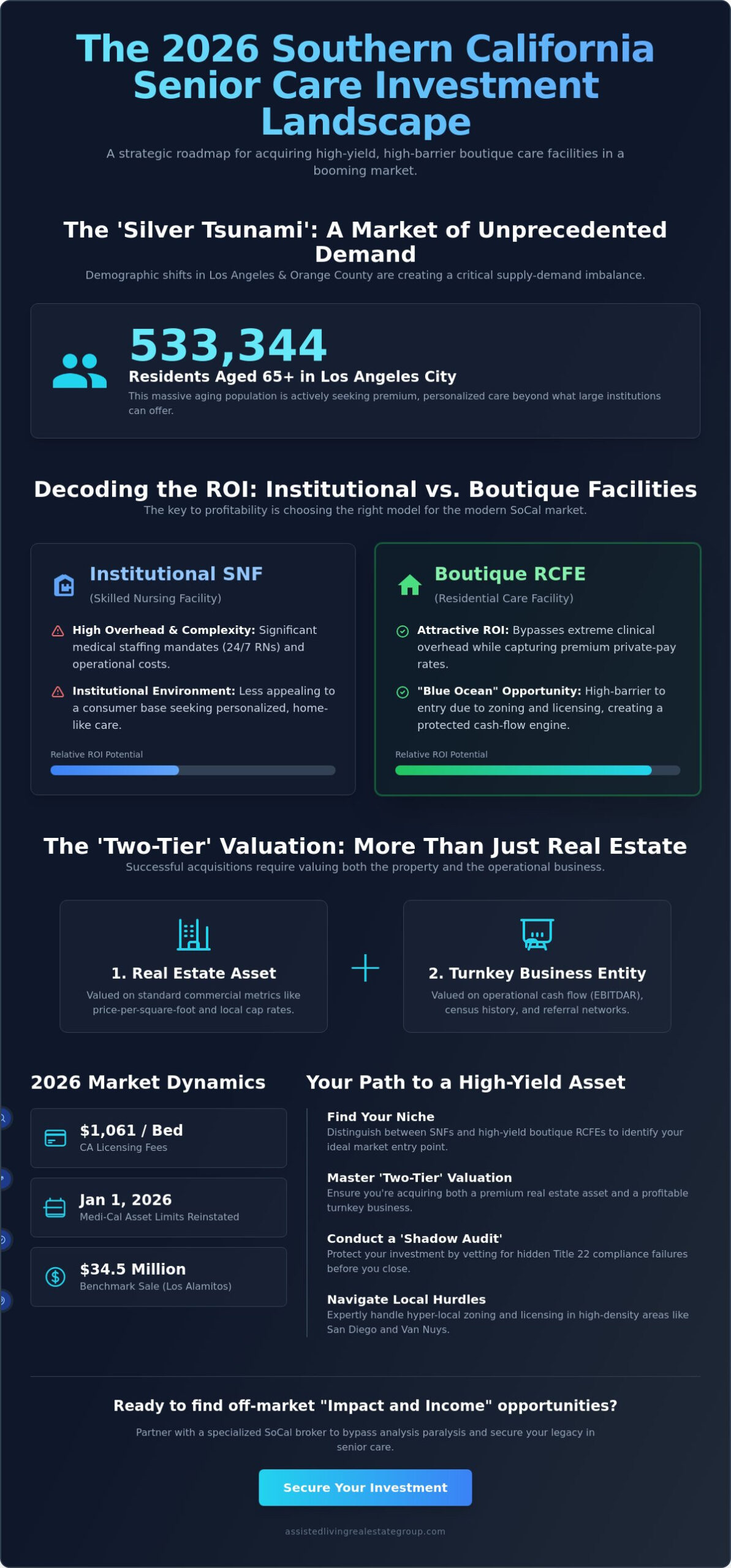
With 533,344 residents aged 65 and older in Los Angeles city alone, the demand for premium senior care has transformed the Southern California market into a premier “blue ocean” for strategic investors. You’ve likely noticed that finding profitable nursing homes for sale in this region is no longer just a real estate transaction; it’s the acquisition of a high-barrier business entity where regulatory mastery equals profit. You understand the massive potential for “Impact and Income,” but the fear of Title 22 licensing traps or missing out on off-market listings often creates a state of analysis paralysis.
This guide provides the specific roadmap you need to acquire a boutique facility with confidence. You’ll discover how to master the 2026 landscape, including the January 1 reinstatement of Medi-Cal asset limits and the $1,061 per bed licensing fees. We’ll analyze recent benchmarks like the $34.5 million Los Alamitos acquisition to help you build a legacy through turnkey senior care without falling victim to costly operational red flags.
Key Takeaways
- Learn to distinguish between institutional Skilled Nursing Facilities and high-yield boutique RCFEs to find your ideal entry point in the 2026 California market.
- Master the “Two-Tier” valuation method to ensure you’re acquiring both a premium real estate asset and a profitable turnkey business entity.
- Discover the “Shadow Audit” process for vetting nursing homes for sale to protect your investment from hidden Title 22 compliance failures.
- Navigate hyper-local zoning and licensing hurdles in high-density areas like San Diego and Van Nuys without making costly errors.
- Gain access to off-market opportunities and “Impact and Income” assets that general residential brokers typically overlook.
Nursing Homes for Sale in Southern California: The 2026 Market Shift
The Southern California senior housing market in 2026 is no longer about simply finding a building; it’s about securing a strategic position in a high-demand, high-barrier ecosystem. While generic listing sites often group nursing homes for sale with unrelated commercial properties, savvy investors recognize that the real opportunity lies in the specialized distinction between medical institutions and residential care. We’re currently witnessing a pivot toward the “Boutique Care” model. This shift isn’t just a trend; it’s a response to a sophisticated consumer base that demands intimacy over institutionalization. By moving away from the cold, clinical feel of traditional facilities, you can capture a “blue ocean” of opportunity where competition is limited by strict California zoning and licensing requirements.
The “Silver Tsunami” in Los Angeles and Orange County
Demographics in Southern California are shifting at an unprecedented rate. As of March 2026, Los Angeles city alone is home to 533,344 residents aged 65 and older, representing nearly 14% of the total population. This massive aging demographic, often called the “Silver Tsunami,” is creating a supply-demand imbalance that institutional facilities can’t fill. Families in affluent areas of Orange County and the Westside are increasingly rejecting large-scale nursing homes in favor of Residential Care Facilities for the Elderly (RCFE). These smaller environments offer a higher quality of life and more personalized attention. If you’re looking to capitalize on this, understanding the nuances of Investing in an Adult Residential Facility in California is your first step toward market dominance.
Institutional vs. Boutique: Where the ROI Lives
Investors must distinguish between Skilled Nursing Facilities (SNFs) and RCFEs. A traditional SNF is a medical-heavy operation with significant overhead and complex staffing mandates, including the new 24/7 registered nurse presence required in 2026. For a foundational Overview of U.S. Nursing Home Care, one can see how federal regulations shape these large entities. However, in California, the 6-bed “Boutique” RCFE model often yields a more attractive ROI. These facilities bypass the extreme clinical overhead of larger nursing homes for sale while maintaining premium private-pay rates.
This is where the “Impact and Income” philosophy truly comes to life. By acquiring or developing a boutique facility, you provide a dignified, home-like environment for seniors while benefiting from a business model protected by high entry barriers. Consider the April 2025 sale in Los Alamitos, where a facility commanded $34.5 million due to the lack of competitors within a 4-mile radius. In SoCal, scarcity is your greatest ally. When you own a licensed facility in a restricted zone, you don’t just own real estate; you own a protected cash-flow engine.
Evaluating Senior Care Assets: Real Estate vs. Business Operations
When you analyze nursing homes for sale in the Southern California market, you’re looking at two distinct yet inseparable assets. The first is the physical real estate, valued by standard commercial metrics like price-per-square-foot and local cap rates. The second, and often more valuable, is the business entity itself. This “Two-Tier” valuation is where most generalist investors stumble. They treat the property like a standard residential rental, failing to account for the operational cash flow that a licensed facility generates. In 2026, a turnkey business in Orange County or San Diego commands a significant premium because it bypasses the 12 to 18-month lead time required to build and license a new facility from scratch.
To truly understand the ROI, you must master EBITDAR (Earnings Before Interest, Taxes, Depreciation, Amortization, and Rent). This metric is the gold standard for senior care because it allows you to evaluate the operational efficiency of the business regardless of whether you own the dirt or lease the building. When calculating “blue sky” value, or the intangible worth of future earnings, look at the facility’s census history and its referral network. An established facility with a 95% occupancy rate and a waitlist in a high-income zip code like Pasadena isn’t just real estate; it’s a high-performance cash engine. If you’re unsure how to peel back these layers, consulting with an expert senior care advisor can help you uncover the true operational margins.
The Value of an Established License
Time is your most expensive resource. Buying an existing operation means you inherit a license that is already generating revenue. During an ownership transfer, you’ll navigate the California Department of Social Services (CDSS) relicensing process. While this is faster than a fresh application, it requires a clean operational history. Closely adhering to California’s Residential Care Regulations ensures the business remains a viable asset. Look for red flags like recurring “Type A” citations or high staff turnover, which can jeopardize the license transfer and inflate your post-acquisition costs. Remember, the $1,061 per bed licensing fee for 2026 is a small price to pay compared to the cost of a compliance-related shutdown.
Lease-to-Own and Operational Continuity
For investors looking to scale without massive upfront capital, the lease-to-own model offers a strategic pathway. This allows you to step in as the operator, stabilizing the business and building equity before finalizing the real estate purchase. Protecting the facility’s reputation during this transition is paramount. You don’t want to spook the residents or their families with sudden, jarring changes. In the context of RCFE acquisitions in 2026, goodwill is the dollar value assigned to the facility’s reputation, its trained staff, and its established relationships within the local medical community. Maintaining this goodwill ensures that your acquisition of nursing homes for sale translates into long-term “Impact and Income.”
Navigating Southern California’s Regulatory and Zoning Landscape
The regulatory environment in California is arguably the strictest in the nation, yet this complexity is precisely what secures your market position. If you’re browsing nursing homes for sale, you aren’t just buying a building; you’re stepping into a framework governed by California Title 22. This set of regulations dictates every operational detail, from medication management to disaster preparedness. The California Department of Social Services (CDSS) Community Care Licensing Division conducts unannounced inspections, making operational compliance a non-negotiable part of your business plan. In high-density regions like Van Nuys or San Diego, hyper-local zoning ordinances add another layer of complexity. You must verify that a property’s specific use permit aligns with your intended resident capacity before you commit to a purchase.
Staffing mandates in 2026 have become even more rigorous. While a 6-bed boutique home requires at least one qualified caregiver on duty, larger facilities with 30 or more beds now face mandatory minimum staffing ratios. These rules require a specific number of licensed nurses and certified nursing assistants per resident. Additionally, larger facilities must maintain a 24/7 registered nurse presence and undergo annual staffing audits that are made available to the public. This transparency in staffing levels is designed to improve care, but it also means investors must be more diligent than ever during the due diligence phase. These requirements increase operational costs, but they also justify the premium private-pay rates found in the Southern California market.
Zoning Requirements for RCFEs in Southern California
California’s “Six or Fewer” rule is a powerful tool for boutique investors. Under state law, an RCFE serving six or fewer residents is considered a residential use of property, meaning local cities like Los Angeles cannot require a conditional use permit that isn’t required for a single-family home. This protects your ability to operate in prime residential neighborhoods. However, if you plan to expand or acquire larger nursing homes for sale, you’ll face intense scrutiny from local planning commissions. Understanding these nuances is critical, and mastering RCFE Licensing in California will give you the technical edge needed to navigate these bureaucratic waters safely.
The Licensing Barrier: Why it Protects Your Investment
The difficulty of obtaining and maintaining a license acts as a natural moat. It discourages casual speculators and ensures that only serious, mission-driven investors enter the space. Many successful owners pay “Success Fees” to professional consultants to ensure a seamless relicensing process during an acquisition. This investment pays off by securing a boutique environment where you can charge higher monthly rates, often exceeding $12,500 in affluent SoCal pockets. This high-barrier-to-entry market is where “Impact and Income” truly converge, turning regulatory compliance into a competitive advantage.
The Due Diligence Roadmap: From Valuation to Close
Acquiring nursing homes for sale in Southern California requires a level of scrutiny that goes far beyond a standard commercial real estate inspection. You aren’t just buying a property; you’re inheriting a regulatory history and a living community. Our 5-step due diligence process ensures you identify operational red flags before they become liabilities. This includes a financial audit, a physical asset inspection, a census mix analysis, a staffing review, and a compliance “Shadow Audit.” This shadow audit involves reviewing the facility’s internal care logs and incident reports to mirror the scrutiny of a CDSS inspector. By identifying potential Title 22 violations early, you protect your “Impact and Income” potential and ensure a smooth ownership transfer.
Understanding the resident mix is more critical in 2026 than ever before. With the January 1 reinstatement of Medi-Cal asset limits ($130,000 for individuals), the financial profile of your census can shift overnight. You must verify the percentage of Private Pay versus Medi-Cal residents to ensure sustainable cash flow. Most high-quality nursing homes for sale are marketed through confidential channels to protect staff morale and resident stability. Publicly listing a facility can cause caregivers to seek employment elsewhere, destroying the business’s value before you even close escrow. To navigate these sensitive transactions, it’s essential to consult with a specialized senior care broker who understands the SoCal landscape.
Financial Audits: Beyond the Profit & Loss Statement
A standard P&L doesn’t tell the whole story. You must cross-reference resident contracts with actual payment histories to ensure the revenue is real and recurring. In California, labor costs are your largest expense. With rising minimum wage laws and the 2026 staffing mandates, you need to analyze how these costs impact your EBITDAR. If you’re looking for a deeper dive into the acquisition process, check out our RCFE for Sale: The Ultimate Guide to ensure no financial stone is left unturned.
Physical Asset Inspection in 2026
Southern California properties face unique environmental risks, from seismic retrofitting requirements to fire safety codes in Wildland-Urban Interface (WUI) zones. Your inspection must confirm the facility meets modern ADA standards and the “Boutique” luxury expectations of high-end residents in areas like Newport Beach or Pasadena. In the rigorous California regulatory environment, deferred maintenance isn’t just a repair list; it’s a primary deal-breaker that can lead to immediate licensing denials and costly operational shutdowns.
Securing Your Investment: Why Partner with a Specialized SoCal Broker
Partnering with a general residential broker to find nursing homes for sale is a recipe for operational disaster. Most generalists treat these assets as simple rental properties, completely overlooking the complex web of California Title 22 compliance and the specific 2026 staffing mandates. A specialized SoCal broker acts as your strategic partner, bridging the gap between a cold real estate transaction and a mission-driven healthcare acquisition. We understand that in the Southern California market, the most profitable opportunities are often found off-market. These “blue ocean” assets are traded through private networks to maintain the stability of the facility’s care environment. By the time a property hits a public aggregator, the best “Impact and Income” potential has often already been picked over by savvy insiders.
Our expertise extends into the critical relicensing transition. We guide you through the CDSS requirements and help you account for the $1,061 per bed licensing fee for the 2026-27 period. This specialized knowledge ensures that your ROI isn’t drained by unexpected compliance delays or zoning hurdles in high-density areas like Pasadena or San Diego. We don’t just sell buildings; we provide the roadmap for building a legacy of quality care. This ensures you acquire a business that is ready to perform from day one.
Confidential Marketing: The Broker’s Secret Weapon
In the senior care industry, discretion is the ultimate currency. If you’re looking to exit, our confidential marketing strategy ensures you can Sell Your Adult Residential Facility in California without alerting competitors or distressing your residents. We strictly qualify every potential buyer before disclosing any sensitive facility details or operational records. This protective layer maintains the goodwill of the business, ensuring that staff stay focused on care rather than worrying about their job security during an ownership change. This process keeps the valuation high and the transition seamless.
Your Next Steps in the Southern California Care Market
The 2026 California market is moving fast, with rising occupancy rates and shifting Medi-Cal asset limits creating new windows of opportunity. Don’t leave your investment to chance with a generalist who doesn’t know an RCFE from a retail strip mall. With 25 years of combined experience in the California senior housing sector, we’re ready to help you navigate this high-barrier market with precision. Whether you’re a first-time investor or looking to scale your portfolio, View our current Southern California listings or request a consultation today to secure your place in the future of boutique senior care.
Secure Your Legacy in the SoCal Senior Care Market
The “Silver Tsunami” isn’t a distant forecast; it’s a current reality for the 533,344 seniors living in Los Angeles city today. You’ve learned that navigating the 2026 landscape requires more than just an interest in real estate. It demands a deep understanding of Title 22 compliance, the latest Medi-Cal asset limit shifts, and the high-barrier boutique model. Success in this niche depends on your ability to identify nursing homes for sale that offer both clinical stability and high-yield potential. By focusing on “Impact and Income,” you can build a business that provides exceptional quality of life while securing your financial future.
Don’t leave your acquisition to a generalist who lacks the technical expertise this market demands. With 25 years of specialized California experience, we serve as confidential marketing experts with a proven track record in RCFE and ARF sales. We provide the strategic roadmap necessary to bypass costly licensing mistakes and access off-market opportunities. Ready to find your next high-performance asset?
Explore Exclusive Southern California Senior Care Listings and start your journey toward a meaningful, profitable legacy today.
Frequently Asked Questions
What is the difference between an RCFE and a nursing home for sale in California?
An RCFE, or Residential Care Facility for the Elderly, focuses on a social model of care for seniors who need help with daily activities but don’t require 24-hour medical supervision. Skilled nursing homes provide high-level clinical care and are regulated as medical institutions. When evaluating nursing homes for sale, you must decide if you want the high-overhead medical model or the intimate, private-pay boutique model common in residential assisted living.
Can I buy a nursing home in Southern California without a healthcare background?
You don’t need a medical degree to own or operate a senior care business in California. Most successful investors act as the visionary business owner while hiring a state-certified administrator to manage the daily care of residents. You’ll need to ensure your facility has the required staffing, such as the 24/7 registered nurse presence mandated for larger facilities in 2026, to remain in compliance with state laws.
How much does a 6-bed RCFE typically cost in Los Angeles or Orange County?
Prices are determined by the “Two-Tier” valuation of the real estate and the business’s operational history. For context, a vacant 28,512-square-foot skilled nursing facility in Pasadena sold for $5.1 million in July 2025. A turnkey 6-bed facility in a premium zip code is valued based on its EBITDAR and the scarcity of licensed beds in that specific four-mile radius, often commanding a significant premium over standard residential homes.
What is Title 22 and why does it matter for my investment?
Title 22 is the set of California state regulations that governs the licensing and operation of all community care facilities. It’s the rulebook for everything from resident rights to fire safety and staff training. Failing to master Title 22 can lead to “Type A” citations or license revocation, which is why compliance is the most critical factor in protecting your ROI and long-term “Impact and Income.”
How long does the relicensing process take when buying an existing facility?
The relicensing process for an ownership transfer typically takes between 90 and 120 days through the California Department of Social Services. This is a much faster route to revenue than starting from scratch, which can take 18 months or more for new construction and initial approvals. Buying existing nursing homes for sale allows you to inherit an established census and a trained staff from day one.
Are there specific financing options for buying a senior care business in California?
Investors have access to several specialized loan products with competitive rates as of May 1, 2026. SBA 7(a) loans currently start at 6.50%, while SBA 504 loans for real estate acquisitions start as low as 5.61%. Conventional medical office and healthcare loans are also available starting at 6.39%, allowing you to leverage the facility’s cash flow to secure the necessary capital for acquisition.
What are the most profitable areas in Southern California for assisted living?
Profitability is highest in affluent “high-barrier” markets like Newport Beach, Pasadena, and the Westside of Los Angeles. These areas have a senior population that can afford the $12,524 average monthly cost for care in Los Angeles. Because new development is restricted by strict zoning, existing facilities in these regions enjoy high occupancy rates and the ability to maintain premium private-pay margins.
What is the “Silver Tsunami” and how does it affect my ROI?
The “Silver Tsunami” refers to the demographic shift where 13.8% of Los Angeles residents are now aged 65 or older as of March 2026. This creates a “blue ocean” opportunity where the demand for quality boutique care is far outpacing the current supply of licensed beds. This supply-demand imbalance ensures steady revenue growth and long-term asset appreciation for investors who provide high-quality, dignified care environments.