
A single poorly timed conversation can slash 20% off your RCFE’s valuation before the escrow period even begins. For California facility owners, the risk isn’t just financial; it’s operational. If your caregivers walk out because they’re scared of new ownership, your staffing ratios will fail Title 22 requirements within 24 hours. Learning how to tell staff you are selling the business is the most critical strategic move you’ll make to protect your legacy and your bottom line. You’ve worked hard to build a boutique environment that balances impact and income, and you deserve an exit that reflects that effort.
You’ve likely spent years treating your team like family, and the thought of breaking their trust feels like a betrayal. We understand that anxiety. This guide will show you how to execute a professional, regulatory-compliant announcement that maintains 100% staff retention through the close of escrow. We’ll break down the specific communication timeline, the legal disclosures required by the California Department of Social Services, and the exact scripts you need to provide peace of mind to your residents and their families.
Key Takeaways
- Protect your RCFE’s valuation by understanding how staff stability directly influences cap rates and buyer confidence in the competitive Southern California market.
- Master the “Cone of Silence” to learn exactly how to tell staff you are selling the business at the precise moment that minimizes turnover and preserves resident care standards.
- Deploy a two-tiered communication strategy to secure key personnel and prevent damaging rumors from disrupting your facility’s licensing compliance.
- Craft a mission-driven announcement that bridges high-level financial ROI with your heart-centered legacy, ensuring your team feels secure in their future roles.
- Leverage the expertise of a specialized California broker to manage post-announcement friction and navigate the complex human element of a boutique care transition.
The Unique Stakes of Disclosing an RCFE Sale in Southern California
Selling a Residential Care Facility for the Elderly (RCFE) isn’t like offloading a dry cleaner or a software startup. In the Southern California market, where the Silver Tsunami creates a massive blue ocean for savvy investors, your workforce represents your most valuable asset. If you don’t master how to tell staff you are selling the business, you risk a 20% drop in facility valuation overnight. High-performing facilities in Los Angeles or Orange County often command cap rates between 8% and 11%, but these numbers rely entirely on staffing stability. Your caregivers are the heartbeat of the operation. Their sudden departure doesn’t just leave a hole in the schedule; it erodes the boutique care quality that justifies premium private-pay rates.
While traditional mergers and acquisitions focus on balance sheets and intellectual property, RCFE transitions live or die on human continuity. We call this the Impact and Income model. To maintain your ROI, you must ensure that the mission of care remains uninterrupted. Staff flight is the single greatest threat to a successful exit. When caregivers sense uncertainty, they look for the exit, which can lead to a cascade of operational failures that jeopardize your entire legacy.
Title 22 Compliance and Staffing Ratios
The California Department of Social Services (CDSS) doesn’t pause its oversight because you’re in escrow. Title 22, Division 6, Chapter 8 mandates specific caregiver-to-resident ratios 24 hours a day. A single resignation during a sale can trigger an immediate inspection. If your staffing drops below mandated levels for a boutique 6-bed RAL, you face Type A citations. These citations are public record and can kill a $1.5 million deal within 48 hours. Maintaining legal staffing levels is a non-negotiable requirement for a clean ownership transfer.
The Resident and Family Ripple Effect
In a boutique RCFE environment, the bond between staff and seniors is intimate and profound. When a caregiver feels anxious, the 85-year-old resident feels it too. Families pay $6,500 to $9,500 monthly for consistency. If a family senses operational instability or sees their favorite caregiver leave, they’ll often move their loved one out within 30 days. This creates a vacancy that slashes your net operating income just as you’re trying to close. Understanding how to tell staff you are selling the business is about stabilizing these emotional anchors first to protect your financial outcome.
Timing Your Announcement: When to Break the Silence
In California’s high-stakes RCFE market, confidentiality is your most valuable currency. We refer to this as the “Cone of Silence.” Maintaining it ensures your operations remain stable while you navigate the complexities of a sale. Determining how to tell staff you are selling the business involves mapping your announcement precisely to the California escrow and licensing timeline. If you speak too early, you risk “staff leakage.” Caregivers in a 6-bed facility in Fresno or a larger boutique community in Van Nuys may seek the perceived security of a competitor if they feel their future is uncertain. This exodus can tank your census and reduce your final valuation by 15% or more before you even reach the closing table.
Conversely, waiting too long creates a vacuum of trust. Your legacy depends on a smooth handoff that preserves the “Impact and Income” you’ve worked hard to build. A specialized broker acts as your strategic partner here, ensuring that the transition feels like an evolution rather than a disruption. They help you balance the analytical requirements of the deal with the heart-centered needs of your care team.
The Letter of Intent (LOI) Phase
Signing an LOI is a significant milestone, but it’s not a guarantee of a closed deal. Roughly 25% of RCFE transactions in California stall during the deep due diligence phase due to physical plant issues or financing hurdles. Disclosing your intent at this stage is premature and high-risk. If you must involve a lead administrator to gather records, require a formal Non-Disclosure Agreement (NDA) specifically tailored to California labor laws. When the buyer requests site visits, frame them as “insurance inspectors” or “long-term care consultants.” This keeps the peace while allowing the buyer to verify the asset’s boutique quality.
The “Point of No Return” Milestone
The optimal window for disclosure opens only when the buyer’s financing is fully secured and all contingencies are removed. This usually occurs 60 to 90 days before the final transfer of the license. This timing typically aligns with the buyer’s submission of the LIC 200 application to the California Department of Social Services (CDSS). You must also ensure your timeline adheres to the California WARN Act requirements if your facility meets the employee threshold for notice. This is the moment to reveal the transition to your “Key Staff” first, followed by a general announcement.
By coordinating the announcement with the LIC transfer process, you provide staff with a clear roadmap of what comes next. Learning how to tell staff you are selling the business is about maintaining the momentum of the deal while honoring the caregivers who sustain your RAL’s reputation. A methodical approach ensures you exit with your ROI intact and your professional legacy secured.
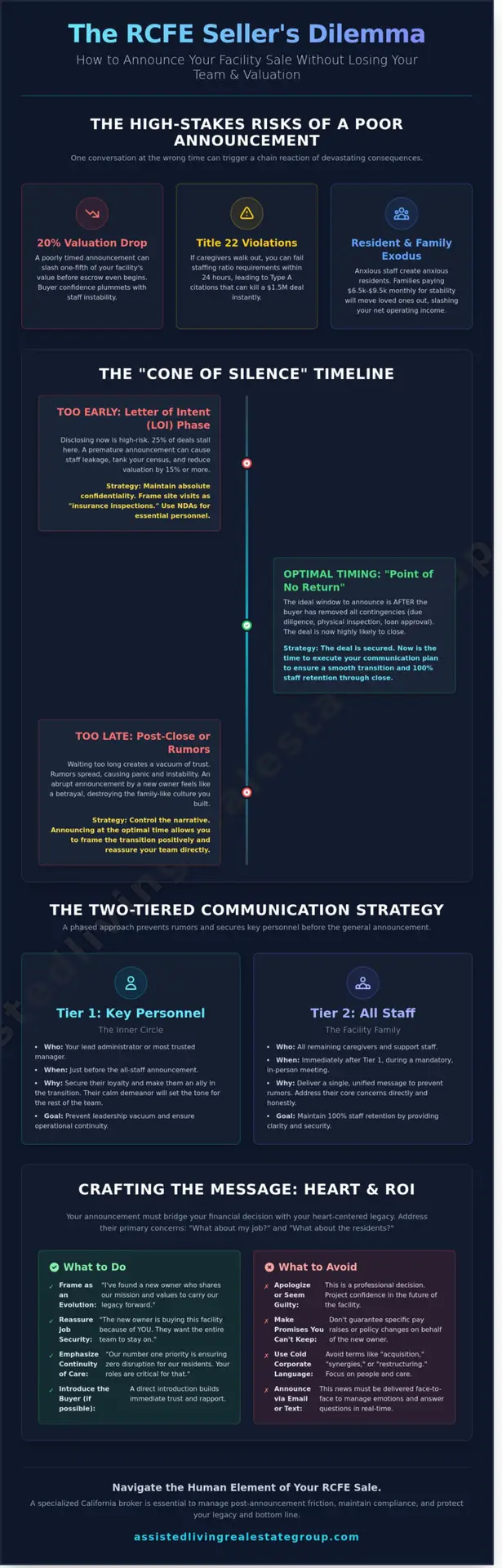
The Two-Tiered Communication Strategy for Care Facilities
Information leaks are the primary killers of high-value RCFE transactions. In California’s competitive senior housing market, losing a lead caregiver 30 days before closing can trigger a licensing delay that stalls your ROI. You’ve worked hard to build a boutique environment; protecting that legacy requires a disciplined hierarchy of communication. By controlling the narrative, you ensure that the “Silver Tsunami” of aging residents continues to receive elite care while you secure your financial exit.
Step 1: The Private Manager Meeting
Your Facility Manager or Administrator is your most critical asset during a transition. They hold the institutional knowledge required for a smooth Title 22 compliance transfer. You should meet with them at least 14 days before the general announcement to secure their buy-in. This isn’t just a courtesy; it’s a strategic move to prevent them from seeking employment elsewhere during the sensitive California Department of Social Services (CDSS) relicensing phase.
To guarantee stability, draft a “Stay Bonus” agreement. This typically involves a cash incentive, often ranging from 5% to 10% of their annual salary, paid out 90 days after the close of escrow. This financial anchor ensures they remain focused on operations while you focus on the sale. Empower your manager by letting them help refine the talking points for the rest of the team. When your leadership team stands united, the rest of the staff feels the transition is a planned evolution rather than a crisis.
Step 2: The General Staff Announcement
Timing is your most valuable asset when deciding how to tell staff you are selling the business. Schedule the “All-Hands” meeting during a natural shift change, such as 2:00 PM at a facility in Carson or Thousand Oaks, to capture the maximum number of caregivers and med-techs. This minimizes the “telephone game” where rumors distort the truth before you’ve had a chance to speak.
- Introduce the Strategic Partner: Introduce the buyer as a “Strategic Partner” rather than a “new owner.” This language suggests growth and continuity rather than a cold takeover.
- Buyer Presence: Ensure the buyer is physically present. In California’s heart-centered RAL industry, staff need to see the face of the person who will be signing their paychecks.
- Address the Big Three: Immediately confirm that pay rates, schedules, and seniority will remain intact. Data shows that 85% of staff anxiety in RCFE sales stems from fear of immediate “corporate” restructuring.
Managing the immediate Q&A session is about emotional intelligence. Provide a clear roadmap of the next 60 days of the transition. By framing the sale as a way to bring more resources into the home, you align the staff’s interests with the buyer’s vision. This ensures you maintain the “Impact and Income” balance that defines a successful boutique care facility.
Crafting the Message: Addressing Employment and Resident Care
Selling a Residential Assisted Living (RAL) facility is a significant milestone that represents years of dedicated service. It’s the culmination of your legacy. When you’re determining how to tell staff you are selling the business, you must pivot from the technicalities of cap rates to the human element of boutique care. Your team created the value that made this exit possible. They deserve a narrative that honors their contribution while painting a vision of an even brighter future. This transition is a strategic evolution designed to preserve the high standards you’ve established.
Addressing the “Why Now?” Question
Transparency builds trust. If you’re retiring after 15 years in the RCFE industry, share that personal milestone. If you are part of the 68% of owners currently looking to scale into larger Southern California developments, explain that this sale funds a new chapter of regional growth. Frame the transition as a victory lap. The facility isn’t selling because it’s failing; it’s selling because your team achieved a 95% occupancy rate and a reputation for excellence that savvy investors crave. You’re passing the torch to ensure the “Impact and Income” model continues to thrive under fresh leadership.
Employment Security and Benefits
The primary fear for any RCFE caregiver is the loss of their livelihood. Address this immediately. Explain that the new owner is specifically investing in the heart-centered culture your team provides. In California, you must be clear about continuity. Confirm that their seniority remains intact and that all state-mandated benefits, including the 40 hours of paid sick leave required by the Healthy Workplaces, Healthy Families Act of 2014, will transition seamlessly. This isn’t a downsizing event. It’s a resource upgrade. New ownership often brings the capital needed for facility renovations or enhanced medical equipment. This allows the staff to provide even higher levels of boutique care without the constraints of a limited budget.
When you explain how to tell staff you are selling the business, focus on the buyer’s commitment to “Boutique” excellence. Describe the new owner as a partner who recognizes that the staff is the facility’s most valuable asset. This isn’t just about maintaining the status quo. It’s about empowering the team with better resources to navigate the “Silver Tsunami” with confidence. You’re securing their future by placing the business in the hands of someone with the liquidity to weather any market shift.
Navigating Post-Announcement Friction with a Specialized Broker
Selling a California RCFE is a transfer of trust. Once you determine how to tell staff you are selling the business, the weeks following that announcement are critical for facility stability. Teri Szoke and her team act as a vital buffer between you, the buyer, and your caregivers. We manage the human element that traditional real estate agents often ignore. Our Success Fee model ensures our goals align with a smooth staff transition; we only succeed when the deal closes with your team and your legacy of Impact and Income intact.
The transition period is where most deals fail or succeed based on staff sentiment. We step in to field the difficult questions that owners often feel uncomfortable answering. This specialized advocacy prevents the “us versus them” mentality that can stall a Change of Ownership. By positioning the sale as an upgrade in resources and support, we keep your caregivers focused on the residents rather than their resumes.
Managing the “Silver Tsunami” Transition
The Silver Tsunami is creating a blue ocean of opportunity for California investors, but it requires a steady hand to navigate. We use 25 years of state-specific care experience to stabilize your facility during the sale. A specialized broker identifies buyers who value your staff as much as the RAL real estate itself. These buyers know that keeping a Boutique environment requires the same dedicated team that built your reputation. You can find more details on this process in our How to Sell Your Assisted Living Facility in California strategic guide.
The Final Handover in Southern California
In Southern California markets like Orange County and San Diego, the final handover involves more than just signing papers. We coordinate “Meet the New Owner” events for residents and families to prevent panic and maintain census levels. Our team ensures every piece of Title 22 documentation is ready for the Change of Ownership (CHOW) filing with the Department of Social Services. This meticulous approach prevents the 20% staff turnover rate that typically plagues unguided transitions. It’s about protecting your ROI while honoring your mission to provide elite care. Get a Confidential Valuation for Your CA Care Home to begin your transition today.
Securing Your Impact and Income Through a Strategic Exit
Selling a California RCFE is a high-stakes evolution that requires more than just a buyer. It demands a roadmap that protects your staff, your residents, and your hard-earned reputation. Mastering how to tell staff you are selling the business is the definitive factor between a seamless transition and a costly disruption in care. By utilizing a two-tiered communication strategy, you ensure that your boutique facility remains stable while you finalize the complex details of the sale. Most successful SoCal owners wait until the 90 day escrow period is well underway before making a formal announcement to the broader team. This specific timing safeguards your operations and preserves the unique culture you’ve built over the years.
Our team brings 25+ years of specialized California care facility experience to your side. We don’t just list properties; we deploy a Proprietary Confidential Marketing Strategy that addresses both real estate and business licensing nuances. You’ve worked hard to create a legacy of quality care in the Golden State. Now it’s time to ensure that legacy translates into the financial return you deserve. Secure your legacy and maximize your ROI, contact our specialized RCFE brokers today. Your next chapter is a blue ocean of opportunity, and we’re here to guide you through every step of the journey.
Frequently Asked Questions
When is the absolute latest I can tell my staff I am selling the business?
The absolute latest you should tell your staff is 30 days before the close of escrow. While California labor laws don’t mandate a specific notice period for small business sales, waiting until the final hour risks a mass exodus that can tank your valuation. A 30 day window allows the buyer to conduct necessary interviews while you maintain operational stability during the final transition phase of the deal.
Should I offer a stay bonus to my RCFE manager during the sale?
You should offer a stay bonus of 10% to 15% of their annual salary to ensure your RCFE manager remains through the transition. In the California market, experienced administrators are the glue that holds a boutique facility together. This financial incentive is typically paid out in two installments: 50% at the close of escrow and 50% after 90 days of successful operation under the new ownership team.
What happens if a key caregiver quits after I announce the sale?
If a key caregiver quits, you must immediately tap into your backup staffing registry to maintain Title 22 compliance. Losing a lead caregiver can reduce your facility’s quality of care score, which might lead a buyer to request a 5% price reduction during the final walk-through. Keeping a bench of 2 on-call caregivers ensures that a single resignation doesn’t jeopardize the $1.5 million valuation of your residential assisted living asset.
Do I have to tell my residents at the same time I tell my staff?
You don’t have to tell residents at the same time, but you must provide a written notice at least 60 days before any change in ownership that affects the Plan of Operation. For California RCFEs, residents and their families often react more calmly when they see staff are already informed and supportive. Aligning these announcements within a 48 hour window prevents rumors from spreading through the facility and causing unnecessary move-outs.
Can a buyer pull out of the deal if too many staff members leave?
A buyer can pull out if the loss of staff triggers a Material Adverse Change clause in your California Association of Realtors commercial purchase agreement. If 30% or more of your workforce resigns, the buyer may argue that the business’s goodwill has diminished. This is why knowing how to tell staff you are selling the business is critical to protecting your ROI and ensuring the deal reaches the finish line successfully.
How do I handle staff members who try to talk to the buyer during due diligence?
You must establish a strict communication protocol in your Non-Disclosure Agreement that prohibits direct contact between staff and the buyer before the official announcement. In 95% of successful RCFE sales, all due diligence site visits occur after hours or under the guise of a routine facility inspection. If a staff member bypasses these rules, you should remind them that their employment contract requires confidentiality regarding sensitive business operations.
What if my staff asks about the sale price or my personal ROI?
You should decline to share specific financial figures like the sale price or your personal ROI, as these are private investment matters. Instead, pivot the conversation toward the buyer’s commitment to Impact and Income and the future stability of the boutique care environment. Explain that the transaction ensures the facility’s legacy continues for the 6 residents currently in your care. Focus on their job security rather than the capital gains.