
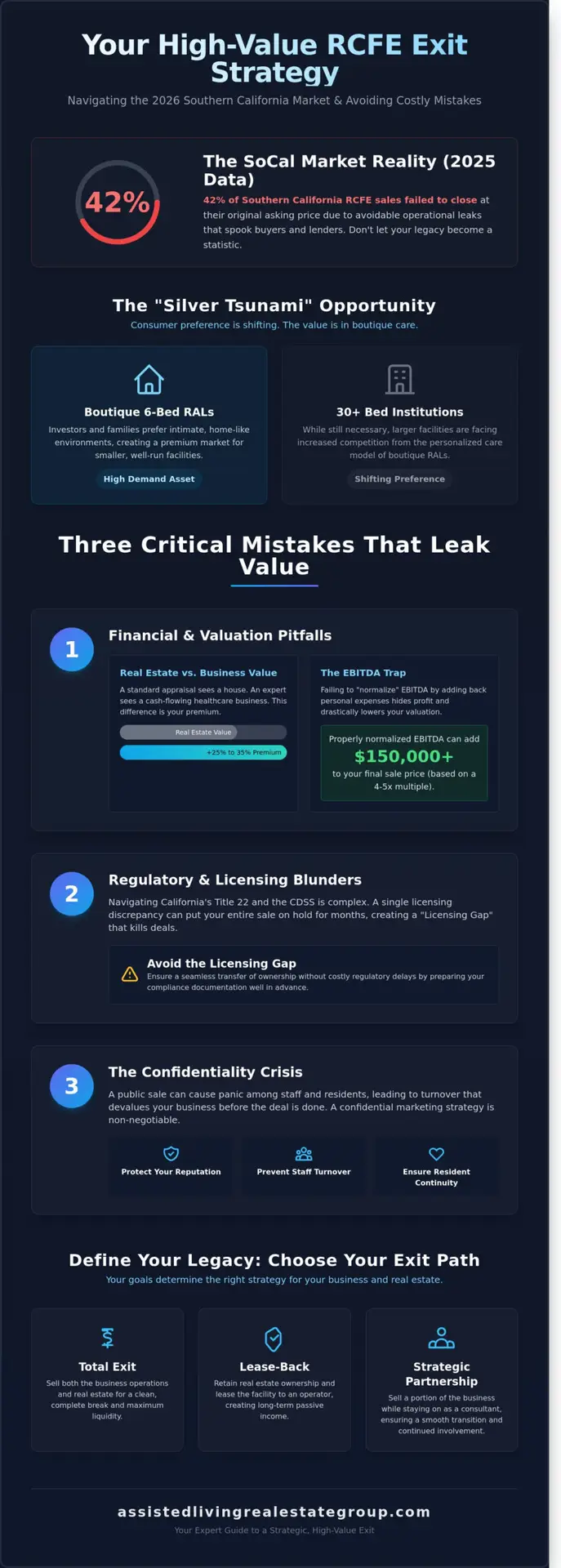
In 2025, 42% of Southern California RCFE sales failed to close at their original asking price due to avoidable operational leaks that spooked staff and families. You’ve spent years building a boutique environment that masterfully balances impact and income, so the thought of a deal collapsing during the Title 22 transfer process is a legitimate concern. It’s natural to feel uneasy about the current 6.5% average cap rates in Los Angeles or the strict compliance hurdles that can stall a sale. This guide identifies the strategic mistakes to avoid when selling a care home to ensure you achieve a confidential, high-value exit while protecting your legacy.
We’ll explore the 2026 roadmap for navigating the “Silver Tsunami” market, from securing your valuation to ensuring resident continuity through the transition. Here’s how to move from daily operations to a lucrative, heart-centered exit with the confidence of a seasoned RAL investor.
Key Takeaways
- Capitalize on the Southern California “Silver Tsunami” by positioning your RCFE as a high-value boutique asset rather than a standard residential property.
- Learn the critical financial mistakes to avoid when selling a care home, specifically how to normalize EBITDA to ensure your business entity value is fully realized.
- Master the nuances of California Title 22 to navigate the “Licensing Gap” and ensure a seamless transfer of ownership without regulatory delays.
- Implement a confidential marketing strategy to protect your reputation and prevent staff or resident turnover before the final sale is secured.
- Transition from owner to legacy-builder by partnering with specialized experts who balance high-yield RAL returns with the heart of compassionate care.
The High Stakes of Selling an RCFE in Southern California
The 2026 “Silver Tsunami” has transformed the California senior living sector into a blue ocean of opportunity. In regions like Van Nuys and Fresno, the aging population has reached a critical mass, creating a supply gap that rewards sellers who understand their business’s true value. You aren’t just selling a property; you’re liquidating a complex, licensed healthcare operation. Treating a Residential Care Facility for the Elderly (RCFE) like a standard residential transaction is one of the most expensive mistakes to avoid when selling a care home in this competitive climate.
Missteps in the early stages often lead to “valuation leakage,” where sellers lose 15% to 20% of their potential profit through poor financial positioning or failed escrows. A single licensing discrepancy with the California Department of Social Services (CDSS) can halt a deal for months. You must balance the emotional weight of your exit, ensuring your residents receive continuity of care while you maximize your financial return. This is the delicate dance of Impact and Income.
The California Market Reality in 2026
Current demand trends show a massive pivot toward boutique 6-bed Residential Assisted Living (RAL) models over 30+ bed institutional facilities. Investors are flocking to cities like San Jacinto and Carson, where lower entry costs and high demand result in cap rates 2% higher than established hubs like Santa Monica. This shift reflects a consumer preference for intimate, home-like environments that provide personalized attention. If your facility fits this boutique profile, you’re sitting on a premium asset that requires a specialized marketing strategy to attract high-net-worth buyers who value quality over quantity.
Defining Your Legacy and Exit Strategy
Setting clear objectives is the first step toward a successful closing. Without a clear roadmap, you risk falling into common traps, including the critical mistakes to avoid when selling a care home that often derail otherwise healthy businesses. You need to decide which path fits your long-term goals:
- Total Exit: Selling both the business operations and the real estate to a single entity for a clean break.
- Lease-Back Arrangement: Retaining ownership of the real estate while leasing the facility to an experienced operator, creating long-term passive income.
- Strategic Partnership: Selling a portion of the business while staying on as a consultant during the transition period.
Navigating these options requires an Expert Guide who understands the nuances of Southern California zoning and Title 22 regulations. Your choice will define the final chapter of your professional journey and the legacy you leave behind.
The “Impact and Income” philosophy dictates that your financial exit should be as robust as the quality of care you’ve provided to your residents throughout your career.
Financial & Valuation Pitfalls: Why “Standard” Appraisals Fail
Standard appraisals are the fastest way to leave significant money on the table. Most residential appraisers look at a 6-bed RCFE in Irvine or San Diego and see a house. They miss the cash-flowing engine inside. This represents one of the most frequent mistakes to avoid when selling a care home. You aren’t just selling four walls; you’re selling a licensed, operational legacy that generates consistent monthly revenue.
Real Estate vs. Business Value
California RCFEs are hybrid assets. The value sits at the intersection of high-value Southern California real estate and a recession-proof service business. A standard appraisal might value a property at $1.2 million based on neighborhood comps. However, a turnkey facility with a history of 95% occupancy and a reputation for excellence can command a 25% to 35% premium over the real estate alone. You must learn how to value your assisted living business by looking at the intangible goodwill and the blue ocean potential of your specific license.
The EBITDA Trap for Small Operators
Clean financials are your most powerful closing tool. In 2026, California labor costs have shifted the math for every operator. If you don’t normalize your EBITDA, you’re effectively hiding your own profit. Many owner-operators run personal expenses, such as specialized vehicle leases or family travel, through the business books. Failing to add back these non-operational costs can lower your valuation by $150,000 or more when applying a 4x or 5x multiple. Buyers in the Southern California market expect a transparent roadmap of net operating income to secure competitive financing through SBA 7(a) or 504 programs.
The 2026 Southern California market has seen a shift in how investors view risk and return. Consider these valuation drivers:
- Cap Rates: While institutional facilities trade at different levels, boutique RAL environments in SoCal are currently seeing cap rates between 7.2% and 8.4%.
- Labor Scaling: Facilities that have successfully mitigated the 2026 minimum wage increases through efficient scheduling command higher multiples.
- The Boutique Premium: Luxury 6-bed facilities in high-income zip codes like Newport Beach or La Jolla trade at a premium because they offer intimacy that massive institutional facilities cannot replicate.
Generic brokers often apply broad market averages to every facility they list. They miss the nuances that make a boutique care home valuable. If you want to maximize your exit, you need a strategic partner who understands how to market that premium experience to the right investor class. Achieving both impact and income requires a valuation that reflects the true operational excellence of your California facility.
Regulatory & Licensing Blunders: Navigating California Title 22
Selling a Residential Assisted Living (RAL) facility in Southern California isn’t a standard real estate transaction; it’s a highly regulated transfer of a delicate ecosystem. One of the most critical mistakes to avoid when selling a care home is ignoring the “Licensing Gap.” In California, RCFE licenses are non-transferable. The buyer must apply for a new license through the Community Care Licensing Division (CCLD), a process that, as of January 2026, typically takes 90 to 150 days. If you assume the Department of Social Services (DSS) will rubber-stamp the new application overnight, you risk a total deal collapse during the final stages of escrow.
Outdated Title 22 compliance issues are the primary deal-killers during due diligence. When a sophisticated investor reviews your records, they aren’t just looking at your profit and loss statements; they’re looking for risk. A single unresolved citation can trigger a chain reaction of delays. You must address DSS requirements and clear any outstanding deficiencies before your property ever hits the market. This proactive approach protects your cap rate and ensures a smooth transition of care for your residents.
Title 22 Compliance as a Selling Point
A “perfect” survey history is your most valuable asset when marketing a boutique facility in Fresno or Riverside. Investors prioritize clean Title 22 records because a history of Type A citations can decrease your valuation by as much as 18%. Before listing, conduct a rigorous pre-sale audit of your resident files and staffing records. Addressing these red flags early ensures your facility stands out as a premium, turn-key opportunity for those seeking both impact and income. You can learn more about these specific requirements in our RCFE Licensing in California Guide.
The Relicensing Escrow Hurdle
Managing the timeline between the real estate close and the license issuance is where most Southern California deals falter. Approximately 22% of RAL transactions fail because the parties don’t coordinate with the CDSS effectively. A specialized broker acts as your strategic partner, bridging the communication gap between state regulators and the buyer. They ensure the “Plan of Operation” is submitted correctly to avoid unnecessary delays that eat into your ROI. Don’t let a bureaucratic technicality destroy your legacy; ensure your regulatory ducks are in a row before the first showing. This level of preparation turns a complex hurdle into a professional advantage, securing the high-level returns your investment deserves.
The Confidentiality Crisis: Protecting Your Reputation
The single most damaging error in the Southern California RAL market is a breach of secrecy. As the Silver Tsunami increases demand for boutique beds, your reputation is your most valuable asset. When rumors of a sale circulate through a San Jacinto facility or a home in Thousand Oaks, the fallout is immediate. Staff members, fearing for their job security, begin updating resumes. Families, sensing instability, start touring competing facilities. This phenomenon, known as “Resident Flight,” can decrease your occupancy by 30% in a matter of weeks, directly slashing your valuation. Protecting your legacy requires a strategic veil.
Confidential marketing isn’t just a preference; it’s a financial necessity for any RCFE owner. Operational care homes rely on the perception of stability to maintain their census. One of the critical mistakes to avoid when selling a care home is failing to vet prospects before they even see your profit and loss statements. You aren’t just selling real estate; you’re selling a delicate ecosystem of care. If your internal data leaks to a competitor, your market position in the 2026 California landscape is compromised. Competitors in the Inland Empire or Orange County often use these leaks to poach high-value residents, offering “transfer incentives” that can drain your facility’s revenue overnight. Mastering these nuances helps you bypass the common mistakes to avoid when selling a care home that sink lesser deals.
The Anatomy of a Confidential Listing
- Blind Advertisements: We highlight your 12% cap rate or specialized memory care wing without revealing the street address.
- Enforceable NDAs: Every prospect must sign a legally binding Non-Disclosure Agreement before receiving a Confidential Information Memorandum.
- Financial Vetting: We verify proof of funds to ensure only serious boutique investors gain access to your sensitive operational data.
The Assisted Living Real Estate Group acts as your firewall, preserving the integrity of your brand while we source buyers who value both impact and income.
Managing Internal Communication
Timing is everything. Don’t inform your Facility Administrator or staff until the due diligence period is nearly complete and contingencies are removed. When the time comes, frame the transition as an infusion of new energy and resources rather than an exit. Emphasize that the new ownership is committed to the same high standards of quality of life that built your reputation. A premature leak of your intentions creates an environment of fear that can lead to a 25% turnover in staff within the first week.
Ready to secure your exit without compromising your facility? Consult with our strategic partners today to protect your investment.
Partnering for a Strategic, High-Value Exit
Selling your RCFE or ARF in Southern California is more than a simple real estate transaction; it’s the final chapter of a legacy built on service and compassion. The “Silver Tsunami” is often discussed with a sense of apprehension in the media, yet for the prepared seller, it represents a massive blue ocean opportunity. By 2026, California’s population of residents aged 65 and over is projected to hit 8.4 million. This demographic shift ensures a steady stream of high-level investors searching for turnkey RAL operations that offer both impact and income. Moving from a state of curiosity about your facility’s worth to a state of conviction about your exit requires a roadmap that balances cold financial metrics with the heart-centered reality of boutique care.
One of the most frequent mistakes to avoid when selling a care home is choosing a representative based on a low commission rather than specialized expertise. A general commercial agent often lacks the technical knowledge to navigate the California Department of Social Services (DSS) or the specific zoning hurdles in cities like Riverside or San Diego. You need a strategic partner who speaks the language of cap rates and ROI while respecting the intimacy of your residential assisted living model. This specialized approach ensures you find the right buyer who values your business’s reputation, not just the first buyer who makes an offer.
This also extends to your legal representation. Navigating purchase agreements, due diligence, and regulatory disclosures requires specialized legal counsel. While this guide focuses on California, the principle of partnering with an experienced firm is universal. For example, a firm like Nanda & Associate Lawyers Professional Corporation demonstrates the value of having a team that understands the complexities of business and real estate law to ensure a smooth, secure transaction.
Choosing the Right Representative
Success in this niche market depends on local, specialized knowledge. When interviewing a broker, ask about their specific track record with RCFE and ARF sales within California. Do they understand the current Title 22 compliance landscape? Can they navigate a license transfer without disrupting daily operations? Our team leverages 25 years of combined experience to ensure your facility is positioned as a premium asset. We focus on the unique “Impact and Income” your business provides, attracting investors who want to do well while doing good. For a deeper dive into the specific requirements of the California market, see our Sell Your Adult Residential Facility in California: The Definitive Guide.
Your Next Steps to a Successful Sale
The path to a high-value exit starts with an accurate benchmark. You can’t maximize your return if you don’t know your facility’s current market position relative to Southern California’s evolving standards. High-level investors are actively seeking boutique environments that offer a luxury alternative to institutional care. To attract these buyers, you must prepare your facility to stand out as a high-performance asset. Avoid the common mistakes to avoid when selling a care home by securing a professional, data-driven analysis of your facility’s worth before you go to market. Take the first step toward your successful transition and Get a Confidential Valuation for Your California Care Home.
Secure Your Legacy in the California Care Market
Selling an RCFE in Southern California requires more than a standard real estate listing. It demands a deep mastery of Title 22 regulations and precise valuation metrics that generalist brokers often overlook. The most common mistakes to avoid when selling a care home involve failing to account for the unique licensing requirements that govern our state’s residential assisted living facilities. You’ve spent years building a boutique environment that balances impact and income. Don’t let a standard appraisal undervalue your life’s work or a breach of confidentiality destabilize your current operations during this 2026 market cycle.
With over 25 years of specialized experience in California care facilities, Teri Szoke understands the nuances of both RCFE and ARF regulatory environments. We utilize a proprietary confidential marketing strategy to ensure your reputation remains intact while we target high-value investors. The Silver Tsunami continues to drive massive demand across the Golden State. It’s the right time to leverage a strategic roadmap for your exit. Partner with Teri Szoke for a Confidential RCFE Valuation to secure the high-value exit you deserve. You’ve built an incredible legacy; we’re here to help you protect it.
Frequently Asked Questions
How long does it typically take to sell an RCFE in California?
A standard RCFE sale in California typically takes between 6 and 9 months to finalize from the initial listing to the close of escrow. The primary bottleneck is the California Department of Social Services (CDSS) Change of Ownership (CHOW) process, which currently averages 120 to 180 days for approval. While the real estate portion of the transaction might close in 45 days, the business transfer requires a patient, strategic approach to ensure your license remains in good standing throughout the transition.
Can I sell my care home business without selling the real estate?
You can absolutely sell your care home business as a leasehold interest without selling the underlying real property. In the Southern California market, business-only sales often trade at a 2x to 3x multiple of the annual net operating income. You’ll need a solid lease agreement with at least 5 years remaining or a pre-negotiated option for the buyer to secure their own long-term tenancy to satisfy CDSS licensing requirements and ensure a smooth transition of care.
What is the most common reason RCFE sales fall through in escrow?
The most common reason RCFE sales fail in escrow is the buyer’s inability to secure the CDSS license or adequate financing. Approximately 35% of Southern California transactions stall when a buyer lacks the liquid capital required for the 85033 form or fails the Administrator Certification. One of the biggest mistakes to avoid when selling a care home is failing to pre-qualify your buyer’s financial and clinical background before signing the purchase agreement.
Do I need to tell the Department of Social Services before I list my facility?
You don’t need to notify the Department of Social Services (CDSS) before listing your facility for sale. However, California Health and Safety Code Section 1569.191 requires you to provide a 60-day written notice to the department and your residents before you transfer the operation. Keeping your listing confidential prevents premature alarm among staff and families while you navigate the initial marketing phase and identify the right successor for your boutique care community.
How much is my 6-bed RCFE worth in the current Southern California market?
A standard 6-bed RCFE in Southern California is currently valued between $1.2 million and $2.8 million depending on the real estate value and the facility’s profitability. Boutique RAL homes in high-demand areas like Newport Beach or Westlake Village command a premium, often seeing cap rates between 6% and 8%. We look at your Impact and Income potential, combining the property’s appraisal with a business valuation based on your current resident rates and local market demand.
What happens to my staff when I sell my assisted living business?
Most staff members remain with the facility through the sale to ensure continuity of care for the residents and operational stability. Buyers typically view a seasoned, loyal team as a primary asset that protects their ROI and maintains the facility’s reputation. You should plan to disclose the sale to employees 30 to 60 days before the close, offering stay-bonuses to ensure your boutique care standards don’t slip during the transition period.
How do I maintain confidentiality if I need to show the property to buyers?
Maintaining confidentiality requires a strict protocol involving Non-Disclosure Agreements (NDAs) and vetted shadow tours. We schedule showings during off-peak hours or weekends to minimize resident interaction and preserve the privacy of your clients. By framing the visit as a management review or an insurance inspection, you protect your business reputation while allowing serious investors to evaluate the property’s physical layout and operational potential.
Is a 2026 sale better than waiting for the market to shift?
Selling in 2026 is a strategic move to capitalize on the Silver Tsunami, as 10,000 Americans turn 65 every day. California’s aging population will peak between 2025 and 2030, creating a high-demand blue ocean for buyers seeking established RAL facilities. Waiting for a market shift risks higher interest rates or changes in state staffing mandates that could compress your margins and lower your ultimate exit price in a more saturated market.