
The most expensive-looking RCFE renovation isn’t necessarily the one that creates the most value. For California investors, RCFE renovation costs and ROI depend less on premium finishes than on whether the work supports the facility’s operating plan. Scope can expand before the business purpose is clear, and potential effects on occupancy, revenue, and expenses are easy to confuse with proven results.
A renovation can be a strategic opportunity, but it needs a clear baseline. Before weighing upgrades, define the operational objective, document the property’s current condition, and identify how California licensing and local building requirements could affect planning.
This guide explains how to assess renovation scope against a specific business goal, compare project types as potential value drivers, and test assumptions without relying on unsupported cost estimates or guaranteed returns. It also shows how to distinguish possible operational benefits from financial impact, and how renovation analysis fits into due diligence, valuation, financing, and management transition during an RCFE acquisition or sale. The goal is a disciplined decision that aligns the facility’s operating purpose with sound investment judgment.
Key Takeaways
- RCFE renovation costs and ROI are property-specific. Assess whether proposed work supports the intended operating model instead of relying on a universal cost-per-bed estimate.
- Compare potential operating value with the investment and any ongoing costs the project could affect. Test the assumptions behind each projection.
- Evaluate resident-room and common-space upgrades separately from building-system or site work, using project-specific evidence to assess likely operational effects.
- California licensing and local review considerations depend on the property and scope. Identify which requirements apply before finalizing project assumptions.
- In a transaction, distinguish documented property condition and planned improvements from demonstrated value, whether you’re evaluating a purchase or preparing a sale.
What RCFE renovation costs and ROI depend on in California
There’s no universal cost-per-bed calculation that can tell a California investor whether an RCFE renovation makes sense. The property’s condition, intended operating model, and transaction context shape both the work required and the value it may create. Renovation ROI is the relationship between project investment and measurable incremental operating value. That value may relate to a specific operational objective, but it should be supported by property-specific evidence, not assumed from a finished appearance.
Start with the facility as it is today. Document visible condition, functional limitations, and known maintenance needs. Keep those facts separate from assumptions about future occupancy, revenue, or expenses. The general overview of an assisted living residence can help frame the setting, but a California RCFE’s resident profile and operating plan matter more than broad descriptions of the category.
Transaction context matters, too. A buyer assessing an acquisition may weigh identified work against the property’s current condition and proposed operating model. A seller may organize condition records and project history to give buyers a clear account of the facility. The California RCFE acquisition guide provides a broader transaction perspective for buyers considering a property-specific opportunity.
Set a property-specific baseline before estimating returns
Build a concise baseline from documented observations. Note which spaces function as intended, where limitations affect use, and what maintenance needs are recorded. Identify the current resident profile and operating model, then distinguish them from any proposed future plan. Label each item as an observed condition, a documented need, or an assumption. This separation helps prevent a projection from being mistaken for an established property fact.
Clarify what the renovation is meant to change
Give every proposed scope item a defined objective. Resident-facing improvements may address how rooms or shared spaces function. Building-system work or deferred maintenance may address the property’s physical condition. These categories can overlap, but they aren’t interchangeable. Record the intended operational effect separately from the physical work, so the analysis makes clear what the project changes and what evidence would show that change.
For example, refreshing a common area is a physical improvement. Its financial rationale might depend on whether the space supports the facility’s intended use or resident experience. A system repair, by contrast, may address a documented building need without creating a directly measurable increase in revenue. Neither project type automatically delivers a return. The key questions are whether the objective is clear and whether its effect can be evaluated.
- Condition: What is currently observed or documented?
- Scope: What physical work is proposed, and which need does it address?
- Operating assumption: What change is expected, and what evidence would support it?
This baseline gives buyers and sellers a shared reference point. It also keeps RCFE renovation costs and ROI analysis anchored to the facility, rather than generic estimates or an assumed payoff from cosmetic upgrades.
How to evaluate RCFE renovation ROI without assuming a guaranteed return
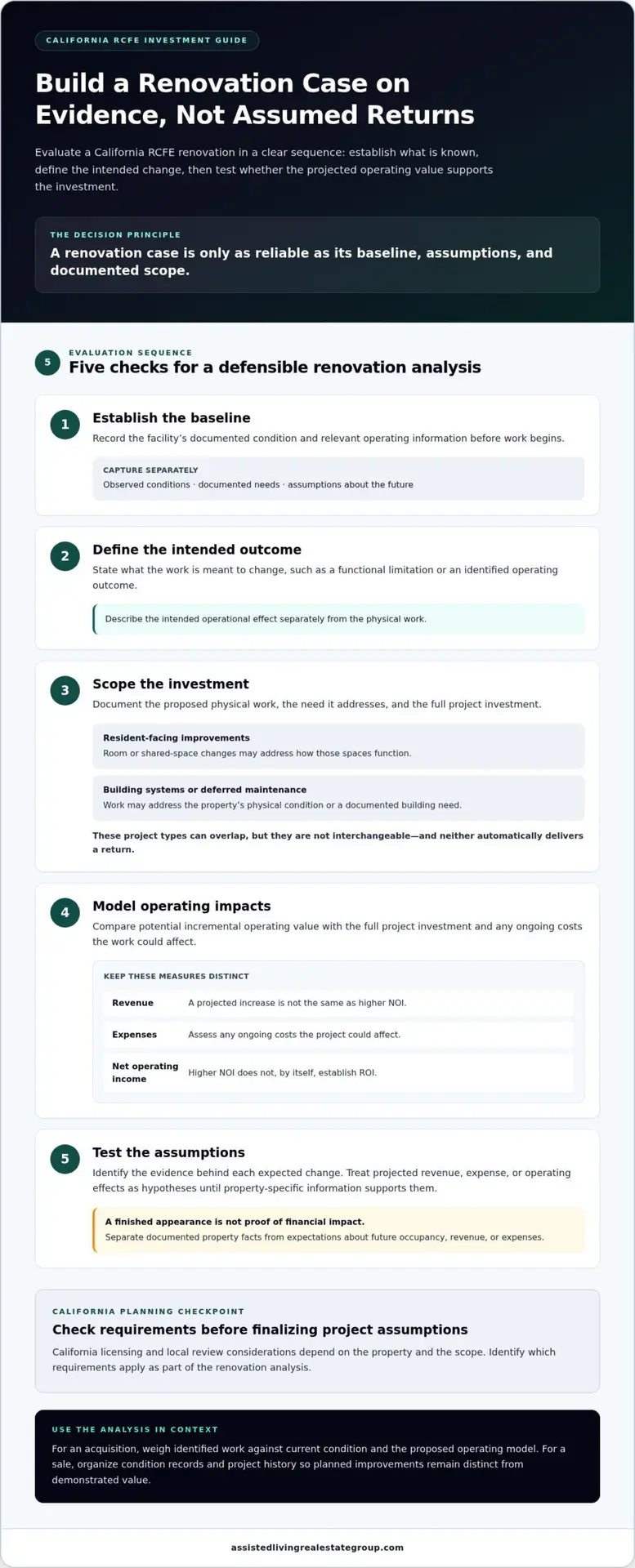
A renovation can improve a California RCFE and still fail to produce the financial result an investor expected. Evaluate the case in sequence: establish the documented baseline, define the intended outcome, scope the investment, model operating impacts, and test the assumptions. A renovation case is only as reliable as its baseline, assumptions, and documented scope.
Build a transparent before-and-after comparison
Use property records and available operating information to describe the facility before work begins. Then specify the expected change and identify the evidence behind it, such as a documented functional limitation, an operating record, or a clearly labeled projection. The California Department of Social Services’ California Department of Social Services (CDSS) Senior Care Facility Types page can help establish the California licensing context, but it doesn’t establish the financial effect of a particular renovation.
Keep revenue, expenses, and net operating income separate. A projected increase in revenue isn’t the same as higher NOI, and neither automatically establishes ROI. Model incremental operating value against the full project investment and any ongoing costs the work could affect. For example, a proposed improvement might be associated with a revenue assumption, while a system upgrade might be evaluated against a documented expense or maintenance issue. Treat each relationship as a hypothesis until property-specific information supports it.
- Establish the baseline. Record the facility’s documented condition and relevant operating information before the project.
- Define the intended outcome. State what the work is meant to change, such as a functional limitation or an identified operating outcome.
- Scope the investment. Describe the proposed work clearly, including known scope elements and ongoing costs it could affect.
- Model the impacts. Show projected revenue, expenses, and NOI separately, then compare incremental operating value with the investment.
- Test the assumptions. Separate documented support from estimates and assess how the conclusion changes if expected results fall short.
Test scenarios and downside exposure
Use more than one plausible scenario instead of relying on a single optimistic projection. Consider what happens if intended occupancy or revenue doesn’t materialize, or if an expected operating efficiency is smaller than projected. Include timing, operational disruption, and scope changes as variables, not certain outcomes. If the project’s rationale depends on several unverified assumptions at once, make that dependence visible before treating the projected return as decision-ready.
This framework makes RCFE renovation costs and ROI easier to assess without unsupported cost figures or a promised payback. For a broader view of investment considerations in Southern California senior housing, the California senior housing investment guide offers related context. Buyers weighing a facility transaction can also use RCFE acquisition and sale guidance to connect property-specific analysis with due diligence and valuation.
Compare California RCFE renovation projects by purpose and evidence
Project categories aren’t interchangeable, and none is automatically the best investment. A resident-room refresh may support a different objective from a system repair or site improvement. Compare each proposal by its purpose, evidence, likely operational effect, and uncertainty. Distinguish elective repositioning, intended to change how a facility is presented or used, from work responding to a documented condition or potential compliance concern. The appropriate scope depends on the property and operating goals.
Resident spaces, common areas, and amenities
Assess rooms, shared spaces, and amenities against the facility’s intended resident experience and operating model. An upgrade may address a specific functional limitation or support a planned use, but claims of stronger demand, occupancy, or revenue need separate evidence. An attractive finish alone doesn’t establish an operating benefit. Treat amenity work as a strategic choice, then identify what would show whether it achieved its objective.
| Project category | Intended objective | Evidence needed | Potential operational impact | Key uncertainty |
|---|---|---|---|---|
| Resident rooms | Improve function or support intended use | Observed room limitations, condition records, and defined use | May affect usability or resident experience | Whether the change supports a measurable operating outcome |
| Common spaces and amenities | Align shared areas with the planned resident experience | Current use, documented limitations, and a clear rationale for the upgrade | May affect how the space is used or presented | Whether the amenity influences demand, occupancy, or revenue |
| Building systems | Address system condition or an identified maintenance need | Available maintenance and condition records | May affect ongoing operations or maintenance needs | Extent of work required and future costs |
| Furnishings and equipment | Support the facility’s intended use | Inventory, condition, and documented operational need | May affect day-to-day functionality | Whether replacement or an upgrade is necessary |
| Exterior or site work | Address a site limitation or defined property objective | Observed site conditions and project rationale | May affect access, use, or upkeep | Scope and any applicable review considerations |
Building systems, furnishings, and deferred maintenance
Keep building-system condition and deferred maintenance distinct from discretionary appearance upgrades. Records of recurring issues or known repair needs can support a system project’s rationale; a cosmetic refresh needs a different value case. Likewise, evaluate furnishings and equipment against intended use and documented operating needs rather than treating them as a default renovation expense. While styling communal areas with comfortable options like fabric corner sofas can improve the resident experience, operators must ensure selections align with practical mobility and maintenance standards. Broader acquisition analysis is covered in this guide to buying an RCFE for sale.
Some scopes may also intersect with compliance considerations, but applicability depends on the project and property. California operators can consult the California Assisted Living Association RCFE regulations resource for regulatory context. It shouldn’t be treated as a determination of what a particular project requires. The strongest comparison is property-specific: prioritize documented needs, explain elective upgrades separately, and don’t assume any category will deliver superior RCFE renovation costs and ROI.
California RCFE renovation due diligence: scope, licensing, and local review
Renovation due diligence for a California RCFE starts with the specific property and proposed work, not a blanket assumption that every project follows the same review path. Routine maintenance, building alterations, and changes in how a space is used may raise different questions. Which reviews apply depends on the scope and property. Confirm current, jurisdiction-specific requirements before treating a schedule, budget, or projected return as settled.
Document scope and identify review questions
Describe the work in practical terms: the affected areas, the physical changes proposed, and whether the intended use of any space would change. That description helps frame questions for relevant reviewing entities without assuming a particular approval is required or guaranteed. Licensing implications also depend on the facility and project. California RCFE licensing guidance can provide process context, but it doesn’t determine the outcome for a specific property.
For licensing-related questions, identify the California Department of Social Services (CDSS) and its Community Care Licensing Division (CCLD) as verification entities. If the proposed scope may involve local building or fire review, identify the appropriate jurisdiction and verify its current requirements for that project. Don’t infer a requirement, approval, or timeline from a different facility or a general description of the work. Keep written records of what has been verified and what remains unresolved.
Useful scope documentation can include:
- A clear description of affected rooms, systems, or site areas and the work proposed.
- Available property and maintenance records that explain the project’s starting condition.
- A list of licensing and local review questions, with confirmed answers distinguished from open items.
Connect renovation diligence to the transaction
During an acquisition or sale, organize available property, operating, and project records alongside the proposed scope. Mark each item as a confirmed condition, an estimate, an assumption, or an unresolved question. For example, a recorded maintenance issue is different from a preliminary estimate of the work it may require. Keeping these categories separate helps prevent a projection from being presented as a verified project fact.
Uncertainty has transaction consequences. If the scope is incomplete, buyers may need to account for that uncertainty in due diligence and valuation discussions. Sellers can clarify project history by organizing records and distinguishing completed work from proposed improvements. Open questions may also shape negotiations, financing discussions, and management transition planning. The purpose isn’t to predict a licensing decision or promise a return; it’s to make the knowns and unknowns visible before commitments are made.
For process context, review this California RCFE licensing guidance. A disciplined review makes RCFE renovation costs and ROI analysis more decision-ready by connecting proposed scope with property records and transaction assumptions. For support evaluating an RCFE acquisition or sale, explore California RCFE transaction guidance.
Use renovation ROI analysis to guide a California RCFE transaction
Renovation analysis is most useful when it informs a transaction decision, not when a projected improvement is treated as established value. Buyers can use property-specific assumptions to understand the work under consideration and its relationship to the intended operating plan. Sellers can present the facility’s condition and project history clearly, giving prospective buyers a grounded basis for review. Neither approach guarantees a particular valuation or investment return.
For buyers: connect renovation assumptions to acquisition decisions
Compare the proposed scope with documented property condition and the operating plan you intend to pursue. Keep verified historical performance separate from projected changes. If a purchase case depends on assumed increases in occupancy, revenue, or efficiency, label them as projections and assess how the decision holds up if they don’t occur. Renovation assumptions belong in due diligence, alongside broader acquisition, financing, and transition considerations—where investors exploring private financing for renovations and acquisitions might consult level4funding.com.
Assisted Living Real Estate Group supports California RCFE buyers through BUY RCFE, including due diligence, valuation, negotiation, closing, financing, and management transition. Its specialized acquisition experience can help connect property-specific renovation questions with the wider transaction. That support provides a framework for informed decision-making, not a promise that improvements will produce a particular result.
For sellers: present property information with clarity and confidentiality
Organize available records describing the property’s condition, completed work, maintenance history, and proposed improvements. Distinguish completed projects from plans, and documented conditions from estimates or assumptions. Clear records can help prospective buyers understand what is known and what remains open for evaluation. They don’t guarantee a valuation premium, but they can support a more transparent transaction discussion.
For sellers, ALREG’s transaction support includes confidential marketing, valuation, negotiation, closing, and management transition. These steps help place project information in context: as part of the facility’s documented condition and transaction story, not as proof of future performance.
Ultimately, RCFE renovation costs and ROI analysis should inform the questions buyers and sellers bring to a transaction. A buyer can examine whether the scope fits the acquisition assumptions; a seller can present the available evidence without overstating what planned work may achieve. This disciplined approach supports sounder decisions while keeping the facility’s operational purpose in view.
If you’re considering a California RCFE acquisition or sale, discuss your California RCFE transaction with ALREG. Bring renovation questions into the transaction conversation, where scope, property information, valuation, and transition planning can be considered together.
Move forward with a clearer California RCFE investment decision
The next step is to decide what evidence you need before acting. For buyers, that may mean resolving open questions about scope and how proposed work fits the acquisition plan. For sellers, it may mean preparing a clear record of the facility’s condition and project history. A disciplined review can keep RCFE renovation costs and ROI analysis grounded in the opportunity at hand, without treating potential improvements as guaranteed value.
Assisted Living Real Estate Group brings specialized California senior-care real estate expertise, confidential marketing strategy, and over 25 years of combined experience with care facilities. With a focus on Southern California and clients across California, the group helps owners and buyers approach RCFE transactions with attention to both business fundamentals and continuity of care.
Ready to discuss your next step? Discuss your California RCFE transaction with ALREG and move forward with a more informed view of the opportunity.
Frequently Asked Questions
How much does it cost to renovate an RCFE in California?
There’s no single reliable cost figure for every California RCFE. The required investment depends on the property’s condition, proposed work, materials, building systems, and any review requirements that apply. A broad estimate shouldn’t be treated as a project budget. For example, a facility with documented system issues may need a different scope from one considering a room refresh. Start with a written, property-specific scope and separate verified details from assumptions.
Can an RCFE renovation improve value without increasing occupancy?
Potentially, if the project supports a clear objective that doesn’t depend on more residents. Work might address a documented property condition, better align a space with the operating plan, or affect an expense. Those effects aren’t guaranteed. For example, if a project is intended to address recurring maintenance, compare the relevant records before and after the work. Identify how the proposed improvement could create value, then look for evidence rather than assuming an occupancy or revenue gain.
Does renovating an RCFE automatically increase its sale price?
No. Renovation doesn’t automatically raise an RCFE’s sale price. A buyer may assess the property’s condition, operating information, completed work, and transaction context, among other factors. Keep completed improvements distinct from proposed projects, and retain records that describe what was done. A planned upgrade may be relevant to negotiations, but expected benefits aren’t the same as demonstrated performance. Use project documentation to inform valuation discussions, not to promise a particular price or financial result.
What should an RCFE renovation ROI analysis include?
A useful analysis includes the property’s documented starting point, proposed scope, verified project investment, intended operating effect, and any ongoing costs the work may change. For RCFE renovation costs and ROI, distinguish revenue from expenses and net operating income, then show the evidence behind each projection. A practical addition is a downside case: consider how the decision changes if a projected benefit is delayed, smaller than expected, or absent.
Can renovation work affect a California RCFE license?
It depends on the facility and the specific work, so don’t assume every renovation has the same licensing effect. Describe the proposed changes and verify their applicability with the California Department of Social Services’ Community Care Licensing Division. If the scope may involve local review, check the relevant California jurisdiction’s current requirements as well. Keep verified answers separate from open questions, and don’t rely on generalized claims about approvals or timelines.
Should I renovate an RCFE before selling or sell it as-is?
It depends on the facility’s condition, proposed scope, likely buyer priorities, and evidence for potential benefits. Consider a documented maintenance issue separately from an elective refresh, then weigh the investment and operational disruption against the transaction rationale. For example, if a proposed improvement is mainly cosmetic, don’t assume it will command a higher sale price. Organized condition and project records can help buyers understand the property either way.
How can a buyer assess planned RCFE renovations before acquiring a facility?
Compare the seller’s proposed work with available property and operating records, then identify what remains an estimate or unresolved question. Ask how each project relates to the buyer’s intended operating plan, while keeping projected performance separate from historical results. A specialized California RCFE brokerage can support acquisition, valuation, due diligence, financing discussions, and transaction planning. That perspective can help buyers place renovation assumptions in context without treating them as a guaranteed return.